Pre-screening patients for clinical trials means deciding, from the records a site already holds, which patients could plausibly be offered a trial, before anyone is approached and before anyone signs a consent form. It is hard because the facts that settle eligibility are never in one place: a performance status sits in a free-text note from May, an EGFR result in a three-page scanned outside pathology report, a QTcF in an ECG PDF, a creatinine clearance in a laboratory table with its own units and its own date. Botminds' Clinical Trial Patient Matching reads all of those sources against the protocol's criteria, marks every criterion met, not met or unknown, and shows the line in the chart that decides each one. This guide builds the map a coordinator needs: criterion by criterion, with the document that proves it, the unit, the window, and what to do when nothing proves it at all.
The worked protocol on this page is sample data: VLT-411, a fictional Phase 2 study of a fourth-generation EGFR inhibitor in EGFR-mutant advanced non-small-cell lung cancer, run at a fictional site, Lakemont Cancer Institute, with 24 inclusion and exclusion criteria. The research figures come from regulators, guidelines and peer-reviewed studies, linked where they appear.
Why a database query cannot finish pre-screening
5 of 6
inclusion criteria that coded electronic health record data could settle for one heart-failure trial
5 of 17
exclusion criteria the same coded data could settle
12of 17
exclusion criteria that needed a human, or a model, to read the notes
What pre-screening is, and where it stops
Pre-screening is the first of two reviews. The NIH's own human-subjects office draws the boundary at the consent form: in its guidance on screening for research studies, pre-screening comes before anyone signs, and its purpose is to see whether a person might qualify and is interested. Screening (the visit with the protocol-specified tests, the fresh labs, the confirmatory read) comes after consent.
That boundary decides what pre-screening can and cannot produce. It cannot produce an eligibility decision, because the protocol's own screening assessments have not happened. What it can produce is a defensible shortlist: the patients for whom every criterion the record can answer is answered, with the remaining questions named. Everything on this page is about making that shortlist honest. The consent and privacy rules that govern the review itself are set out in pre-screening and screening in clinical trials.
The job description is less ambiguous than the practice. The US Department of Labor's occupational profile for clinical research coordinators lists the task plainly: assessing whether potential subjects are eligible by screening interviews, by reviewing medical records, or by talking to physicians and nurses. Three methods, three different kinds of evidence, and no method at all for reconciling them. That is what the map below is for.
How do you pre-screen a patient for a clinical trial?
You pre-screen a patient in five passes, in this order: build the criterion map from the protocol; find the documents that could answer each criterion; read each one and record the line that decides it; mark every criterion met, not met or unknown against the protocol's own threshold and window; and write the remaining unknowns as questions with a date. Doing it in that order matters, because each pass makes the next one cheaper, and because the fifth pass is the one that finds patients.
Most sites do something close to the first three passes and stop. The map lives in a coordinator's head rather than on paper, so it is rebuilt from the protocol every time a new coordinator picks the study up. The fourth pass collapses into a single yes or no on the chart. The fifth does not happen at all, because by the time a chart has been read nobody remembers which facts were absent and which were negative.
Three clocks on one chart: how long each kind of evidence counts
- Counts as current evidence90 days
- Counts28 days
- Counts14 days
The criterion map: every eligibility fact and the document that proves it
Here is the map for all 24 criteria of the sample protocol. Four columns: the criterion as section 5 writes it, what it actually asks, the document type that proves it at this site, and how long the evidence counts. A map like this is worth building once per protocol and keeping, because it is also the answer to every later argument about why a patient was or was not referred.
VLT-411's 24 criteria in Clinical Trial Patient Matching: what each asks, where it is proved, how long it counts
| Criterion | What it asks | Where it is proved | Window |
|---|---|---|---|
| I1 · Age | Age 18 or over at consent | Registration fields | No window |
| I2 · Diagnosis | Histologically confirmed non-squamous NSCLC, stage IIIB or IV | Pathology report | Any date |
| I3 · Driver mutation | Activating EGFR mutation, exon 19 deletion or L858R, by a tissue or plasma test (5.1.3) | Pathology or molecular report, often a scanned outside report | Any date |
| I4 · Prior therapy | Radiographic progression on a third-generation EGFR inhibitor | Imaging report and medicine list, often an outside scan | Any date |
| I5 · Measurable disease | At least one measurable lesion by RECIST 1.1 | Imaging report | 28 days |
| I6 · Performance status | ECOG performance status 0 or 1 | Clinic note | 28 days |
| I7 · Organ function | ANC ≥ 1.5 ×10⁹/L, platelets ≥ 100 ×10⁹/L, haemoglobin ≥ 9.0 g/dL, creatinine clearance ≥ 45 mL/min, bilirubin ≤ 1.5 × ULN, AST and ALT ≤ 3 × ULN | Laboratory results | 14 days |
| I8 · Able to take part | Life expectancy of 12 weeks or more, and able to consent | Clinic note | 28 days |
| E1 · Prior study drug | Any previous fourth-generation EGFR inhibitor | Medicine list | Lifetime |
| E2 · Transformation | Small-cell or squamous transformation on the most recent biopsy | Pathology report | Most recent |
| E3 · Brain metastases | Symptomatic or untreated central nervous system metastases | Brain MRI report | 42 days |
| E4 · QTcF | QTcF over 470 ms on a 12-lead ECG | ECG report | 90 days |
| E5 · Cardiac function | Left ventricular ejection fraction under 50% | Echocardiogram report | 90 days |
| E6 · Hepatitis | Active hepatitis B or hepatitis C | Serology results | 90 days |
| E7 · HIV | Known HIV with a detectable viral load | Serology results | 90 days |
| E8 · Lung disease | Interstitial lung disease or drug-induced pneumonitis | Imaging report or clinic note | Lifetime |
| E9 · Recent surgery | Major surgery in the 28 days before the first dose | Clinic or operative note | 28 days |
| E10 · Recent radiotherapy | Thoracic radiotherapy in the previous 14 days | Clinic note | 14 days |
| E11 · Interacting medicines | A strong CYP3A4 inducer or inhibitor still being taken | Medicine list | Current |
| E12 · Other cancer | Another malignancy needing treatment in the past two years | Clinic note and problem list | 2 years |
| E13 · Blood pressure | Uncontrolled hypertension: systolic over 160 or diastolic over 100 mmHg | Clinic note, vital signs | 14 days |
| E14 · Pregnancy | Pregnant, breastfeeding, or of child-bearing potential without contraception | Laboratory results and clinic note | 14 days |
| E15 · Hypersensitivity | Known hypersensitivity to the study drug or an excipient | Medicine list, allergies | Lifetime |
| E16 · Investigator judgement | Any condition that in the investigator’s judgement would compromise taking part | Clinic note; the investigator answers | At referral |
Read down the third column and the shape of the problem appears. One criterion comes from a coded registration field. Four come from laboratory and serology results. Two come from a cardiology report. The rest come from prose (a clinic note, a pathology report, an imaging narrative, a medicine list with a free-text reason), and two of those routinely arrive as a scan of someone else's paperwork.
Where the 24 criteria are proved: Clinical Trial Patient Matching reads all seven sources
VLT-411, 24 criteria by the source that settles each
- Clinic notes (7) · 29%
- Laboratory and serology results (4) · 17%
- Imaging reports (3) · 13%
- Medicine list (3) · 13%
- Pathology reports (2) · 8%
- Scanned outside records (2) · 8%
- ECG and echocardiogram (2) · 8%
- Registration fields (1) · 4%
Section 5 as written, beside the check that runs
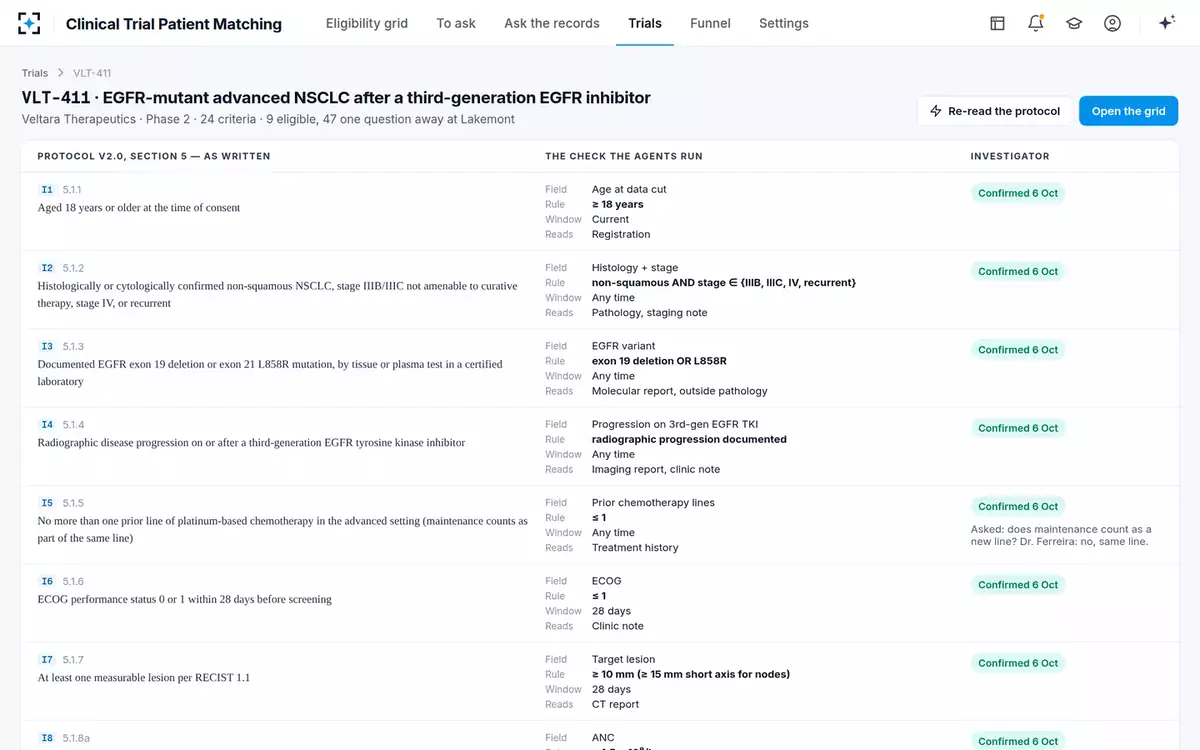
Can you pre-screen from structured EHR data alone?
No, and the useful question is how much of the protocol it gets you. The RECTIFIER team at Brigham and Women's Hospital answered it for one heart-failure trial before they built a thing: coded data could settle five of six inclusion criteria and five of seventeen exclusion criteria. Everything else (one inclusion criterion and twelve of the seventeen exclusions) lived in the notes. Their paper is blunt about who does that work today: “Trained, but non-licensed, study staff complete manual chart review to determine patient eligibility and record their assessment.”
The ratio will differ by specialty, and it is worth measuring on your own protocol rather than assuming. On the sample lung protocol above it is harsher than the heart-failure figure: only age and the four laboratory and serology criteria, five of 24, sit in coded fields. But the direction never reverses, because of what the criteria are made of. A threshold on a numeric laboratory value is coded. A diagnosis with a stage, a mutation with a test method, a progression judgement, a performance status, a transformation on biopsy, a reason a medicine was stopped: those are written in sentences by the clinician who decided them, and the sentence is the evidence.
What a coded query can decide, and what only the prose can
A structured query over coded fields: Decided. A date of birth is a field.
Only the notes, the reports and the scans: —
A structured query over coded fields: A diagnosis code gives lung cancer. It does not reliably give non-squamous histology or stage IIIB versus IV.
Only the notes, the reports and the scans: The pathology report gives the histology; the staging paragraph of the oncology note gives the stage.
A structured query over coded fields: Only if the molecular result was filed as a discrete result at this institution. An outside test is a PDF.
Only the notes, the reports and the scans: The molecular report names the variant and the method: exon 19 deletion by tissue test, which is what 5.1.3 asks for.
A structured query over coded fields: Shows the drug was prescribed and stopped. Not why.
Only the notes, the reports and the scans: The imaging report and the clinic note together say progression rather than toxicity or choice.
A structured query over coded fields: Almost never a coded field outside a trial visit.
Only the notes, the reports and the scans: A phrase in the clinic note: “ECOG 1, fully ambulatory”, with the date of the visit.
A structured query over coded fields: Decided, if the units match the protocol and the result is inside the window.
Only the notes, the reports and the scans: The report carries the unit and the reference range when the feed does not.
A structured query over coded fields: Rarely coded. The number lives in the cardiology narrative.
Only the notes, the reports and the scans: The ECG and echocardiogram reports state both, with the machine’s own measurement.
A structured query over coded fields: Lists the drug. Does not say whether it is still being taken, or whether a washout happened.
Only the notes, the reports and the scans: The medicine list’s free-text reason and the note that stopped it.
A structured query over coded fields: A code may exist. Symptomatic versus treated and stable is not a code.
Only the notes, the reports and the scans: The MRI report and the neuro-oncology note.
A structured query over coded fields: Not a records question.
Only the notes, the reports and the scans: Not a records question. It is the investigator’s, and it waits for him.
Units, thresholds and look-back windows: the three things that go wrong
Almost every pre-screening error that is not a missing document is one of three arithmetic mistakes, and each of them produces a confident wrong answer rather than a visible gap.
Units. A protocol that writes platelets ≥ 100 ×10⁹/L and a laboratory that reports 241 K/µL agree, and a check that compares 241 against 100 without converting says met for the wrong reason, then says not met when the same laboratory reports 98. Creatinine clearance is worse: a protocol asking for ≥ 45 mL/min against a feed that reports estimated GFR in mL/min/1.73 m² is comparing two different quantities. The rule is to copy the protocol's threshold with its unit, exactly, and convert the result to it, never the other way round.
Threshold direction. Inclusion criteria and exclusion criteria run in opposite directions, and an exclusion met means the patient is out. On the sample grid the convention is stated on the screen itself: for exclusions, met means the exclusion is absent. Sites that do not state the convention somewhere a reader can see it end up with grids in which green means two different things in two different rows.
The look-back window. A result outside its window is not weak evidence; under the protocol it is no evidence. The sample site has set ECOG at 28 days, blood count and chemistry at 14, and ECG at 90, and one rule above them is deliberately not adjustable: no evidence inside the window is unknown, never met. That single rule is the difference between a shortlist and a guess, because a patient whose last performance status was recorded five months ago is not a patient with ECOG 1; he is a patient nobody has assessed.
The scanned outside report, and why it decides so many cases
Two of the sample protocol's 24 criteria usually arrive as somebody else's paperwork: the driver mutation and the progression that makes the patient eligible at all. A patient referred into a thoracic clinic brings a molecular report from the laboratory her community oncologist used and a scan read at another hospital. Both are filed as images. Neither is searchable by the institution's own queries, and both are decisive.
In the sample data this is exactly what separates a shortlist of five from a shortlist of sixteen. One patient, P-0883, is met on 23 of 24 criteria; the only open criterion is I3, the EGFR mutation, because the clinic note says “EGFR+ per outside records” and no report was on file. A scanned outside pathology report arrives on 12 October, after the previous night's run. Read, it carries the line “EGFR exon 19 deletion (E746_A750del)”, dated 14 August 2026, which protocol 5.1.3 accepts as a tissue test. The criterion turns, and she moves into the eligible rows.
Note what the clinic note on its own could not do. “EGFR+ per outside records” is a clinician's accurate summary and a useless piece of evidence: it names neither the variant nor the method, and section 5.1.3 asks for both. A pre-screening method that accepts it as proof will refer patients who fail at screening; one that rejects it as a no will lose patients who are eligible. The only honest third answer is unknown, with a question attached: ask pathology for the report.
One criterion, its line, and its date
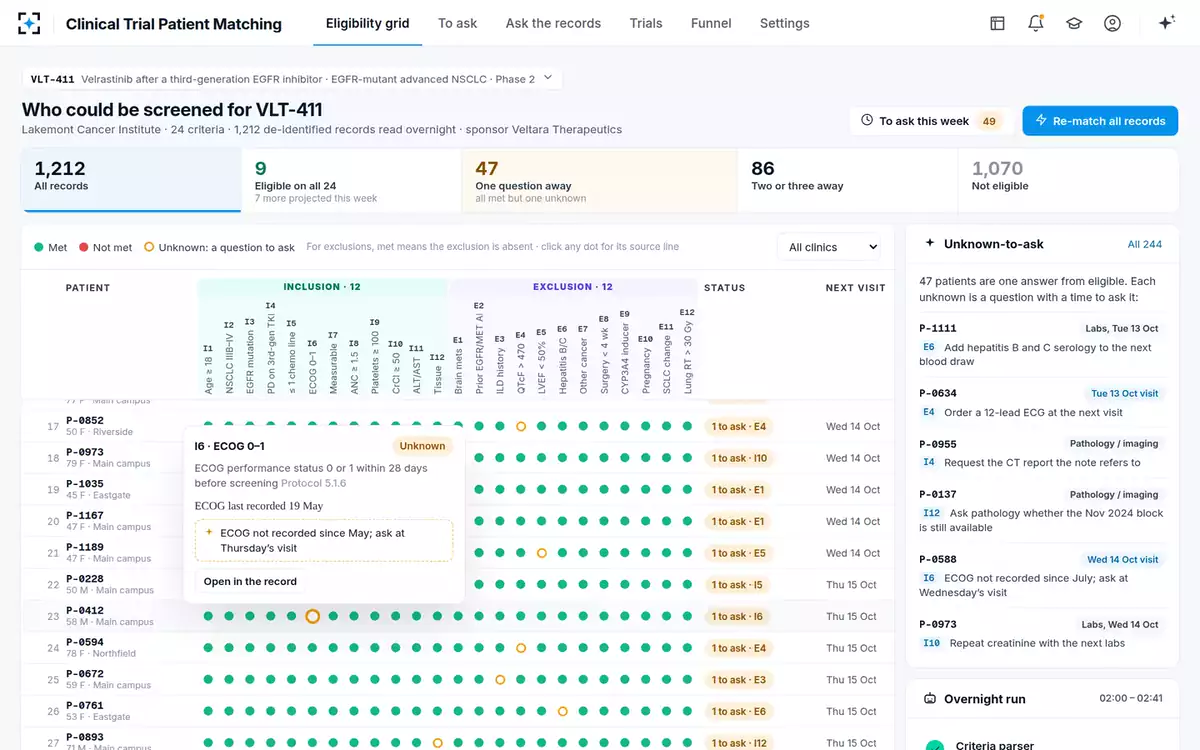
Unknown is a verdict, and it is the useful one
A two-way pre-screen (eligible, not eligible) is a lossy summary of a three-way reality. Every criterion has three possible answers against a given record: the record proves it, the record disproves it, or the record is silent. Collapsing the third into the second is what makes a site's screening numbers look like a patient problem when they are a records problem.
The three verdicts also route differently, which is the practical reason to keep them apart. Met needs nothing. Not met closes the patient for this protocol and should be cited, so that the next protocol's coordinator does not re-read the same chart. Unknown is work: it names a document to find, a test to order, a question to ask at a visit, or a judgement to put to the investigator. On the sample run, 1,212 records against 24 criteria produce 244 unknowns, 49 of them answerable from appointments already in this week's clinic schedule.
That is the difference between a list of patients who passed and a list of things to do. What happens to those unknowns, and why the blank in the record is so much more common than anyone reports, is the subject of missing data in electronic health records.
Eight checks before you call a criterion met
- The unit matches the protocol
Convert the result to the protocol’s unit, not the protocol’s threshold to the laboratory’s. Record both numbers.
- The threshold runs the way you think
Greater than or equal to is not greater than. A protocol that writes ANC ≥ 1.5 excludes 1.49 and includes 1.50.
- The evidence is inside the look-back window
Count back from the screening date the protocol names, not from today, and not from the date of the referral.
- The source type is one the protocol accepts
A plasma test and a tissue test are not interchangeable unless the protocol says so. Section 5.1.3 says which.
- The document is dated, and the date is the clinical one
The date a scan was filed is not the date the sample was taken. Pre-screening wants the second.
- The polarity is right for an exclusion
For an exclusion, you are looking for absence. State on the page which way green runs, every time.
- You are reading the current amendment
A criterion changed by an amendment invalidates every verdict reached under the old wording. Check the version on the check, not on the binder.
- The person who may confirm it has
Judgement criteria and anything ambiguous belong to the investigator. A coordinator’s reading of E16 is not a verdict.
From verdicts to a worksheet the investigator can sign
The output of pre-screening is a document, not a number, and good clinical practice says what it has to be able to do. ICH E6(R3), adopted by ICH in January 2025, asks in section 2.12.2 that source records can be attributed to whoever made them, can be read, were made at the time, are original, and are accurate and complete, and it gives the investigator the job of defining, before the trial starts, what counts as a source record and where it lives. For pre-screening that means deciding, before the first chart is read, that the worksheet is a record of the review and the chart remains the source of the facts in it.
What a pre-screening worksheet has to carry, criterion by criterion
| Column | What it holds | Why it is there | On criterion I6 |
|---|---|---|---|
| The criterion as written | The protocol’s own words, with the section number and the version | So nobody re-reads the criterion from memory, and an amendment is visible | “ECOG performance status 0 or 1 within 28 days prior to screening” (v2.0, §5.1.6) |
| The verdict | Met, not met or unknown | Three verdicts, because two of them mean different work | Unknown |
| The line that decides it | The quoted sentence or value, not a paraphrase | The investigator asked to see the line, not a score | “ECOG 1, fully ambulatory”, oncology clinic note |
| The document and its date | Document type, author where relevant, clinical date | The window is arithmetic on this date | Clinic note, 19 May 2026, 147 days before screening |
| Why not, where it applies | The reason a verdict is unknown rather than met | This is what turns into the question | Outside the 28-day window; no later assessment on file |
| The question and its date | What to ask, of whom, at which visit or draw | A question without a date is a wish | Record ECOG at the visit on Thursday 15 October |
| Who confirmed it | The person, and when | Attributable is the first word in E6(R3)’s list | Awaiting the coordinator’s visit entry, then the investigator |
Once the worksheet exists, the decision is one person's and it is quick: refer to screening, hold, or not eligible. On the sample data the investigator reads the 24 rows on a clinic tablet, chooses, and e-signs with a note naming the visit: “Approach at Thursday visit; consent then screening labs”. The signature is the point at which a pre-screen becomes an action, and it is also the reason the preceding columns have to be right.
The whole record, each criterion beside its line
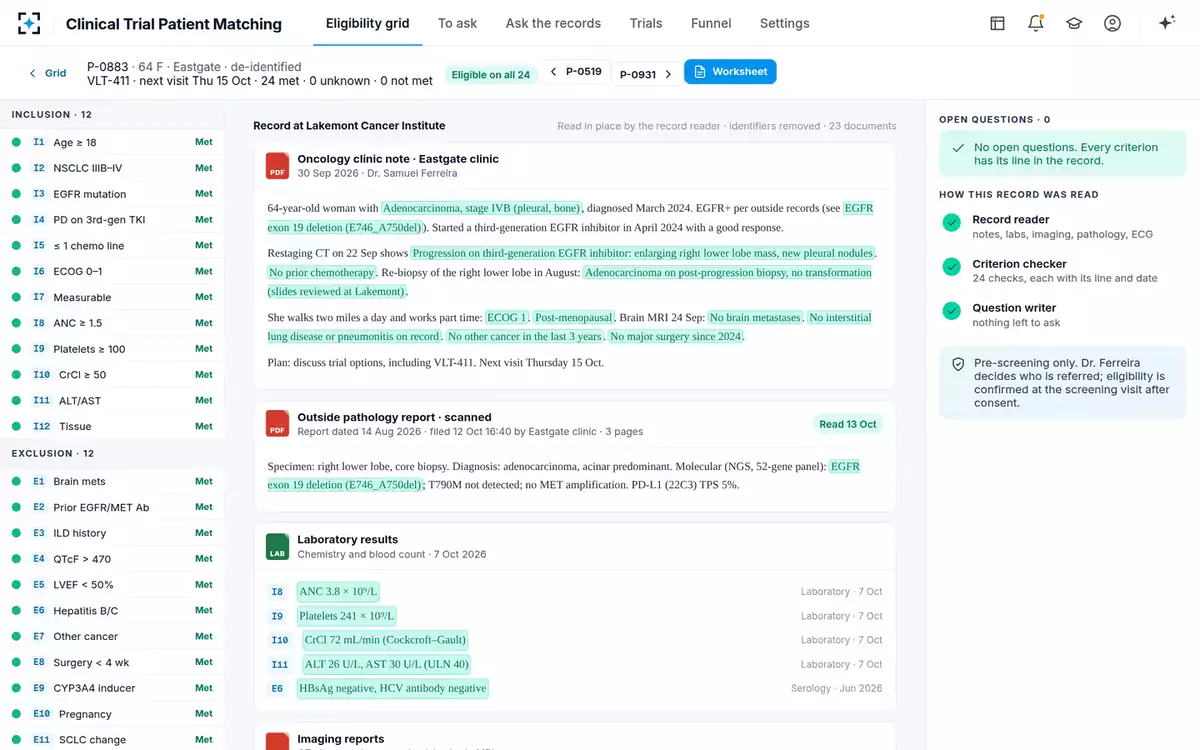
Doing it at scale: one protocol, 1,212 records, 29,088 checks
The map changes the arithmetic of pre-screening, because once a criterion is a check with a field, a threshold, a unit, a window and a list of source types, it can be run against every record rather than the few a coordinator has time for. On the sample data that is 1,212 records against 24 criteria: 29,088 individual checks, each one carrying the line that produced it, read overnight across the main campus and three satellite clinics.
The output is not a ranked score. It is four bands: 9 patients met on all 24 criteria, 47 one question away, 86 two or three away, and 1,070 with a criterion genuinely not met. The second band is the one that pays, because it is a list of specific, answerable questions rather than a list of maybes, and because nobody working by hand ever gets to build it.
Scale is also the FDA's own suggestion for recruitment. Its December 2025 guidance on enhancing participation in clinical trials asks sponsors to “Consider using real-world data to promote more efficient recruitment of trial participants by using, for example, claims data and electronic health records (while maintaining patient privacy and ensuring that patient permissions/consent for the sharing/access of identifiable data from electronic health records is obtained and maintained) to identify potential sites and participants.” The parenthesis is half the sentence, and it is the part a site has to engineer: reading more records only helps if nothing leaves the building.
Whose morning this changes, and what is left of it, is set out in clinical research coordinator workload, and where pre-screening hours go. To see the criterion map, the evidence panels and the worksheet on a protocol of your own, start from Clinical Trial Patient Matching.
Questions people ask
What documents do you need to check trial eligibility?
For the sample lung protocol, seven kinds: clinic notes, laboratory and serology results, pathology and molecular reports, imaging reports, ECG and echocardiogram reports, the medicine list, and scanned outside records. Clinic notes alone settle 7 of the 24 criteria and no single source settles more than a third, which is why a pre-screen that reads only the ones that are easy to query is a pre-screen with holes in it.
Where is ECOG performance status recorded?
Almost always as a phrase inside a clinic note (“ECOG 1” beside the examination) rather than as a coded field, unless your institution captures it discretely at oncology visits. That is why it is the criterion most often answered with an out-of-date value: there may be a performance status in the chart, but not one inside the protocol's look-back window, which for the sample protocol is 28 days.
How do you check lab values against eligibility criteria?
Copy the protocol's threshold with its unit, convert each result into that unit, compare in the protocol's direction, and only then check the collection date against the window. Doing the date check last is a common error: a conversion mistake on an out-of-window result produces a verdict that is wrong twice. For the sample protocol, blood count and chemistry count for 14 days.
What counts as evidence for an eligibility criterion?
A specific line in a specific dated document, of a type the protocol accepts, naming the value and, where the protocol cares, the method. “EGFR+ per outside records” fails all three tests even when it is true. ICH E6(R3) asks that source records be traceable to their author, readable, made at the time, original, accurate and complete, and leaves it to the investigator to define which documents at the site qualify, before the trial starts.
What do you do when a criterion cannot be answered from the chart?
Mark it unknown and write one question with a date: order the test, request the outside report, add the serology to the next blood draw, or put the judgement to the investigator. On the sample run, 244 of 29,088 checks come back unknown and 49 of those can be closed from visits already in this week's schedule, which is why unknown is the verdict worth keeping separate.
Can a coordinator pre-screen the whole patient list, not just the tumour-board list?
Not by hand, which is the real constraint on who gets considered. The sample site reads 1,212 records from the main campus and three satellite clinics overnight; hand pre-screening covered the main-campus list only. The consequence of that choice is not neutral, because the lists differ in who is on them.