Clinical trial matching software checks a site's own patient records against a protocol's inclusion and exclusion criteria and tells the research team who could be screened. That description covers two very different things: a query over coded fields that returns a list of people who might be worth a look, and a system that decides each criterion from whatever evidence exists — including narrative notes and scanned reports — and attaches the line that decides it. Both demonstrate well. Only one changes what a coordinator's morning looks like. The twelve questions below are written to tell them apart in a sixty-minute call, and the last section is honest about where Clinical Trial Patient Matching fits and where it does not.
The figures from the published literature are linked where they appear. Where this page shows the solution working, the site, study, sponsor and patients are fictional sample data.
Twelve questions for a matching vendor, and the answers that should worry you
- 1. Name every document type you read, including the ones that arrive as scans.
Worrying answer: “all your EHR data”. The facts that decide oncology eligibility live in pathology and molecular reports, many of them scanned from another hospital.
- 2. Do you read the protocol, or does someone configure the criteria by hand?
Worrying answer: a services team builds the rules. That is a cost and a delay at every amendment, and it puts the wording a long way from the protocol.
- 3. What happens the day an amendment lands?
Worrying answer: it re-runs automatically. Changed criteria should wait for the investigator; a silent re-score against an unapproved rule is worse than a slow one.
- 4. How far back does evidence count, and who sets that per criterion?
Worrying answer: one global look-back for everything. A performance status and an ECG do not age at the same rate.
- 5. Can it say “I don’t know”, and what does that look like in the output?
Worrying answer: a confidence score. A probability is not an instruction; a question with an owner and a date is.
- 6. Does a missing fact become a no, a yes, or a question?
Worrying answer: a no. That is the oldest failure in hand pre-screening, reproduced faster and at larger scale.
- 7. Who does each question go to, and is it timed to something already booked?
Worrying answer: a task list. “Obtain serology” is a wish; “add it to Thursday’s draw for this patient” is a line someone can act on.
- 8. For any verdict at all, can you show me the line, the document and its date?
Worrying answer: a generated summary of the chart. A summary cannot be audited against the record in seconds, and a worksheet that cannot be checked quickly will not be used.
- 9. What decides eligibility, and whose name is on the decision?
Worrying answer: the system assigns a status. Eligibility is confirmed at the screening visit by the investigator; everything before that is a draft for a clinician.
- 10. Where do the records go, and what leaves the building?
Worrying answer: an answer about encryption. Encryption describes how data travels, not whether it travels.
- 11. What exactly does the sponsor see?
Worrying answer: “a dashboard”. Ask to see the sponsor view. It should contain counts by site and week and no patient.
- 12. What is behind your accuracy claim, and will you replay it on our closed protocols?
Worrying answer: a published average from somebody else’s site. The only number that binds is the one measured on your records.
What is clinical trial matching software?
Software that reads a site's patient records against a protocol's inclusion and exclusion criteria and reports, per patient and per criterion, whether the criterion is met, not met or unanswerable from the record. The useful version produces three things: a grid of patients against criteria, a line of evidence behind every verdict, and a list of questions for the blanks. The weak version produces a list of names.
Note what sits outside the definition. Software that helps a patient find a study is trial search, not matching; software that helps a sponsor choose which hospitals to open is feasibility and site selection. Both are legitimate products and neither does this job, which is why the last section of this page is about fit.
A filtered list and a matched patient are not the same thing
The distinction is not marketing, it is architecture, and the authors of one published system build it into theirs explicitly. "TrialGPT comprises three modules: it first performs large-scale filtering to retrieve candidate trials (TrialGPT-Retrieval); then predicts criterion-level patient eligibility (TrialGPT-Matching); and finally generates trial-level scores (TrialGPT-Ranking)," they write, and the filter stage is deliberately coarse: it "can recall over 90% of relevant trials using less than 6% of the initial collection" (Jin et al., Nature Communications 15:9074). Filtering is a sieve. Matching is a verdict with evidence. A product that stops at the first step and calls the result a match has skipped the part that costs.
A filter over coded fields against criterion-level matching
A filtered list: Coded fields: diagnosis codes, a laboratory table, demographics, sometimes a medication list.
Criterion-level matching: The same fields plus clinic notes, pathology and molecular reports, imaging and ECG reports and scanned outside documents — the places most criteria are actually settled.
A filtered list: The criteria that happen to be coded. In one published study, 5 of 6 inclusion and 5 of 17 exclusion criteria.
Criterion-level matching: Every criterion it can find evidence for, and an explicit unknown for the rest.
A filtered list: Drops the patient out of the query result, silently.
Criterion-level matching: Marks the cell unknown and writes one question, with who to ask and when.
A filtered list: The query. To see why a patient is on the list you re-read the chart.
Criterion-level matching: The quoted line, the document and its date, behind every met and not met.
A filtered list: Unknown, because the misses never surface: a patient filtered out leaves no trace.
Criterion-level matching: Measurable, because a rejection carries the criterion and the line that caused it and can be reviewed.
A filtered list: A list of names to go and read.
Criterion-level matching: A grid, a ranked shortlist, and a dated list of questions a coordinator can work this week.
Questions 1–4: what it reads
Start here because it is cheap to answer and it decides everything downstream. A system that cannot open a scanned pathology report cannot settle a molecular criterion, and no amount of ranking will fix that.
There is a published measurement of how much of a protocol a coded query can reach. Reporting on the criteria of an ongoing heart-failure study, the authors found that coded record data could settle five of its six inclusion criteria and five of its seventeen exclusions, which is why trained study staff without clinical licences were reading charts by hand to decide eligibility (Unlu et al., medRxiv preprint, 2024, later published in NEJM AI).
How much of one study's eligibility a coded query could settle
6 inclusion criteria
- Answerable from structured data · 83.3%
- Needs the notes · 16.7%
17 exclusion criteria
- Answerable from structured data · 29.4%
- Needs the notes · 70.6%
The asymmetry is the part to carry into a demonstration. Inclusion criteria tend to be the things a cancer centre codes anyway — a diagnosis, a stage, a line of therapy. Exclusions are the awkward ones: a cardiac history mentioned in a letter, a second cancer treated elsewhere, an interacting medication a patient takes but nobody has reconciled. Seven in ten of them needed the notes in that study, and exclusions are where a pre-screen fails at the screening visit.
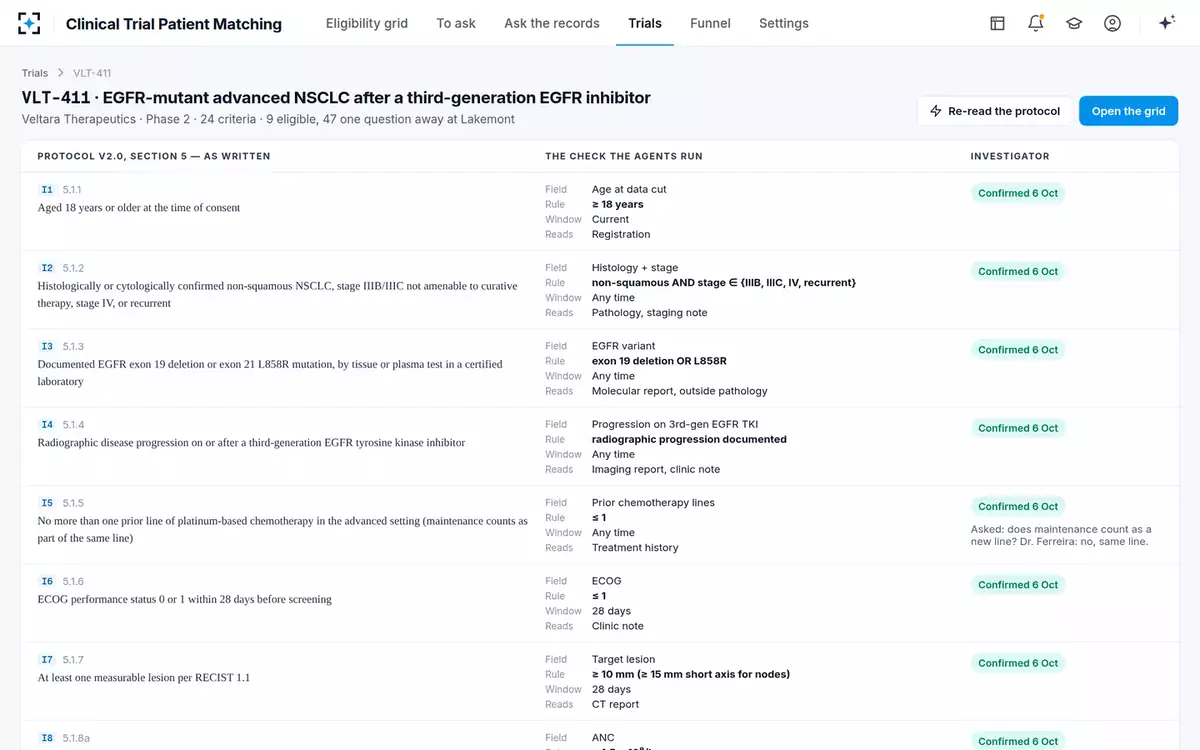
Question 2 and question 3 are about the protocol itself. Ask to watch the protocol being read: section 5 on one side, the checks it produced on the other, each carrying its section number, threshold with units, look-back window and the document types allowed to answer it. Then ask what happens at an amendment. The answer you want is that changed criteria are held until the investigator confirms them, not that everything re-runs overnight.
The protocol beside the checks built from it
Questions 5–7: what it does with a blank
This is the question most likely to be answered badly and the one that most reliably predicts whether the tool will be used. A chart almost never contains everything a protocol asks for. What the system does in that moment is the design.
There are three possible behaviours and only one of them is useful. Treat the blank as a no and the patient is never asked, which is the failure that hand pre-screening already has. Treat it as a yes and it is found at the screening visit, after consent, with the patient in the room. Keep it as unknown and it costs one question — which is why the sample site's rule is that no evidence inside the look-back window is unknown and never met, and why that rule is locked rather than configurable.
Then ask what an unknown looks like in the output. A confidence score is not an answer: nobody can act on 0.63. A question with a named owner and a visit date is. In the sample run, 244 unknowns became 244 questions and 49 of them were askable at visits and blood draws already in the diary. Why the question list is the real output works that design through one night's run.
Questions 8–9: what it shows you, and what it decides
Ask, in the demonstration, for any cell at all — not one the vendor chooses — and expect the criterion as written, the verdict, the quoted line, and the document with its date. The test is not whether the evidence exists somewhere but whether it is one click from the verdict, because a worksheet that takes longer to check than the chart takes to read will not be used twice.
Question 9 is about authority, and it is worth being precise. The FDA's draft guidance on AI in regulatory decision-making asks sponsors to begin by writing down what the model is for: first the specific question, decision or concern the model addresses, then a context of use that fixes the model's role and scope in answering it (FDA, draft guidance, January 2025). A vendor who cannot write that sentence for their own product — what it decides, what it only drafts — has not thought about it.
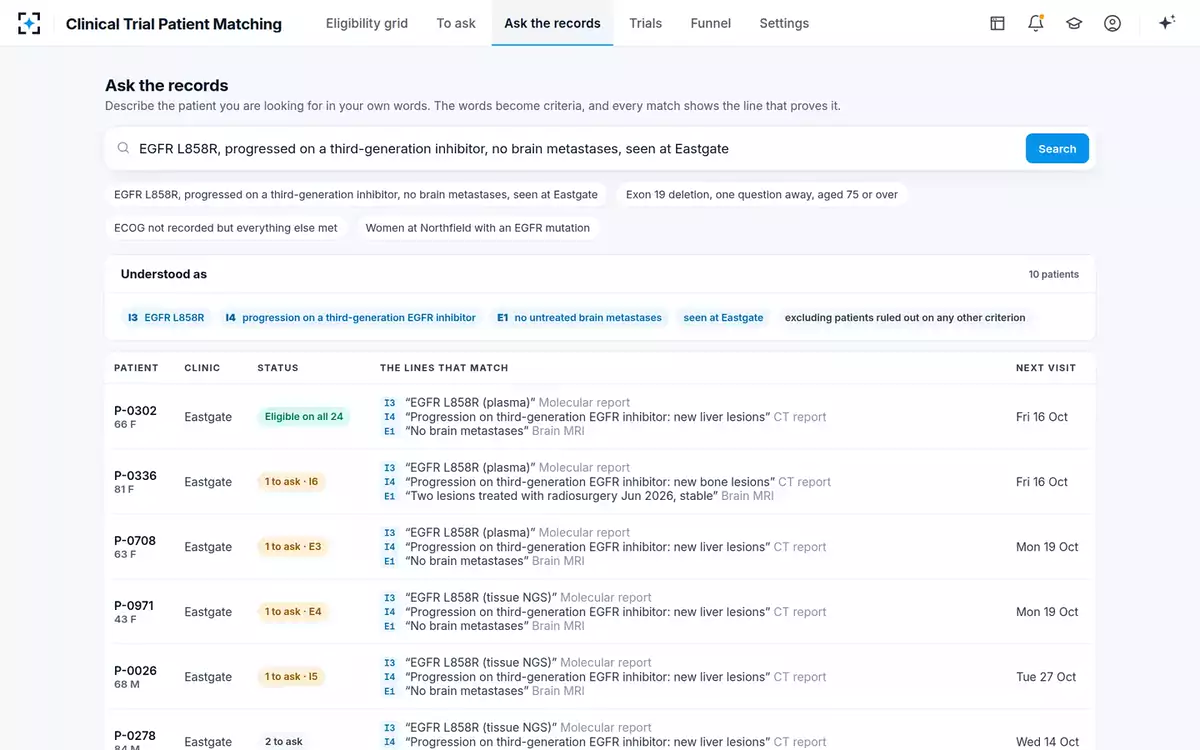
Describing a patient in plain words, and getting the lines that prove each match
Questions 10–12: where the data sits, and how it is measured
Question 10 has a one-line test, and it is written into the rule that lets a research team look at records before anyone has consented. A covered entity may permit a review preparatory to research on the researcher's representation that, among other things, the researcher will take no protected health information out of the covered entity during the review (45 CFR 164.512(i)(1)(ii)(B)).
Read it as a product question and it becomes concrete: does the reading happen where the records live, or does the product need a copy? Both architectures exist and both can be lawful under the right agreements, but they are different conversations with your privacy office, and the answer should be a sentence rather than a diagram. The sample solution reads in place with identifiers removed and copies nothing off site, and those settings are locked by the research office rather than by the study team. What the privacy rule and the Common Rule actually permit before consent covers the ground underneath.
Question 11 takes thirty seconds and is often revealing: ask to see the sponsor's view with your own eyes. In the sample solution it contains records read, eligible, one question away and referred, by site and by week, and no patient at all.
Question 12 is the one to hold out for. Published accuracy figures are useful context and they are somebody else's site: in one criterion-level evaluation a model reached 87.3% accuracy on 1,015 patient-criterion pairs, close to expert performance. What binds is a replay on your own closed protocols, where the screening log already holds the answers. An outline of what to ask for, and what the three published evaluations do and do not prove, is in the guide to matching accuracy.
Four numbers worth taking into a vendor call
5 of 17
exclusion criteria in one study that structured record data could determine
87.3%
criterion-level accuracy on 1,015 patient-criterion pairs in a published evaluation
1,117
accrual sites in one national molecular screening protocol — the scale a site-side tool is not built for
17.8%
of patients in that protocol were assigned to a treatment arm after clinical and molecular exclusions
Does trial matching software read scanned reports?
Some does and much does not, and the difference decides whether a molecular criterion can be settled at all. A patient referred from another hospital arrives with her diagnosis in a PDF somebody faxed; the EGFR result that decides her eligibility is a line on page two of it. A product whose answer to question 1 was "all your EHR data" will see a document stub and no content.
The worked case in the sample data is exactly this. A clinic note said "EGFR+ per outside records" and no report was on file, so the criterion stood at unknown rather than met — an implication is not evidence. A three-page scanned pathology report was filed later and carried the line "EGFR exon 19 deletion (E746_A750del)", dated 14 August 2026, which settles the criterion under the protocol's own section 5.1.3. In a demonstration, hand over a scan of your own and watch.
How is trial matching software validated?
By replaying a protocol whose answers already exist, and by keeping the measurement going afterwards. The published deployments all follow the same shape: validate retrospectively against chart review on one study, then run prospectively on the same study, then widen. Ask the vendor to commit to the first of those on two of your closed protocols, one simple and one with molecular or imaging criteria.
Ask also how the system is governed once it is live, and expect the answer to name a framework rather than a feeling. The NIST AI Risk Management Framework is the usual reference point in the United States — a voluntary framework for managing the risks AI poses to people, organisations and society, meant to help build trustworthiness into how AI systems are designed, developed, used and evaluated (NIST, AI RMF 1.0, 2023; NIST notes it is being revised). It is voluntary, and the point of citing it in a procurement is not compliance but vocabulary: it gives both sides the same words for what is being governed.
Grading the answers: a scoring sheet for three demonstrations
Three vendors in three weeks blur together, and the blur is where polish beats substance. The sheet below is the twelve questions in four groups, with what a good answer sounds like and what should worry you, so the notes from each call can be compared rather than remembered.
Four groups, twelve questions: what to write down after each call
1–4 · What it reads
A good answer sounds likeNames the document types, including scanned outside reports, and reads the protocol itself so an amendment re-opens the affected criteria.
This should worry youTalks about “data sources” and “integrations” without naming a document type, or treats the protocol as a configuration exercise someone does by hand.
5–7 · What it does with a blank
A good answer sounds likeHas a third verdict, outputs it as a specific question with an owner and a date, and will not call a criterion met on evidence outside the protocol’s window.
This should worry youAnswers with a score, a confidence or a percentage match. A blank has been resolved into a number somewhere, and you will not be shown where.
8–9 · What it shows, what it decides
A good answer sounds likeOpens any verdict to the quoted line, the document and its date, and records a named clinician’s decision on every referral.
This should worry youShows a summary it generated rather than the line it read, or produces a ranked list with no decision step at all.
10–12 · Where the data sits, how it is measured
A good answer sounds likeReads in place, states plainly what leaves the site, limits the sponsor to counts, and offers a replay on your own closed protocols.
This should worry youNeeds a copy of the records to work, cannot say what its sponsor view contains, and answers the accuracy question with a published average rather than an offer to measure.
One habit is worth more than the sheet: ask every vendor the unknown question — what happens when the record does not say — and write the answer down verbatim. It is the question that cannot be answered well by accident, and a vendor who needs a paragraph to get to "it becomes a question" is describing a scoring model.
What it fits: site pre-screening, not a patient searching for a trial
Clinical Trial Patient Matching is a site-side tool. It takes one protocol the site is already running and the records the site already holds, and it tells the research team who could be screened for it. That is the whole shape, and three adjacent jobs sit outside it.
It is not trial search for patients: a person asking which studies might suit them anywhere in the country needs a registry-facing tool, and one patient against thousands of protocols is the opposite problem. It is not feasibility or site selection: a sponsor deciding which hospitals to open is working from counts across institutions, and the scale is different in kind — the national NCI-MATCH screening protocol profiled tumour samples from 5,954 patients at 1,117 accrual sites, and 17.8% of the patients with results were assigned to a treatment arm after clinical and molecular exclusions (Flaherty et al., Journal of Clinical Oncology 38(33)). And it is not a replacement for the screening visit: everything it produces is a pre-screen, and eligibility is confirmed after consent by the investigator.
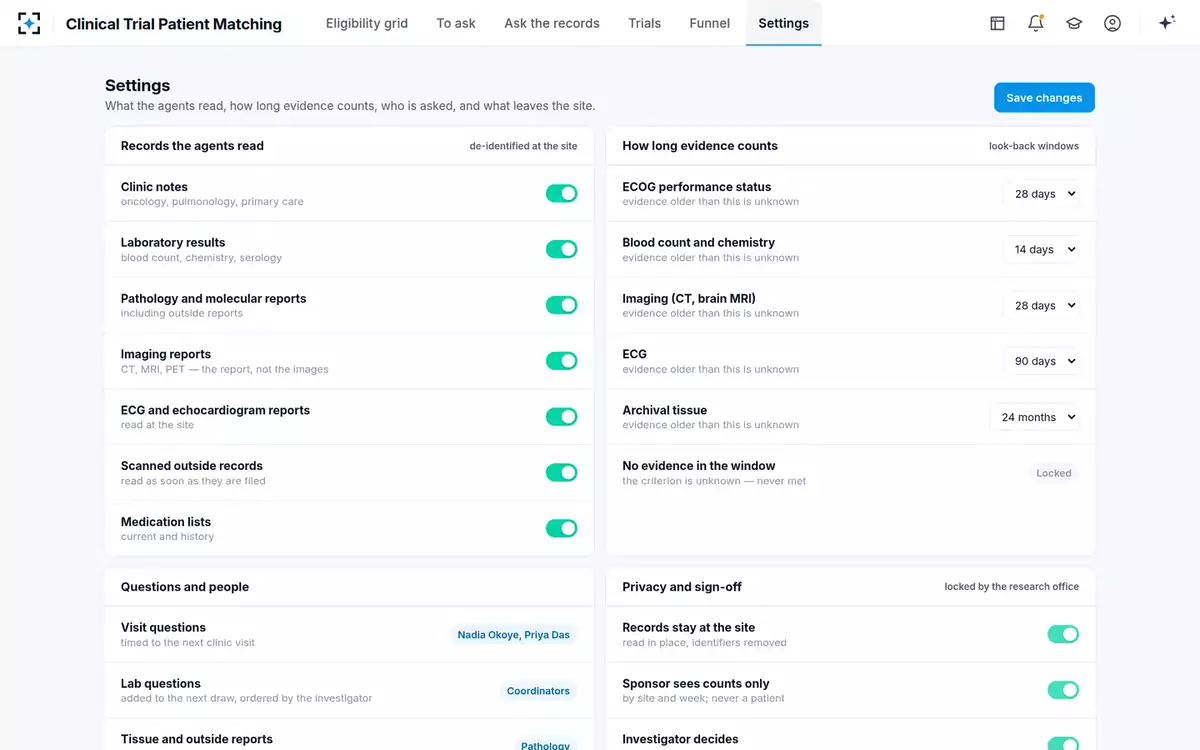
What it does do is narrow: six agents turn the protocol's criteria into checks the investigator confirms, read every record at the site, mark each criterion with the line that decides it, turn each blank into one timed question, and draft the worksheet the investigator signs. The research office sets what is read, how long evidence counts, who is asked and what leaves the building.
The settings a research office holds, which are half the answers above
Questions people ask
What is the difference between a patient list and patient matching?
A list says who might be worth reading. Matching says, for each criterion, what the record shows and where it shows it — and names the criteria the record cannot settle. The practical test is what the output lets someone do next: a list sends a coordinator to the chart, a match sends her to a visit with a specific question.
Where does the patient data go?
Ask rather than assume; both architectures exist. The relevant line in the HIPAA Privacy Rule's provision for reviews preparatory to research is that no protected health information is to be removed from the covered entity in the course of the review, which makes "does it read in place, or does it need a copy?" the question to put to a vendor. The sample solution reads in place with identifiers removed and copies nothing off site.
Can the software show the evidence for a decision?
It should show the quoted line, the document and the date for every met and not met, one click from the verdict, and the question with its owner for every unknown. A generated summary is not evidence: it cannot be checked against the chart faster than the chart can be read, which is the only test that matters at a clinic tablet.
Do we need an IRB submission for trial matching software?
Usually, because pre-screening activities themselves are what the IRB reviews rather than the software as such: the procedures and the instruments used are described in the protocol and approved before they begin. The practical questions your board will ask are which records are read, by whom, what leaves the institution and who makes contact with a patient — which is why those four should be settled before a pilot rather than during one.
What does clinical trial matching software cost?
Vendors price per study, per site or per seat, and the figure is rarely the deciding number. The computation itself is cents a patient in published evaluations, and the real costs are connecting record sources, clinician time confirming criteria and validating output, and the coordinator time spent on the questions produced. Weigh it against what a study costs rather than against the recruitment line, which is under 3% of a trial's cost.
What should I ask a trial matching vendor first?
What happens when the record does not say. Everything else — the document types, the evidence line, the privacy architecture, the validation offer — follows from whether the system has a third verdict at all. If the answer arrives as a score or a confidence, the rest of the call is about a different kind of product.