Clinical trial recruitment software can be planned to go live on one protocol in about six weeks, and the schedule is set almost entirely by things that have nothing to do with software: how long it takes to agree what counts as a source record, how long the people who own each record system take to grant access, and how long a clinician needs to confirm that the checks built from the protocol say what the protocol says. The build is the short part. This guide sets out a six-week plan for Clinical Trial Patient Matching that starts on a study whose answers are already known, a readiness list by record source, and four numbers to judge it on at day ninety.
The plan below is written for a site putting this on its own records for the first time. Where it shows the solution running, the site, study, sponsor and people are fictional sample data; the regulatory sources are linked where they appear.
Six weeks from first decision to a live protocol
- Four decisions, nothing connectedWeek 0
- Protocol read, criteria confirmedWeeks 1–2
- Replay on a closed studyWeeks 3–4
- One live study, one clinicWeek 5
- Screening log and handoverWeek 6
How long does clinical trial recruitment software take to go live?
Six weeks to a first live protocol at one site, if week 0's decisions are made before anything is connected, and considerably longer if they are made afterwards. The reason is that each decision changes what has to be read, and every change in what has to be read sends somebody back to a system owner for access.
What does not take six weeks is the reading itself. In the sample site's nightly run, 1,212 patients' records — 48,216 documents — are read against 24 criteria in about 41 minutes. Elapsed time in a go-live is consent from record owners, a clinician's attention, and the deliberate choice to prove the thing on a study that has already closed before pointing it at a study that has not.
Week 0: four decisions to make before anything is connected
Three of these are the research office's and one is the investigator's, and all four are cheaper to settle in a meeting than to discover in week 4. Good clinical practice puts the first of them on the investigator explicitly: "the investigator should define what is considered to be a source record(s), the methods of data capture and their location prior to starting the trial and should update this definition when needed" (ICH E6(R3), section 2.12.2). Prior to starting is the operative phrase, and a pre-screening deployment is a good forcing function for a definition many sites have never written down.
The four week-0 decisions, the options, and who signs each one
What counts as a source record
What is being chosenWhich systems hold the evidence a criterion may be decided on, and which are reference only — the scheduling system, a shared drive of scanned referrals, a departmental molecular database.
Who signsPrincipal investigator, with the research office
Which clinics and which record sources are in scope
What is being chosenSeven source types, each on or off: clinic notes, laboratory results, pathology and molecular reports, imaging reports, ECG and echocardiogram reports, scanned outside records, medication lists. Then which clinics — main campus only, or the satellites too.
Who signsResearch office director
How long each kind of evidence counts
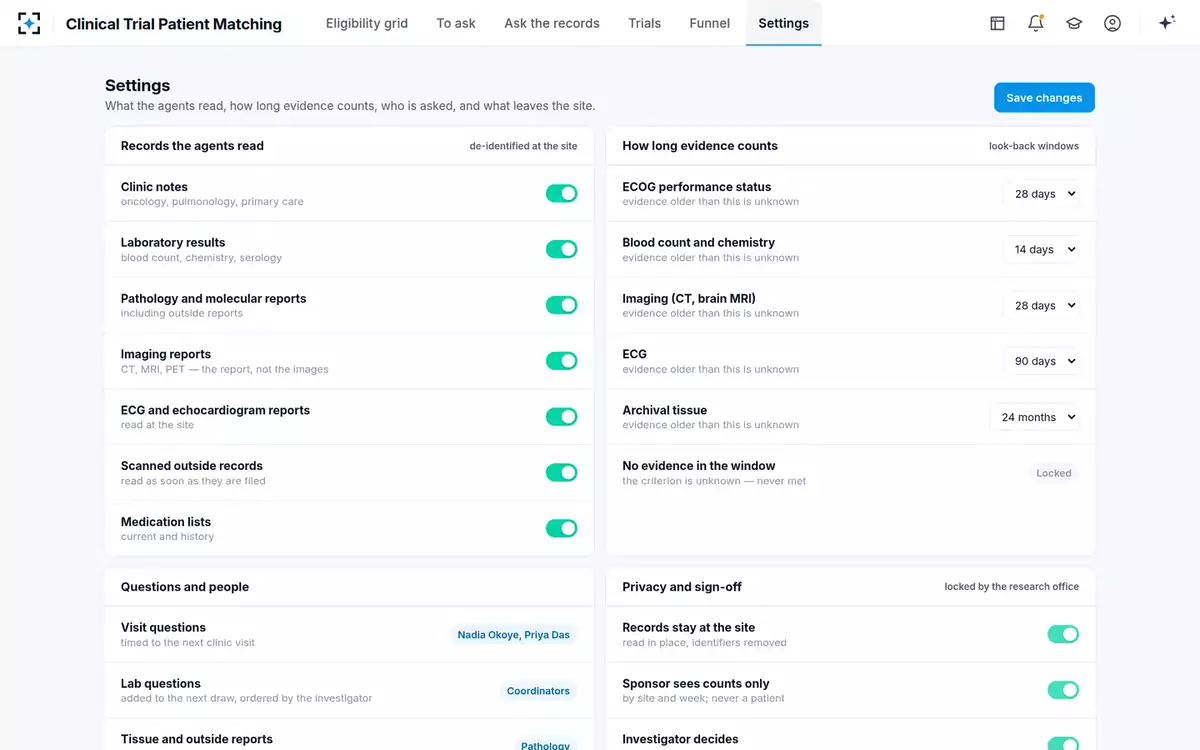
What is being chosenA look-back window per evidence type where the protocol leaves it open. In the sample settings: performance status 28 days, blood count and chemistry 14 days, ECG 90 days. What happens outside the window is not a choice — it is unknown, never met.
Who signsPrincipal investigator
What leaves the building, and who is asked
What is being chosenWhether records are read in place, what the sponsor receives, who may contact a patient, which questions go to the coordinators, which to pathology and which to the investigator.
Who signsResearch office with the privacy office
The fourth decision is the one that will be asked about for years afterwards, so write the answer in a sentence rather than a diagram: records are read where they live, with identifiers removed; nothing is copied off site; the sponsor receives counts by site and week and never a patient; the coordinator, not the system, speaks to patients. In the sample solution those four are locked by the research office rather than being a study team's setting, which is the right place for them.
What do we need before we start?
Four things, and only one is technical. A protocol the site is actually running, with its amendments. Named owners for each record source, which is a list of people rather than a list of systems. A closed study with a complete screening log, to replay against. And an hour of the principal investigator's time, twice: once to confirm the criteria and once to read the first worksheets.
The readiness list, record source by record source
- Clinic notes — who owns them, and how far back?
Agree a look-back for the record as a whole, usually two to three years for an oncology list. Note which clinics are in and which are not; the gap is usually the satellites, which is also where the unread patients are.
- Laboratory results — the feed, and the units
The easiest source and the one most often wrong in detail. Check that units and reference ranges come through, because a threshold compared against the wrong unit fails silently.
- Pathology and molecular reports — including the scans
Ask specifically whether outside reports arrive as images. If they do, this is the source that decides whether molecular criteria can be settled at all.
- Imaging, ECG and echocardiogram reports — the report, not the images
The text report is what a criterion is decided from. Nobody needs the pixels, and saying so early shortens the conversation with radiology.
- Medication lists — reconciled or raw?
Exclusions on interacting medicines are common and medication data is the most variable thing in any record. Know which list you are reading before you trust an exclusion.
- The clinic schedule — this is what makes a question actionable
Without it, every unknown becomes an undated task. With it, the question says Thursday. It is usually owned by an operations team that nobody has thought to invite.
- The screening log — the thing you will be measured on
Needed twice: as the source of truth for the replay, and as the place every decision lands afterwards. Agree the format now, with whoever maintains it today.
- A named owner and an access route for each of the above
The honest version of this list is a column of people’s names. Access requests, not software, are what makes a six-week plan a ten-week plan.
The regulator's own encouragement to use records this way is worth having in the pack that goes to your committees. The FDA's final guidance on enhancing participation in clinical trials, revised in December 2025, suggests that sponsors use real-world data such as claims and electronic health records to find potential sites and participants — on the condition, written into the same sentence, that patient privacy is maintained and that permission for sharing or accessing identifiable record data is obtained and kept (FDA, Enhancing Participation in Clinical Trials). The condition is half the sentence, and it is the half your privacy office will read first.
Weeks 1–2: the protocol, parsed and confirmed by the investigator
The protocol is read first and the records second, which surprises people who expect an integration project. Section 5 becomes a list of checks: for each criterion, the field, the rule, the threshold with its units, the look-back window and the document types allowed to answer it, each carrying the section number it came from.
Then the investigator reads that list beside the protocol and confirms it, criterion by criterion. Nothing is matched before he does. This hour is where the pilot is usually won or lost, because it is where ambiguity surfaces: a criterion that says "adequate organ function" without numbers, a threshold whose units differ from the laboratory's, an exclusion that depends on a judgement no record contains. Each of those is a conversation the site would otherwise have had at a screening visit, one patient at a time.
The protocol beside the checks, waiting for a signature
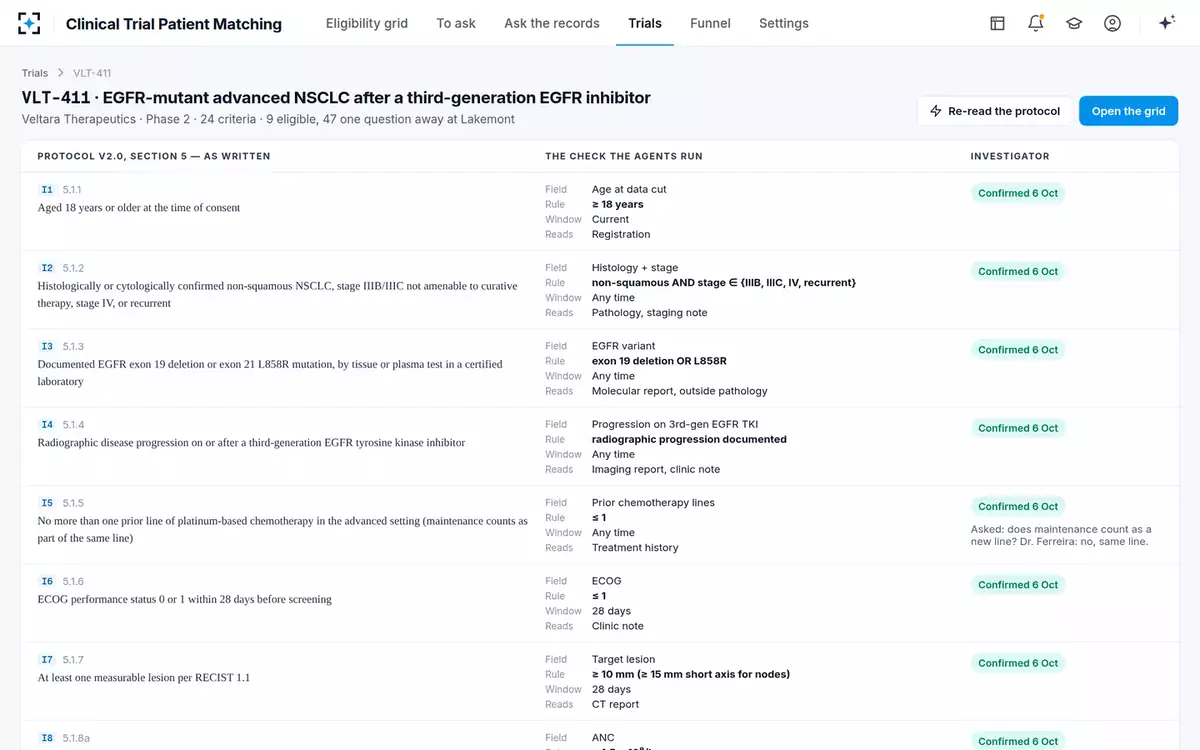
Amendments work the same way for the rest of the study's life: the amended text is compared with the confirmed checks, and any criterion whose meaning changed waits for the investigator rather than re-running overnight. Agree in week 1 who receives that notification when he is on leave.
Weeks 3–4: the replay on a closed protocol
Point the system at a study that has finished, with the records frozen as they stood at each screening decision, and compare what it produces with what the screening log recorded. The truth already exists, no patient is affected, and the result is a number measured on your records rather than somebody else's.
The replay and the first live run prove different things
Replay on a closed study: Sensitivity and specificity against decisions a clinician already made, on your records, your clinics and your protocol wording.
First live run on an open study: That the questions produced are ones your clinic can actually answer, and that the morning works.
Replay on a closed study: Nothing about whether a question gets asked, or whether a coordinator’s week has room for it.
First live run on an open study: Nothing about accuracy: there is no independent truth to compare against until the screening visits happen.
Replay on a closed study: The screening log for those screened, plus a clinician reading a sample of the patients who were never screened — the misses only live there.
First live run on an open study: The investigator, decision by decision, in the ordinary course of the study.
Replay on a closed study: A clinician’s reading time, concentrated into one week. This is the expensive part of the pilot.
First live run on an open study: Coordinator time on the questions, which is the time the system is supposed to be saving.
Replay on a closed study: Read every one. Each is a model error, a protocol-wording problem or a record problem, and the mix is the finding.
First live run on an open study: Record it in the log with the investigator’s reason, which becomes next quarter’s comparison.
The design is not ours; it is what the published deployments did. One cancer centre validated its matching tool against chart review on a single metastatic colorectal study before widening, and reports what the widening produced: "since September 2022, the system has screened 98,348 patients across 29 trials, identifying 825 eligible candidates and facilitating 117 patient enrollments with 9%-37% consent rates" (Gong et al., JCO Clinical Cancer Informatics 10:e2500262). The first study is the proof; the 29 are the consequence.
What one validated deployment produced from September 2022
29
trials running on one deployed matching system since September 2022, after validation on a single study
98,348
patients screened by it over that period
825
eligible candidates identified, which became 117 enrolments
10×
reduction in chart review workload reported on the validation study
The FDA's draft guidance on AI frames the same week as a deliverable rather than an activity: step 4 of its framework is to "develop a plan to establish the credibility of AI model output within the COU" (FDA, draft guidance, January 2025). Writing that plan down before week 3 — what will be measured, against what truth, by whom, and what result would stop the pilot — is the difference between a validation and a demonstration.
Week 5: one open protocol, one clinic at a time
Now point it at a live study, and resist the temptation to point it at all of them. One protocol, one clinic, one coordinator for the first week. What is being tested here is not accuracy — that was week 4 — but whether the questions are answerable: whether the tests can actually be added to Thursday's draw, whether pathology responds to a request phrased that way, whether the investigator's judgement calls arrive in a form he can answer between patients.
Expect the first week's list to be too long. In the sample run, 244 unknowns were produced and 49 were askable that week at visits and draws already booked; the rest carried an owner and a due date. A coordinator meeting the full list on day one without that split will reasonably conclude the system has made her job bigger.
The nightly run, visible step by step on the first live week
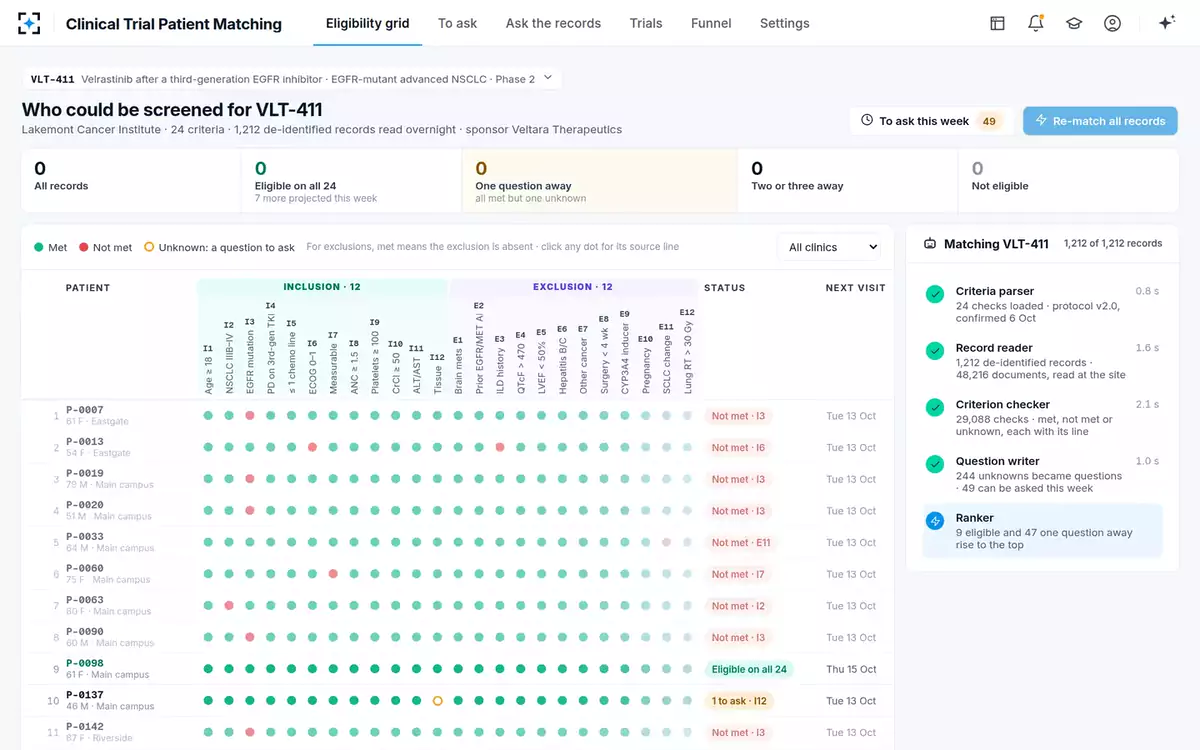
Then add the second clinic. Widening by clinic rather than by study is deliberate: a new clinic is a new set of record habits and a new coordinator, which is where surprises live, whereas a second study on clinics you have already proved is mostly a second protocol to confirm.
Week 6: the screening log, and who owns it
By week 6 the question is no longer whether it works but who holds it. Three ownerships have to be named, and a pilot that ends without them quietly becomes nobody's.
The screening log is the first. Every decision the investigator makes — refer, hold, not eligible — lands there with his name, the criteria as they stood and the lines that supported them. Whoever maintains the log today should maintain it afterwards; the change is that it is being written as decisions are made rather than reconstructed later.
The settings are the second: record sources, windows, routing, privacy. These belong to the research office, not to a study team, because they are the answers the site gave its committees. The third is the protocol confirmations, which belong to each study's investigator and have to be re-done when an amendment changes a criterion.
Who does what in the six weeks
Today
Owns accrual and the site’s commitments, with no view across clinics.
With agents
Makes three of the four week-0 decisions, chases record access in weeks 1–2, and owns the settings afterwards.
Still theirs: What is read, how long evidence counts, and what leaves the building
Today
Signs off who is approached, from a summary.
With agents
Confirms the criteria in week 2, reads the replay disagreements in week 4, decides and e-signs from week 5.
Still theirs: Every referral decision, and the definition of a source record
Today
Reads charts by hand against the criteria, for several studies at once.
With agents
Works the question list from week 5 and tells the project what is unanswerable in practice.
Still theirs: All contact with patients, under the site’s own process
Today
Fields ad-hoc data requests from study teams.
With agents
Connects the agreed record sources in weeks 1–2 and nothing else, then hands over.
Still theirs: The access route for each source, and the record of who approved it
Does trial recruitment software need IRB approval?
The software is not what the board reviews; the pre-screening activity is, and it needs to be described and approved. The NIH's human subjects protection office puts the expectation plainly in its guidance for investigators: both pre-screening and screening must be described in the study protocol, the IRB must review and approve the procedures and instruments that will be used before they begin, researchers should collect only the minimum information needed to determine eligibility, and privacy and confidentiality must always be protected (NIH OHSRP, Screening for Research Studies).
The regulation underneath is the Common Rule's provision on screening, which contemplates exactly this activity. An IRB may approve a proposal in which an investigator obtains information for screening, recruiting or determining eligibility without the prospective subject's informed consent, and one of the two routes the rule names is getting identifiable information by accessing records (45 CFR 46.116(g)(2)). For a drug or device study, the FDA's own rules in 21 CFR parts 50 and 56 apply alongside it. Reading records to see who might qualify is a recognised activity with a route through the board, not an exception to be argued for.
In practice your board will ask four things, which are the same four as week 0: which records are read, by whom, what leaves the institution, and who makes first contact with a patient. Have the written answers before the submission rather than after it. The ground underneath — the Privacy Rule's review preparatory to research, and where consent begins — is set out in the guide to pre-screening and screening.
The first ninety days: four numbers that say it worked
Agree these four in week 0 and compute them at day ninety, so the judgement is not retrospective. Each has a defined comparison, and three of the four come out of the screening log rather than out of the software.
Eligible patients confirmed, per site per month, against the hand baseline. Confirmed by the investigator on every criterion, not identified and not projected, compared with what the same records yielded under the previous method. This is the number that justifies the work.
Sensitivity from the replay, restated at ninety days. The week-4 figure is the baseline; at ninety days you can also compare what the system proposed with what the investigator decided, which catches drift from amendments and from new clinics.
The share of questions that were answerable at an already-booked visit. The test of whether the clinic schedule is doing its job. A low share means the questions are arriving as tasks rather than as appointments, and the fix is usually the schedule feed, not the model.
The lag from a document being filed to the grid changing. In the sample settings the site re-matches nightly at 02:00 and whenever a new document is filed, which is what let one patient's scanned outside pathology report move her into the eligible rows the same morning rather than the next day.
Report the consent rate separately, and do not let it into the comparison. Finding a patient and enrolling one are different problems with different owners, and in the published deployment above 825 candidates became 117 enrolments at consent rates between 9% and 37%. Why eligible patients found is the right metric makes the argument against the alternatives.
The settings as the research office leaves them at week 6
Three ways a pilot goes wrong
It starts on an open protocol. There is no truth to measure against, so the pilot produces impressions. Four weeks later the question "did it work?" has no answer and the loudest opinion wins. Start closed, where the screening log already knows.
Everything is connected at once. Seven record sources across four clinics means seven access conversations before anything runs, and the slowest one sets the date. Switch off what is not ready by the end of week 2, run with the rest, and add the laggards afterwards — a source added later changes the grid, which is the normal behaviour of the system rather than a rework.
It is measured on records read. Volume is the easiest number to produce and the least informative; a system that reads twice as many charts and refers the same patients has achieved nothing. Measure confirmed patients, and measure them against your own previous method rather than against zero.
One further habit is worth building in from week 5: ask the coordinator at the end of each week which questions she could not ask, and why. The answers are the only reliable guide to what the routing settings should be, and they arrive nowhere else.
Questions people ask
Which protocol should we start with?
Two, in fact: a closed one for the replay and an open one for the live week. For the closed study, pick one whose screening log is complete and whose criteria include at least one that needs the notes — a molecular result, a performance status, a cardiac history — because the easy criteria prove only the plumbing. For the live study, pick one with an active clinic and a coordinator who has time in week 5.
What record sources do we have to connect?
As few as will settle the protocol's criteria. Clinic notes, laboratory results and the clinic schedule are the irreducible three: without the schedule the questions have no date and stop being actionable. Pathology and molecular reports matter enormously in oncology and barely at all in some other areas. Anything not ready by the end of week 2 should be left out of the pilot and added later.
How do we know it worked?
Eligible patients confirmed per site per month against your own previous baseline, sensitivity from the replay, the share of questions answerable at visits already booked, and the lag from a document arriving to the grid changing. Agree all four before week 1, compute them at day ninety, and keep the consent rate as a separate line.
Who owns it after go-live?
Three owners, named in week 6. The research office owns the settings — record sources, windows, routing, privacy — because those are the answers the site gave its committees. Each study's investigator owns the criteria confirmations and re-confirms them at every amendment. Whoever maintains the screening log today keeps it, now written as decisions are made.
How do you pilot a trial matching tool without risking a patient?
By replaying a study that has closed. No living patient is approached, no screening slot is used, and the records are read as they stood at the time, so there is nothing to get wrong clinically. The only resource it consumes is a clinician's reading time in week 4, and that is also the week that produces the number you will quote for the next two years.
What happens to the pilot when the protocol is amended?
The amended text is compared with the confirmed checks, and any criterion whose meaning changed is held until the investigator confirms it rather than re-running against a rule nobody approved. Decide in week 1 who is notified and who may confirm in the investigator's absence, because an amendment arriving in week 5 is otherwise the most likely thing to stall the live run.