AI clinical trial patient matching is software that reads a site's own patient records against a protocol's inclusion and exclusion criteria and says, for each patient and each criterion, whether it is met, not met or unknown. The third verdict is the one that decides whether the system is any use. A chart almost never contains everything a protocol asks for: the performance status is three months stale, the serology was never drawn, the molecular report is a scan from another hospital. A matcher that resolves those blanks into a score produces confident nonsense. One that keeps them as unknowns produces something a research coordinator can actually work — a list of questions, each tied to one criterion, one person to ask and one visit. Botminds' Clinical Trial Patient Matching is built the second way: every unknown becomes one question, and the principal investigator decides who is referred.
The site, sponsor, study and people on this page are fictional sample data, shown as the solution runs them. Lakemont Cancer Institute runs VLT-411 for Veltara Therapeutics, a Phase 2 study in EGFR-mutant advanced non-small-cell lung cancer with 24 inclusion and exclusion criteria. The research cited is linked where it appears.
One night's pre-screening for VLT-411, and what it produced to ask
29,088
patient-by-criterion checks, each carrying the line in the record that decides it
244
unknowns, each written as one question with a named person to ask
49
of those questions askable this week, at a visit or a blood draw already booked
9 / 47
patients eligible on all 24 criteria, and one question away
Can AI match patients to clinical trials?
Yes, at the level of one criterion at a time, and that qualification carries the whole answer. The published evaluations are criterion-level evaluations: a model is asked whether this patient meets this rule, given these notes, and its answer is compared with a clinician's. One published system, TrialGPT, is built in three parts — retrieval, then criterion-level matching, then a trial-level score — and the first part is frankly a sieve: in its evaluation it kept more than nine in ten of the relevant trials while passing on fewer than one in sixteen of the candidates (Jin et al., Nature Communications 15:9074, 2024). Narrowing is cheap and approximate. Deciding is not, which is why it is a separate step with a human at the end of it.
What AI does well here is reading at a volume no coordinator can reach. A site screening for one open study has thousands of patients whose charts nobody will ever open, because opening them by hand costs minutes each and the clinic list arrives every morning. What AI does badly is pretending to certainty. The honest system is the one whose answer to "is this patient eligible?" is most often "not yet known, and here is exactly what would settle it".
Three verdicts, and why the third one matters most
Every cell in the grid holds one of three verdicts. Met means a line in the record satisfies the rule, inside its window, and the line is attached. Not met means a line in the record contradicts it — for an exclusion, that the exclusion is present. Unknown means nothing in the record answers the question, or nothing recent enough does.
Two-verdict systems have to force the third case into one of the other two, and both choices are bad. Treat a blank as a no and the system reproduces the oldest failure in hand pre-screening: the patient whose chart was set aside because a fact was missing, and who was therefore never asked. Treat a blank as a yes and the coordinator discovers it at the screening visit, after consent, which wastes the patient's day and the site's screening slot. Keeping the blank as a blank costs one question.
The arithmetic of the sample night shows why the third verdict is where the value sits. Nine patients were met on all 24 criteria. Forty-seven were met on 23 and unknown on one. Under a two-verdict system those 47 would have been scored, ranked and mostly discarded. As unknowns they are 47 questions, and 49 of the site's 244 questions can be asked this week without booking anything new.
Old evidence is unknown, never met: the look-back window
A protocol does not only say what must be true; it says how recently it must have been shown. VLT-411 asks for an ECOG performance status of 0 or 1 recorded within 28 days before screening. The site sets the window for each kind of evidence once — performance status 28 days, blood count and chemistry 14 days, ECG 90 days — and the rule that applies when nothing falls inside it is not a setting at all. No evidence in the window is unknown, never met. It is locked.
That rule is unglamorous and it is the one that keeps the grid honest. Patient P-0412, 58, seen at the main campus, is met on every criterion but one. His last recorded ECOG is from 19 May. He is very likely still a 0 or a 1; a system tuned to be helpful would carry the old score forward and mark the criterion met. The checker will not, because a criterion met on evidence the protocol would not accept is a criterion that fails at the screening visit, in front of the patient. It marks I6 unknown and writes the question: ECOG not recorded since May, ask at Thursday's visit.
Where the 41 minutes of one night's run went
- Checks loaded
- Records read at the site48,216 documents
- Every criterion checked29,088 checks
- Unknowns written as questions
- Patients ranked
What happens when the record does not say?
It becomes exactly one question, addressed to exactly one person, timed to something already in the diary. That last part is what separates a question list from a wish list. "Obtain hepatitis serology" is a task somebody will do eventually. "Add hepatitis B and C serology to Thursday's blood draw for P-0761" is a line a coordinator can act on at once, because the draw is already booked and the patient is already coming.
The four questions at the top of the sample to-ask list are worth reading as a set, because they show the four different shapes an unknown takes. Add hepatitis B and C serology to the next blood draw: a test that was simply never ordered. Order a 12-lead ECG at the next visit: a test whose result exists but has aged out of its 90-day window. Ask pathology whether the November 2024 block is still available: a fact that lives in another department's system and in no chart at all. Ask the investigator whether an echocardiogram is needed: not a missing fact but a missing judgement, which no amount of reading will supply.
One unknown, one question, one visit: how each blank is routed
No performance status inside 28 days
Who is askedThe coordinator
WhenAt the next clinic visit
What closes itAn ECOG recorded and dated by the treating clinician
CriterionI6 — ECOG 0 or 1 within 28 days
No hepatitis B and C serology on file
Who is askedThe coordinator, on the investigator’s order
WhenAdded to the next blood draw
What closes itThe serology result in the laboratory record
CriterionE6 — active hepatitis B or C
No ECG inside 90 days
Who is askedThe coordinator
WhenA 12-lead ECG at the next visit
What closes itThe ECG report, with QTcF
CriterionE4 — QTcF above the protocol’s limit
Archival tissue of unknown availability
Who is askedPathology
WhenThis week, by request
What closes itPathology confirming the November 2024 block is still held for a tissue test
CriterionI3 — EGFR mutation by tissue or plasma test
A judgement the protocol leaves to the site
Who is askedThe investigator
WhenAt the next worksheet review
What closes itHis written answer — here, whether an echocardiogram is needed
CriterionE5 — ejection fraction under 50%
Asked in plain words which questions can be closed at Thursday's visits, the sample site's answer is specific enough to work from: ten questions, on nine patients, at the visits of 15 October — and three of those nine are one answer away from eligible, P-0412 on his performance status, P-0761 on serology and P-0594 on an ECG. That is a morning's work with a defined outcome, which a ranked list of likely candidates is not.
One unknown, one question, one visit
The one-question-per-unknown rule sounds like a style guide and is really a control. A single question that bundles three criteria comes back half-answered, and a half-answered bundle cannot close any cell cleanly. Worse, it hides which criterion is actually blocking the patient, so the coordinator cannot tell whether chasing it is worth the call.
Keeping the questions atomic also makes the projection honest. The ranker estimates how many patients become eligible once this week's answers come back, from how similar questions closed over the previous 90 days — serology comes back nearly always, archival tissue from two years ago often does not. On the sample morning that projection was nine eligible now plus seven expected, sixteen in all, against five patients found by hand pre-screening in the previous quarter. Later the same morning a scanned outside pathology report was read and the projection moved to seventeen, which is the second point about projections: they are labelled as projections and they move.
Who receives which question, and what changes for them
Today
Read the tumour-board list and new-patient notes every morning for four lung studies, and set charts aside when a fact was missing.
With agents
Starts from 49 questions that can be asked this week, each naming the patient, the test and the visit it belongs to.
Still theirs: She decides what is actually asked, and she is the one who speaks to the patient
Today
Rarely reached the satellite lists at all, so Eastgate patients were seldom pre-screened.
With agents
Gets the questions for her own clinics, timed to visits already booked there.
Still theirs: Her clinics are in the same run as the main campus, not a second pass
Today
Fielded ad-hoc calls asking whether old blocks still existed, with no criterion attached.
With agents
Receives a named request: is the November 2024 block still held, for criterion I3.
Still theirs: One request, one answer, no chasing
Today
Was asked to judge eligibility from a summary and a score.
With agents
Answers only the questions that need his judgement, then decides from a worksheet that shows each criterion with its line.
Still theirs: Every referral decision, and the signature on it
Where the authority line sits: model influence and decision consequence
A site governance committee will ask, reasonably, how much risk it is taking by letting a model near eligibility. The FDA's draft guidance on AI in regulatory decision-making gives a usable frame for answering, and it is a two-part frame rather than a single dial. Model risk, in the FDA's draft guidance of January 2025, is made of two things: model influence — how much the model's output counts against the other evidence behind the decision — and decision consequence — how bad the outcome is if the decision turns out wrong.
Read against pre-screening, the second factor is high and the first is deliberately low. The consequence of a wrong eligibility decision is real — an ineligible person in a study, or an eligible person who never hears about it. But the model's influence on that decision is bounded by design: it reads, it cites, it asks, and the evidence that reaches the investigator is the quoted line from the chart rather than the model's opinion about it. He is reading the record, with the model's help in finding the right page of it. The same guidance's earlier step asks a sponsor to set out its context of use: in detail, what is being modelled and how the model's output will be used — which for a site is a one-paragraph answer: the output is a draft worksheet of cited lines, used by the investigator to decide whom to approach.
Keeping influence low is not a limitation that the published work argues against. The authors of a blinded head-to-head evaluation conclude that these systems "can significantly enhance clinical trial screening performance and reduce costs by automating the screening process", and then, in the same breath, that "integrating such technologies requires careful consideration of potential hazards and should include safeguards such as final clinician review" (Unlu et al., NEJM AI, 2024). What those evaluations measured, and how close the numbers came to a clinician's, is set out separately.
What the agents are forbidden to do
Each of the six agents is defined as much by its prohibitions as by its job, and the prohibitions are the part a site should read first. The criteria parser copies thresholds exactly, with units, and never rounds one; anything ambiguous goes to the investigator rather than being resolved. The record reader runs inside the site, reads records with identifiers removed, and quotes what is written rather than inferring what is probably true. The criterion checker gives no verdict without a source line. The question writer never contacts a patient. The ranker never decides eligibility. The screening-log writer sends the sponsor counts, never a patient.
Five rules an asking system must obey, and the failure each one prevents
- No source line, no verdict
Without the quoted line, a met is an assertion. The failure it prevents is a worksheet the investigator cannot check faster than he could read the chart himself.
- No evidence inside the window is unknown, never met
The failure it prevents is the patient who passes pre-screening on a stale performance status and fails at the screening visit, after consent.
- One unknown, one question, one owner
The failure it prevents is the bundled question that comes back half-answered and closes nothing.
- The system never speaks to a patient
The failure it prevents is contact outside the site’s own approved pre-screening process, by something nobody authorised to make it.
- Only a person signs a referral
The failure it prevents is a decision with no name on it — and a screening log that cannot say who made it.
Re-reading the record the moment a new document is filed
Records do not change on a schedule, so neither can the reading. The sample site re-matches nightly at 02:00 and again whenever a new document is filed, and the difference between those two triggers was the whole story of one patient's morning.
P-0883, 64, seen at the Eastgate satellite clinic, was met on 23 of her 24 criteria. The one gap was I3, the EGFR mutation itself: a clinic note said "EGFR+ per outside records" and no report was on file to support it. Under the no-source-line rule that is an unknown, not a met, however strongly the note implies the answer. Then Eastgate scanned in a three-page outside pathology report, after the night's run had finished. The record reader opened it, found the line — "EGFR exon 19 deletion (E746_A750del)", on a report dated 14 August 2026 — and the checker marked I3 met under protocol section 5.1.3, which accepts an exon 19 deletion by tissue test. Patients eligible on all 24 criteria went from 9 to 10; one question away fell from 47 to 46.
One question away: the patient, the criterion and the document that settles it
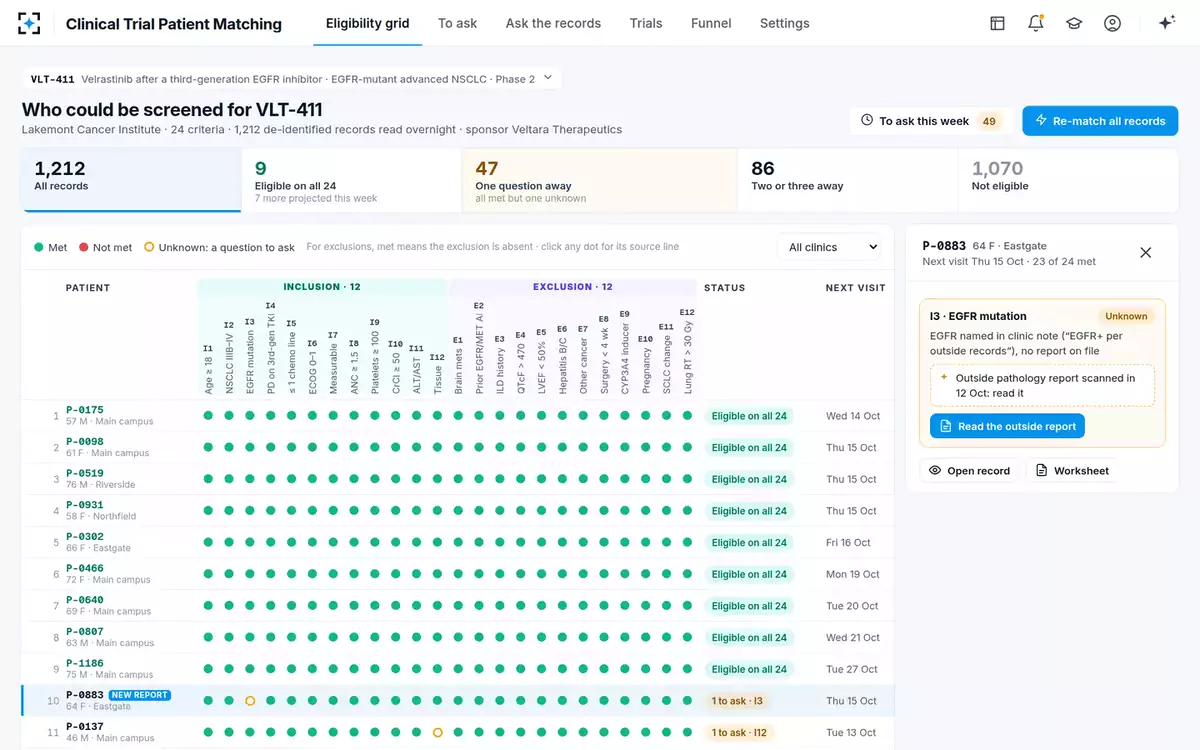
Nightly batch reading alone would have left her in the one-question-away band until the next morning, and a coordinator would have spent part of her day chasing a result that was already in the building. The same argument runs the other way for amendments: when a protocol changes, the criteria parser compares the amended text with the confirmed rules and holds every changed criterion until the investigator confirms it, rather than silently re-scoring a thousand patients against a rule nobody has approved.
There is a regulatory reading of the same point. ICH E6(R3) makes the investigator responsible for "the timely review of data, including relevant data from external sources that can have an impact on, for example, participant eligibility, treatment or safety (e.g., central laboratory data, centrally read imaging data, other institution's records …)" (ICH E6(R3), section 2.12.3). Another institution's records are named there explicitly. A scanned outside report sitting unread for a day is a small instance of exactly what that clause is about.
What the investigator's worksheet has to show before it can be signed
The output of the whole run is not the grid. It is one worksheet per patient the investigator is being asked to decide on, and the test of the design is whether he can check it faster than he could read the chart. Each worksheet carries, for every one of the 24 criteria: the criterion as written in the protocol, with its section number; the verdict; the line in the record that produced it; and the document and date that line came from. An unknown carries the question instead of a line, with who was asked and when the answer is due.
He then chooses between three outcomes — refer to screening, hold, or not eligible — and e-signs with a PIN and a note. On the sample morning the note read: approach at Thursday's visit, consent then screening labs. The decision, with his name on it, goes into the screening log; the sponsor's trial manager sees her site counts move and never sees the patient.
It is worth being plain about what the worksheet is not. It is a pre-screen. Eligibility is confirmed at the screening visit, after consent, under the protocol in force — and the boundary between the two is a regulatory line rather than a product one, which the difference between pre-screening and screening sets out in full. A deployment of a comparable system across 29 oncology trials reached the same conclusion from the opposite direction, its authors writing that the tool works "by enabling research teams to focus on qualified candidates rather than exhaustive chart reviews" (Gong et al., JCO Clinical Cancer Informatics, 2026). Focusing the people is the goal. Replacing their judgement is not.
Clinical Trial Patient Matching: one night, step by step, with what each step may never do
A person decides
The investigator, onceConfirms the 24 checks built from protocol v2.0 — field, rule, threshold, look-back window and which documents may answer it.
Never: Nothing is matched against a criterion the investigator has not confirmed
Agent
The record readerReads 48,216 documents behind 1,212 patients — clinic notes, labs, pathology and molecular reports, imaging and ECG reports, medication lists, scanned outside reports — and keeps each fact with the line, the document and its date.
Never: Never infers a value that is not written, and nothing is copied off site
Agent
The criterion checkerMarks 29,088 patient-by-criterion cells met, not met or unknown, each carrying the line that decides it.
Never: No source line, no verdict — and no evidence inside the window is unknown, never met
Agent
The question writerTurns 244 unknowns into 244 questions: what to ask, of whom, and at which visit or blood draw, read off the clinic schedule.
Never: Never contacts a patient — the coordinator asks, under the site’s own process
Agent
The rankerSorts patients by how close they are to eligible and projects how many become eligible once this week’s answers come back.
Never: Never decides eligibility; a projection is labelled a projection
A person decides
The coordinator, in the morningWorks the question list visit by visit, adds the tests to Thursday’s draws and asks pathology about the archival block.
Never: Nothing goes to a patient that the site’s pre-screening process does not already allow
A person decides
The investigator, at the endReads the worksheet — every criterion, its verdict, the line and its date — and decides: refer to screening, hold, or not eligible. He e-signs the decision into the screening log.
Never: No referral exists until he has signed it
Questions people ask
Can AI decide if a patient is eligible for a trial?
No, and a system built so that it could is the wrong system. Eligibility for a study is confirmed at the screening visit, after consent, by the investigator under the protocol. What AI can do beforehand is check each criterion against the record, cite the line that decides it, and name the ones it cannot answer. In the sample run that is 29,088 cited checks and 244 open questions — a draft for a clinician to confirm, not a determination.
Can AI contact a patient about a clinical trial?
Not in this design. The question writer produces the question and names who should ask it; the coordinator asks, under the site's own approved pre-screening process. Keeping first contact human is partly a governance matter and partly a practical one: the coordinator knows which patients have just had bad news, and no record says so.
How does AI know a lab result is too old?
Because the window is part of the check, not an afterthought. The criteria parser reads the look-back period out of the protocol along with the threshold and the units, so a criterion arrives as "ECOG 0 or 1, within 28 days" rather than "ECOG 0 or 1". The sample site also sets its own defaults for evidence the protocol leaves open: 14 days for blood count and chemistry, 90 days for an ECG. Outside the window the verdict is unknown, which is locked and cannot be configured away.
What should AI never do in trial screening?
Four things, in practice: give a verdict with no line in the record behind it; treat a missing fact as a negative; alter or round a threshold the protocol states; and initiate contact with a patient. The published evaluation that compared a model with study staff reached the fifth and largest one — that the process should "include safeguards such as final clinician review" — which in a site workflow means the investigator signs.
Who signs off a referral to screening?
The principal investigator, by name, on the worksheet. He confirms the rules built from the protocol before any matching happens, and then signs each decision — refer, hold or not eligible — into the screening log. Nothing in the run creates a referral without that signature, and the sponsor receives counts by site and week rather than any patient's details.
Does an asking system actually find more patients, or just more work?
It should find more and ask less, and the way to test that at your own site is to count both. On the sample night the 244 unknowns were not 244 new tasks: 49 were askable at visits and draws already booked, and the rest sat with a named owner and a due date rather than with the coordinator. The figure to watch over a quarter is eligible patients found per site, against what hand pre-screening found from the same records.