Pre-screening and screening in clinical trials are two reviews separated by one event: the patient signing a consent form. Pre-screening is the review that happens before it — a look at records a site already holds, to see who might qualify — and in the United States an IRB may approve it without consent under the Common Rule, on terms that keep every piece of patient information inside the covered entity. Screening is what happens after consent: the protocol's own assessments, fresh labs, the confirmatory reads, the eligibility decision. Botminds' Clinical Trial Patient Matching does only the first, and does it in place: records are read inside the site with identifiers removed, the sponsor is shown counts, and the investigator signs every referral. Most of the confusion at sites — including the loose use of the word de-identified — comes from treating the two reviews as one.
The site, study and patients on this page are fictional sample data: Lakemont Cancer Institute, running study VLT-411 under its own pre-screening procedure, SOP CR-014. The regulations are quoted from their current text and linked where they appear; they are United States rules, and a site outside the United States should read its own.
The two reviews, side by side
Pre-screening: Before anyone signs. The patient may not know the trial exists yet.
Screening: After consent, at a scheduled visit.
Pre-screening: An IRB-approved procedure — under 45 CFR 46.116(g) where the Common Rule applies — and, for records, a review preparatory to research under the Privacy Rule.
Screening: The signed consent form itself, and the protocol.
Pre-screening: Records that already exist: clinic notes, labs, pathology, imaging, ECG, medicines.
Screening: Protocol-specified assessments, performed because of the trial.
Pre-screening: That a patient might qualify, and what is still unknown.
Screening: That a patient is eligible, or is a screen failure.
Pre-screening: Nothing about an individual. Counts, yes.
Screening: Trial data under the consent the patient gave, as the protocol specifies.
Pre-screening: A pre-screening log, and a worksheet for each patient considered.
Screening: Case histories under 21 CFR 312.62(b), including the signed consent form.
Pre-screening: The investigator decides who is approached. Nobody is enrolled.
Screening: The investigator decides eligibility, against the protocol.
Do you need consent to pre-screen a patient?
Not necessarily — and under the 2018 Common Rule, usually not, if an IRB has approved the activity. The NIH's own human-subjects office states the boundary in two sentences: “Pre-screening happens before a person signs a consent form. Its purpose is to see if someone might qualify and is interested in the study.” Screening to determine further eligibility, it continues, happens after consent is obtained unless the IRB waives it.
That is the answer to the question as it is usually asked. It is not the whole answer, because two different bodies of law apply at once and they ask different things. The Common Rule governs the research; the Privacy Rule governs the health information. A site can satisfy one and breach the other, and the breach that is easiest to commit is the quiet one: a spreadsheet of candidate patients emailed to a sponsor's recruitment vendor.
There is also a harder operational question hiding behind the legal one. Pre-screening without consent is permitted; pre-screening every patient in the institution has never been feasible by hand, so the real constraint on who gets considered has not been the law. What the method can cover is set out in pre-screening patients for clinical trials.
45 CFR 46.116(g): what an IRB may approve without consent
The 2018 revision of the Common Rule added a paragraph specifically for this activity. An IRB may approve a proposal in which an investigator obtains information “for the purpose of screening, recruiting, or determining the eligibility of prospective subjects without the informed consent of the prospective subject”, on one of two conditions: the investigator obtains the information by talking to the patient, or the investigator “will obtain identifiable private information or identifiable biospecimens by accessing records or stored identifiable biospecimens.”
Three things follow from the wording, and sites trip on all three. First, the permission is the IRB's, not the investigator's: there has to be an approval, describing the activity and its instruments. Second, it covers screening, recruiting and eligibility determination — not the trial. Third, it says nothing at all about privacy; it removes the consent requirement for the research, and leaves the health information to be handled under its own rule.
A drug study run under an IND, like the sample one, is also governed by the FDA's own human-subject rules in 21 CFR parts 50 and 56, and the Common Rule applies to it only where the research is federally funded or the institution has extended the Common Rule to all its studies. The FDA's position on screening is set out in its information sheet on screening tests prior to study enrollment: procedures done as part of ordinary medical care may be done, and their results later used to judge eligibility, without first obtaining consent, while any clinical screening procedure done only to decide research eligibility needs consent first. A records review that orders nothing and touches no patient sits on the first side of that line, and the IRB still has to approve how it is done.
Protocols approved under the pre-2018 Common Rule sit differently: for those, pre-screening before consent needs either consent as the IRB approved it, or an IRB-approved waiver. A site running studies of both vintages has two answers on the same corridor, which is exactly the kind of detail a written procedure exists to settle.
HIPAA's reviews preparatory to research, and the sentence that matters
On the privacy side, a covered entity may let a researcher look at protected health information without authorisation for a review preparatory to research. The provision is short, and one clause in it does most of the work at a trial site.
“No protected health information is to be removed from the covered entity by the researcher in the course of the review.”
45 CFR 164.512(i)(1)(ii)(B), HIPAA Privacy Rule
Read the three representations together. The use must be “sought solely to review protected health information as necessary to prepare a research protocol or for similar purposes preparatory to research”; nothing may be removed; and the information sought must be necessary for the research purposes. The second is the one that decides architecture. A pre-screening method that copies charts out to someone else's environment to be read there is hard to square with that representation, whatever it is called in the contract — and is a question for the privacy office before it is a question for IT.
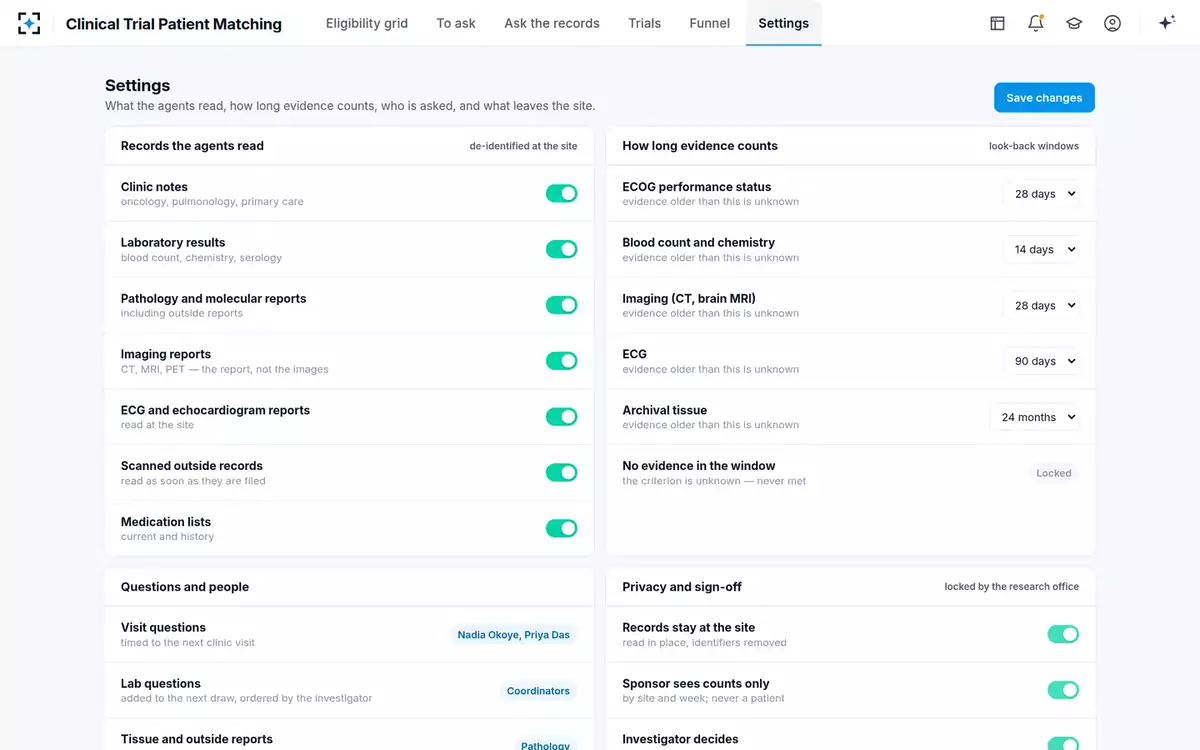
This is why the sample site's privacy settings are locked by its clinical research office rather than left to each study: records are read in place with identifiers removed, nothing is copied off site, the sponsor sees counts only, and no agent ever contacts a patient. Those are not product preferences. They are the four representations above, written as settings so that the next protocol inherits them.
The rules the research office locks, not the study team
What is the difference between de-identified data and a limited data set?
They are two different objects under the Privacy Rule, and the practical difference for a trial site is dates. De-identified information under the safe harbour has eighteen categories of identifier removed, and one of them is dates: every element of a date tied to the individual except the year — birth, admission, discharge, death — has to go. Once de-identified, it is no longer protected health information at all. A limited data set excludes sixteen categories of direct identifier — and dates are not among them, so it keeps them, and it remains protected health information used under a data use agreement.
The safe harbour's eighteen against the limited data set's sixteen
| Identifier | Safe-harbour de-identification, 164.514(b)(2)(i) | Limited data set, 164.514(e)(2) |
|---|---|---|
| Names | Removed | Excluded |
| Geography below State level — street, city, county, precinct, zip | Removed, except the first three digits of a zip code in an area of more than 20,000 people | Town or city, State and zip code may stay; the street address may not |
| Dates tied to the individual — birth, admission, discharge, death | Removed. Only the year may remain | May stay, in full |
| Ages over 89 | Removed, or banded as 90 or older | May stay |
| Telephone and fax numbers | Removed | Excluded |
| Email addresses | Removed | Excluded |
| Social security numbers | Removed | Excluded |
| Medical record numbers | Removed | Excluded |
| Health plan beneficiary numbers | Removed | Excluded |
| Account numbers | Removed | Excluded |
| Certificate and licence numbers | Removed | Excluded |
| Vehicle identifiers and plate numbers | Removed | Excluded |
| Device identifiers and serial numbers | Removed | Excluded |
| Web addresses and IP addresses | Removed | Excluded |
| Biometric identifiers, including finger and voice prints | Removed | Excluded |
| Full face photographs and comparable images | Removed | Excluded |
| Any other unique identifying number, characteristic or code | Removed | Not listed — a study identifier may stay |
| What it is called | De-identified: outside the Privacy Rule altogether | Still protected health information, used under a data use agreement |
The expert determination route at 164.514(b)(1) is the other way to de-identify, and it does not work from a fixed list; a qualified person judges that the risk of identification is very small and documents the method. It is a real option for a research data warehouse. It is not a plausible route for a pre-screening file that has to be matched back to a named patient the same afternoon.
Dates are the trap: why a 28-day window and safe-harbour de-identification pull apart
Here is the contradiction almost every site's SOP contains. Eligibility criteria are written in days. The sample protocol asks for a performance status within 28 days of screening, blood counts within 14, an ECG within 90. Every one of those tests is arithmetic on a date tied to an individual — which safe-harbour de-identification removes. A genuinely de-identified record cannot answer a look-back window at all. If your pre-screening file can tell you that an ECOG of 1 was recorded on 19 May and is therefore out of window, that file keeps dates, and it is not de-identified under the safe harbour.
Nothing is wrong with that; the mistake is only in the word. The correct descriptions are available and precise: the records are read in place with direct identifiers removed, or the file is a limited data set used under a data use agreement. Both are honest. “De-identified” used loosely in an SOP is the sentence an auditor will ask you to defend, and you will not be able to, because the dates are right there on the screen.
The same slip has a practical cost beyond the audit. A team that believes its pre-screening file is de-identified will treat it as outside the Privacy Rule and feel free to move it — to a shared drive, a laptop, a sponsor's portal — which is precisely what the preparatory-to-research representation forbids. The word is doing work the law never gave it.
One patient, records review to randomisation, with the rule behind each step
- Records read in place164.512(i)
- Criteria checked, unknowns listedIRB-approved
- Worksheet; investigator decides46.116(g)
- Coordinator approaches at a visitSOP CR-014
- Consent signed21 CFR 50
- Screening visit and assessmentsThe protocol
- Eligibility confirmed; randomisation312.62(b)
Who may contact the patient, and who may not
The permission to review records is not a permission to telephone people. In practice the safest rule, and the one the sample site writes into SOP CR-014, is that the approach comes from someone already in the patient's care — the treating clinician, or the research coordinator attached to that clinic — at a visit that was going to happen anyway. The pre-screening work produces a list and a reason; a person makes the approach.
From a list to a conversation: who does each step
Agent
Record readerReads the existing records at the site and keeps each fact with its line and date
Never: Copies anything off site
Agent
Criterion checkerMarks each criterion met, not met or unknown with the line that decides it
Never: Decides eligibility
Agent
Question writerTurns each unknown into one question, timed to a visit or a draw
Never: Contacts a patient
A person decides
Principal investigatorReviews the worksheet and decides: refer to screening, hold, or not eligible — then e-signs
A person decides
Research coordinatorApproaches the patient at the next visit, under the site’s IRB-approved procedure
A person decides
The patientDecides whether to consent. Everything the protocol specifies starts here
Two details are worth settling in writing. First, who tells the treating clinician: most physicians object less to a trial being offered than to hearing about it from the patient. Second, what happens to a patient who declines — the log records that the approach was made, and the next protocol's pre-screen should know not to repeat it the same month.
What the pre-screening log has to show
A pre-screening log is a record of a decision process, and two different rulebooks expect it to exist. ICH E6(R3), adopted by ICH in January 2025, lists among the records a trial must keep one that “Documents the recruitment, pre-trial screening and consenting process of trial participants and their identity and chronological enrolment as appropriate”. On the United States regulatory side, 21 CFR 312.62(b) requires an investigator to “prepare and maintain adequate and accurate case histories that record all observations and other data pertinent to the investigation” for each person administered the investigational drug or used as a control — which begins once someone is in the trial, and reads backwards into how they got there.
The FDA's own inspection metrics show what happens when those records are thin. Among the most common observations on Form FDA 483s issued to clinical investigators, reported in its Bioresearch Monitoring metrics for fiscal year 2023, are “Inadequate and/or inaccurate case history records; inadequate study records” and “Inadequate subject protection; informed consent issues”, alongside failures to follow the investigational plan. Those are the categories, not a count, and they are a reasonable list of what to keep tidy.
What the sample site's pre-screening log holds for each patient considered
| Field | Why it is there | Example |
|---|---|---|
| Study and protocol version | A criterion changed by an amendment changes the verdict | VLT-411, protocol v2.0 |
| Site identifier for the patient | Links back to the chart without a name in the log | P-0883 |
| Date considered | Shows the review happened before the approach | 13 October |
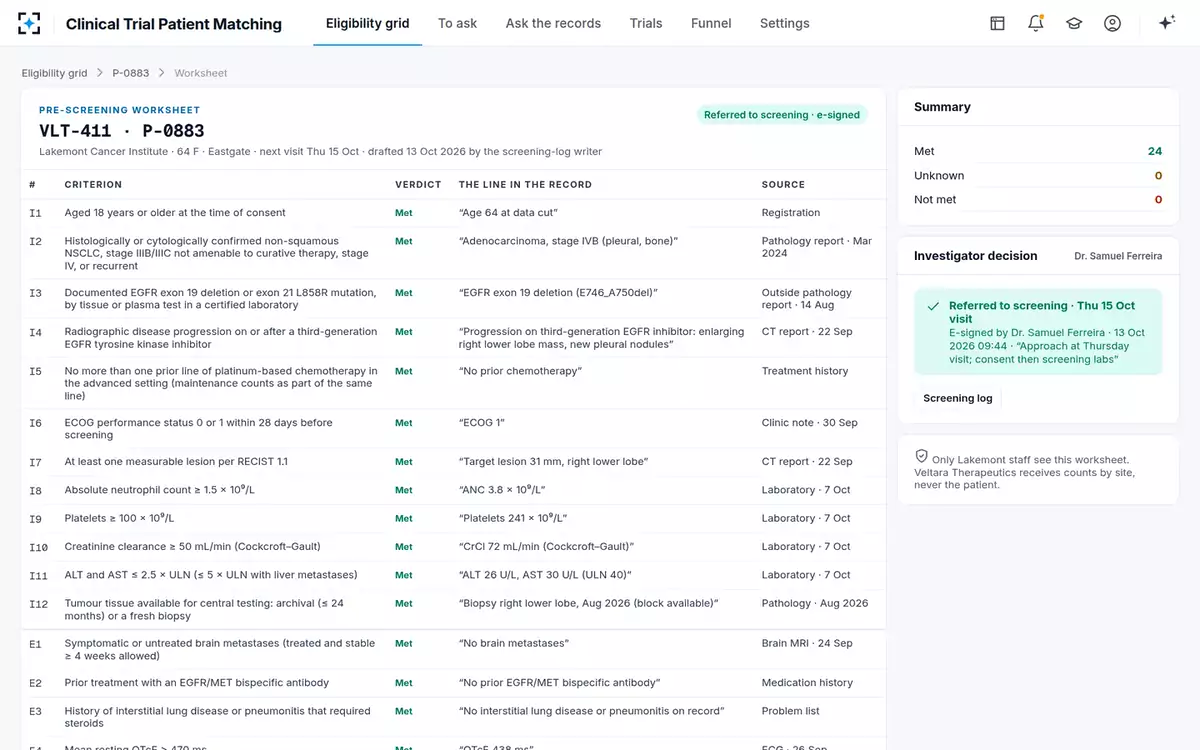
| Outcome of the review | Three outcomes, not two: eligible so far, one or more questions open, not eligible | Met on 23 of 24; I3 open |
| The criterion that closed it, where not eligible | So the next protocol does not re-read the same chart to the same answer | n/a |
| Decision and who made it | The investigator’s, with an electronic signature | Refer to screening — e-signed 09:44 |
| What was said to the patient, and when | Approach, decline and consent all belong to the same trail | Approached at visit, Thu 15 Oct |
What the sponsor may see, and what it may not
A sponsor needs to know whether a site has patients. It does not need to know who they are, and under the preparatory-to-research representation it cannot be given that even if it asks. The clean split is counts by site and by week: records read, eligible, one question away, referred. That is enough for a sponsor's trial manager to decide where to put a monitoring visit or a second site, and it carries nothing about an individual.
On the sample study, the sponsor's trial manager watches six sites on exactly that feed, and the site keeps the worksheets. A sponsor asking for patient-level pre-screening data is asking a site to make a disclosure it has no basis for; the honest reply names the basis the site does have, and offers the counts.
What the site keeps: the worksheet, with the decision on it
Writing it into your own SOP: eight decisions
Most of what is above becomes practice only when a site has decided it in advance and written it down. These are the eight decisions the sample site's SOP CR-014 settles before the first chart is read; the answers below are that site's, and yours are for your IRB and your privacy office to approve.
Eight decisions a pre-screening procedure has to settle
- Which approval covers the review
The IRB approval under 46.116(g), named by number, and whether the protocol predates the 2018 Common Rule.
- Where the records are read
Inside the covered entity, with the representation at 164.512(i)(1)(ii)(B) written into the procedure, not assumed.
- What the file actually is
A limited data set under a data use agreement, or records read in place with identifiers removed. Not the word de-identified, unless dates are gone.
- Which record sources are in scope
Name them. At the sample site, seven: notes, labs, pathology and molecular, imaging, ECG and echocardiogram, scanned outside records, medicines.
- How long each kind of evidence counts
The look-back windows, and the rule that no evidence inside the window is unknown rather than met.
- Who approaches the patient, and how
A named role, at a visit that was already scheduled, with the treating clinician informed first.
- What the log records, including declines
Three outcomes, the deciding criterion, the decision and who made it, and what was said to the patient.
- What the sponsor receives
Counts by site and week. Write the sentence now, so nobody negotiates it under enrolment pressure later.
Vendors should be asked the same eight questions, in the same order, and the second and third are the ones that separate methods. What else to ask is set out in clinical trial matching software: how to tell matching from a filter. To see records read in place, each criterion beside its line, start from Clinical Trial Patient Matching.
Questions people ask
Can you review medical records for a clinical trial without consent?
In the United States, yes, with two permissions in place: an IRB-approved pre-screening procedure (under 45 CFR 46.116(g) where the Common Rule applies, alongside the FDA's own rules for a drug or device study) and, on the privacy side, a review preparatory to research under 45 CFR 164.512(i), which requires the covered entity to obtain representations that nothing is removed from it during the review. Protocols approved under the pre-2018 Common Rule need consent or an IRB-approved waiver instead.
What is the HIPAA preparatory to research exception?
It lets a covered entity give a researcher access to protected health information to prepare a protocol or for similar preparatory purposes, without patient authorisation, on three representations: that the access is sought solely for that review, that no protected health information will be removed from the covered entity during it, and that the information is necessary for the research. It is permission to look, not permission to take.
Can a researcher take patient data off site for recruitment?
Not under the preparatory-to-research provision, whose second representation says in terms that no protected health information is to be removed from the covered entity in the course of the review. Moving candidate lists to a sponsor, a recruitment vendor or a personal drive needs a different basis — patient authorisation, a waiver, or a limited data set under a data use agreement — and each of those has to be approved before the file moves, not after.
Who may contact a potential participant about a trial?
The site's own approved procedure decides, and many IRBs expect the first approach to come from someone already involved in the patient's care, or from study staff with the treating clinician's knowledge, at a scheduled visit. At the sample site no automated step ever contacts a patient: the coordinator does, under SOP CR-014, after the investigator has decided from the worksheet.
What must a pre-screening log record?
Enough to show who was considered, when, on what basis and with what outcome. ICH E6(R3) expects records that document the recruitment, pre-trial screening and consenting process and the participants' chronological enrolment. The field most logs are missing is the third outcome: a patient whose chart was silent on a criterion is not the same as a patient who failed it.
Does the sponsor see who was pre-screened?
It should not. Counts by site and week — records read, eligible, one question away, referred — tell a sponsor what it needs for enrolment planning and carry nothing about an individual. On the sample study the sponsor's trial manager sees exactly that for six sites, and the worksheets stay with the site that wrote them.