Clinical research coordinator workload is the time research staff spend running a site's studies, and the part a research office measures least is pre-screening: finding patients who might fit an open trial, proving each criterion against the chart, and working out which unknowns to ask about. Workload tools such as ASCO's count patient encounters and protocol acuity, but pre-screening happens before there is an enrolled patient to count, so it hides inside "coordinator time" while it decides whether a study enrols at all. Across four open trials it can mean a hundred criteria against every candidate chart. Botminds' Clinical Trial Patient Matching reads the site's records overnight against each protocol, shows every criterion as met, not met or unknown with the line that proves it, and turns each unknown into a question, leaving the asking to coordinators and the decision to investigators.
The guide is written for directors of clinical research offices, cancer centre research leadership and site managers who set coordinator caseloads. The worked example is a fictional site, Lakemont Cancer Institute, with four open lung trials; research figures come from peer-reviewed studies linked where they appear.
What published matching implementations measured in coordinator time
10×
less chart-review workload at one cancer centre after a semi-automated matching system went live
41%
less screening time a chart (3.1 to 1.8 minutes) for patients who still went to review
42.6%
less screening time in a user study of a large language model matching system
How is clinical research coordinator workload measured?
Most research offices measure it by patients on study, and the better ones by acuity: how demanding each protocol is per patient. The ASCO Clinical Trial Workload Assessment Tool was built for exactly this question, which its authors put plainly: research program managers are "regularly faced with the quandary of determining how much of a workload research staff members can manage while they balance clinical practice and still achieve clinical trial accrual goals" (Good et al., J Oncol Pract 2016).
Tested across 51 community research programs in 30 states, the tool showed acuity was highest for staff with patients on treatment, higher on treatment trials than on prevention or registry studies, and higher on industry trials than on NIH or NCI trials. Its conclusion was that "trial-specific acuity measurement is a better measure of workload than simply counting the number of patients".
What these tools do not capture well is the work before enrolment. Pre-screening has no patient encounter to log and no enrolled participant to weight; it is chart reading, list building and questions. A site can therefore look adequately staffed on acuity while its coordinators spend days a month on searches that produce one or two referrals, and the research office has no number to show it.
Where pre-screening hours go: finding, proving and asking
Pre-screening divides into three jobs. Finding is deciding which patients to look at. Proving is opening each chart and checking each criterion against what is written. Asking is working out what is missing and who can settle it, before the patient's next visit. Proving takes most of the time and is the most mechanical; asking takes the least time and carries most of the judgement.
One open study's pre-screening month at the sample site, by hand and from a checked grid
- Reading the lists and new-patient notes1.5 d
- Checking each chart against every criterion2 d
- Finding results in scanned outside reports1 d
- Working out what is missing and when to ask0.5 d
- Worksheets, the log and sponsor counts1 d
- Lists · 0.1 d
- Charts · 0.3 d
- Outside reports · 0.1 d
- What is missing · 0.2 d
- Worksheets and log · 0.2 d
Multiply by a portfolio. If one open study costs about six coordinator days a month in pre-screening by hand, four studies cost more than a coordinator's month before any visit, sample or case report form. In practice the arithmetic is never done; coordinators triage, screening most carefully for the study they know best, and that triage becomes the site's sampling rule without anyone choosing it.
Four open trials, a hundred criteria: why the portfolio drives the hours
Pre-screening workload scales with the number of open studies and the number of criteria in each, not with the number of patients enrolled. A site's portfolio decision is therefore a staffing decision, though it is rarely made as one.
Four open studies on one coordinator's desk, and where each one's deciding answers live
| Study | What it needs | Criteria | Where the deciding answers live |
|---|---|---|---|
| A post-inhibitor study (VLT-411) | Progression on a third-generation inhibitor, with a documented driver mutation | 24 | A molecular report, often from outside; an imaging report that says progression rather than toxicity |
| A first-line combination study | Newly diagnosed patients before any systemic treatment, a window of days | 31 | The new-patient note and staging scan, read within a day of clinic |
| A maintenance study | Patients finishing induction with organ function in range | 19 | Laboratory results inside a 14-day window, re-checked each cycle |
| An early-phase expansion study | A narrow molecular subgroup with prior lines specified exactly | 27 | The molecular report, the full treatment history and a recent cardiac assessment |
The second row shows why weekly list reading fails some studies outright: a criterion with a window measured in days cannot be met by a review that happens once a week. The fourth shows why outside reports matter: the deciding result is often in a scanned document a structured query cannot read. How each kind of criterion is found in a record is set out in where each pre-screening answer lives.
What does pre-screening yield per coordinator hour?
Less than most sites assume, and the published funnel shows why. In a pooled analysis of 13 studies and 8,883 cancer patients, no trial was available at the patient's own institution 55.6% of the time; 21.5% were ineligible for an available trial, 14.8% did not enrol, and 8.1% enrolled (Unger et al., JNCI 2019).
Where cancer patients fall out before enrolment, pooled across 13 studies
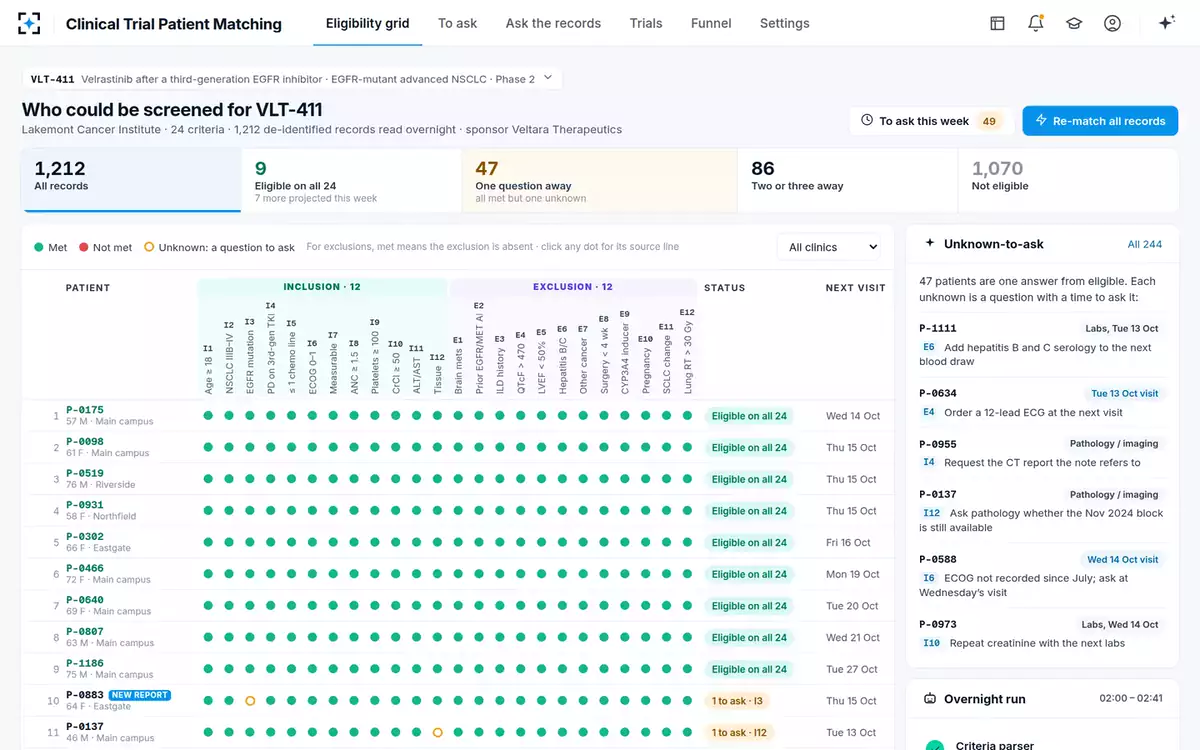
For a research office the useful reading is the middle two bars. Ineligibility is partly real and partly a recording problem: a criterion the chart does not mention is treated as a no, and the patient is never asked. At the sample site, last quarter's hand pre-screening found 5 eligible patients for VLT-411. An overnight read of 1,212 de-identified records from the main campus and three satellite clinics found 9 eligible on all 24 criteria, 47 one question away and 86 two or three away. The difference is not better patients; it is records nobody had time to read, and unknowns nobody turned into questions.
The morning grid: every candidate against all 24 criteria, already checked
The rules that bound pre-screening at a covered entity
Pre-screening uses protected health information before anyone has consented, so it runs inside HIPAA's research provisions and the protocol's own description of pre-screening. A research office that staffs it needs the governance as clearly as the hours.
Under HIPAA, a covered entity may let researchers review protected health information "preparatory to research" if it obtains representations that the use "is sought solely to review protected health information as necessary to prepare a research protocol or for similar purposes preparatory to research", that no protected health information "is to be removed from the covered entity by the researcher in the course of the review", and that the information "is necessary for the research purposes" (45 CFR 164.512(i)(1)(ii)). The alternative route is an IRB or privacy board waiver or alteration of authorisation under 164.512(i)(1)(i). Which route a site uses for recruitment, and how contact with patients is handled, is its own and its IRB's decision.
ICH E6(R3) adds two documentary anchors. The protocol should describe the "mechanism for pre-screening, where appropriate, and screening of participants" (Appendix B.5.3), and a completed participant screening log appears among the essential records in Appendix C. Section 2.2.2 asks the investigator to have "sufficient time, an adequate number of available and qualified staff, and adequate facilities", a staffing duty that pre-screening hours count against. Where pre-screening ends and consent-based screening begins is worked through in pre-screening and screening.
The screening log as a workload instrument
A screening log is usually kept for the sponsor's counts, but it is also the research office's best evidence about where coordinator time goes. Read for reasons rather than totals, it shows how many charts were opened per eligible patient, how many were set aside as "not eligible" because a value was missing, and which clinics were never reviewed.
“Half my ‘not eligible’ are really ‘nobody wrote it down’.”
A senior research coordinator at the fictional sample site
That claim is testable. A quarterly re-count of the log, which samples "not eligible" entries and checks whether the deciding criterion was failed or simply undocumented, tells the office whether it is half, a third or less. Each undocumented no is a patient who was not asked and a coordinator hour that bought nothing. The method for that re-count, and what it typically finds, is in missing data in electronic health records.
Workload, turnover and the research office's capacity
Turnover is the cost that makes pre-screening workload a leadership problem rather than a desk problem, because a departing coordinator takes the site's working knowledge of several protocols with them. The evidence on why coordinators leave points at management as much as at hours.
A survey of 85 current and former coordinators found that "adequate salary, greater respect, collaboration, and engagement from the PI were significantly associated with higher retention", while, in the authors' word, "surprisingly, greater workload and lack of opportunity for professional growth were not associated with retention" (Mayo Clinic Proceedings: Innovations, Quality & Outcomes). The finding cuts against the easy argument that cutting hours will by itself keep staff. A better reading for a research office is that the work coordinators value (collaboration with an engaged investigator on real candidates) is the work pre-screening by hand crowds out.
Seven pre-screening measures a research office should report monthly
- Coordinator days on pre-screening, by study.
Logged separately from visits, samples and data entry, so it can be weighed against acuity.
- Charts opened per eligible patient found.
The yield of each hour; falls when finding and proving improve.
- Share of “not eligible” that were undocumented, not failed.
From a quarterly sample of the screening log.
- Unknowns turned into questions, and how many were answered before the visit.
The asking job, measured.
- Candidates and referrals by clinic, including satellites.
Shows which patients were never reviewed.
- Time from a patient becoming eligible to referral.
Critical for criteria with windows measured in days.
- Referrals accepted by the investigator, and screen-fail reasons after consent.
Tests whether pre-screening is finding the right patients.
Where Clinical Trial Patient Matching fits in coordinator workload
Clinical Trial Patient Matching does the finding and the proving. Each night it reads the site's records (clinic notes, outside reports, laboratory results and imaging) in place with identifiers removed, checks every patient against every criterion of each open protocol, and shows each criterion as met, not met or unknown with the line in the record that proves it. Each unknown becomes one question, with when and whom to ask, timed to the patient's next visit.
From records read to referrals, by clinic and against hand screening
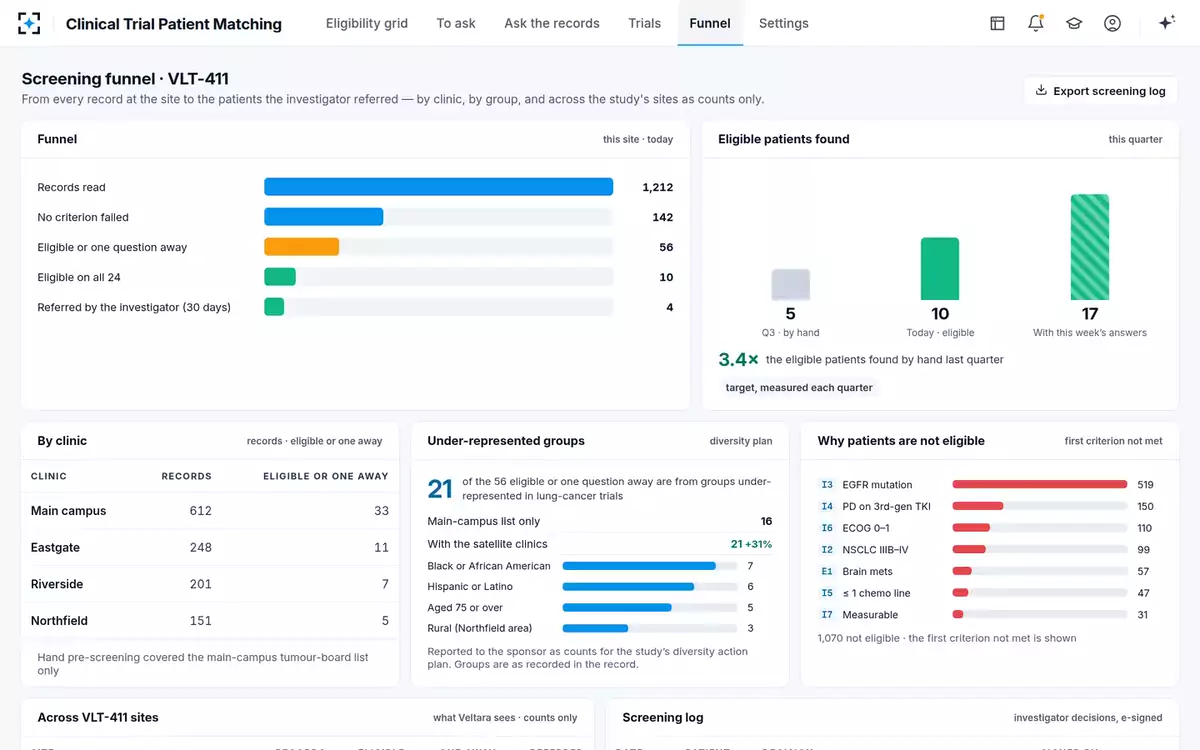
It does not decide eligibility or refer anyone. The coordinator asks the questions; the investigator decides who is referred and e-signs each decision, which is kept in the screening log; eligibility is confirmed at the screening visit after consent. Records stay at the site, privacy settings are locked by the clinical research office, and the sponsor sees counts only. What it changes for the research office is the shape of coordinator time: fewer days reading charts, more time on the conversations with patients and investigators that only a person can have. How a site starts on its first protocol is set out in the first protocol, week by week.
Questions people ask
What is the ASCO clinical trial workload assessment tool?
It is a tool for research programs to record monthly, trial-specific workload as staff acuity scores and patient encounters. Tested in 51 community research programs in 30 states, it found acuity was a better measure of workload than counting patients, with treatment and industry trials carrying the highest acuity. It does not separately capture pre-screening before enrolment.
How many trials can one clinical research coordinator manage?
There is no standard number, which is why acuity tools exist: a coordinator with patients on treatment in industry trials carries more work than one with patients in follow-up. Pre-screening adds load per open study and per criterion, so four open trials with about a hundred criteria between them can consume several coordinator days a month before any visit.
Can coordinators review medical records before consent to pre-screen?
Under HIPAA, a covered entity may allow review preparatory to research with representations that the review is necessary, that no protected health information leaves the entity, and that it is solely preparatory; or it may rely on an IRB or privacy board waiver. The protocol should describe the pre-screening mechanism, and the site's IRB sets how patients are approached.
What should a pre-screening log record?
Each patient reviewed, the study, the date, the outcome and the reason, distinguishing a criterion failed from one not documented. ICH E6(R3) lists a completed participant screening log among essential records. Read for reasons, the log is also the research office's best evidence of pre-screening yield and coordinator time.
Does AI pre-screening reduce coordinator workload?
Published implementations report it reduces chart-review time: one cancer centre reported a tenfold cut in chart-review workload and 41% less time per chart reviewed, and a user study of a language-model system reported 42.6% less screening time. Neither measures enrolment, and both leave the eligibility decision with people.
Does coordinator workload drive turnover at research sites?
Not on its own, in the published evidence. In a survey of 85 coordinators, retention was associated with adequate pay, respect, collaboration and engagement from the principal investigator, while workload itself was not significantly associated. For a research office that suggests protecting time for investigator collaboration matters as much as reducing hours.