The legal entity customer definition in FinCEN's customer due diligence rule reads: "a corporation, limited liability company, or other entity that is created by the filing of a public document with a Secretary of State or similar office, a general partnership, and any similar entity formed under the laws of a foreign jurisdiction that opens an account" (31 CFR 1010.230(e)(1)). A business inside that definition owes the bank its beneficial owners, every individual with 25% or more and one controller, identified and verified at opening. Sixteen kinds of entity are excluded outright, nonprofits and some pooled investment vehicles owe only the controller, and sole proprietorships and unincorporated associations are outside the definition even when they file a trade name. Botminds' Business Account Opening (KYB) is built for community and regional banks: the bank's document rules by entity type are settings, so the banker classifies once, the agents check the packet against the duties that class carries, and anything unusual goes to the BSA officer.
This guide is for the BSA officer who writes the classification policy, the business banker who applies it and the tester who samples it. Rule text is quoted from the eCFR and FinCEN as of November 2026; examples use fictional customers of a fictional community bank.
Classify before you collect: five questions, in order
| Question | If yes | If no |
|---|---|---|
| 1. Is the customer one of the 16 excluded types, such as a regulated bank, an SEC-registered issuer or a state-regulated insurer? | No beneficial owners to identify | Go to 2 |
| 2. Was it created by a public filing with a state office, or is it a general partnership or a foreign equivalent? | Legal entity customer: go to 3 | Not a legal entity customer: identify the individuals under CIP (sole proprietor, unincorporated association) |
| 3. Is it a nonprofit corporation that filed with the state, or a pooled vehicle run by a non-excluded financial institution? | Control prong only: one controller | Go to 4 |
| 4. Is the account one of the exempt kinds, such as point-of-sale retail credit up to $50,000 or premium finance? | No beneficial owners for this account, within the exemption's limits | Go to 5 |
| 5. Has the bank already verified this customer's owners, with nothing calling them into question? | It may rely on them under the February 2026 relief order | Identify and verify every 25% owner and one controller |
What counts as a legal entity customer, and what does it owe?
It is a business that exists as a separate legal person because someone filed a public document to create it, plus general partnerships and their foreign equivalents, at the moment it opens an account. Corporations and LLCs are the core cases: an LLC is created by filing articles of organization, so it is a legal entity customer from its first day. The definition also reaches limited partnerships, business trusts created by a state filing and similar foreign entities.
FinCEN explained the test when it wrote the rule. The definition covers entities that can act as "a shield permitting an individual to obscure his or her identity," and the duty to name owners exists to see through that shield (81 FR 29398, May 11, 2016). A business with no separate legal existence has no shield to see through, which is why the definition stops where it does.
For a legal entity customer the bank owes two prongs. The ownership prong names "Each individual, if any, who, directly or indirectly, through any contract, arrangement, understanding, relationship or otherwise, owns 25 percent or more of the equity interests." The control prong names "A single individual with significant responsibility to control, manage, or direct" the entity (31 CFR 1010.230(d)). The rule's own note does the arithmetic: up to four owners and one controller, and the same person may appear in both.
The numbers the definition turns on
16
kinds of entity excluded from the definition outright
2
kinds that owe only the control prong: certain nonprofits and pooled investment vehicles
~75%
of businesses filing tax returns are sole proprietorships, outside the definition
Which entities are excluded from the legal entity customer definition?
Sixteen kinds, almost all of them already supervised or already transparent about their owners. A bank opening an account for one of them identifies the entity under its CIP but names no beneficial owners. The exclusions also cut ownership chains: if an excluded entity owns 25% or more of a customer, "no individual need be identified" for that stake.
The exclusions, grouped by why they are there
| Group | Excluded types | What the bank keeps on file |
|---|---|---|
| Regulated financial firms | Banks and federally regulated financial institutions; registered investment companies and advisers; registered exchanges, clearing agencies and other SEC registrants; CFTC registrants; bank holding companies and savings and loan holding companies; state-regulated insurers | Evidence of the registration or regulator |
| Public companies | Issuers registered under section 12 of the Exchange Act or reporting under section 15(d); companies listed on the NYSE, the American Stock Exchange or the NASDAQ National Market, and their US subsidiaries at least 51% owned by them | The listing or reporting status, and the ownership link for a subsidiary |
| Government | US federal, state and local departments and agencies, and entities exercising governmental authority; foreign governmental bodies acting only in a governmental capacity | The governmental status relied on |
| Others already transparent | Registered public accounting firms; designated financial market utilities; foreign financial institutions whose regulator keeps owner information; pooled vehicles run by an excluded institution; private banking accounts covered by 31 CFR 1010.620 | The basis for the exclusion |
The practical risk with exclusions is the claim, not the rule. A customer that says it is a subsidiary of a listed company, or a registered adviser, is asking the bank to skip the owners. The file should show the evidence the bank relied on, such as the registration number or the listing. A subsidiary is excluded in its own right only if it fits a listed type, such as a US subsidiary at least 51% owned by a listed company; otherwise the parent's status cuts the chain for the parent's stake and leaves the subsidiary a legal entity customer.
Nonprofits and pooled vehicles: the control prong only
A nonprofit corporation owes a controller but no owners. The rule places "Any legal entity that is established as a nonprofit corporation or similar entity and has filed its organizational documents with the appropriate State authority as necessary" under the control prong only, alongside pooled investment vehicles operated or advised by a financial institution that is not itself excluded (31 CFR 1010.230(e)(3)).
FinCEN described how a nonprofit shows that it qualifies: "by providing a certified copy of its certificate of incorporation or a certificate of good standing from the appropriate State authority." It added that the controller is often already known to the bank as a signatory. An unincorporated club or association that never filed with the state is outside the definition altogether, and the bank identifies the individuals who open the account.
Sole proprietors and DBAs: outside the definition
A sole proprietorship is not a legal entity customer, even when it files a trade name. FinCEN said so in the rule's preamble: the definition "would not include, for example, sole proprietorships or unincorporated associations even though such businesses may file with the Secretary of State in order to, for example, register a trade name or establish a tax account," because neither "is an entity with legal existence separate from the associated individual or individuals" (81 FR 29398).
The bank therefore opens a sole proprietor's business account on the individual's CIP, with the trade name as a second name on the account and the assumed-name filing as the link between the name on the checks and the person. The classification error that matters here runs the other way: a business presented as a sole proprietorship that is in fact an LLC. If the application gives a name ending in LLC, or the state search finds an entity under the trade name, the business is a legal entity customer and owes its owners.
LLCs: single-member, multi-member and the 25% line
Every LLC is a legal entity customer; what varies is who goes on the certification. A single-member LLC always names its member, or looks through a member that is itself a company. A multi-member LLC names each member at 25% or more, and the line is inclusive, so a member at exactly 25% is named.
Single-member and multi-member LLCs at the bank
Single-member LLC: Yes: created by filing articles
Multi-member LLC: Yes: same test
Single-member LLC: The one member at 100%, or the individuals behind a company member
Multi-member LLC: Each member at 25% or more, up to four
Single-member LLC: One individual, usually the member or a manager
Multi-member LLC: One individual, such as the managing member
Single-member LLC: EIN, or the member's SSN if disregarded with none; bank policy decides
Multi-member LLC: EIN: a partnership for tax by default
Single-member LLC: A company member nobody looks through
Multi-member LLC: A member at exactly 25% left off the certification
Tax status confuses classification more than it should. The IRS treats a single-member LLC, by default, as "an entity disregarded as separate from its owner" for income tax (IRS, Single member limited liability companies). For the bank it is still a separate legal entity created by a state filing, so it is still a legal entity customer. Being disregarded for income tax does not make an LLC disregarded for the CDD rule.
The sample bank's hardest LLC case was an ordinary one. The operating agreement listed members at 40%, 35% and 25%; the certification named two. The third member was a required owner and the only document that said so was section 3.1 of the agreement, which is why KYB documents should be read against each other, not one at a time.
Trusts and indirect ownership: whom to name for a layered stake
Where a trust owns 25% or more of a legal entity customer, the person named for that stake is the trustee, not the beneficiaries: "the beneficial owner for purposes of paragraph (d)(1) of this section shall mean the trustee" (31 CFR 1010.230(d)(3)). Where the trustee is itself a company, the bank's procedures decide how far to look; the sample bank sends every trust-owned company to its BSA officer.
Indirect ownership has no US formula, but the common method is to multiply through the chain. The European Union wrote that method into law in its Anti-Money Laundering Regulation, applying from 10 July 2027: indirect ownership "shall be calculated by multiplying the shares or voting rights or other ownership interests held by the intermediate entities in the chain" and adding the chains together (Regulation (EU) 2024/1624, Art. 52). For a US bank it is a defensible method, not a requirement.
Three structures, and who goes on the certification
| Structure | Arithmetic | Named for ownership |
|---|---|---|
| Members A 40%, B 35%, C 25% | Direct holdings | A, B and C: 25% is at the line |
| A 60%; Holding Co 40%, owned by D 70% and E 30% | D: 70% × 40% = 28%; E: 30% × 40% = 12% | A and D; E is under 25% indirectly |
| A 50%; Family Trust 50%, trustee T | The trust holds 50% | A, and T as trustee; the beneficiaries are not named for the trust's stake |
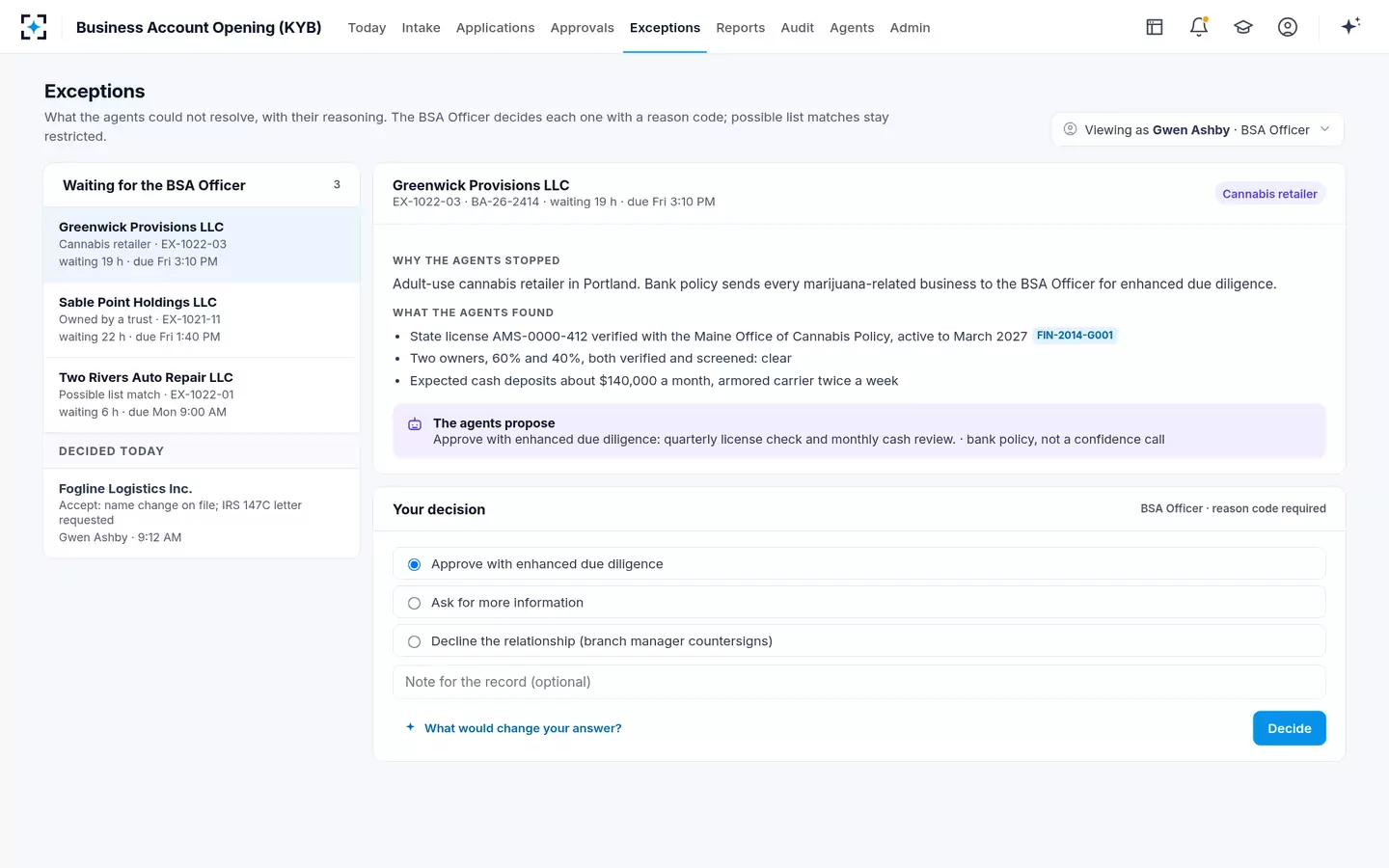
A trust-owned company waits for the BSA officer, with the reason the agents stopped
Exempt accounts: when a legal entity owes no owners for this account
Some accounts are exempt even though the customer is a legal entity. The rule lists four: point-of-sale credit for retail purchases up to $50,000, and financing of postage, insurance premiums, or equipment purchases and leases where the bank pays the provider directly (31 CFR 1010.230(h)). The limits matter: the last three exemptions do not apply to transaction accounts through which the customer can pay or be paid by third parties, and a possible cash refund brings the duty back.
For a deposit desk, the practical effect is narrow: a business operating account is never exempt. The exemptions are lending and payment-specific, and a policy that lists them under "business accounts" invites a banker to apply them where they do not reach.
How should a bank control classification?
By making it a recorded decision with evidence, not an assumption buried in a form. Classification decides whether owners are collected at all, so an error at this step propagates through every later check. A tester sampling business files should be able to see what the bank decided the customer was, why, and who decided.
Classification controls a BSA officer can test
- Record the entity type and the evidence for it
The state filing, the partnership agreement, the nonprofit's certificate, or the individual's trade name filing.
- Check the claimed type against the state search
A "sole proprietor" whose trade name is an LLC is a legal entity customer.
- Evidence every exclusion claimed
Registration, listing or regulator, and the link to the customer itself, not only its parent.
- Apply exemptions only to the account types the rule names
Never to an operating or transaction account.
- Recompute ownership from the governing document
Operating agreement, bylaws or partnership agreement, with amendments; multiply through layers.
- Route trusts, layered owners and unclear cases to the BSA officer
With a summary of why, and a clock.
- Keep the document rules by entity type as versioned settings
Changed only through an approved change request.
Recordkeeping follows the same rule for every class. The bank keeps the identifying information, including the certification, for five years after the account closes, and a description of how each owner was verified and how "each substantive discrepancy" was resolved for five years after the record is made (31 CFR 1010.230(i)). Whether beneficial ownership is still required at the bank covers the 2025–26 changes that sit on top of these duties, and the KYB process step by step shows where classification sits in the queue.
Questions people ask
Is a single-member LLC a legal entity customer?
Yes. It is created by filing articles with a state office, which is the test. Its federal income tax treatment as a disregarded entity does not change that, so the bank identifies and verifies the member, or the individuals behind a company member, and one controller.
Are sole proprietorships subject to beneficial ownership requirements?
No. FinCEN's 2016 rule says the definition does not include sole proprietorships or unincorporated associations, even if they file a trade name with the state, because neither has a legal existence separate from the individual. The bank identifies the proprietor under its CIP.
Do nonprofits need to certify beneficial owners?
A nonprofit corporation that filed its organisational documents with the state owes only the control prong: one individual with significant responsibility to control, manage or direct it. It names no owners, because it has no equity holders.
Is a general partnership a legal entity customer?
Yes. The definition names general partnerships expressly, even though many are formed without any public filing. The bank names each partner with 25% or more of the equity and one controller.
Who is the beneficial owner when a trust owns the business?
For a trust holding 25% or more, the rule names the trustee as the beneficial owner for that stake. The trust's beneficiaries are not named for the trust's interest, though the bank may identify more people on the basis of risk.
Does a subsidiary of a public company owe beneficial owners?
A US subsidiary at least 51% owned by a company listed on the NYSE, the American Stock Exchange or the NASDAQ National Market is excluded from the definition. Below that, the listed parent's stake cuts the chain, so no individual is named for it, but the subsidiary is still a legal entity customer and the bank names one controller and any other 25% owners.