The KYB process at a bank is the sequence that turns a business's application into an open account: classify the entity, collect the packet, verify the business exists, identify and verify its owners and controller, screen everyone against the government lists, rate the risk, decide exceptions, have a second person check, and board the account. GAO found that it takes bank staff "over 1 hour" for a business account, against about 30 minutes for a personal one, mainly because of beneficial ownership and state documents. The elapsed time is longer and far more variable, because each gap in the packet sends a question back to the owner and restarts the wait. Botminds' Business Account Opening (KYB) is built for community and regional banks to shorten that wait: agents read the whole packet in the first minutes, find every gap at once, and draft one request to the owner, while bankers, deposit operations and the BSA officer keep the decisions.
This guide is for the head of business banking who owns the experience, the deposit operations manager who owns the queue and the BSA officer who owns the controls. The worked example is a fictional customer at a fictional community bank, Tessaly Community Bank, as it runs through the solution.
The KYB process, step by step, with who does each
A person decides
Classify the entityLLC, corporation, partnership, nonprofit, sole proprietor or trust: the class decides which duties apply and what the packet holds.
Agent
Read the whole packetSplits and types each document, pulls the state filing, reads the ownership document and checks every line against its source.
Never: Never fills a gap by guessing
Agent
Identify, verify and screenVerifies the entity, each 25% owner, the controller and each signer; screens all of them on OFAC and the 314(a) list.
Never: Never clears a possible list match
A person decides
Ask the owner onceThe banker reads and sends one request for everything missing, with personal data on a secure form.
A person decides
Rate risk and decide exceptionsThe banker accepts or changes the proposed rating; the BSA officer decides cannabis, trust-owned and list-match files.
A person decides
Second checkA deposit operations specialist approves every field to be written to the core. Nobody approves a file they submitted.
Agent
Board the accountWrites the customer and account to the core, the documents to imaging and the welcome notice, only after the check.
What is the KYB process, and which rules set its steps?
Three federal rules set its core. The Customer Identification Program rule requires the business's name, address and tax number before opening and verification within a reasonable time (31 CFR 1020.220). The beneficial ownership rule requires the bank to identify and verify each 25% owner and one controller at opening (31 CFR 1010.230). And the AML program rule requires "Understanding the nature and purpose of customer relationships for the purpose of developing a customer risk profile," which is where the risk rating comes from (31 CFR 1020.210(a)(2)(v)).
Everything else in the process is the bank's design: who classifies, who reads the operating agreement, who talks to the owner, who decides exceptions, who checks, in what order and against which clock. That is why two banks under the same rules can differ by days on the same business. The rules set what must be true when the account opens; the process decides how long it takes to get there.
How long does the KYB process take a bank?
About an hour of staff time per business account, and more for complex ones. GAO, studying 11 banks, estimated "about 30 minutes, on average, to collect and review customer information when opening new consumer (or personal) accounts, compared to over 1 hour for new commercial (or business) accounts, which often required the collection of beneficial ownership information," adding that several banks collected "documentation from state agencies to verify this information, such as certificates of good standing" (GAO-20-574, page 43).
The bank's clock: short per account, large across a year
1 hr+
staff time per new business account, against about 30 minutes for a personal one
20–40min
extra onboarding time FinCEN estimated per legal entity account for the beneficial ownership step
8M
new legal entity accounts a year in FinCEN's cost estimate, after exclusions and exemptions
FinCEN's own rulemaking shows how that time lands on a smaller bank. It cited one small bank that opened 471 accounts for organizations in a year and another that opened 333, and estimated the beneficial ownership step alone would cost a small bank "between approximately $2,000 and $4,000 per year at account opening" (81 FR 29398). Those are staff-time figures. None of them counts the days a file waits between touches, which is what the business experiences. KYB software and bank size sets the cost side out in full.
Two clocks: staff time and elapsed time
The bank's clock counts touches; the owner's clock counts days. A process that measures only the first will optimise keying and miss the waiting. In the sample case the packet arrived by email at 11:35 a.m. and the account was open at 2:47 p.m.: 3 hours 12 minutes elapsed, of which the bank's people and agents were working for 58 minutes, and half of those were the file waiting in the checker's queue.
One sample packet: 192 minutes elapsed, 58 of them on the bank's clock
- Read and one request
- Waiting for the third owner134 min
- Verify and submit
- Checker queue32 min
- Approve and board
- Read and request
- Verify and submit
- Checker queue and boarding38 min
The design point is the order of discovery. The sample packet had one missing owner, found in the first nine minutes, so the owner was asked once. In a process where the expired certificate is found on Tuesday, the missing owner on Wednesday and the trade name mismatch on Thursday, the same three questions cost three round trips, and each restarts the owner's clock.
Where does the KYB process stall?
It stalls in queues, and mostly in the queue the bank does not control: the owner's. At the sample bank, 33 applications were open at one moment. Most were with bankers, a quarter were waiting on owners, three were with the BSA officer and one with deposit operations. Over the previous 30 days, 22% of packets arrived with a missing or conflicting document; that is sample data, not an industry rate, but the mechanism is general.
Where 33 open applications sat at the sample bank, by stage
Four causes account for most stalls. A missing beneficial owner, usually a member at exactly 25% left off the certification. A name mismatch between the articles, the state filing and the IRS letter. A stale certificate of good standing. And an exception, such as a cannabis-related business, a trust-owned company or a possible list match, that reaches the BSA officer with no clock and no summary. The first three are found by reading the documents against each other; KYB documents and the rule each answers covers that reading. The fourth is a routing problem.
A clock on every stage, and an owner for every clock
A process gets faster when each stage has a named owner, a clock, and an escalation when the clock runs out. The sample bank's clocks are settings its onboarding administrator proposes and its BSA officer approves; the point is not the numbers but that every queue has one.
The sample bank's clocks, stage by stage
| Stage | Owner | Clock | When it runs out |
|---|---|---|---|
| Complete packet to submission | Business banker | 24 hours from a complete packet | Warning to the branch manager at 20 hours; escalation at 24, then to the regional manager at 48 |
| Request with the owner | The business | Paused on the bank's clock | Reminders at 24 and 48 hours; a call task at 72 hours |
| Exception decision | BSA officer | 2 business days | Escalation, with the agents' summary of why they stopped |
| Second check before boarding | Deposit operations specialist | 4 hours | Reassignment within the team |
| Large opening deposit | Branch manager | Same day | Countersignature needed above $250,000 |
The owner's stage deserves its own measures even though the bank's clock pauses. Reminders that cancel themselves when the owner answers, an abandonment watch at 72 hours, and a single request rather than several all shorten it. So does asking in a way the owner can answer from a phone: in the sample case the third owner photographed her licence on a secure form and the managing owner e-signed the updated certification minutes later.
Verify before opening, or open and then verify?
The rules allow either, within limits, and the choice changes the process. The CIP rule requires the identifying information before opening but allows verification "within a reasonable time after the account is opened," and the program must say what a customer may do with the account meanwhile and when the bank will close it if verification fails (31 CFR 1020.220(a)(2)(ii)–(iii)). The beneficial ownership rule asks the bank to identify owners "at the time a new account is opened" and verify them under risk-based procedures.
Opening first shortens the business's wait and lengthens the bank's exposure. Examiners know it: the FFIEC's CIP examination procedures direct them to sample new accounts and, on a risk basis, include accounts that opened while verification was still incomplete (FFIEC BSA/AML Manual, CIP examination procedures). A bank that opens first needs a written list of restrictions for the interim and a report of every account still unverified past its limit. The sample bank verifies everything before boarding, which is why its fast cases depend on finding gaps early.
The second check, and why the banker cannot be the checker
The last control before the core changes is a different person approving every field that will be written. In the sample process, the deposit operations specialist sees each field the Boarding agent will write, with its source: legal and trade name, tax ID, formation, address, industry code, risk rating, the owners, the controller, the signers, the product and the opening deposit. The banker who submitted the file cannot approve it.
A different person checks what will be written to the core
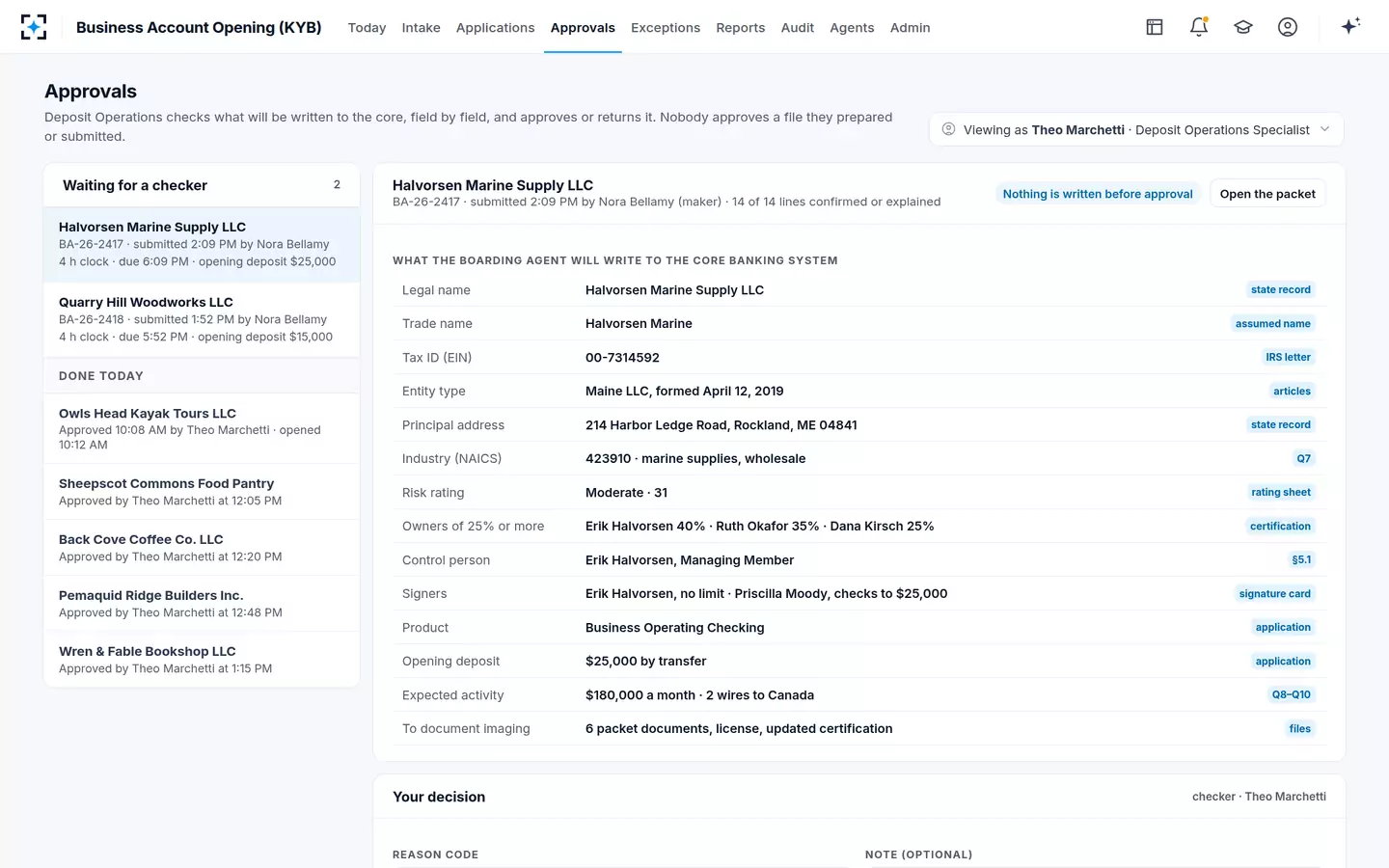
The exception path needs the same discipline. At the sample bank, files the agents stop on reach the BSA officer with why they stopped, what they found and what they propose, on a two-business-day clock, and the decision carries a reason code. Nothing about that review may appear in a message to the business: a bank may not reveal a suspicious activity report or anything that would show one exists (31 CFR 1020.320(e)), so the solution blocks any draft that mentions screening, lists or compliance review.
What should a bank measure in its KYB process?
Elapsed time from a complete packet to an open account, and the number of times the bank had to go back to the owner. Those two numbers explain most of what a business experiences, and both can be measured from the file's own trail without a survey. The table lists the measures that tell a manager where to act.
KYB process measures, and what each one tells a manager
| Measure | How to compute it | What a bad value means |
|---|---|---|
| Elapsed time, complete packet to open | Median and 90th percentile, by entity type | Queues are long, or gaps are found late |
| Requests to the owner per file | Count of outbound requests before opening | Gaps are found one at a time |
| First-pass complete rate | Share of packets with no gap on arrival | The application or checklist is unclear to owners |
| Checker returns | Share of files sent back by deposit operations, by reason | Bankers submit before every line is confirmed |
| Exception age | Days each file has sat with the BSA officer | Exceptions lack a clock or a summary |
| Abandonment | Share of applications with no owner reply after 72 hours | Requests are too many, too long or hard to answer |
| Staff minutes per file | Touch time from the trail, by role | Reading and keying still done by hand |
Measured this way, the KYB process stops being a compliance cost that is hard to see and becomes a queue a manager can run. Banks evaluating tools should ask for these measures on their own past files, which is what KYB automation that asks the owner once recommends as the test.
Questions people ask
What are the steps of the KYB process?
Classify the entity; collect the packet; verify the business exists; identify and verify each 25% owner and one controller; screen everyone against OFAC and the 314(a) list; rate the customer's risk; decide any exceptions; have a second person check; and board the account. Ongoing due diligence then keeps the information current.
Is KYB the same as KYC?
KYB applies KYC to a business: it verifies the entity and then performs KYC on each person who owns or controls it and on each signer. In US banks the entity steps come from the CIP rule and the owner steps from the beneficial ownership rule, 31 CFR 1010.230.
How long should a bank take to open a business account?
No federal rule sets a deadline. GAO estimated over an hour of staff time for a business account; elapsed time depends on how quickly gaps are found and answered. A complete packet for a simple LLC can open the same day, as in the sample case at 3 hours 12 minutes.
Can a business account open before the owners are verified?
The CIP rule allows verification within a reasonable time after opening if the bank's procedures say what the customer may do meanwhile and when the account will be closed if verification fails. Examiners sample accounts that opened with verification incomplete, so the restrictions and follow-up should be documented.
Who should approve a business account opening?
Someone other than the person who assembled the file. A common split is the banker as maker, a deposit operations specialist as checker before the core is updated, the BSA officer for exceptions, and a branch or regional manager for large opening deposits.
Does the KYB process change for an online application?
The required information does not change, but verification does. The CIP rule says a bank's non-documentary procedures must address a customer who opens an account without appearing in person, so online processes lean on database checks, photographed identification and secure uploads.