KYB documents are the papers a bank uses to know a business customer: the formation document, the IRS confirmation of the employer identification number, a certificate of good standing, the operating agreement or bylaws, the beneficial ownership certification, identification for the owners, the control person and every signer, and any trade name filing. Each answers a different requirement. The Customer Identification Program rule needs the business's name, address and tax number before opening and documents or other methods that show the entity exists; the beneficial ownership rule needs every 25% owner and one controller identified and verified; and signer authority is the bank's own control. A bank that cannot say which rule each paper serves will either over-collect or miss the one that matters. Botminds' Business Account Opening (KYB) is built for community and regional banks: agents read the whole packet, check each document against its rule and against the others, and draft one request to the owner for only what is missing.
This guide is for the business banker who collects the packet, the deposit operations specialist who checks it and the BSA officer who writes the document policy. The worked example is a fictional sample customer at a fictional community bank, as it runs through the solution.
One business packet, document by document: what it proves and which rule asks
| Document | What it proves | Rule or control | How firm |
|---|---|---|---|
| Articles of organization or incorporation | The entity exists; its exact legal name, state and formation date | CIP verification, 31 CFR 1020.220(a)(2)(ii) | Required in practice |
| IRS EIN confirmation (CP 575 or Letter 147C) | The tax number and the name the IRS holds for it | CIP identification number, 1020.220(a)(2)(i) | Required in practice |
| Certificate of good standing | The state still treats the entity as active | CIP verification; the bank's freshness rule | Often required |
| Operating agreement, bylaws or partnership agreement | Who owns what, who manages, who may bind the business | Signer authority; a check on the certification | Usually asked for |
| Beneficial ownership certification | Each 25% owner and one controller, certified by the person opening | 31 CFR 1010.230(b) | Required for legal entities |
| ID for each owner, the controller and each signer | Each named person exists and is who they say | 1010.230(b)(2) for owners; bank policy for signers | Required for owners |
| Trade name (DBA) filing | The name on the checks belongs to the entity | Bank control | When a trade name is used |
| Signature card and account resolution | Who may sign, and up to what limit | Bank control | Required by the bank |
What are KYB documents, and which rules do they answer?
KYB, know your business, documents are the evidence behind the information a business gives on its application. In a US bank they answer two federal rules and a set of the bank's own controls. The application supplies the facts; the documents let the bank verify them. Both steps are required, at different times, which is why a bank asks for the same fact twice.
The Customer Identification Program rule applies to the business as a customer. It requires the bank to "obtain, at a minimum, the following information from the customer prior to opening an account": name, address and identification number, plus date of birth for individuals (31 CFR 1020.220(a)(2)(i)). The beneficial ownership rule then applies to the people behind it: the bank must identify each owner of 25% or more and "a single individual with significant responsibility to control, manage, or direct" the business, and verify them (31 CFR 1010.230(b), (d)). Everything else in the packet, the operating agreement, the resolution, the signature card, serves the bank's control of who may move the money.
Three numbers that shape every business packet
4
identity items the bank must hold before it opens: name, address, tax number and, for people, date of birth
25%
the ownership share at which an owner must be identified and verified
1
control person per business, however many managers it has
Proof the entity exists: articles, standing and trade names
For a business that is verified by documents, the rule names what it means: "documents showing the existence of the entity, such as certified articles of incorporation, a government-issued business license, a partnership agreement, or trust instrument" (1020.220(a)(2)(ii)(A)). The list is examples, and a bank may verify instead, or as well, by non-documentary methods such as the state's online filing. The program must say which it uses and when.
A certificate of good standing is not on the rule's list, but it answers a question the articles cannot: whether the entity is active today. Articles show a company was formed; a state can administratively dissolve it later for a missed annual report or franchise tax. Banks therefore set a freshness rule of their own. The sample bank's is 90 days, a setting its onboarding administrator can tighten to 60 or 30 with the BSA officer's approval.
The address the rule asks for is easy to get wrong. For a business it is "a principal place of business, local office, or other physical location." A registered agent's office is an address for service of legal papers, not where the business operates, so a packet that gives only the agent's address has not yet answered the rule. A trade name works the same way: if the business will deposit checks payable to another name, the bank needs the assumed-name filing that ties the two together.
The tax number: which IRS document, and the 2025 relief
The bank must hold the taxpayer identification number before opening, and most verify it against the IRS's own confirmation rather than the number typed on the application. The IRS lists the documents that confirm an EIN: an entity transcript, a digital CP 575 "Employer Identification Number Verification Notice," or Letter 147C, "EIN Previously Assigned," requested by phone (IRS, Employer identification number). The name on that letter is the one the bank compares with the articles and the state filing; a stray comma or abbreviation is enough to put a line in "differs."
Three exceptions belong in the bank's procedures. A single-member LLC that is disregarded for income tax and has no employees may have no EIN, though the IRS says it may obtain one if it needs one "to open a bank account" (IRS, Single member limited liability companies). The CIP may allow opening for a customer that has applied for, but not received, a tax number, provided the bank confirms the application was filed and obtains the number "within a reasonable period of time after the account is opened." And since 2025 a bank may obtain the number from a third party rather than the customer, under FinCEN orders issued with the OCC, FDIC and NCUA on June 27, 2025 and with the Federal Reserve on July 31, 2025. The number must still be in hand before opening, and each relief is optional.
The beneficial ownership certification: what it must contain
The certification names each individual owning 25% or more, directly or indirectly, and one controller. For each, the bank collects the name, date of birth, address and Social Security or other government identification number (FinCEN CDD Rule FAQs, updated May 6, 2026). The rule lets the bank obtain it on FinCEN's form "from the individual opening the account," or by another means if that individual certifies the information to the best of their knowledge, so the bank need not collect from each owner directly.
The control person is one individual, from FinCEN's list of "a Chief Executive Officer, Chief Financial Officer, Chief Operating Officer, Managing Member, General Partner, President, Vice President, or Treasurer," or someone who regularly performs similar functions. An owner can also be the controller. Since February 13, 2026, a FinCEN exceptive relief order lets banks verify owners at a customer's first account and rely on that later, unless facts call the information into question or the bank's own risk-based procedures require an update. Whether beneficial ownership is still required at the bank sets out what changed in 2025 and 2026, and what did not.
Which KYB documents are required for each entity type?
It depends on the entity, because the beneficial ownership rule applies differently to each. A corporation or LLC carries the full packet; a nonprofit corporation names a controller but no owners; a sole proprietor is not a legal entity customer at all and is identified as an individual. Classifying the business first decides what the packet should contain, which the legal entity customer definition covers in full.
KYB documents by entity type, as a bank's policy would list them
| Entity | Existence | Tax ID | Ownership certification | Usually also |
|---|---|---|---|---|
| Single-member LLC | Articles of organization | EIN, or the member's SSN if none (bank policy) | The member, or the people behind a company member, plus one controller | Operating agreement, standing, signer ID |
| Multi-member LLC | Articles of organization | EIN | Every member at 25% or more, plus one controller | Operating agreement, standing, resolution |
| Corporation | Articles of incorporation | EIN | Every shareholder at 25% or more, plus one controller | Bylaws or resolution, standing |
| General partnership | Partnership agreement | EIN | Every partner at 25% or more, plus one controller | Trade name filing, if any |
| Nonprofit corporation | Articles of incorporation | EIN | One controller only | Board resolution; IRS determination letter if exempt |
| Sole proprietorship | None: not a separate entity | Owner's SSN, or an EIN if it has one | None: not a legal entity customer | Trade name (DBA) filing |
Scale explains why the classification step deserves care. FinCEN, writing the rule in 2016, noted from IRS data that "approximately 75 percent of all businesses filing tax returns are sole proprietorships," none of which owe a certification, and estimated 20 to 40 minutes of extra onboarding time for each legal entity account that does (81 FR 29398). A desk that asks every business for every document wastes the first group's time; one that skips classification misses owners in the second.
Read the documents against each other, not one at a time
Most packet failures are not missing documents but documents that disagree. The operating agreement is the only paper in the packet that independently states who owns what, so it is where a careful banker tests the certification; the state filing is where the legal name, registered agent and standing are tested; the IRS letter is where the name behind the tax number is tested. A packet can contain every required document and still be wrong.
At the sample bank, section 3.1 of an amended and restated operating agreement listed three members at 40%, 35% and 25%. The certification named the first two. The third was a required beneficial owner, because the 25% line is inclusive, and the only document that said so was the agreement. Reading each paper on its own, the file looked complete.
The agreement says 100%; the certification says 75%
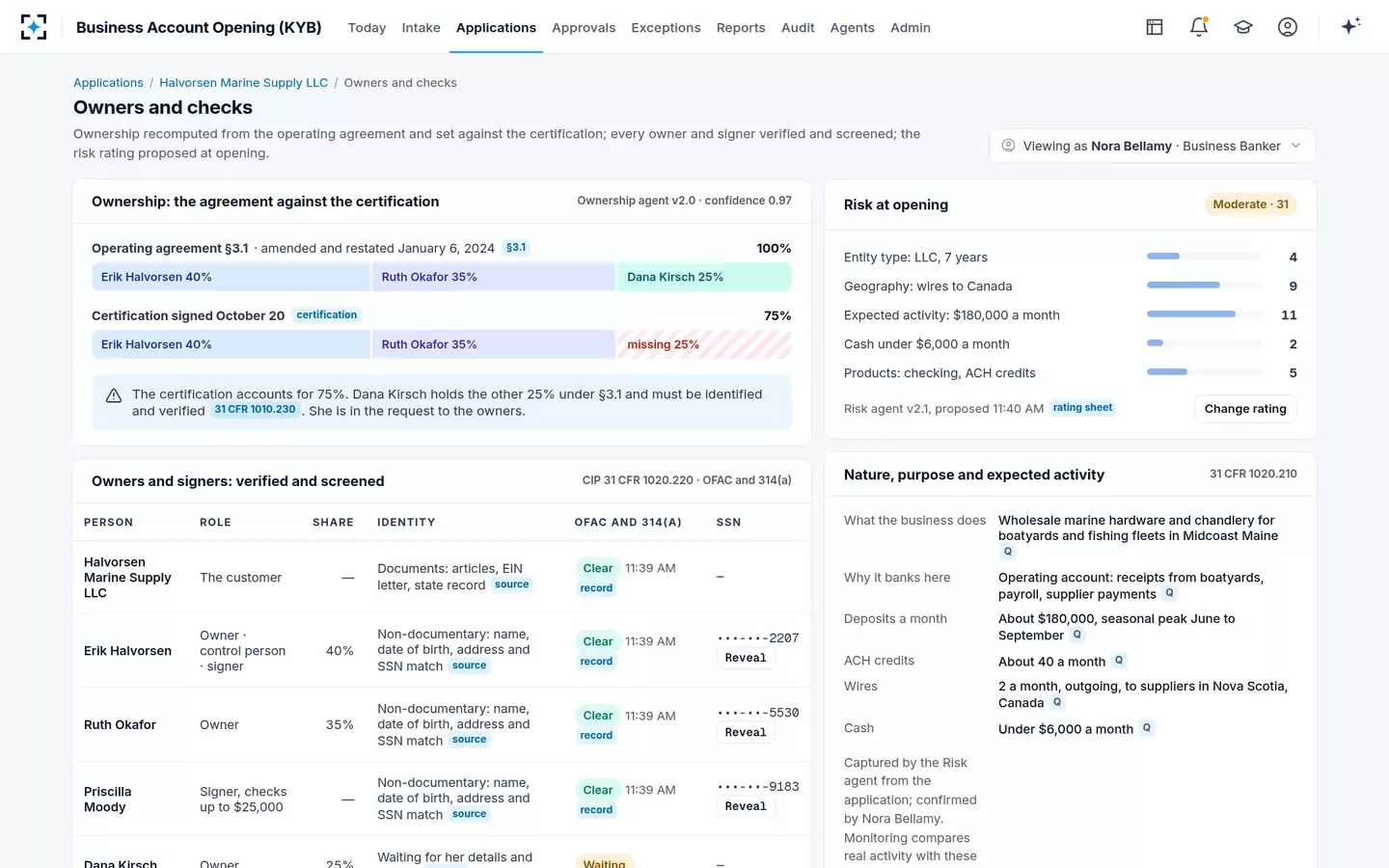
The same cross-reading settles explanations as well as gaps. In the sample packet the trade name on the application differed from the legal name, and the registered agent differed from the articles. The trade name was an assumed name already on file with the state, and the new agent had been filed by a statement of change, so the banker accepted both with a reason rather than calling the owner. Of 14 lines on the file, 11 were confirmed, 2 differed with explanations, and 1 was missing.
Where a banker's hours go on one packet that arrives with a gap
Asking for what is missing, once and safely
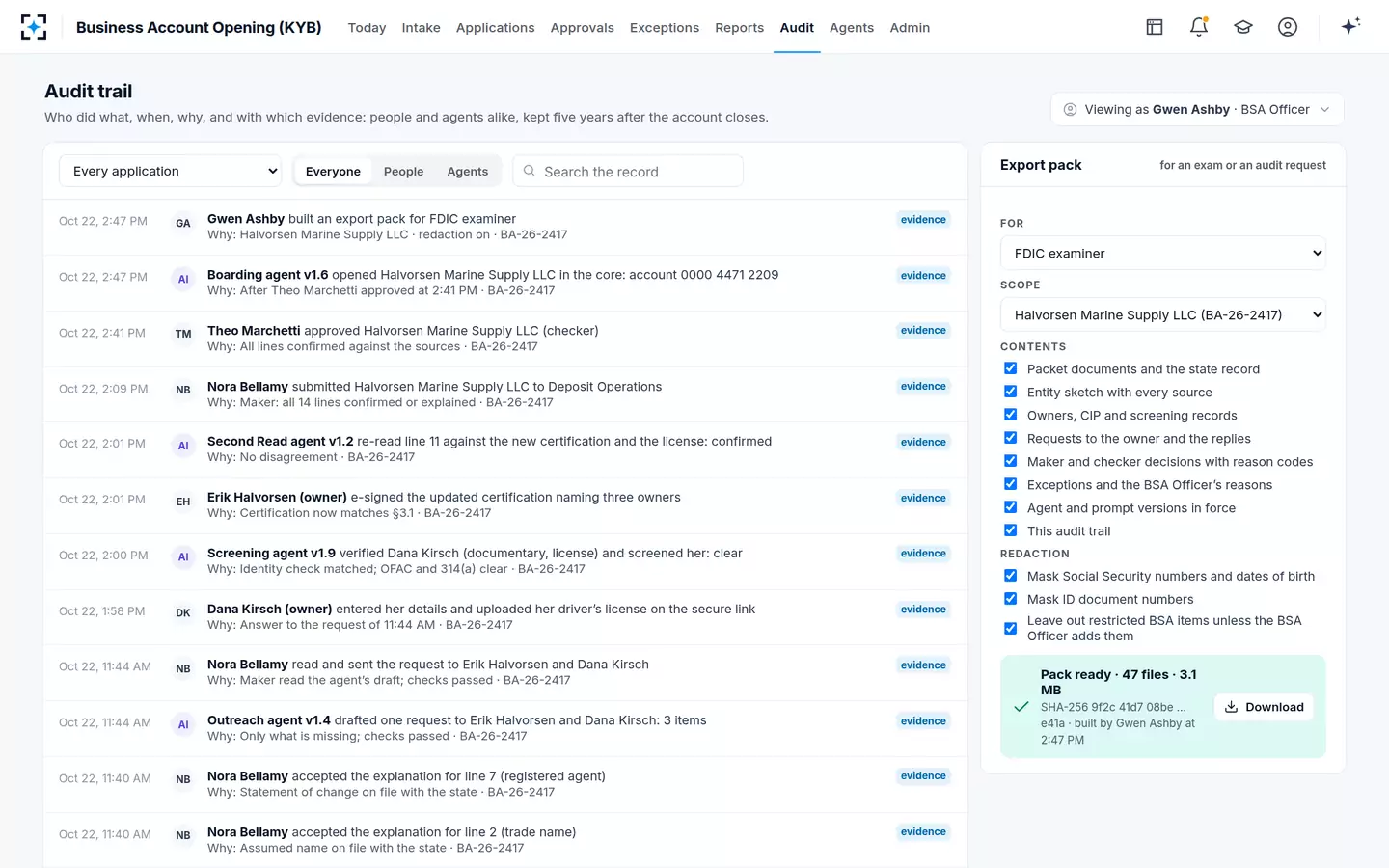
Once the gaps are known, the request to the owner should list all of them, ask only for what is missing, and move personal data through a secure channel. At the sample bank, the request for the third owner asked for three things out of 14 lines: her identifying details on a secure form, never by email; a photo of a driver's licence or passport; and the managing owner's signature on an updated certification. The third owner answered from her phone about two hours later.
One rule governs the wording. A bank may not reveal a suspicious activity report or anything that would show one exists, so a request should never mention screening, lists or compliance review. The solution checks every draft for that language and for personal data before the banker can send it; a sentence such as "we are also completing a screening review of each owner" locks the send button until it is removed. KYB automation that asks the owner once follows that design in detail.
Documents the rules do not require: keep them, do not decide on them
Owners often send more than the bank asks for: tax returns, business plans, leases, bank statements from another institution. A clear policy decides whether those are kept and whether they may influence a decision. The sample bank's setting keeps them in document imaging but never uses them for a decision, so the file shows what the rules and the bank's policy required and nothing that would be hard to explain later.
A document policy a BSA officer can defend
- List required documents by entity type, not one list for all
Classify first; the packet follows.
- Say which rule or control each document serves
So a banker can explain the request and a tester can check it.
- Set a freshness limit for standing certificates
And say what replaces a stale one: a new certificate or the state's online filing.
- Name the acceptable IRS confirmations of the tax number
CP 575, Letter 147C or a transcript; and whether the 2025 third-party relief is used.
- Require the certification to be checked against the ownership document
The operating agreement, bylaws or partnership agreement, with amendments.
- Route personal data through a secure channel only
Never email for Social Security numbers or ID images.
- Decide what happens to unrequested documents
Kept or returned, and never a basis for a decision unless the policy says so.
- Version every change to the list
Proposed by the onboarding administrator, approved by the BSA officer.
How long must KYB documents be kept, and what will an examiner ask to see?
For both rules, identifying information is kept for five years after the account closes, and the record of how it was verified for five years after that record is made. The beneficial ownership rule requires the bank to keep "any identifying information obtained," including the certification, and "a description of any document relied on," any non-documentary methods and their results, and "the resolution of each substantive discrepancy" (31 CFR 1010.230(i)). The CIP rule's recordkeeping section sets the same pattern for the business itself.
The phrase examiners return to is the last one. A file in which the certification said 75% and the agreement said 100% must show how the discrepancy was resolved: the third owner identified, verified and screened, and the updated certification signed. A file that simply holds both documents, unreconciled, has recorded the problem without resolving it.
The whole file, ready for an examiner
Questions people ask
What is the difference between KYB documents and KYC documents?
KYC documents verify an individual: a driver's licence, a passport, proof of address. KYB documents verify a business and the people behind it: formation, tax number, standing, ownership and control, plus KYC documents for each owner, the controller and signers. A business file therefore contains a set of KYC files inside it.
Is a certificate of good standing required to open a business account?
No federal rule names it. The CIP rule requires documents or other methods that show the entity exists, and many banks require a recent certificate because articles cannot show the entity is still active. Some accept the state's online filing instead, or skip the certificate for an entity formed in the last few weeks.
Does every owner have to come to the branch?
No federal rule requires it. The beneficial ownership rule lets the bank obtain owner information from the individual opening the account, and verification may be documentary or non-documentary. A bank may accept a photographed ID through a secure upload, as in the sample case.
Can a registered agent's address be the business address?
Usually not on its own. For a business, the CIP rule asks for a principal place of business, local office or other physical location. A registered agent's office is an address for legal service; the bank needs the place the business actually operates, which may be a home office.
Do KYB documents change for an account opened online?
No: the same rules apply in every channel, and the documents are uploaded instead of handed over. What changes is verification, which online relies more on non-documentary checks and photographed identification, and the bank's procedures must address customers who do not appear in person.
Must a bank collect a new certification for a second account?
Not necessarily. Under FinCEN's February 13, 2026 exceptive relief order, a bank may identify and verify owners at the first account and rely on that information later, unless it knows of facts that call it into question or its own risk-based procedures require an update.