A straw purchase of a vehicle is a car bought in one person's name for somebody else who will keep it and pay for it — usually somebody the lender would not have approved. It is the hardest kind of auto fraud to catch at the application, because nothing in the file is false: the licence is real, the income is real, the credit history belongs to the person who signed. Botminds' Auto Loan Fraud Detection finds it the only way it can be found, by searching across applications and dealerships for the details that repeat, and it is deliberately barred from calling a dealership complicit on the strength of a pattern.
The ninety-day case below is an illustration of ours, on invented people, written to show the shape of the thing rather than to report anything measured. Where a figure comes from Auto Loan Fraud Detection it is sample data on fictional buyers and dealerships, and says so. The statutes and the rules are quoted and linked where they appear.
One pattern over ninety days, and what each file showed on its own
- Day 0 · first contractfunded
- Day 18 · second applicationsame phone
- Day 45 · third applicationnew dealership
- Day 66 · fourth applicationdeclined
- Day 78 · contract onepayment missed
- Every document genuine, every signature realnothing to find
What is a straw purchase of a vehicle?
A straw purchase of a vehicle has three parts. Someone who cannot get credit wants a car. Someone who can get credit signs for it. The car goes to the first person, who drives it and makes the payments, and whose name appears nowhere on the contract.
The signer is the straw: a real, creditworthy, consenting person whose only role is to be the name on the paper. In our illustration Corinne Hartnell signs a retail installment contract at a fictional dealership, Westline Auto, for a car that Devin Okpara collects the same evening and pays for by transfer every month. Corinne never drives it. Devin never appears in the file.
What makes the arrangement fraud is not the favour; it is the representation. A credit application asks who the borrower is and, in substance, who the vehicle is for. A straw purchase answers the first question truthfully and the second one falsely, and the lender prices a loan against a credit history belonging to a person who will not be driving, insuring, garaging or ultimately paying for the collateral.
Is a straw purchase of a car illegal, and who does the law reach?
There is no offence called a straw purchase outside the firearms context. What there is, for vehicle finance, is a set of general statutes that reach the conduct from different angles, and which of them applies depends on who the lender is and who did what.
The narrowest is 18 U.S.C. §1014, which makes it an offence knowingly to make a false statement to influence the action of a federally insured bank or a federal or state-chartered credit union on a loan application. Read its list of institutions before relying on it: it reaches banks and credit unions and not a stand-alone finance company, so two lenders looking at the same arrangement are not in the same legal position.
The broader one is bank fraud. Section 1344 reaches "whoever knowingly executes, or attempts to execute, a scheme or artifice — (1) to defraud a financial institution; or (2) to obtain any of the moneys, funds, credits, assets, securities, or other property owned by, or under the custody or control of, a financial institution, by means of false or fraudulent pretenses, representations, or promises" (18 U.S.C. §1344). A scheme is the operative word, and it is why a single favour and a pattern of twenty are treated so differently.
Two further sections matter when more than one person is involved, and they are the ones that answer "but I only signed". Under 18 U.S.C. §2, "whoever commits an offense against the United States or aids, abets, counsels, commands, induces or procures its commission, is punishable as a principal", and whoever "willfully causes an act to be done which if directly performed by him or another would be an offense against the United States, is punishable as a principal". And for the fraud chapter that contains bank, mail and wire fraud, "any person who attempts or conspires to commit any offense under this chapter shall be subject to the same penalties as those prescribed for the offense, the commission of which was the object of the attempt or conspiracy" (18 U.S.C. §1349).
The practical reading, for a fraud desk rather than a prosecutor, is that the organiser and the signer are not in meaningfully different positions under these sections — which is worth knowing, because the signer is usually the only one the lender can see, and is often the one who understood least.
The paperwork is genuine, which is the problem
Every test a fraud desk runs on a document comes back clean on a straw purchase. The licence passes, because it is the signer's licence. The pay stubs recompute to the cent, because the signer really earns what they say. The bank statement shows payroll deposits from a real employer. The credit file is the signer's own and carries whatever history it carries.
That is why a straw purchase is invisible to the controls lenders invest most in. The arithmetic that catches a fabricated pay stub cannot help, because no stub has been fabricated. An identity check cannot help, because no identity has been borrowed without permission — and the line between first-party and third-party fraud runs straight through the middle of a straw purchase: the identity data is true, and the misrepresentation is about who the car is for.
It also changes what a demonstration proves. A fraud system shown reading a forged pay stub is showing you its strongest trick on its favourite problem; the same system shown four genuine applications and asked which one is a straw purchase is being asked the question that actually separates products. A desk that buys on document forensics alone has bought a control for one half of its exposure and nothing for the other.
There is one document signal worth knowing about, and it is weak on purpose. A straw arrangement is often assembled by somebody who also assembled the last one, so the files can share a template even when every figure in them is true — the same employer letter wording, the same reference names, the same two documents missing. That is a similarity between files rather than a defect in any of them, which is why it belongs to a link search and not to a document check.
What one shared phone number reached, in the solution’s sample data
4
applications carrying the same employer and the same phone number
2
dealerships, one of them carrying three of the four applications
11
applications sharing one pay-stub layout, misspelling included, at 4 dealerships in 90 days
1
of the four already funded, with its first payment not yet due
What is the difference between a co-signer and a straw buyer?
Disclosure, and nothing else. A co-signer is a second person the lender knows about, assessed, priced and named on the contract. A straw buyer is a person the lender does not know about, standing behind a borrower it does know about.
Buying a car for somebody else is lawful and ordinary. Parents do it for children, children for parents, a partner for a partner. Paying somebody else's car loan is lawful too; a lender takes money from whoever sends it. None of that is a straw purchase, because none of it involves telling the lender something untrue.
Regulation B even anticipates the multiple-signer case directly: "When an application involves more than one applicant, notification need only be given to one of them but must be given to the primary applicant where one is readily apparent" (12 CFR 1002.9(f)). The rule assumes the lender knows who the applicants are. A straw purchase is the arrangement that defeats that assumption.
So the question that separates the two is short, and it is not about documents: did the lender get the chance to assess the person who will actually pay? If the answer is yes, it is a co-buyer, however unusual the family arrangement. If the answer is no, the lender has priced the wrong credit.
Four applications, one employer: how a ring looks from the queue
From a single case, nothing. From sixty to ninety days of applications, a shape. The shape is almost always an attribute that was easier to reuse than to invent: one phone number, one employer, one address, one email domain, one pay-stub template.
The same two details on four applications at two dealerships
Three properties of that picture matter for how a desk works. It is only visible at the level of a portfolio, so no amount of care on a single file produces it. It grows, because an organiser who has one working template uses it again. And it is evidence of a relationship rather than of a crime: four applications sharing a phone number is a reason to look, and on its own it is not a finding about anybody.
The rule's own illustrative list reaches the same territory from the credit file rather than from the application. Among the patterns it names as inconsistent with an applicant's history are "a recent and significant increase in the volume of inquiries", "an unusual number of recently established credit relationships", and "a material change in the use of credit, especially with respect to recently established credit relationships" (16 CFR 681, Supplement A, red flag 4). A straw buyer who has signed twice in sixty days produces all three.
The window a lender searches is a real policy choice and it is usually made by default. Thirty days is too short: an organiser who has just been declined waits. Ninety days across every dealership in the channel catches the pattern and produces more coincidences to clear — one employer that genuinely employs forty people in one town will light up every time. Sixty to ninety days, searched across dealerships rather than within one, is where most desks settle, and the number of real customers telephoned as a result is the cost of the setting rather than a defect in it.
What one phone number was worth across two dealerships
Who pays the bill — the signal no document carries
The strongest signal in a straw purchase arrives after funding, from the servicing side, and it is almost never routed back to the fraud desk. Somebody other than the borrower is making the payments.
It is not proof of anything. Spouses pay each other's loans; a parent pays a student's car; an employer reimburses a sales representative. What makes it worth a look is its combination with the rest: a payer who is not the borrower, on a loan where the insurance is in a third name, where the registered address and the garaging address differ, and where the servicing mail comes back.
The rule's list names two of those directly, and both sit in the category about unusual use of an account. One is where "mail sent to the customer is returned repeatedly as undeliverable although transactions continue to be conducted in connection with the customer's covered account". The other is where the institution "is notified that the customer is not receiving paper account statements" (16 CFR 681, Supplement A, red flags 23 and 24). Both describe a car whose paperwork goes to one address and whose keys are at another.
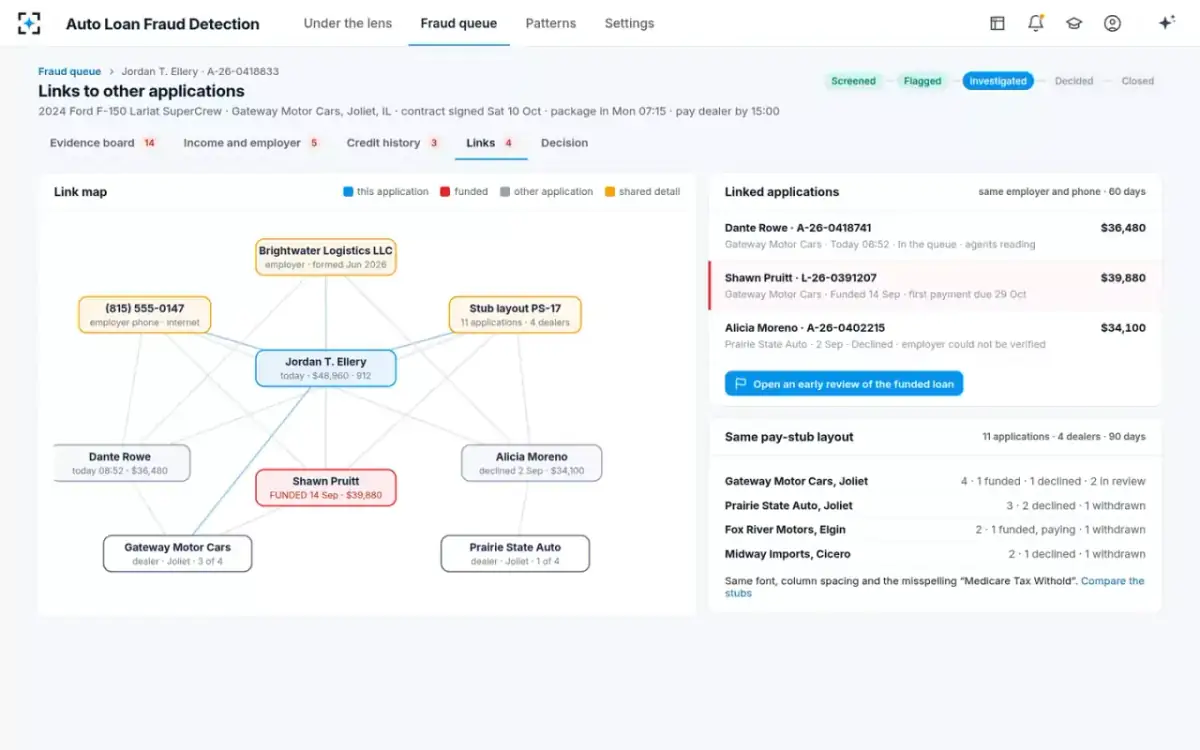
One employer, four applications, two dealerships, on one screen
How do lenders detect a straw buyer?
By looking at the neighbours of the application rather than at the application. Four searches carry most of the weight, and all four need data a lender already has.
Shared attributes across recent applications. Phone, employer, email, address, and the layout of the documents themselves. In the sample data, one employer and one phone reach four applications at two dealerships inside sixty days, and one pay-stub layout reaches eleven at four dealerships inside ninety.
Velocity on the signer's own file. A thin, clean, recently active file with a burst of inquiries is the signature of somebody being used, or of somebody using themselves repeatedly.
Who the vehicle is actually for. Insurance in another name, a garaging address that is not the borrower's, a second set of keys requested at delivery, a trade-in registered to somebody else.
Who pays. The first three payments on a funded loan answer a question no application can.
In Auto Loan Fraud Detection this is one agent's whole job. It searches recent applications across dealerships for shared phones, employers, emails, addresses and document layouts, and its two published limits are the interesting part: it never accuses a dealership, and what it produces goes to a review feed rather than to a decision. A pattern is an input to a person, not an output of the system.
Five questions that separate a co-buyer from a straw buyer
- Who will drive the car, and does the file say so?
Ask it plainly at application. An honest answer that a relative will use the car is a disclosure, and a disclosed arrangement can be underwritten; it is the undisclosed one that mispriced the loan.
- Does the insurance name the borrower as the principal driver?
The insurance policy is written by a third party for its own reasons, which makes it better evidence than anything in the credit package.
- Where will the car be kept, and is that the borrower’s address?
A garaging address that differs from the borrower’s is common and explainable. It is also the single cheapest question to ask.
- Has anything on this application appeared on another one recently?
Phone, employer, email, address, document layout. Search sixty to ninety days across dealerships, not one file.
- On loans already funded, who sent the first three payments?
A payer who is not the borrower is not a finding on its own. Combined with a shared attribute and a returned statement, it is the clearest picture a lender will get.
What a lender can do about a loan that has already funded
Less than it would like, and more than it usually does.
What it cannot generally do is unwind the contract because it has formed a view about who is driving. The borrower is real, the signature is genuine, and the loan is performing until it is not. Acceleration clauses turn on default and on specific covenants, and "we believe the car is somebody else's" is rarely one of them.
What it can do is open an early review before the first payment is due — a payroll check, a welcome call, a confirmation of the insurance and the garaging address. In the sample data that is exactly what happens to the one funded application in the cluster: the analyst opens an early review of a loan funded for $39,880 with its first payment not yet due, which is the only window in which a welcome call is a service rather than a collection.
Where the conduct crosses into something reportable, a bank's duty arrives with its own machinery and its own confidentiality. A report is due no later than thirty calendar days after initial detection, and the rule is emphatic about what may be said afterwards: "No bank, and no director, officer, employee, or agent of any bank, shall disclose a SAR or any information that would reveal the existence of a SAR" (31 CFR 1020.320(e)(1)(i)). The same paragraph preserves the thing a fraud desk actually needs, provided nobody in the reported transaction is told it was reported: the rule is not to be construed as prohibiting disclosure of "the underlying facts, transactions, and documents upon which a SAR is based".
That distinction is the whole basis of a workable dealer conversation. The facts are shareable. The report is not.
The more useful thing a lender can do is instrument the servicing side once, so that the next arrangement surfaces by itself. Three fields carry nearly all of the signal and almost no lender reports on them: who sent each of the first three payments, whether the first statement was returned undeliverable, and whether the insurance names the borrower as the principal driver. None of the three requires a new system; all three require somebody to decide that the answers go back to the fraud desk rather than into a servicing record nobody reads. A desk that receives those three answers finds its straw purchases at ninety days instead of at charge-off, which is the difference between a pattern it can act on and a loss it can only count.
Dealers: a reason to look, not a finding
A pattern that crosses two dealerships says something about the organiser and almost nothing about either dealership. Four applications with one phone number can mean a dealership is running a scheme, a dealership is being used by one, or a finance office has a habit of letting an applicant fill in the employer field from memory. Those three are not distinguishable from the data, and they lead to three completely different conversations.
So the useful output is deals, not verdicts. A dealer relationship manager who arrives with "here are the four applications, here is the detail they share, here are the two that did not fund" is asking a question a dealer principal can answer. A manager who arrives with a score is making an accusation they cannot support, about a business relationship worth more than the four deals.
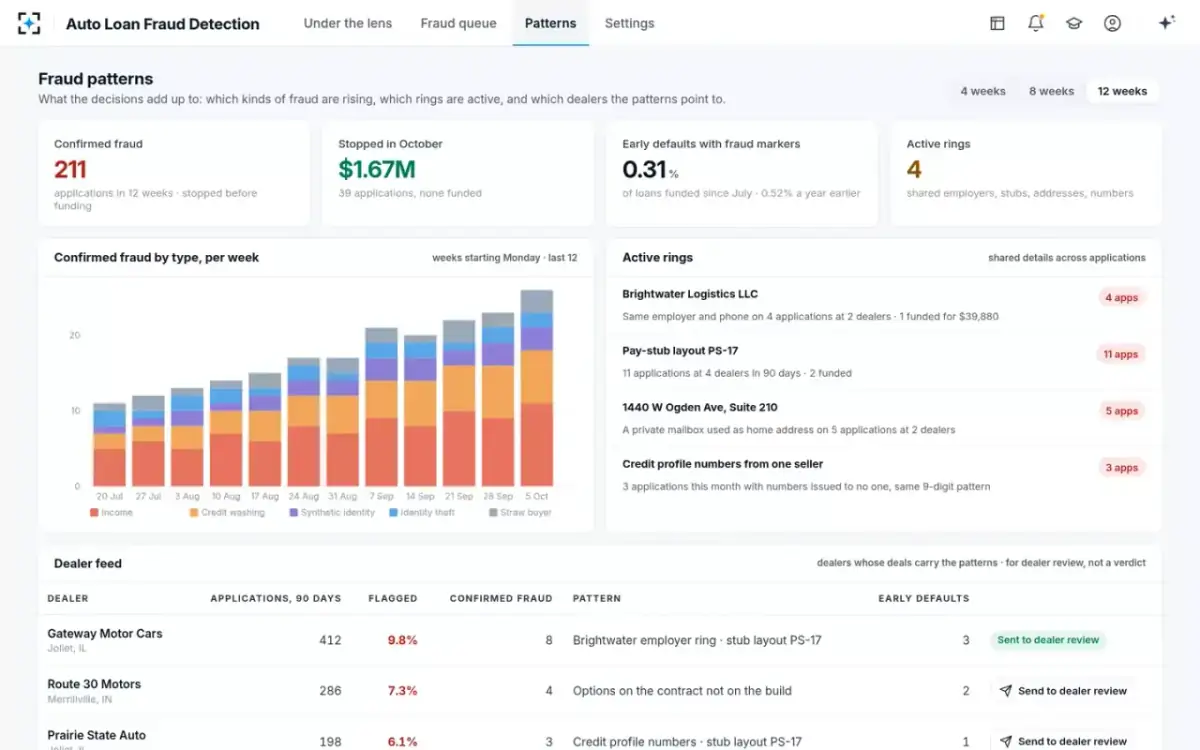
In Auto Loan Fraud Detection the limit is written into the component rather than left to etiquette: the link agent never accuses a dealership and sends patterns to a review feed. If you are choosing between systems, the question to ask about every component is what it refuses to do, and this is the clearest example of why the answer matters.
Confirmed patterns, active clusters, and the feed a dealer conversation starts from
To see the link search, the early review and the limits on each component together, start from Auto Loan Fraud Detection.
Questions people ask
Can you buy a car for someone else with bad credit?
Yes, if you tell the lender. Buying a car in your own name and lending it to a relative is lawful, and so is paying somebody else's car loan. What turns the same arrangement into fraud is answering an application in a way that stops the lender assessing the person who will actually hold and pay for the car. The safe route is a disclosed co-buyer, which lets the lender price the credit it is actually taking.
What is the penalty for a straw purchase of a vehicle?
It depends entirely on which statute the conduct falls under and who the lender was, so no single figure is honest. A false statement on a loan application to a federally insured bank or a credit union is reached by 18 U.S.C. §1014; a scheme to defraud a financial institution is reached by §1344; and under §1349 an attempt or a conspiracy carries the same penalties as the offence itself. A lender's own decision is narrower than any of this: whether to fund.
What happens to the car in a straw purchase?
It stays with the person who is driving it, usually until the loan stops being paid. The title and the loan are in the signer's name, so the signer carries the debt, the credit damage and any deficiency after a repossession, while the driver carries nothing. That asymmetry is what makes a straw purchase a poor favour as well as a misrepresentation, and it is worth saying plainly to anyone who is asked to sign one.
Can a lender repossess a car bought by a straw buyer?
On the same terms as any other car: when the contract is in default and the law of the state allows it. A suspicion about who is driving is not a default. In practice a lender that identifies the arrangement early does something less dramatic and more useful — a welcome call and a verification before the first payment is due, which either resolves the question or produces the first hard fact in the file.
Is a straw purchase first-party or third-party fraud?
Usually neither cleanly, which is why it is often filed as second-party. The identity on the contract is real and used with permission, so no consumer has been impersonated and no identity-theft duty is engaged; but the person who benefits is not the person assessed, so the misrepresentation is not the signer's own position in the way an inflated income is. The practical consequence is that a straw purchase produces no victim to notify and no credit-file block to unwind.
How many shared details should trigger a review?
More than one, and the threshold belongs to the lender rather than to a vendor. A single shared employer across two applications at one dealership is often a genuine workplace; the same phone number on four applications at two dealerships is not. In Auto Loan Fraud Detection the search window and what counts as a match are settings with a version history and a named approver, which is the right place for a number that decides how many real customers get a phone call.