Car dealerships collect proof of income; they very rarely verify it. In an indirect deal the dealership takes the credit application, copies the licence and the pay stubs, and sends the file to several lenders — and the lender that buys the contract is the party that tests whether the income is real, because it is the party whose money is at risk. Botminds' Auto Loan Fraud Detection sits at that second step: it recomputes every stub, reads the bank statement for payroll, dates the employer from public filings and hands a fraud analyst the findings before the dealership is paid. The awkward consequence of the order, for a buyer, is that the verification usually happens after the car has gone home.
Everyone named below — buyer, dealership, employer and lender — is fictional, part of the sample data in Auto Loan Fraud Detection, used here because one deal is easier to follow than a description of a process. The rules and the public guidance are quoted and linked where they appear.
Who holds the deal, in the order they hold it
A person decides
The dealership’s finance officeTakes the credit application, copies the licence, collects pay stubs and bank statements, and sends the deal to several lenders. Decides which lenders see it — and whether the car goes home tonight.
Never: Lends its own money, or decides whether the income is true
Agent
The lender’s application screenerScores the application when it arrives and again when the contract and the stipulations land, and ranks the queue by score and by the time left before the dealership must be paid.
Never: Declines an application
Agent
Income and employment verifierRecomputes each stub line by line, reads the statement for payroll deposits rather than transfers, and dates the employer from its state filing, its domain and its phone type.
Never: Treats the applicant’s own phone number as proof, or telephones the employer itself
Agent
Identity checkerTests the licence barcode and photo, the number’s issue date against the date of birth, and the age of the phone and email.
Never: Decides identity theft on one signal
Agent
Case recommenderAssembles the findings with the document line or record behind each one, and drafts the decision, the reasons and the notice to the dealership.
Never: Declines, files or moves money
A person decides
Fraud analystReads the findings and the documents behind them, asks for what is missing, and signs the decision on every flagged application before funding.
Never: —
A person decides
Funding analystPays the dealership, or holds the contract. A case still open at the cutoff is held, not funded.
Never: —
Do car dealerships verify income? The short answer, and who actually checks
Two different jobs get called the same thing. The dealership's job is to assemble a file a lender will fund: identity, residence, employment, stated income, and whatever documents the lender's approval asks for. The lender's job is to decide whether that file is true. Only the second is verification, and it happens at the lender.
The reason is structural rather than a matter of goodwill. In an indirect deal the dealership sells the retail installment contract on, and the Federal Trade Commission's rule on consumer credit contracts puts the buyer of that paper squarely behind the seller: every such contract must carry, in ten point bold face type, the notice that "ANY HOLDER OF THIS CONSUMER CREDIT CONTRACT IS SUBJECT TO ALL CLAIMS AND DEFENSES WHICH THE DEBTOR COULD ASSERT AGAINST THE SELLER OF GOODS OR SERVICES OBTAINED PURSUANT HERETO OR WITH THE PROCEEDS HEREOF" (16 CFR 433.2(a)). The same part defines the relationship in which this happens — a "business arrangement" meaning "any understanding, procedure, course of dealing, or arrangement, formal or informal, between a creditor and a seller, in connection with the sale of goods or services to consumers or the financing thereof" (16 CFR 433.1(g)).
So the lender is buying a contract it did not write, from documents it did not collect, about a person it has never met, and it will carry whatever the buyer could have argued with the dealership about. A lender that did not re-read the file would be underwriting somebody else's paperwork. That is the whole argument for the second check, and it has nothing to do with suspecting the dealership.
What the dealership collects, and why
The finance office is working to a different question from the lender's: not "is this true" but "is this fundable". A complete file gets an approval quickly, an incomplete one comes back with conditions, and the dealership is paid when the lender funds. Collecting well is in its interest; verifying is not its job and, for most of what matters, not within its reach.
What it typically takes is a credit application, a driver's licence, proof of residence, the stated employer and income, and one or two pay stubs. What it typically cannot do is set a stub against the employer's payroll data, pull an earlier credit file the lender ran seven weeks ago, or search another lender's recent applications for the same employer phone number.
None of that puts the dealership outside the identity-theft rules. The Federal Trade Commission's own guide to the Red Flags Rule describes the reach of "creditor" by conduct rather than by trade — a business is covered if, in the ordinary course of business, it "advance funds to — or for — someone who must repay them" — and says plainly that "Anyone who lends money — like a payday lender or automobile title lender — is covered by the Rule" (FTC, Fighting Identity Theft with the Red Flags Rule). An auto loan is named in the rule's own definition of an account it covers, and the written programme the rule requires is where each party sets out what it will look for.
What the lender does with it, after the car has gone
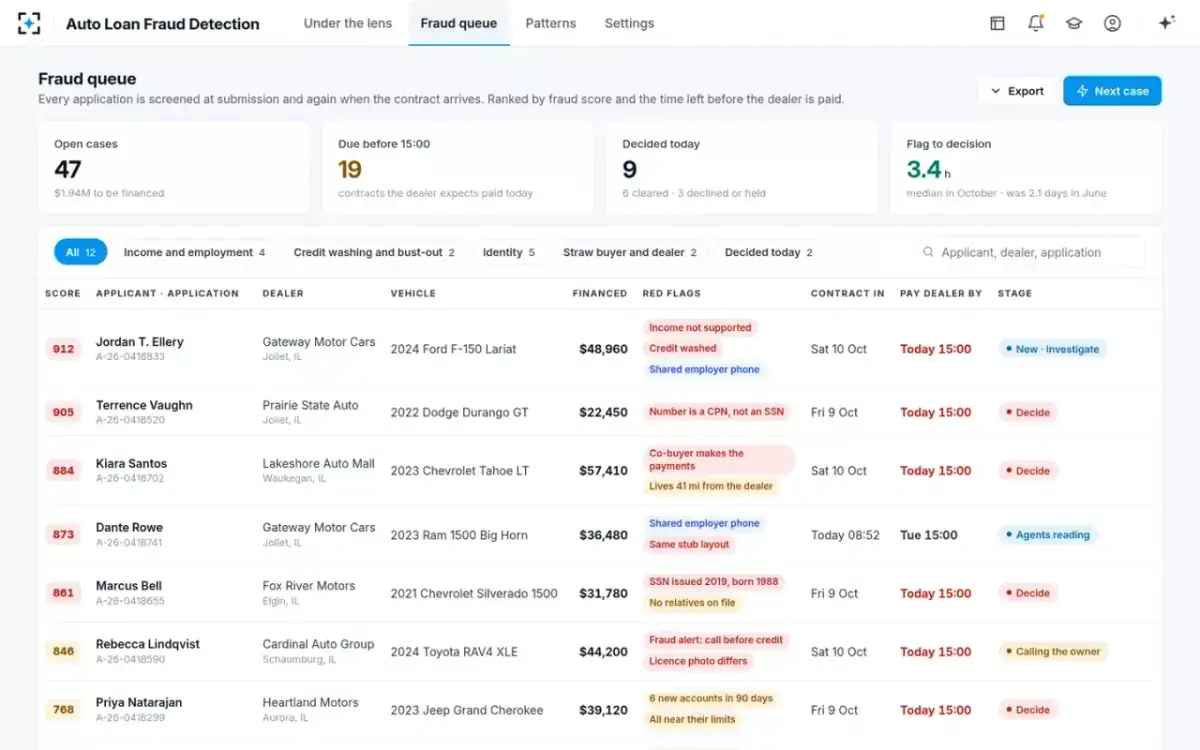
The funding package usually lands the next working morning. In the sample case the contract was signed on Saturday at a fictional dealership, Gateway Motor Cars, for $48,960 financed over 72 months; the package arrives Monday at 07:15, and the dealer expects to be paid by 15:00. Nine documents come with it.
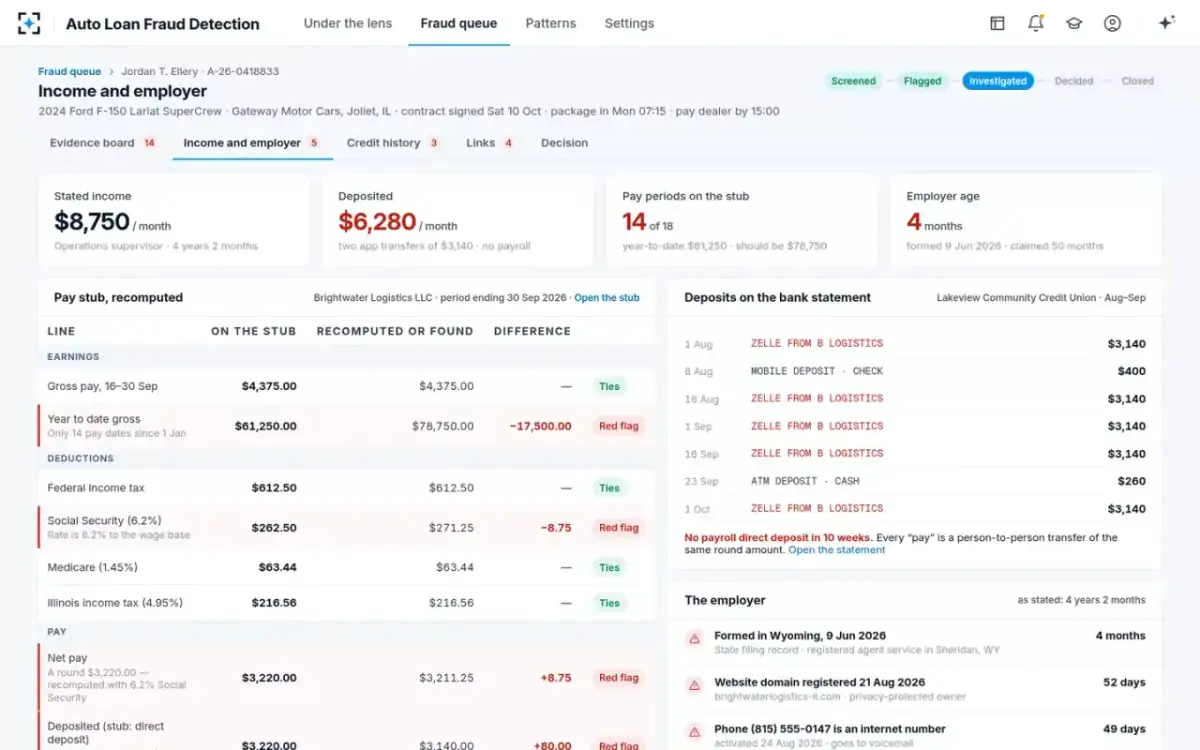
The lender reads all nine. In the sample case the pay stub from the fictional Brightwater Logistics LLC comes back with six findings, the first of them pure arithmetic: year to date is $61,250.00, which divides into 14 semi-monthly pay periods, and 30 September is the eighteenth. The bank statement has no edits at all and shows no payroll — the "pay" arrives as $3,140.00 transfers through a consumer payment app. The Illinois driver's licence is genuine. The four calculations that catch a fabricated stub are worth reading if you want the arithmetic rather than the outcome.
There is a clock on this, and it is not the one most people assume. Regulation B's official interpretation starts the thirty-day notice period only when the file is finished: "Once a creditor has obtained all the information it normally considers in making a credit decision, the application is complete and the creditor has 30 days in which to notify the applicant of the credit decision" (Supplement I to 12 CFR part 1002, comment 9(a)(1)-1). An outstanding condition keeps the application incomplete, which is exactly why conditions are the lever everything else moves on.
Forty-seven deals, each with the time left before a dealership is paid
Stipulations: what a stipulation on a car loan actually is
A stipulation is a condition attached to an approval: the lender will buy the contract once it has one more thing. Proof of income from a source the applicant did not produce. Proof of residence. A clearer licence scan. A letter explaining a name change. Nothing happens to the money until the list is empty.
Regulation B gives the mechanism a shape. Within thirty days of receiving an application that is incomplete "regarding matters that an applicant can complete", a creditor must notify the applicant either of action taken or of the incompleteness (12 CFR 1002.9(c)(1)). The interpretation adds the choice behind it: where an application is missing information and the creditor lacks enough to decide, "the creditor may deny the application giving as the reason for denial that the application is incomplete", with the alternative of sending the notice of incompleteness instead (comment 9(a)(1)-3). A stipulation is the second of those two roads, and it is the friendlier one: it asks rather than refuses.
It is also, if it goes unanswered, a signal in its own right. The Red Flags Rule's illustrative list includes, word for word, the case where "The person opening the covered account or the customer fails to provide all required personal identifying information on an application or in response to notification that the application is incomplete" (16 CFR 681, Supplement A, red flag 16). A buyer who cannot produce what was asked for has not been accused of anything — but a lender is entitled to notice.
In the sample lender's own settings, stated income above $6,000 a month requires payroll data or an Internal Revenue Service transcript, with "two pay stubs and a bank statement" and "IRS transcript only" offered as the alternatives, and the arithmetic tolerance on a stub is $5 per line. Those are policy choices a lender makes once and applies to everybody, not judgements about a particular buyer.
Spot delivery: can a car loan be cancelled after you drive away?
Yes, where the paperwork said so, and it is the single most useful thing a buyer can understand before signing. If the dealership has delivered the car while the financing is still being arranged, the deal is conditional, and the condition is a lender agreeing to buy the contract on the terms written down.
The Federal Trade Commission's consumer guidance says it in one line: "And if the dealer says they're still working on the approval, the deal isn't final." It adds the practical advice that follows — "Consider waiting to sign the contract, and keeping your current car, until the financing has been fully approved" — and explains where the paper goes: "The dealer typically sells the contract to a bank, finance company, or credit union that will service the account and collect your payments" (FTC, Financing or leasing a car).
What happens when a lender declines to buy is mechanical rather than dramatic. The contract goes back to the dealership unfunded. The dealership either finds another lender, re-contracts on different terms, or asks for the car back. In the sample case the decline is signed at 10:38 on the Monday, a second signature follows at 10:42 because the amount is above the analyst's limit, and the contract returns to Gateway with the notice queued and its reasons stated.
Two things make this less alarming than it sounds. The buyer's exposure is real but bounded, and the Federal Trade Commission's guidance tells them where to look: "Make sure you understand whether the deal is final before you leave in your new (or new-to-you) car. If you're called back to the dealership because the financing wasn't final or didn't go through, carefully review any changes or new documents you're asked to sign." And a decline for a condition that was never satisfied is not the same thing as a decline for fraud; the reasons a lender gives have to describe what it actually relied on.
What proof of income a car dealership accepts, ranked by how hard it is to fake
Dealerships accept a wide range because their job is to produce a fundable file; lenders narrow it, and the narrowing follows one principle. The further a document is from the applicant's own keyboard, the more it is worth.
Seven kinds of income proof, from hardest to fabricate to easiest
| What it is | Who produces it | How hard it is to fabricate | What it still cannot show |
|---|---|---|---|
| Payroll data from the employer’s own provider | The employer’s payroll system, with the applicant’s permission | Very hard. The applicant never touches the file | Income the employer does not pay: tips in cash, a second job off payroll |
| An IRS transcript, requested on Form 4506-C | The Internal Revenue Service, on the taxpayer’s consent | Very hard | What is being earned now. A transcript is filed history, so it answers for last year |
| A bank statement showing payroll deposits | The bank. Running balances have to tie | Hard, and testable: every balance on a genuine statement reconciles | Gross pay, and any income that arrives in cash |
| A letter from the employer on headed paper | Whoever has the letterhead | Easy, unless the lender telephones a number it found independently | Anything, on its own. It is a claim, not a record |
| Two or more recent pay stubs | A payroll system — or a web generator | Moderate. The layout copies well; the arithmetic does not | Whether the money arrived. Only the bank shows that |
| Self-employment invoices and a profit figure | The applicant | Easy to assemble, hard to disprove quickly | Expenses, seasonality, and whether the invoices were ever paid |
| The stated income on the application alone | The applicant, or whoever typed the application | Nothing to fabricate — it is an assertion | Everything. It is the thing the rest of the list exists to test |
The transcript route is worth understanding from the buyer's side, because it is the one that asks something of them. The Internal Revenue Service's Income Verification Express Service is built on consent in both directions: "You can authorize a lender to request your tax transcript through your account, or through your lender with Form 4506-C, IVES Request for Transcript of Tax Return", and the service tells taxpayers how to "review a request, authorize a request, or reject a request" (IRS, Income Verification Express Service). A buyer can say no. The consequence is that the condition stays unmet, not that anyone draws a conclusion about them.
Does a car dealership call your employer, or does the lender?
Usually neither, and when a call is made it is almost always the lender making it. A dealership that telephones an employer is checking that the job exists; a lender that telephones an employer is building a file it may have to defend months later, which is a different standard of care.
The rule worth writing into a policy is about the number, not the call. An applicant who supplies both the employer's name and the employer's phone number has supplied one fact, not two: if the employer is invented, so is the number. The Red Flags Rule's own list reaches the same point from the data side, with a phone number that "is invalid, or is associated with a pager or answering service" among its illustrative examples. A verification call therefore goes to a number found independently — a state business registry, a licence, a public listing.
In Auto Loan Fraud Detection the division of labour is explicit, and both halves of it are limits rather than features. The income and employment agent assembles what the public record says — when the company was formed, how old its website domain is, what kind of line its number is — and it never treats the number on the application as proof and never makes the call itself. A person decides whether to dial, and what the answer meant.
The stub recomputed, and the employer dated from the public record
What happens if you lie about income on a car loan
Three things can follow, and they are wildly different in likelihood.
The ordinary outcome is that the deal does not fund. The lender cannot verify the income, the condition goes unsatisfied, and the contract goes back to the dealership. The notice the applicant receives says what the lender actually tested — in most such files, that income could not be verified — and nothing about fraud, because nothing about fraud has been established.
The second outcome is a referral inside the lender, where the pattern is bigger than one deal. That is a matter of the lender's own duties and it produces no contact with the applicant at all.
The third is criminal, and it is rare enough that it should not be the headline. Knowingly making a false statement on a loan application to influence the action of a federally insured bank or a federal or state-chartered credit union is an offence under 18 U.S.C. §1014, carrying substantial penalties, and the list of institutions in that section matters: it reaches banks and credit unions and not a stand-alone finance company. Whether a prosecutor is ever interested is not a question a funding desk answers. Its question is narrower and it is the honest one: whether the position claimed is true, which is a decision about a loan rather than about a person.
The clock everybody is working to
The two sides of this deal are working to clocks that never meet. The buyer's clock is a Saturday afternoon in a finance office and it ends when the car leaves. The lender's clock starts on Monday morning and ends at a funding cutoff.
Two clocks on the same deal: the buyer’s Saturday and the lender’s Monday
- 15:00 · on the lot45 min
- 15:45 · the finance office50 min
- 16:35 · signed, and driven away45 min
- 07:15 · read, worked, signed, co-signed3 h 27 min
- 10:42 · the dealership waits to be paid4 h 18 min
That gap is the reason a funding desk needs a default rather than a habit. In the sample lender the default is written down: a flagged case still open at the 15:00 Central cutoff is held, not funded, and the funding analyst sees every flagged contract with its pay-dealer-by time rather than a score. Holding is the only safe setting, because the alternative is that the slowest cases fund themselves.
Five people, one deal, and what each of them is actually waiting for
Today
“I can call five employers before cutoff. The queue has forty-seven deals.”
With agents
Opens each deal with the documents already recomputed and the findings assembled, each one tied to the line it came from
Still theirs: The decision on every flagged application, and the call that settles it
Today
“Tell me by three o’clock whether I can pay Gateway.”
With agents
Sees every flagged contract with the time left before the dealership is paid
Still theirs: The funding action, and the rule that an undecided deal is held
Today
“If it funded and it was fraud, I want to know which signal we ignored.”
With agents
Sees the rule behind each finding and the version history of every change to it
Still theirs: The second signature above the analyst’s limit, and the rule set
Today
“Show me the deals, not a score, before I call a dealer principal.”
With agents
Gets the deals behind a pattern — the shared employer, the stub layout, the links
Still theirs: The conversation with the dealership, which is a review and not a verdict
Today
“Fraud hiding in my delinquency line makes my reserve wrong.”
With agents
Sees confirmed fraud by type each week and the early defaults that carry fraud markers
Still theirs: The reserve, and where review time is spent
Six things a buyer can reasonably expect to be asked
- Recent pay stubs, and the pay frequency they are on
Weekly, every two weeks, twice a month or monthly. The frequency decides whether the year-to-date figure can be true, so saying it plainly saves a question later.
- A bank statement that shows the pay arriving
Payroll deposits are the strongest ordinary proof, because the bank wrote them. Pay that arrives by app transfer is common at small employers and is simply weaker evidence.
- Permission to pull payroll data or a tax transcript, above a stated-income threshold
Both need consent and both can be refused. Refusing leaves a condition unmet; it is not treated as an admission.
- A number for the employer that is not the one on your application
A main switchboard, a public listing, a licence. One independent number removes the most common reason a file stalls.
- An explanation of anything that changed this year
A pay rise, a promotion, a gap, a new job. A stub that does not divide evenly often has an ordinary reason, and the reason is only useful if somebody writes it down.
- Whether the delivery is conditional, in writing
Ask before signing whether the financing is final. A conditional delivery is lawful and common; not knowing which kind you signed is the avoidable part.
To see the recomputation, the employer checks and the signed decision on one package, start from Auto Loan Fraud Detection.
Questions people ask
Do dealerships check your credit or your income first?
Credit, almost always, because it is instant and it decides whether there is a deal to work on. Income comes second and arrives as documents rather than as data: a dealership reads the credit file in seconds and then asks for stubs to satisfy whatever the approval conditions. That order is why a buyer can be told they are approved on a Saturday and asked for proof of income on a Tuesday.
How long does it take for a car loan to fund?
For a clean deal, one to three working days after the dealership sends the signed contract. The lender re-reads the package, clears any conditions and pays. Where something does not tie, the clock stops at the condition rather than at the lender: under Regulation B the thirty-day notice period does not begin until the creditor has everything it normally considers, so an unanswered request for a document can hold a file open far longer than the underwriting itself takes.
Can a dealership approve a car loan itself?
Only where it is also the lender, which is the buy-here-pay-here model rather than the indirect one. In an indirect deal the dealership arranges the financing and a lender approves it; the words "you're approved" on a Saturday afternoon usually mean a lender has returned a conditional approval, and the conditions are the part that has not happened yet.
What is a conditional delivery agreement?
A document in which the buyer takes the car before the financing is final, on the understanding that the deal can be unwound if no lender buys the contract on those terms. It is lawful and widely used. The Federal Trade Commission's guidance is to treat the approval as unfinished until somebody says it is finished, and to read anything you are asked to sign if you are called back to the dealership.
Do I have to give a dealership my pay stubs?
No, and you can also ask who will see them. Declining means a lender cannot verify stated income, which usually means a condition stays open and the deal does not fund — a consequence rather than a penalty. A buyer who would rather not hand stubs to a dealership can often satisfy the same condition directly with the lender, through payroll data or a tax transcript, both of which run on the buyer's own consent.
Who decides whether my income is believable?
A person at the lender, on every flagged deal. In Auto Loan Fraud Detection the agents recompute, compare and assemble, and they are barred from declining anything; a fraud analyst signs each flagged application before funding, and a decline above the analyst's limit carries the fraud manager's signature as well. The output a buyer eventually receives is a reason about what could be verified, which is the only thing the lender has actually tested.