Auto loan delinquency rates measure the share of auto loan balances that have fallen behind, and the national series is published quarterly by the Federal Reserve Bank of New York: in the second quarter of 2026, 3.00% of auto balances flowed into serious delinquency, against 2.93% a year earlier. Useful context, and nothing a lender can act on. The number that can be acted on is narrower and is nobody else's: the share of a lender's own loans that miss their very first payment, which is the one delinquency with no life event behind it. Botminds' Auto Loan Fraud Detection exists for that read-back, because an early default booked as credit risk takes with it the only evidence about which check at the front door failed.
The national figures below are the New York Fed's, quoted and linked. Where a figure comes from Auto Loan Fraud Detection it is sample data on a fictional lender and applicant, and says so; the cost structure further down is a set of terms rather than a set of numbers, for reasons the figure explains.
The quarter the national series last reported
4.7%
of all outstanding household debt was in some stage of delinquency at the end of the second quarter of 2026
$58bn
added to auto loan balances over the year, on a book of $1.713 trillion
2.57%
flow into serious delinquency across all household debt, against 3.00% for auto loans on their own
45days
between funding and the first payment due date on the already-funded loan in the sample data
What are auto loan delinquency rates, and what the national series shows
Two different measures travel under the same name, and conflating them is the commonest mistake in a board paper. A stock measure asks what share of balances is behind today. A flow measure asks what share of balances newly fell behind this quarter. The second moves earlier and is the one worth watching.
The New York Fed publishes both, and defines its flow measure precisely enough to be reproduced: "Flow into serious delinquency is computed as the balances that have newly become at least 90 days late in the reference quarter divided by the balances that were current of less than 90 days past due in the previous quarter" (New York Fed, Q2 2026). Note what is in the denominator. It is not originations and it is not accounts; it is the balances that were still more or less performing at the start of the quarter.
The last reported quarter had auto loan balances rising by $28 billion to $1.713 trillion, $211 billion of new auto loans appearing in three months, and aggregate delinquency improving slightly, "with 4.7% of outstanding debt in some stage of delinquency". Within that, auto sat where it usually sits: worse than mortgages and home equity lines, better than credit cards, and above the all-product average.
Flow into serious delinquency by product, in one quarter
What the series cannot do is tell a lender anything about itself. It is an average across every originator, channel, credit tier and state in the country, and the differences between two lenders' books are larger than the differences between two quarters of the national number. Treat it as the denominator a business case is really arguing about, and nothing more.
Where $18.8 trillion of household debt actually sits
Household debt by product, end of the second quarter of 2026
- Mortgages · 69.9%
- Auto loans · 9.1%
- Student loans · 8.8%
- Credit cards · 6.7%
- Home equity lines and other · 5.4%
Why are auto loan delinquencies rising?
Carefully, is the honest answer, and not uniformly. The New York Fed's own commentary on the last quarter was deliberately measured: "Delinquency rates across most products have held steady over the past two years," said Joelle Scally, Economic Policy Advisor at the New York Fed. "Still, new delinquencies for auto loans and credit cards remain at elevated levels, a trend we'll continue to monitor" (New York Fed, Q2 2026). Transition into early delinquency rose slightly for auto loans and mortgages in that quarter and was largely steady elsewhere.
Three structural things sit behind the level without being a cause anybody can act on quarter to quarter: vehicle prices and therefore loan sizes, term lengths that spread a payment further than the collateral holds its value, and the mix of credit tiers a lender chooses to write. None of them is the subject of this page.
The fourth thing is the subject of this page, and it is the one that never appears in a delinquency commentary because it is definitionally invisible there. Some share of any lender's new delinquency was never credit risk at all; it was a misrepresentation at the application that nobody tested, and it has been recorded as a borrower who stopped paying. How large that share is for your own book is measurable. How large it is nationally is not, and figures circulating on the point come from parties with something to sell, so this page does not print any of them.
What is an early payment default on an auto loan?
An early payment default is a loan that goes delinquent within the first few scheduled payments — most strictly, one that misses the very first. The usefulness of the measure comes entirely from its timing: between the day the contract was signed and the day the first payment was due, almost nothing has happened in the borrower's life.
In the sample data the gap is forty-five days. One of the four applications linked by a shared employer and phone number had already been funded, on 14 September for $39,880, with its first payment due on 29 October. Six and a half weeks is not enough time for a job loss, an illness and a change of circumstances to explain a missed payment — and a lender that does not go back and look will file it as though it were.
There is no regulatory definition of an early payment default for auto lending. The mortgage world has one because an investor imposed it; auto lenders write their own, and the window they choose decides what the measure can tell them.
Four windows a lender can choose, and what each one can tell you
| The window | What it catches | What it cannot tell you | What it is good for |
|---|---|---|---|
| First payment missed | The purest signal available: nothing had time to change | Nothing about loans that paid once and then stopped — a common fraud shape | Testing the front door. This is the fraud read-back window |
| Delinquent within 3 payments | First-payment defaults, plus the pattern of one payment made to clear a funding condition | Whether the cause was the application or the first bill the borrower could not meet | A fraud and an affordability read together, which is why it is the most used |
| Delinquent within 6 payments | Affordability failures and deliberate patterns that take a few months to show | Which of those two it was, without reading the file | Underwriting calibration rather than fraud detection |
| Delinquent within 12 months | Most of what will go wrong early in a book’s life | Almost nothing about the application. By now real life has intervened | Credit policy and pricing. Not a fraud measure at all |
The illustrative red flags a lender is already expected to watch reach the same event from two directions. One names the case where "the customer fails to make the first payment or makes an initial payment but no subsequent payments" — an example the rule gives for new revolving accounts, which an installment lender can adopt because the list is illustrative. The other, in the same category, names "nonpayment when there is no history of late or missed payments" (16 CFR 681, Supplement A, red flags 20 and 21). Both are detection signals in a rule about identity theft, and both arrive after the money has gone — which is the only reason they are on the list at all.
Is an early payment default a sign of fraud?
It is a reason to read the application again. It is not a finding, and treating it as one would be both wrong and unkind.
Real first-payment defaults happen for ordinary reasons. A payment date that falls before a pay date. An automatic payment set up on the wrong account. A buyer who did not understand that the dealership's promise about the first payment was not the lender's. A genuine emergency inside six weeks. Each of those is visible in a five-minute read of the file and a phone call, and each one closes the question.
What makes the signal worth a standing process is the asymmetry of the alternative. If the cause was a misrepresentation, the application contains the evidence, the evidence is still there, and nobody will ever look at it again unless somebody goes back deliberately. The loan has already been handed to collections, and collections is working on recovery, not on attribution. The reason first-party losses disappear is exactly this: there is no victim to notify and no report to trigger, so the loss is recorded as what it looks like.
One further caution about reading too much into early default research. The best-known academic measurement of first-year auto default comes from a study of a single large subprime auto retailer's loans between 2001 and 2004, where "the average purchaser finances around 90 percent of the price of the automobile, with the average loan size being around $11,000", and "more than half of the loans default, and the majority of these default within the first year of repayment" (NBER, summarising Adams, Einav and Levin, working paper 13067). That is a deep-subprime book from two decades ago at one company. It tells you that early default is where the action is in that segment, and nothing at all about a prime indirect book today.
What is the difference between delinquency and charge off?
Delinquency is a status; a charge-off is an accounting act. A loan can be delinquent for months and still sit on the balance sheet at its full value. A charge-off is the moment the lender writes it off, and for retail credit the federal banking agencies set out when that should happen in a policy that has been in force since 2000.
Its thresholds are explicit. "Open- and closed-end retail loans past due 90 cumulative days from the contractual due date should be classified Substandard." Then: "Closed-end retail loans that become past due 120 cumulative days and open-end retail loans that become past due 180 cumulative days from the contractual due date should be classified Loss and charged off." An auto loan is closed-end retail credit, so 120 days is the clock. And the policy makes one allowance aimed squarely at a car: "In lieu of charging off the entire loan balance, loans with non-real estate collateral may be written down to the value of the collateral, less cost to sell, if repossession of collateral is assured and in process" (Uniform Retail Credit Classification and Account Management Policy, 65 FR 36903).
And then there is the sentence that ought to be on the wall of every fraud desk, because it treats a fraudulent loan as a different thing on a shorter clock: "Fraudulent loans should be classified Loss and charged off no later than 90 days of discovery or within the time frames adopted in this classification policy, whichever is shorter."
Read the two clocks together. A loan that misses its first payment reaches the ordinary 120-day charge-off at around the fifth month. The same loan, if discovered to be fraudulent, is charged off within ninety days of the discovery — which can be sooner or later, and is on a different trigger entirely. So the classification a lender gives an early default is not a label on a report. It changes when the loss is taken, which is a different sentence from the one most fraud teams use when they argue for a read-back.
How much does an auto loan default cost a lender?
Nobody can answer that in a single number honestly, and any figure quoted at you without your own remarketing data behind it is marketing. What can be set out is the structure, which is the part that is the same for everybody.
The cost of one early default, term by term rather than figure by figure
What the contract promised
$39,880 financed
The already-funded loan in the sample data, with its first payment due 45 days after funding.
Sample data in the solution
Payments received
− the whole schedule
An early payment default is defined by an absence. Where the first payment never arrives there is no principal reduction to set against anything below.
The borrower, who did not
The car, recovered and sold
+ auction proceeds − transport, storage, reconditioning and fees
The only term with an asset behind it, and the one every lender measures differently. Use your own last four quarters of remarketing results; a benchmark from another book is worse than no number.
Your own remarketing data
The gap the collateral never covers
− (balance − net proceeds)
On a contract written above the vehicle’s value the gap starts negative and grows for as long as the car is unavailable. In the same sample cluster, one application was for 118% of the truck’s book value.
Arithmetic, on your own loan-to-value mix
The work
− repossession, notices, collections, the review
Repossession and sale administration, the statutory notices your state requires, collections time, and the hours of the fraud review that should follow. Real money, routinely left out of a business case.
Your own staffing
Two terms are usually missing from a business case and both are the fraud desk's. The first is that the review itself costs hours: going back to a funded loan, reopening the funding package, reading the links to other applications and writing an attribution is half a day's work per case before anybody learns anything. The second is that a confirmed early fraud usually implicates more than one loan, so the work multiplies at exactly the moment it becomes worth doing.
How do you measure early payment default?
Four decisions, taken once, in this order.
Choose the window, and write it down. First payment missed, or delinquent within three payments. Anything longer stops being a measure of the front door.
Choose the denominator. Loans funded in a vintage month, not loans outstanding. An early default rate computed over a growing book will fall as the book grows, which is the most common way this measure gets quietly broken.
Cut it by the things you can change. Dealership, channel, credit tier, loan-to-value band, stated-income band, and whether a stipulation was waived. The cut that matters most is the last one: a lender that cannot tell you its early default rate on deals where a condition was waived has not instrumented the decision it most wants to make.
Decide what a confirmed fraud marker does. If it does not change where the loss is recorded, the measurement will not survive its second quarter, because nobody's number improves by using it.
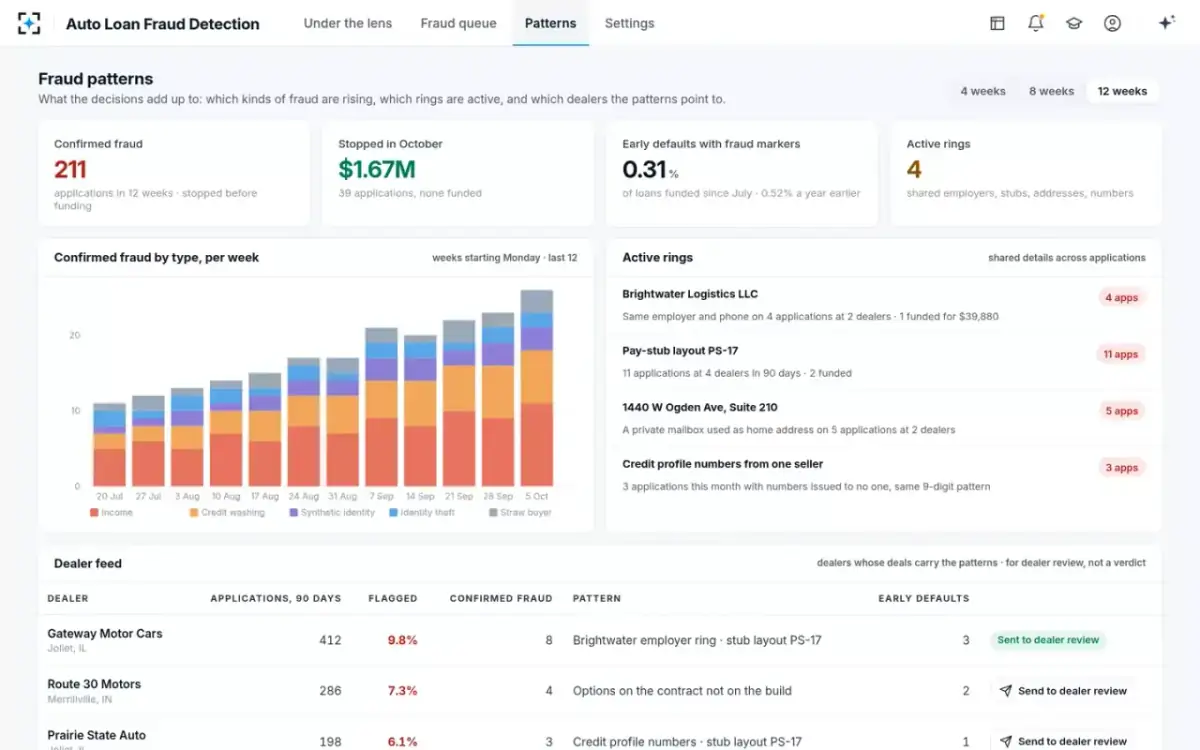
Confirmed fraud by type, and the early defaults that carry a marker
How to run an early payment default review on your own book
The review is not difficult and it is almost never resourced. Five steps, and the third is the one that gets cut.
Select on the event, not on suspicion. Every loan that misses its first scheduled payment enters the review. A selection based on a score reproduces the front door's blind spots inside the measurement meant to find them.
Reopen the funding package, not the collections file. The stubs, the statements, the licence scan, the bureau pull as it was on the day, and the stated income. Most lenders can produce the collections file in a minute and the funding package in a week, which is a systems problem worth fixing once.
Run the same tests the front door should have run. Recompute the stub against the pay calendar and the statutory rates. Look for payroll in the deposits. Date the employer from its state filing. Compare the bureau file with the lender's own earlier pulls. Search the sixty days of applications around it for shared details. If any of those produces a finding, the loan was not a credit loss.
Attribute, in a field somebody reports on. Application misrepresentation, affordability, a servicing or payment-setup failure, or a genuine early hardship. Four buckets are enough, and a fifth labelled "unknown" keeps the other four honest.
Feed it back as a change, not as a chart. A rule, a threshold, a stipulation that stops being waivable, a dealership that goes into review. The loop is the point; the chart is evidence that the loop ran.
What should a lender do when a loan defaults on the first payment?
Three things, in parallel, and the second is the one most organisations are not built to do.
Service the loan. The borrower may be a real person with a real problem, and the first call should be about the payment rather than about the application. Nothing on this page argues for treating a missed payment as an accusation.
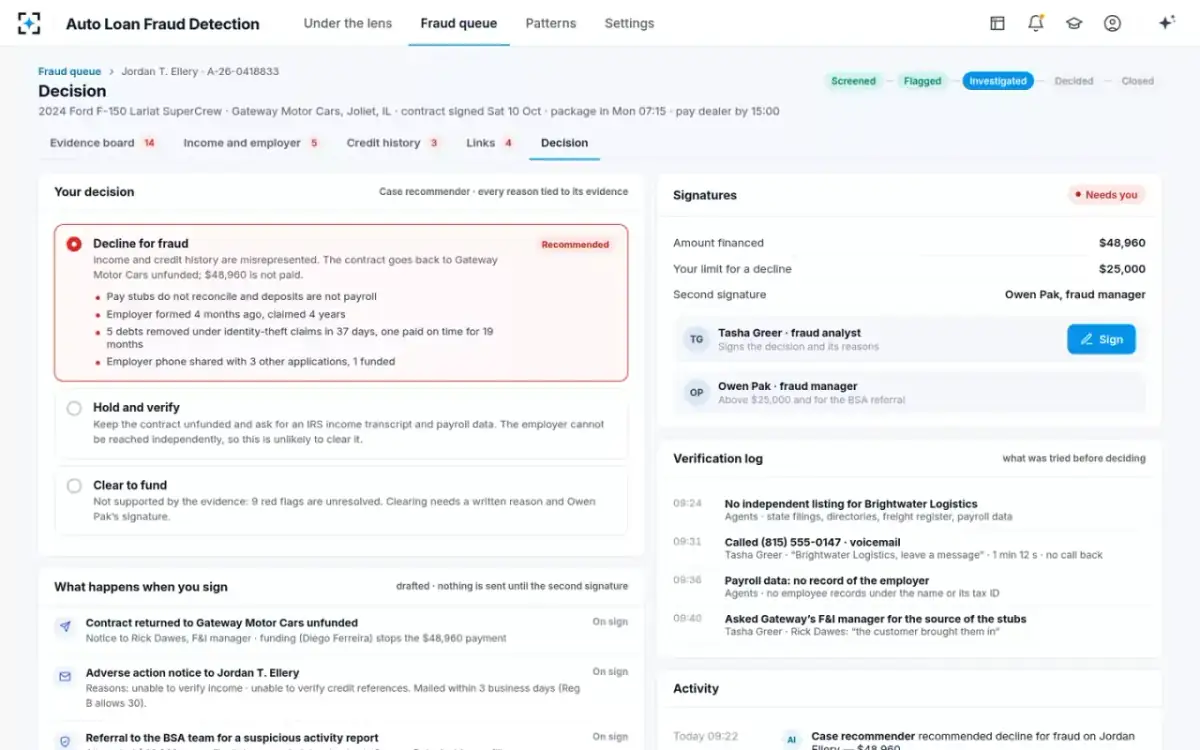
Read the application again, within days. The evidence is at its freshest, the neighbouring applications are still inside a search window, and the dealership still remembers the deal. In the sample case the trigger runs the other way and is better for it: a link pattern found on a deal still in the queue causes the analyst to open an early review of the loan that had already funded, before its first payment was due on 29 October. A welcome call and a payroll check at that moment is a service; the same call after a default is a collection.
Decide where the loss belongs, and say so out loud. The federal retail classification policy puts fraudulent loans on their own charge-off clock, so the attribution has a consequence beyond a report. And if the pattern is bigger than one loan, the referral goes to the team that carries the reporting duty, and the deals go to dealer review — as a reason to look rather than as a finding against anybody.
The decision, and what signing it sets in motion
To see the early review, the link pattern behind it and the weekly fraud-by-type view together, start from Auto Loan Fraud Detection.
Questions people ask
What is a good early payment default rate?
There is no published benchmark worth using, because the measure has no standard window, no standard denominator and no standard credit mix behind it. The number that matters is your own, measured the same way every month, cut by dealership and by whether a condition was waived. A lender whose rate is stable and whose attribution is improving is in better shape than one with a lower rate it cannot explain.
How long after funding is a default still worth investigating as fraud?
Through the first three scheduled payments, and the first is worth most. The argument is about what could have intervened: six weeks cannot absorb a job loss, an illness and a house move, so a first missed payment points at the application by elimination. By month six, real life has had time to supply an honest explanation, and the review becomes an underwriting exercise rather than a fraud one.
Does a repossession recover the loss on an early default?
Rarely in full, and the federal retail classification policy anticipates the shortfall: a loan with non-real estate collateral may be written down to the value of the collateral, less cost to sell, where repossession "is assured and in process", rather than charged off entirely. On a contract written above the vehicle's book value the gap exists from day one and widens while the car is unavailable, which is why loan-to-value and early default belong in the same report.
Why does fraud hidden in delinquency make a reserve wrong?
Because a reserve is an estimate of credit losses built from credit experience. Misrepresentation losses recorded in the delinquency line enter that estimate as though they were borrower behaviour, so they make the credit model look slightly worse than it is and the fraud controls look considerably better. Nothing in ordinary reporting ever corrects it: fraud totals are built from cases somebody opened, and these cases were never opened.
Who should own the early payment default review?
The fraud desk should run it and credit risk should receive it, with one named owner for the attribution field. Collections cannot own it: its job is recovery on a specific account, and the review's output is a change to a rule at the front door. In the sample lender the weekly view of confirmed fraud by type and of early defaults carrying fraud markers goes to the head of auto credit risk, which is the right reader for a number that moves a reserve.
Can a lender report an early default to the bureaus as fraud?
A furnisher reports what it knows to be accurate, and the status it reports is about the account rather than about a motive. What changes with a confirmed finding is internal: the classification, the charge-off clock, where the loss is attributed, and whether a referral is owed to the team that files suspicious activity reports. None of that requires a characterisation of the borrower's conduct on a credit file, and a lender should be slow to make one.