Credit washing is the practice of filing a false identity-theft claim so that real, defaulted accounts are blocked from a consumer's credit file, lifting the score that lenders then price against. It works because the Fair Credit Reporting Act deliberately favours speed over proof: a consumer reporting agency must block the disputed information not later than 4 business days after receiving an identity-theft report and three statements from the consumer. Nothing in that sequence asks the creditor whether the debt was real. Botminds' Auto Loan Fraud Detection answers the question the bureau file no longer can, by setting today's file beside every earlier pull the lender already holds and reading the payment history of each account that has gone.
Every person, employer and lender named below is fictional — characters and sample data in Auto Loan Fraud Detection, used here because the arithmetic is easier to follow on one deal than in the abstract. The rules and the figures from them are quoted and linked where they appear.
One applicant's file, 52 days apart
541
score when the same applicant, SSN and address were declined on 18 August
702
score on the 9 October application for a $48,960 truck
5
accounts, $26,815 of charged-off debt, blocked between those two dates
4days
the maximum the law allows a bureau to take over a block request
What is credit washing?
Credit washing is the removal of accurate negative information from a credit file by claiming it was somebody else's fraud. The accounts are the consumer's own: a charged-off car loan, a collection, a repossession. The claim is that an identity thief opened them. Once a bureau accepts the claim, the account stops appearing on reports, so the score built from those reports rises, and the next lender sees a thinner, cleaner file than the facts support.
It is worth being precise about the words, because three different things get called the same thing. A dispute under §611 asks a bureau to investigate whether an item is accurate, and the furnisher gets to answer. A fraud alert under §605A is a flag on the file asking users to verify identity before they lend. A block under §605B is the one that removes information, and it is the only one of the three in which the consumer's own statement, plus a report they filed, is the whole input.
Three things called a credit dispute, and only one of them removes an account
| The tool | What the consumer gives | What happens | What the lender sees |
|---|---|---|---|
| Dispute (§611) | A statement that an item is inaccurate | The bureau investigates with the furnisher; 30 days, 45 with new documents | The item, marked disputed, until it is corrected or confirmed |
| Fraud alert (§605A) | A request, and optionally a phone number | A one-year flag; the lender may not extend credit unless it forms a reasonable belief it knows who is asking | The alert, and a duty to call |
| Block (§605B) | Proof of identity, an identity theft report, the items, and a statement that they are not the consumer’s transactions | The bureau blocks the reporting of the items within 4 business days and notifies each furnisher | Nothing. The accounts are not in the file |
The block is the instrument of credit washing because it is the only one whose output is absence. A lender reading a disputed tradeline knows to slow down. A lender reading a file from which five accounts have been blocked sees no trace of them at all, and the score does not carry a footnote.
What is an identity theft block on a credit report, and what it hides
Section 605B is short and its conditions are mechanical. The bureau "shall block the reporting of any information in the file of a consumer that the consumer identifies as information that resulted from an alleged identity theft, not later than 4 business days after the date of receipt" of four things: proof of the consumer's identity, a copy of an identity theft report, the consumer's identification of the information, and "a statement by the consumer that the information is not information relating to any transaction by the consumer" (15 U.S.C. §1681c-2(a)).
Read the list again for what is not on it. There is no requirement that the furnisher agree, no investigation period, and no documentary test of the underlying transaction. The bureau's duty in subsection (b) is to notify the furnisher after the fact — that the information may be a result of identity theft, that a report has been filed, that a block has been requested, and when it takes effect. The creditor learns about it; the creditor does not decide it.
That design is deliberate and, for a real victim, humane: somebody whose identity has been stolen should not have to argue an account down tradeline by tradeline while a lender denies them a car. The cost of the design is that the same four inputs are available to a borrower whose own loan was repossessed.
How credit washing works, and the four business days the law gives it
In the sample case the sequence runs over 52 days and is visible only because the lender kept its own earlier pull. On 18 August a fictional applicant, Jordan T. Ellery, was declined through a dealer at a score of 541. Between 27 August and 2 October, five accounts carrying $26,815 of charged-off debt left the file under identity-theft blocks. On 9 October the same person, the same Social Security number and the same address came back through a different dealer at 702, and the application was for a $48,960 truck over 72 months.
Fifty-two days from a decline at 541 to an application at 702
- 18–26 Augaccounts present
- 27 Aug – 2 Octfive blocks · $26,815 removed
- 3–9 Octno trace of them
- 18 Augdeclined at 541
- Thirty-six daysthe furnisher is told, the next lender is not
- 9 Octapplies at 702
Five blocks in 36 days is not a coincidence of paperwork. Each one needed its own report and its own statement, and each one landed inside the four-day window. By 9 October the file was not merely better; it was a different credit, and the credit model that scored the application had nothing to disagree with.
What counts as an identity theft report, and what does not
The whole mechanism turns on one definition, and it is stricter than most lenders assume. An identity theft report must be "a copy of an official, valid report filed by a consumer with an appropriate Federal, State, or local law enforcement agency, including the United States Postal Inspection Service", and "the filing of which subjects the person filing the report to criminal penalties relating to the filing of false information if, in fact, the information in the report is false" (15 U.S.C. §1681a(q)(4)).
Regulation V adds the part lenders can actually use. A furnisher or a bureau may ask the consumer for more, and the rule gives it a clock: a request "not later than fifteen days after the date of receipt of the copy of the report", any supplemental request and a final determination "within another fifteen days", and five days to decide where documents arrive late in that second window (12 CFR 1022.3(i)). A furnisher that asks nothing has used none of the 30-odd days the rule gives it.
"the filing of which subjects the person filing the report to criminal penalties relating to the filing of false information if, in fact, the information in the report is false"
15 U.S.C. §1681a(q)(4), the definition of an identity theft report
So the honest summary is this: the report is self-written, it is accepted on its face, and the only thing standing behind it is a criminal exposure that is almost never tested. A fraud desk should treat the presence of a report as neutral evidence — it tells you a claim was made, not that a theft occurred.
Is credit washing illegal?
There is no offence called credit washing. There are two laws that the conduct usually runs into, and they are different in reach. The first is the criminal exposure the FCRA definition points at: a false identity theft report filed with a law-enforcement agency is a false report, and the statute's own definition is written on the assumption that it is punishable.
The second is the loan application itself. Under 18 U.S.C. §1014, knowingly making a false statement to influence the action of a federally insured bank or a federal or state-chartered credit union, on any loan application, carries a fine of up to $1,000,000 and up to 30 years (18 U.S.C. §1014). Read the list of institutions in that section closely before leaning on it: it reaches banks and credit unions, and it does not reach a stand-alone finance company, which has to rely on the general fraud statutes instead. A captive auto lender and a credit union, looking at the same washed file, are not in the same legal position.
For the fraud desk, the practical consequence of all this is narrower than it sounds. The lender is not prosecuting anybody. It is deciding whether to lend $48,960 on a credit history it can no longer see, and the law's main gift to that decision is the furnisher duty in the next section.
How a lender can tell credit washing from identity theft
Two tests do most of the work, and both use evidence a lender already owns.
The payment-history test. A thief who opens an account in somebody else's name does not service it. In the sample case one of the five blocked accounts, a fictional Kestrel Auto Credit loan, had been paid on time for 19 months before it defaulted. A thief does not make 19 payments. Nineteen on-time payments followed by a default is the shape of a borrower whose circumstances changed, which is a credit story, not a theft.
The earlier-pull test. The lender had pulled this applicant's file on 18 August and declined at 541. Nothing obliges a bureau to tell a lender which accounts were blocked, but nothing stops the lender comparing the file it has today with the file it printed seven weeks ago. The five accounts that are missing from the second pull are the list.
The same five blocked accounts, read two ways
A real identity-theft victim: Little or none. An account opened fraudulently is used and abandoned
A washed file: Months of on-time payments, then a default. In the sample case, 19 payments on one loan
A real identity-theft victim: The accounts are absent from older files too, or appear with a dispute already on them
A washed file: The accounts were on the lender’s own 18 August pull, under this name, SSN and address
A real identity-theft victim: Usually none — the victim was not applying
A washed file: A decline at 541 through another dealer, seven weeks before
A real identity-theft victim: A police report, a case number, often a creditor’s fraud confirmation
A washed file: A self-certified report filed online, with no police report on file
A real identity-theft victim: One event, often many accounts at once, in a tight window around the discovery
A washed file: Five blocks staggered over 36 days, on accounts of different ages
A real identity-theft victim: Unchanged. The victim did not move
A washed file: Often a new phone or a recently ported number on the new application
Neither test is conclusive alone, and the asymmetry of the error matters. Treating a genuine victim as a suspect is the worse mistake: they are already carrying somebody else's fraud, and a decline for "unable to verify credit references" adds a second injury. That is why the rule in the solution is a floor of two or more blocks within 90 days on accounts that carry an on-time payment history, not a flag on any block at all, and why a documented victim — a police report, or a creditor's own fraud confirmation — is never treated as a suspect.
Every account that left the file, with the payment history it left behind
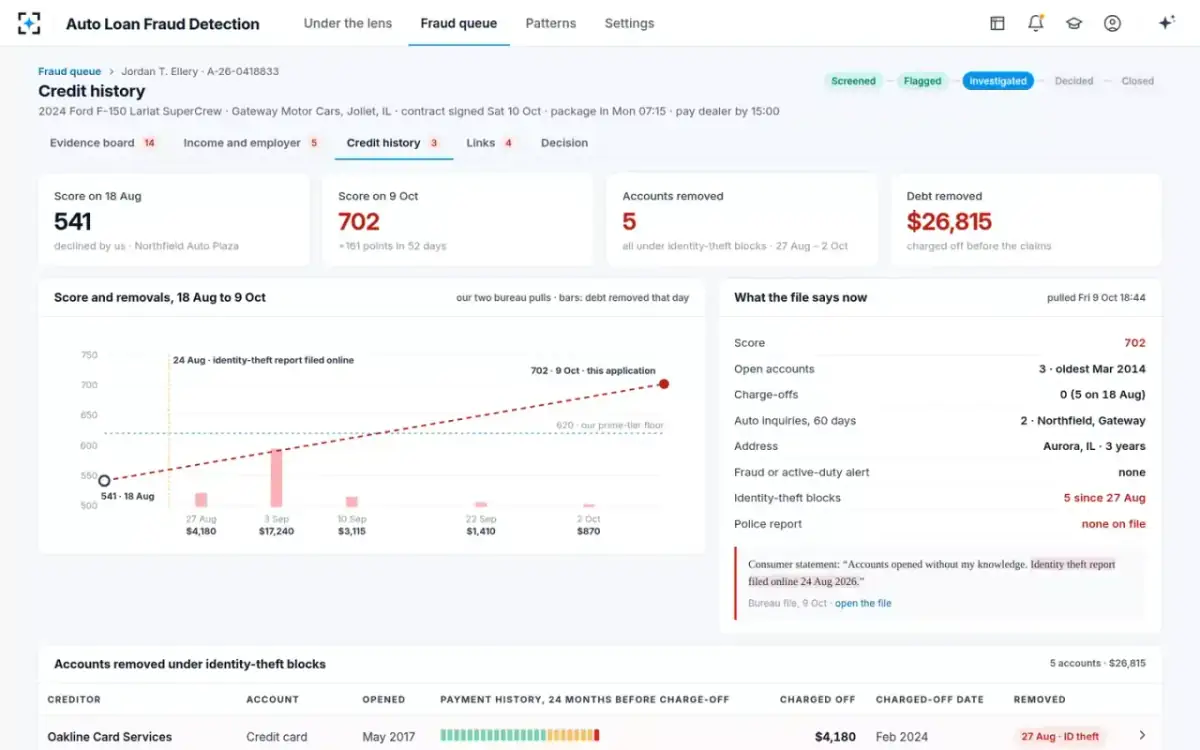
How do lenders detect credit washing? The comparison most never make
Most lenders detect credit washing by accident, months later, when a loan misses its first payment and somebody pulls the file. The comparison that would have caught it is cheap and almost nobody runs it: today's bureau file against the lender's own earlier pulls of the same consumer.
The reason it goes unrun is organisational rather than technical. Earlier pulls sit in the origination system attached to a dead application, not to a person; the fraud desk works from today's file; and the 15:00 funding cutoff decides how deep anybody goes. In the sample queue, 47 flagged deals are open and 19 of them have contracts the dealers expect paid before the cutoff. An analyst with 47 cases does not go looking for a 7-week-old decline on each one.
In Auto Loan Fraud Detection the comparison is a step rather than an errand. One of the six agents, the credit history analyst, sets the current file against every earlier pull the lender holds, lists each account removed or blocked since, and tests the result against the credit washing rule in the lender's own settings. Two of its limits matter as much as its output: it never treats a documented identity-theft victim as a suspect, and a police report or a creditor confirmation reopens the case. The identity theft prevention program the Red Flags Rule requires is where that rule is written down and approved.
Six checks on a file you suspect has been washed
- Pull your own earlier reports on this consumer, by name, Social Security number and address
Not by application. The whole point is that the person came back under a different deal, often at a different dealer.
- List what is missing, not what is there
Blocked accounts leave no mark. The difference between two pulls is the only inventory you will get.
- Read the payment grid on each missing account
Months of on-time payments before a default is the single strongest sign the debt was the consumer’s own.
- Ask for the report, and ask inside fifteen days
Regulation V lets a furnisher request further documentation within fifteen days of receiving the report, with a further fifteen to decide.
- Check whether a police report exists, separately from the online report
The statutory definition contemplates a report filed with a law-enforcement agency. Its absence is not proof of anything, but its presence changes the case.
- Decide on the application in front of you, and say so in the reasons
The decision is whether income and credit history are verifiable, not whether a crime occurred. Keep the adverse action reasons to what you tested.
What FCRA 605B lets a lender do about a file it believes is washed
Two provisions matter, and they point in opposite directions.
The first is the bureau's power to undo a block. Section 605B(c) says a consumer reporting agency "may decline to block, or may rescind any block" where it reasonably determines that the information was blocked in error, that the block was requested "on the basis of a material misrepresentation of fact by the consumer relevant to the request to block", or that "the consumer obtained possession of goods, services, or money as a result of the blocked transaction or transactions" (§1681c-2(c)). That third clause is the one a car describes exactly. The power is the bureau's, not the lender's; what the lender can do is give the bureau and the original furnisher the facts.
The second is the furnisher's own duty, and it cuts the other way. Under §623(a)(6)(B), a creditor that receives an identity theft report about information it furnishes "may not furnish such information that purports to relate to the consumer to any consumer reporting agency, unless the person subsequently knows or is informed by the consumer that the information is correct" (15 U.S.C. §1681s-2(a)(6)(B)). So the original lender on the charged-off loan is required to stop reporting it — until it knows the information is correct. Nineteen months of its own payment records is how it comes to know.
For the lender looking at the new application, the sequence is therefore: decide the application on what you can verify, refer the pattern to whoever files suspicious activity reports, and send the original furnisher what you hold. None of that requires a view on whether a crime took place, which is the right posture for a fraud analyst at 10:38 on a Monday.
How long does an identity theft block take to come off?
Going on is fast and coming off is slow, which is the asymmetry the whole problem rests on. The block goes on within four business days. There is no statutory clock for a rescission: §605B(c) gives the bureau the authority and no deadline. In practice the account comes back when the original furnisher resumes reporting it, and the furnisher may not resume until it knows the information is correct.
What that means for an auto lender is that the washed file in front of you today will probably still be washed next month, and the applicant knows it. The practical window is the one you control: the 3 hours and 27 minutes in the sample case between the funding package arriving at 07:15 and a signed decline at 10:42. It is a shorter clock than the bureau's, and it is the only one in which the money is still yours.
Fourteen red flags in five lanes, and one green card
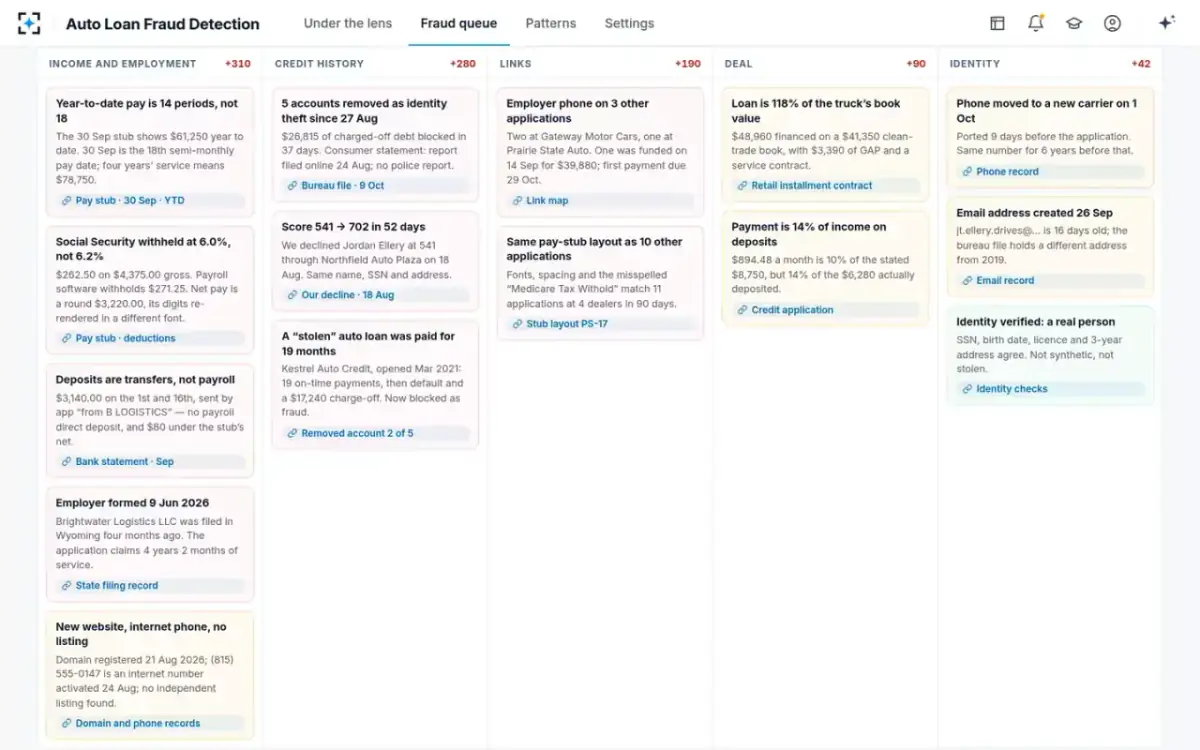
Where credit washing surfaces next
A washed file rarely travels alone. In the sample case the same application also claimed $8,750 a month from an employer formed in Wyoming four months earlier, against $6,280 of deposits — a pay stub problem, not a bureau problem, and the arithmetic that catches a fake pay stub is a separate test with separate evidence. The same employer and phone turned up on three other applications at two dealers, one of them already funded.
That combination is the reason credit washing belongs on the fraud desk rather than in credit policy. It is a borrower acting on their own behalf, with their own real identity, to misrepresent their own history — the definition of first-party fraud, and why identity controls never see it is worth reading next if your fraud reporting is organised around identity theft. The Red Flags Rule's own list of illustrative red flags includes "an account that was closed for cause or identified for abuse of account privileges by a financial institution or creditor" as a pattern inconsistent with an applicant's history (16 CFR 681, Supplement A) — but a closed-for-cause account that has been blocked is not in the report to be inconsistent with.
To see the credit comparison, the payment grids and the decision together, start from Auto Loan Fraud Detection.
Questions people ask
What is the difference between credit washing and a credit sweep?
They describe the same mechanism from different ends. A credit sweep is the service — the filing of identity-theft claims across a file to clear it — and credit washing is the result a lender sees. Neither is a legal term. The legal instrument underneath both is the block at FCRA §605B, which obliges a bureau to stop reporting identified information within four business days of receiving the consumer's report and statements.
Can a lender report a washed account back to the bureau?
Only once it knows the information is correct. Under §623(a)(6)(B) a furnisher that receives an identity theft report may not furnish that information "unless the person subsequently knows or is informed by the consumer that the information is correct". A payment history showing the consumer serviced the account for months is the kind of knowledge that satisfies the exception, which is why the original lender's own records, not the new lender's suspicion, are what gets an account reinstated.
Does a police report prove identity theft?
No, and no lender should treat it that way in either direction. The statutory definition of an identity theft report contemplates an official report filed with a law-enforcement agency, whose filing exposes the filer to criminal penalties if it is false — that is a deterrent, not a finding. A police report makes a claim substantially more credible and should move a case toward the victim reading; its absence proves nothing on its own.
Is an identity theft block the same as a credit freeze?
No. A freeze stops new lenders from pulling the file at all, and the consumer lifts it when they want credit. A block removes specified information from the file while leaving the file available. A freeze protects a victim going forward; a block changes what history says. Only the second one moves a score.
How much can a score move after a block?
As much as the removed accounts were costing. In the sample case five accounts carrying $26,815 of charged-off debt came off and the score moved 161 points, from 541 to 702 — enough to cross most lenders' boundary between a decline and an approval, which is the whole purpose. Treat any large move over a short period as a question rather than an answer: a genuine victim's score can move just as far.
What should a lender do if the applicant really is a victim?
Decide the application on what can be verified, and say nothing in the reasons about fraud you have not established. If a fraud alert is on the file, §605A obliges the lender to form a reasonable belief it knows who is asking, and to call the number the consumer gave for verification if they gave one. In Auto Loan Fraud Detection a documented victim is never treated as a suspect, a fraud alert always means a call before credit, and a police report or a creditor's confirmation reopens a case the desk has already closed.