Auto loan fraud detection software screens applications and their funding packages for inflated income, invented employers, borrowed or assembled identities, washed credit files and straw purchases, before the lender pays the dealer. Buying one well is mostly a matter of resisting the demonstration: a vendor's sample case will always look decisive, and the two things that decide whether the system survives contact with your funding desk — the reason a declined applicant receives, and the result on files you already know the answer to — are both things you have to insist on testing. Botminds' Auto Loan Fraud Detection is one of the systems in this market, and this guide is written so you can interrogate it as sceptically as any other.
Where the solution's own figures appear below they are sample data on a fictional lender, a design target, or our estimate, and each says which. The rules are quoted and linked.
The two architectures you will be shown, and what each leaves on your desk
Score-first: A ranked queue and a score, with contributing factors named in general terms
Evidence-first: A ranked queue and, per deal, findings already made, each tied to the line, page or record it came from
Score-first: The analyst, after the score has told them which deals to read
Evidence-first: The system, before the case is opened; the analyst reads the findings and the documents behind them
Score-first: What the analyst can establish in the time left before the cutoff
Evidence-first: What was measured: the arithmetic, the deposits, the formation date, the earlier pull
Score-first: Unchanged. The score changes which deals get the time, not how long each takes
Evidence-first: The mechanical part collapses; the judgement at the end becomes most of the work
Score-first: The model, its governance, and the queue
Evidence-first: The same, plus for each deal the findings, their sources, who decided and when
Score-first: A high score with nothing behind it, declined at 14:55 because nobody had time to look
Evidence-first: A finding that is true and irrelevant, cleared by a person — which costs a minute, not a loan
What is auto loan fraud detection software, and what should it do?
It is software that sits between an application and the money, and it has five jobs. Score and rank every application, so a desk with a cutoff works the right deals first. Read the funding package — pay stubs, bank statements, licence scans — and test it. Check the identity against sources the applicant does not control. Compare the credit file with what the lender itself has seen before. And find the links between applications, because fraud repeats.
What it should produce is not a verdict. It should produce a case: a set of findings, each naming the document line or record behind it, assembled fast enough that a person can decide before the dealer expects to be paid. The reason that framing matters is legal as well as operational, and the next section is about it.
Two scoping questions are worth settling before you look at any product. First, does the problem you are buying for sit at application or at funding? Scoring an application is cheap and early; reading a funding package is the expensive part and the part most products do least well. Second, is your exposure first-party or third-party? Identity-centred products and document-centred products are good at different things, and the distinction between the two frauds will tell you which half of your losses a given product is pointed at.
Can software decline a loan application?
Technically, usually. Sensibly, no — and the reason is a rule rather than a preference.
Regulation B obliges a creditor to notify an applicant of action taken within 30 days of a completed application, and the notice must contain either "a statement of specific reasons for the action taken" or a disclosure of the right to one on request (12 CFR 1002.9(a)). Those reasons are then constrained: they "must be specific and indicate the principal reason(s) for the adverse action", and "statements that the adverse action was based on the creditor's internal standards or policies or that the applicant, joint applicant, or similar party failed to achieve a qualifying score on the creditor's credit scoring system are insufficient" (12 CFR 1002.9(b)(2)).
So a system whose output is a number cannot, on its own, produce a compliant decline. Someone has to be able to say what was relied on. That does not stop a lender automating a decline where the reasons are themselves specific and verifiable; it does mean that the architecture question — what evidence does the system hand a person — is settled before any accuracy argument begins. It is also why the rule's own list of permitted responses includes "determining that no response is warranted": the framework assumes a judgement, not a threshold.
What reason do you give an applicant declined for fraud?
Reasons about verification, not about fraud you have not established. The honest pair in most first-party cases is "unable to verify income" and "unable to verify credit references", and each has to be true: you asked, the applicant did not or could not satisfy it, and the file records what was asked.
Regulation B also provides the better route in many fraud cases, which lenders under-use. Where an application is incomplete in a respect the applicant can complete, the creditor may send a notice of incompleteness specifying "the information needed, designating a reasonable period of time for the applicant to provide the information, and informing the applicant that failure to provide the information requested will result in no further consideration being given to the application" (12 CFR 1002.9(c)(2)). A stipulation for payroll data or an IRS transcript is exactly that notice. The applicant who can satisfy it does; the one who cannot has not been accused of anything.
Two things never belong in the notice: the fraud score, and a characterisation of the applicant's conduct. The first is insufficient as a matter of rule. The second is a claim you would have to defend, and nothing about a funding decision requires you to make it.
How to choose fraud detection software for an auto lender: twelve questions
Ask these in a demonstration, in this order, and insist on the demonstration being run on a file you supply rather than the vendor's.
Twelve questions, and the answer that should worry you
- Show me a decline notice this system produced. Which words came from the software?
Worrying answer: "the reasons are configurable." Ask to see one, on a real deal, with the reasons traced to findings.
- Open the pay stub and show me the arithmetic you ran on it.
Worrying answer: a confidence percentage with no arithmetic behind it. You want year to date against the pay calendar, the two statutory tax rates, and net pay against the deduction column.
- What did you read that the applicant did not write?
Worrying answer: only the application and the bureau file. You want bank deposits, a state formation date, a domain age, a phone line type.
- Compare today’s bureau file with our own earlier pull on the same person.
Worrying answer: "we use the current report." Blocked accounts leave no trace in the current report, so this comparison is the only way to see them.
- What does each component refuse to do?
Worrying answer: nothing. Stated limits — never declines, never treats the application’s own phone as proof, never treats a documented victim as a suspect — are what makes an automated case defensible.
- Where is the threshold, and who changes it?
Worrying answer: the vendor. Score bands, document tolerances, approval limits and the cutoff are your policy; you should be able to change them, with a version history and an approver.
- Run it on fifty deals we have already closed, including ten we funded and regret.
Worrying answer: "the model needs to be trained on your data first." That may be true, and it is also the point of the exercise — agree what the pilot proves either way.
- What is the false positive rate at the threshold you are proposing, on our mix?
Worrying answer: a single number from another lender’s book. Different dealer channels and credit tiers produce different rates.
- How long does one case take end to end, on our document sizes?
Worrying answer: a figure that excludes document ingestion. Measure from the package arriving to the findings being readable.
- Who do we call when the system is wrong about a real customer?
Worrying answer: a support queue. A wrongly declined applicant is time-critical, and someone has to be able to reopen a case the same day.
- Show me the audit trail for one decision, as an examiner would see it.
Worrying answer: logs. You want who, what and when against each step and each decision, and the rule version in force at the time.
- What happens to a deal still open at our funding cutoff?
Worrying answer: it funds. The only safe default is that an undecided flagged deal is held, and that is a policy you should be able to set.
One meta-question is worth more than any of the twelve: ask what the system does when it disagrees with itself. In the sample case published with Auto Loan Fraud Detection, one card on the evidence board is green — identity verified, a real person — while thirteen others are red. A product that cannot hold that shape, and insists on resolving everything into one number, has thrown away the information that tells you which kind of fraud you are looking at.
The queue a cutoff actually produces
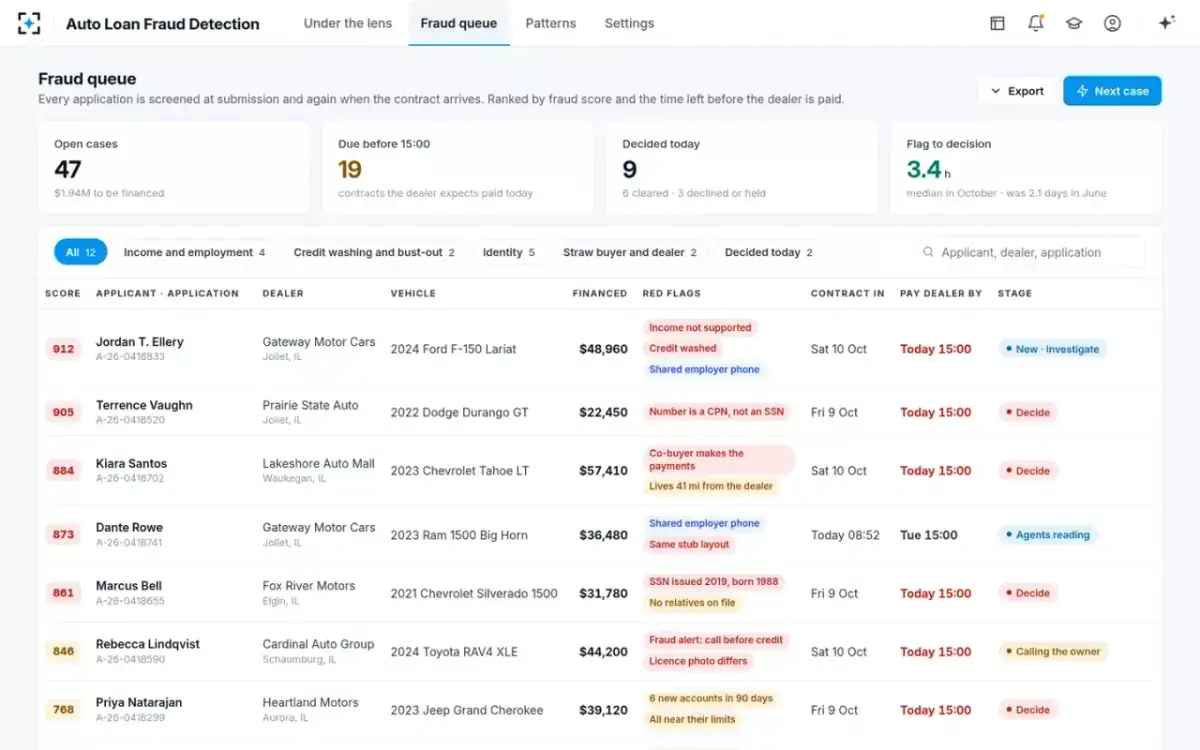
How do you pilot fraud detection software on your own closed files?
A pilot on live deals tells you about operations and nothing about accuracy, because you do not know the answers. A pilot on closed files tells you about accuracy, because you do. Run the second one first.
The design is simple and the discipline is in the sampling. Take deals you closed between twelve and thirty months ago — old enough that performance is known, recent enough that your documents and dealers look like today's. Include four groups deliberately: deals you declined for fraud and were sure about, deals you funded that went to an early payment default, deals you funded that performed perfectly, and deals you declined for credit reasons alone. The fourth group is the one that catches a system that merely re-derives the credit score.
A six-week pilot that produces a decision rather than an impression
- Week 1agree what it proves
- Week 2load closed deals
- Weeks 3–4run it blind
- Week 5read disagreements
- Week 6set thresholds
Week five is where the value is. For each deal the system and your analysts disagreed about, write down why in one sentence. Two categories will emerge. In the first, the system saw something your team did not have time to look at — that is the purchase case, and it is usually documentary. In the second, the system flagged something true and irrelevant: a small employer paying by transfer, a legitimate mid-year pay change, a thin file belonging to a real young borrower. Those are the cost, and you should be able to price them before you sign.
Set thresholds only after that read. Every product arrives with a default band — in the sample lender's settings the fraud queue starts at score 700 and decline review at 850, on a scale configurable from 500 to 900 in steps of 25 — and a default band is a guess about a book that is not yours.
What data does fraud detection software need before the pilot?
More than vendors ask for, and the gap is usually where a pilot stalls. The table below is the load list for an evidence-first system; a score-only system needs the first two rows and will produce a correspondingly thinner answer.
What to load before the pilot starts, and why each one earns its place
| What | Why it is needed | Where it usually lives |
|---|---|---|
| The credit application and the retail installment contract | The stated position the whole test is against, plus the dealer and vehicle | Origination system |
| Today’s bureau file and every earlier pull you hold on the same consumer | Accounts blocked out of the current report are visible only as the difference between two pulls | Origination system, often attached to a dead application rather than to a person |
| The funding package as it arrived: stubs, statements, licence scans, as PDFs or photos | The document tests need the original file, not a re-rendered copy. A re-saved PDF loses the edit history | Document store, or the dealer portal |
| Your fraud policy as settings: score bands, income proof thresholds, document tolerances, approval limits, the cutoff | A pilot run on a vendor’s defaults measures the vendor’s policy, not yours | A policy document nobody has turned into parameters yet |
| Sixty to ninety days of applications around each pilot deal | Link detection needs neighbours. One deal in isolation cannot show a shared employer or a repeated stub layout | Origination system |
| Outcomes: what you decided, and how each funded loan performed | Without outcomes there is no measurement, only a demonstration | Servicing and collections, which is a different team |
| Payroll or IRS transcript access, where your policy requires it | Income from a source the applicant cannot edit. It needs the applicant’s consent, so it rarely exists on closed files | A verification vendor, or Form 4506-C |
The seventh row deserves its caveat. The IRS route is consent-based by design — the service "lets you authorize banks and lenders to access your tax records", and "the IRS only provides tax records to a third party with the consent of the taxpayer" (IRS, Income Verification Express Service) — so a retrospective pilot will not have it. Test the rest of the stack on closed files, and test the transcript step on live deals once the policy threshold exists.
Who signs, and the limits worth setting
Buying the software is the smaller half of the decision. The larger half is who may decide what, and that is a set of numbers you should settle before the system goes anywhere near a live deal.
Four seats, and what each one should own
Today
Works whatever part of the queue the cutoff allows, mostly by calling employers and re-reading stubs
With agents
Opens each flagged deal with the findings already made and the sources one click away
Still theirs: The decision on every flagged application, and the signature on it
Today
Learns which signal was missed after a loss
With agents
Sees the rule that produced each finding, and the version history of every change to it
Still theirs: The second signature above the analyst’s limit, every referral, and ownership of the rule set
Today
Chases the fraud desk for an answer before the dealer has to be paid
With agents
Sees every flagged contract with the time left before the dealer is paid
Still theirs: The funding action — and the default that an undecided deal is held, not funded
Today
Reads a delinquency line that contains fraud nobody has attributed
With agents
Sees confirmed fraud by type, the active patterns and the early defaults carrying fraud markers
Still theirs: The reserve, and the choice of where review time is spent
Three limits are worth writing down before go-live even if you buy nothing. An undecided flagged deal at the cutoff is held rather than funded. A fraud alert on a credit file means a call before credit, because the FCRA obliges a user of the report to "form a reasonable belief that the user knows the identity of the person making the request" and, where the consumer gave a number for verification, to contact them on it (15 U.S.C. §1681c-1(h)). And a documented identity-theft victim is never treated as a suspect, which has to be a rule rather than an instinct, because the pattern that catches credit washing is the same pattern a real victim produces.
Auto loan fraud detection software vs manual review
The comparison is usually posed as accuracy against cost, and that is the wrong axis. A good analyst reading one deal carefully beats any system. The constraint is that nobody reads one deal; they read a sample of forty-seven before a cutoff, and the sampling is where the losses enter.
What the shift actually changes, on the sample lender
82s
for the six agents to read 14 sources and assemble the evidence board
sample data
3.4h
design target from a flag to a signed decision, against about two days for a hand-worked sample
target, and our estimate for the baseline
47
flagged deals open at once, of which 19 have contracts due to be paid before the cutoff
sample data
3.00%
of auto loan balances nationally flowed into serious delinquency in one quarter
New York Fed, Q2 2026
So the honest comparison is not "software versus an analyst". It is "every flagged deal read, with a person deciding" versus "a sample read, with a person deciding". The second is cheaper per deal and more expensive per book, and the size of that difference depends entirely on how many deals your desk currently cannot get to — which is a number you already have.
How much does fraud detection software cost to run, in people and hours?
We found no independent public price data for this category, and any figure a vendor quotes for a competitor should be treated as marketing. What can be reasoned about honestly is the running cost in your own people, which is usually the larger number anyway.
Three drivers decide it. Volume through the queue, which your threshold sets: dropping the queue band by 50 points can double the cases a desk sees. Time per case, which the system changes by collapsing the mechanical part — in our estimate for one flagged indirect deal, recomputing stubs and reading statements falls from about four hours to half an hour, employer checks from four hours to half an hour, the bureau comparison from two hours to a quarter, and searching other applications from three hours to a quarter, while writing the decision, the second signature and the funding hold barely move. The cost of a false positive, which is a real applicant's deal, a dealer's complaint and an analyst's time, and which you should price from your pilot's week five rather than from a vendor's benchmark.
Two costs are routinely left out of business cases. The first is the referral work: where a bank is subject to the duty, a suspicious activity report is due "no later than 30 calendar days after the date of initial detection", with supporting documentation kept for five years (31 CFR 1020.320) — more detection means more of that work, and it is a real person's week. The second is the early-review work on loans already funded that a link pattern implicates; in the sample case one linked loan had already been funded for $39,880, and somebody has to work it.
Where it fits, and four things it will not do
Auto loan fraud detection software fits where documents arrive from third parties under time pressure and a person has to decide before money moves — which describes indirect auto lending almost exactly. It fits badly where the fraud is in servicing behaviour rather than in the application, and it adds little to a direct channel where the lender collected every document itself.
Four honest limits, and they apply to Auto Loan Fraud Detection as much as to anything else in the market.
It will not verify income on its own. The arithmetic can show a stub is wrong. Only payroll data or an IRS transcript shows what someone earns, both need the applicant's consent, and both take time the cutoff may not have. The software's real contribution is deciding which deals are worth spending that time on.
It will not tell you whether a dealer is complicit. It can show that eleven applications at four dealers in ninety days share a stub layout, misspelling and all. Whether that is a dealer running a scheme, a dealer being used, or an F&I office with a bad habit is a judgement for a person who knows the dealer. In this solution patterns go to a dealer feed for relationship review, and the link component is explicitly barred from accusing a dealer.
It will not make the decision. Not as a matter of product design but as a matter of rule: the applicant is owed principal reasons, and a score is insufficient. Any product that offers to take the decision off your desk is offering you a compliance problem.
It will not find fraud you never ask it about. Red flag 20(b) in the rule's own list is a customer who "fails to make the first payment or makes an initial payment but no subsequent payments" (16 CFR 681, Supplement A) — written as an example for new revolving accounts, but the list is illustrative, and it describes an auto contract's early payment default exactly. If your early defaults go to collections and never back to the application, no amount of software at the front door will tell you how much of your delinquency line is fraud.
What signing actually sets in motion
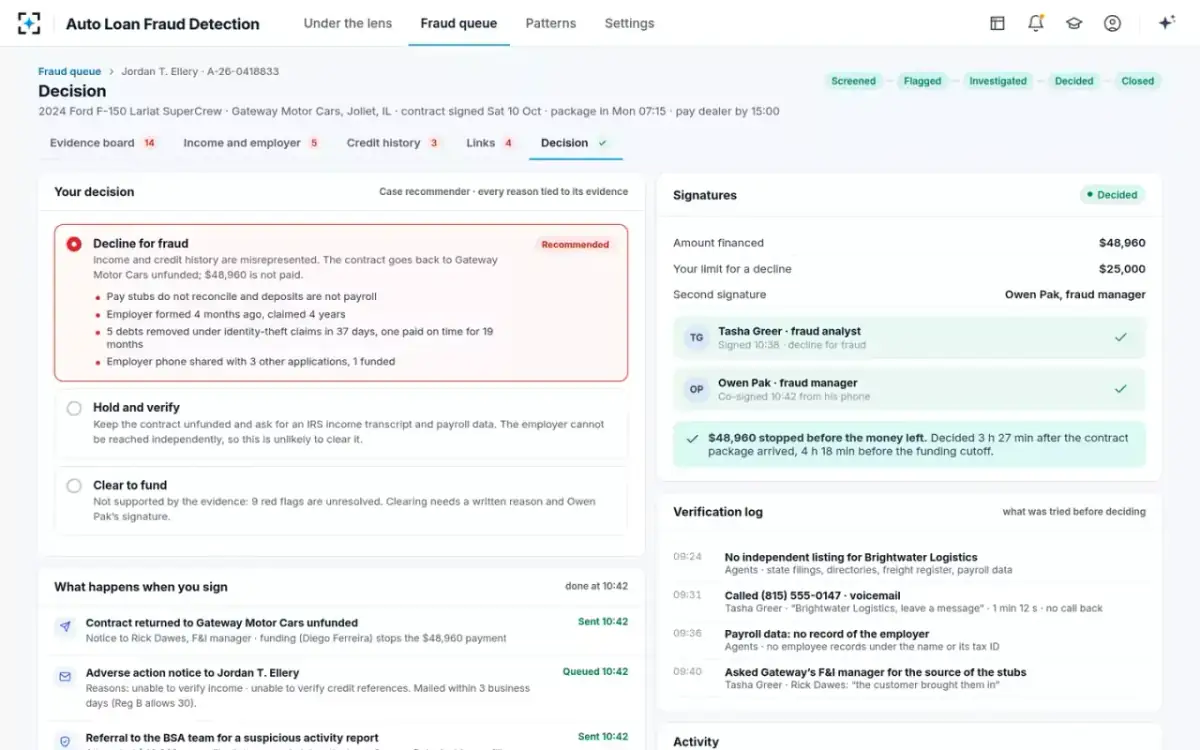
Before the buying conversation, it is worth reading the two tests a fraud desk runs most often, because they are what a demonstration should be made to perform: the arithmetic on one pay stub and the comparison that finds a washed credit file. Then start from Auto Loan Fraud Detection and ask it the twelve questions.
Questions people ask
What should we test first in a demonstration?
A decline notice. Ask the vendor to show one the system produced on a real deal and to trace each reason back to a finding, then to a document line. It takes five minutes and it separates products that assemble evidence from products that rank risk, which is the distinction every other answer depends on. The second thing to test is a document you supply, not one they bring.
Should a pilot run on live deals or closed files?
Closed files first, because you know the answers and can measure. Live deals second, because they are the only way to learn whether the system fits the clock — whether findings are readable before the funding cutoff, whether the hold behaviour works, whether the desk trusts what it sees. A pilot that skips the closed-file stage produces an impression rather than a measurement.
How many deals does a credible pilot need?
Enough to see each group you care about, which usually means somewhere between fifty and a hundred and fifty: confirmed fraud declines, early payment defaults, clean performers and credit-only declines. What matters more than the total is that the mix resembles your book and that the fourth group is present, because a system that merely re-derives the credit score will look excellent until you include deals that failed on credit and nothing else.
Who should own the fraud rules once it is live?
One named person, with a version history behind every change. In the sample lender in Auto Loan Fraud Detection the fraud manager owns the rule set, approves each change and co-signs declines above the analyst's limit. The Red Flags Rule points the same way: it requires board or senior-management oversight, specific responsibility for implementation, and at least annual reporting on compliance.
Does buying software satisfy our Red Flags Rule obligations?
It can satisfy the detection element for the red flags it actually reads, and nothing more. The rule asks a lender to identify relevant red flags, detect them, respond appropriately and keep the programme current, and it makes the lender responsible for oversight of service provider arrangements — the guidelines suggest requiring a provider by contract to detect relevant red flags and either report them or act on them. The obligation stays with you; what you can buy is part of the second element.
What is the biggest avoidable mistake in this purchase?
Accepting the vendor's thresholds. Score bands, document tolerances and income-proof triggers determine how many cases your desk sees and how many real customers are inconvenienced, and a default band is a guess about somebody else's book. Set them from your own pilot curve, write them down as policy with an approver, and keep the ability to change them without a release.