AI fraud detection in lending is good at reading everything and bad at being accountable for anything. It can recompute every pay stub in a funding package, cross-check an identity against five sources, compare a credit file with a pull from seven weeks ago and search ninety days of applications for a shared phone number — all before a person opens the case. What it may not do is decide, and that is a matter of rule rather than of taste: a declined applicant is owed the principal reasons, those reasons must describe the factors actually considered, and a statement that an applicant failed to reach a qualifying score is insufficient. Botminds' Auto Loan Fraud Detection publishes a limit beside every component for exactly this reason, and the limits are the product.
Where a figure below comes from Auto Loan Fraud Detection it is sample data on a fictional lender and applicant, or a design target, and says which. The rules, the interpretations and the supervisory guidance are quoted and linked where they appear.
One declining decision, by who holds the authority at each step
Agent
RankingScores every application at submission and again when the contract and the conditions arrive, and orders the queue by score and by the funding cutoff.
Never: Declines anything. A rank is a statement about where to spend attention
Agent
Reading the documentsRecomputes each stub against the pay calendar and the statutory rates, reads statements for payroll, and dates the employer from public filings.
Never: Concludes that a person lied. It produces two numbers and the rule that separates them
Agent
Cross-checking identityTests the licence, the number’s issue date against the date of birth, address history and the age of the phone and email.
Never: Decides identity theft on one signal. A fraud alert always means a call first
Agent
Assembling the caseCollects every finding with the document line or record behind it, and drafts a recommendation, the reasons, the dealer notice and the referral.
Never: Declines, files or moves money. Every reason names its evidence
A person decides
Choosing the reasonsReads the findings and the documents behind them, decides what was actually relied on, and signs. The reasons on the notice are the ones this person reviewed.
Never: —
A person decides
The second signatureCo-signs a decline above the analyst’s limit and every referral, and owns the rule set that produced the findings.
Never: —
Can AI detect loan fraud? What it is good at, and what it cannot be trusted to do
Yes, within a boundary that is easy to state and easy to forget. Three things it does better than a desk under time pressure, and three it should not be asked to do at all.
It reads everything. A fraud desk with forty-seven open cases and a funding cutoff samples; software does not. That difference — every flagged package read rather than a selection — is the whole operational case, and it has nothing to do with being cleverer than an analyst.
It is reproducible. "Year to date divides into fourteen pay periods and the stub is dated on the eighteenth" is the same sentence today and at an examination next year. An impression is not.
It sees across files. Shared phones, employers, addresses and document layouts are invisible one application at a time and obvious across ninety days of them.
And three it cannot carry. It cannot establish intent, which is the difference between a wrong number and a lie. It cannot weigh the cost of being wrong about a particular person, because that cost is not in its inputs. And it cannot be accountable: an adverse action notice is a statement by a creditor about what a creditor relied on, and there has to be somebody who relied.
How does AI fraud detection work in lending?
In practice it is five jobs, and only the first is what people usually mean by a model.
Ranking. A score over structured attributes — application velocity, shared details, data inconsistency, deal structure — that decides the order of work. This part is a statistical model in the ordinary sense, and the supervisory guidance quoted further down is about it.
Document reading. Extracting figures from a stub or a statement, recomputing them, and examining the file itself for re-set text, regions saved at a different compression from the page, and editing objects. Most of the useful output here is arithmetic, not prediction.
Cross-checking. Setting one source against another: the number against the birth date, the address against the report's address history, the employer against a state filing and a domain registration.
Searching. Finding the neighbours of an application across dealerships and across time.
Assembling. Turning all of it into a case a person can read in minutes, with each finding opening the line or record it rests on, plus a drafted recommendation, reasons, notice and referral.
It is worth noticing how little of that list is prediction. The findings that actually carry a decline in an auto file are almost always arithmetic and public-record facts — a pay calendar, a statutory withholding rate, a formation date, a bureau comparison — and the four calculations on one pay stub are a better demonstration of what this software is for than any accuracy figure.
Can AI decline a loan application? The rule that decides the architecture
Technically, usually. Defensibly, not on its own — and the reason is in Regulation B rather than in anybody's AI policy.
The notice a declined applicant receives has required contents: a statement of the action taken, the creditor's name and address, the notice of the Equal Credit Opportunity Act's provisions, the name and address of the federal agency that administers compliance, and either "a statement of specific reasons for the action taken" or a disclosure of the right to one on request (12 CFR 1002.9(a)(2)). Then the reasons themselves are constrained.
"Statements that the adverse action was based on the creditor's internal standards or policies or that the applicant, joint applicant, or similar party failed to achieve a qualifying score on the creditor's credit scoring system are insufficient."
12 CFR 1002.9(b)(2), Regulation B
That sentence settles the architecture question before any argument about accuracy begins. A system whose output is a number cannot produce a compliant decline by itself, because the number is the one thing the rule names as insufficient. What a lender needs from software is therefore evidence, in a form a person can read, choose from and sign under — which is a different specification from "a better score", and it is the specification to put in a tender.
None of this prohibits automation. A lender may decline automatically where the reasons are themselves specific, verifiable and genuinely the ones relied on. The question to ask of any such design is simply: if an applicant telephones and asks why, can the lender answer in terms it actually tested?
What reason must a lender give when it declines an application?
The principal reasons, specifically, and no more than a handful. The interpretation is unusually practical about the number: "A creditor must disclose the principal reasons for denying an application or taking other adverse action. The regulation does not mandate that a specific number of reasons be disclosed, but disclosure of more than four reasons is not likely to be helpful to the applicant" (Supplement I to 12 CFR part 1002, comment 9(b)(2)-1).
Then it constrains where those reasons may come from: "The specific reasons disclosed under §§1002.9(a)(2) and (b)(2) must relate to and accurately describe the factors actually considered or scored by a creditor" (comment 9(b)(2)-2). And it removes a temptation: a creditor "need not describe how or why a factor adversely affected an applicant", so the notice may say "length of residence" rather than "too short a period of residence" (comment 9(b)(2)-3).
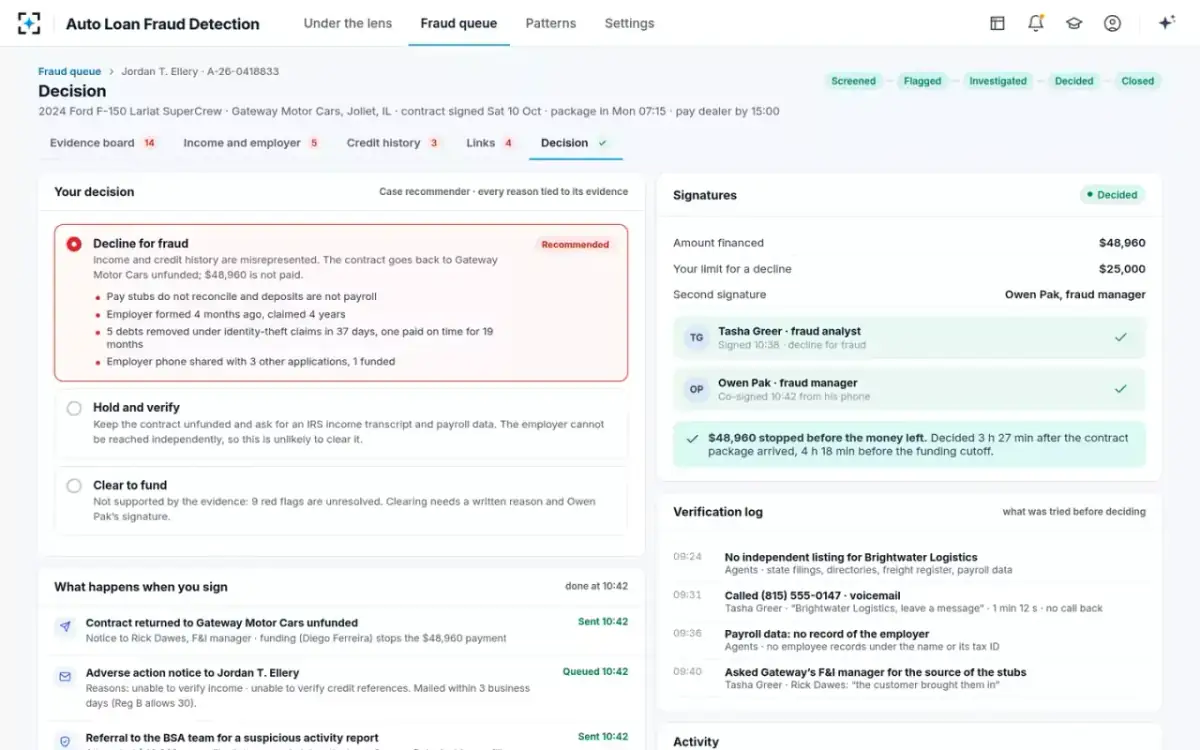
For a fraud file the honest reasons are almost always about verification. In the sample case the notice gives "unable to verify income" and "unable to verify credit references" on a declined contract of $48,960 — two reasons, each of which the file can support line by line, and neither of which characterises the applicant's conduct. The fraud score of 912 appears nowhere in it, which is not discretion; it is the rule.
Where the reasons have to come from, and how the decision was made
This is the part of Regulation B that an AI-assisted desk has to read closely, because the interpretation answers the architecture question four different ways depending on how the decision was actually reached.
Where a decline’s reasons must come from, by how the decision was made
| How the decision was reached | What the interpretation says the reasons must relate to | What that means for an AI-assisted desk |
|---|---|---|
| A credit scoring system | "the reasons disclosed must relate only to those factors actually scored in the system", and "no factor that was a principal reason for adverse action may be excluded from disclosure" | If the model decided, the reasons are the model’s factors — and you must be able to name them, including the inconvenient ones |
| A judgmental system | "the reasons for the denial or other adverse action must relate to those factors in the applicant’s record actually reviewed by the person making the decision" | This is the clause that makes an evidence-first design work: a person reviewed findings, so the findings are the reasons |
| Both, in combination | "the reasons for the denial must come from the component of the system that the applicant failed" — and where a score puts a file in a grey band and a person then decides, "the reasons disclosed must come from both components" | The common shape of a fraud desk. Expect to disclose from the ranking and from the human review, and to stay inside four reasons in total |
| An automatic-denial factor | Where a creditor "denies the credit request because of an automatic-denial factor, the creditor must disclose that specific factor" | Any hard rule in the configuration is a disclosable reason. Know which rules in your settings are hard |
Read the second row twice. Where a person reviewed the applicant's record and decided, the reasons must relate to the factors that person actually reviewed. A desk where an analyst reads findings tied to document lines is a desk that can satisfy that sentence from its own case file. A desk where an analyst reads a number and a time-to-cutoff cannot, however good the number is.
The same decline, written two ways
A score-only decline: A fraud score, the factors that drove it in general terms, and the analyst’s note
A cited decline: Each finding with the pay stub line, statement entry, bureau file or public record behind it, and who read it
A score-only decline: Reasons the analyst can stand behind in the time left before the cutoff
A cited decline: Reasons that name what was measured: the pay calendar, the withholding rate, the deposits, the formation date
A score-only decline: The lender explains a model it did not build
A cited decline: The lender reads back two numbers and the rule that separates them
A score-only decline: Hard to see, because the signals that catch a washed file are the signals a victim produces
A cited decline: Visible, because the payment history on the removed accounts is in the file next to the finding
A score-only decline: The model, its governance and the queue
A cited decline: The same, plus for each deal the findings, their sources, who decided, when, and the rule version in force
A score-only decline: A high score with nothing behind it, declined because nobody had time to look
A cited decline: A finding that is true and irrelevant, cleared by a person — which costs a minute
Is a fraud model a model under the supervisory guidance?
Sometimes, and the answer changed in April 2026 in a way that matters a great deal to anyone buying one of these systems.
The guidance everyone still cites is the 2011 supervisory letter on model risk management, which defined the term broadly: "the term model refers to a quantitative method, system, or approach that applies statistical, economic, financial, or mathematical theories, techniques, and assumptions to process input data into quantitative estimates", and added that the definition "also covers quantitative approaches whose inputs are partially or wholly qualitative or based on expert judgment, provided that the output is quantitative in nature" (Supervisory Guidance on Model Risk Management, 2011). On that definition a fraud score is a model and almost everything else on a fraud desk is too.
The three federal banking agencies issued revised guidance on 17 April 2026, and it narrows the definition and the population. The term now "refers to a complex quantitative method, system, or approach that applies statistical, economic, or financial theories to process input data into quantitative estimates", and it "excludes simple arithmetic calculations, such as those found within spreadsheets, as well as deterministic rule-based processes and software where there are no statistical, economic, or financial theories underpinning their design or use". The guidance "is expected to be most relevant to banking organizations with over $30 billion in total assets" (Supervisory Guidance on Model Risk Management, 17 April 2026).
Two consequences follow for a fraud desk, and they point in opposite directions. The ranking score is a model. The arithmetic that recomputes a pay stub, the comparison between two bureau pulls and the search for a shared phone number are deterministic rule-based processes, and are outside the definition — which is a strong argument for building the load-bearing findings out of rules rather than out of predictions, since a rule is both easier to explain to an applicant and lighter to govern.
And then there is the footnote that ought to be read aloud in every vendor meeting: "Generative AI and agentic AI models are novel and rapidly evolving. As such, they are not within the scope of this guidance. Nonetheless, a banking organization's risk management and governance practices should guide the determination of appropriate governance and controls for any tools, processes, or systems not covered in this document." The guidance also says plainly that it "does not set forth enforceable standards or prescriptive requirements". So for the agent-shaped part of a fraud system there is no supervisory template at all: the governance is the lender's own, and the only hard law in the room is the one about the reasons an applicant receives.
How do you validate a fraud model before it touches a deal?
With the same discipline the agencies describe for any model, plus the two things a fraud system needs that a credit model does not: a measured false positive rate on your own mix, and a file that survives being read by somebody who was not there.
The revised guidance sets the frame: "Model validation evaluates whether models perform as expected and includes an assessment of a model's reliability and its limitations", and "validation generally occurs prior to a model's first use". It allows for the real world — where an urgent business need means a model is used before validation finishes, sound practice "involves greater attention to the model's limitations", informing stakeholders and "placing limits on model use or more closely monitoring its performance". It insists on independence of judgement rather than of org chart: "the quality of validation process depends on the rigor and effectiveness of the review rather than on organizational structure". And it has a section written for exactly this purchase, on vendor and third-party products: because components may be proprietary, a banking organisation "may not receive from the vendor the underlying code, data, or methodology that they would have if a model were developed internally. Nevertheless, the principles of model risk management remain applicable."
The vocabulary that travels best across a governance committee is the National Institute of Standards and Technology's framework, whose four functions — govern, map, measure and manage — give the stages names that are not a vendor's. Two of its sentences are worth carrying: "AI systems should be tested before their deployment and regularly while in operation", and "processes for independent review can improve the effectiveness of testing and can mitigate internal biases and potential conflicts of interest". It is also blunt about what the whole thing rests on: "Trustworthy AI depends upon accountability. Accountability presupposes transparency" (NIST AI 100-1, AI Risk Management Framework 1.0). The framework is a vocabulary and a set of practices; it is not evidence that any particular system works.
Nine things to finish before a fraud system touches a live deal
- Run it blind on closed files, including ones you funded and regret
You know the answers. Include deals declined on credit alone, or you will not notice a system that has quietly re-derived your credit score.
- Measure the false positive rate on your own mix, not on a benchmark
Different dealer channels and credit tiers produce different rates. A single number from another lender’s book tells you nothing about your desk.
- Decide what happens when it is used before validation is complete
The revised guidance contemplates it, and asks for stated limitations, informed stakeholders and limits on use. Write those down in advance rather than during.
- Have the review done by someone who did not build or buy it
Independence of judgement, not of reporting line. The point is a critical reading, and the person who chose the vendor cannot give you one.
- Write down which rules in the configuration are hard
An automatic-denial factor is a disclosable reason under Regulation B. If you cannot list them, you cannot write a compliant notice when one fires.
- Produce a decline notice end to end, on a real file
Trace each reason to a finding and each finding to a document line. If that chain breaks anywhere, the system is not ready however good its ranking is.
- Test the reopen path, with a clock on it
A wrongly declined applicant is time-critical. Somebody must be able to reopen a case the same day, and you should know who before you need them.
- Fix the default for an undecided deal at the cutoff
Held, not funded. Any other default means the slowest cases fund themselves, which is the opposite of the control you are buying.
- Agree who approves a change to a threshold, and where the version history lives
The identity-theft programme’s own guidelines ask for assigning specific responsibility for implementation, reviewing staff reports on compliance, and approving material changes.
What each component may do, and what it may never do
A published limit is worth more than a published accuracy figure, because a limit is testable in a demonstration and an accuracy figure is not testable until you have run your own pilot.
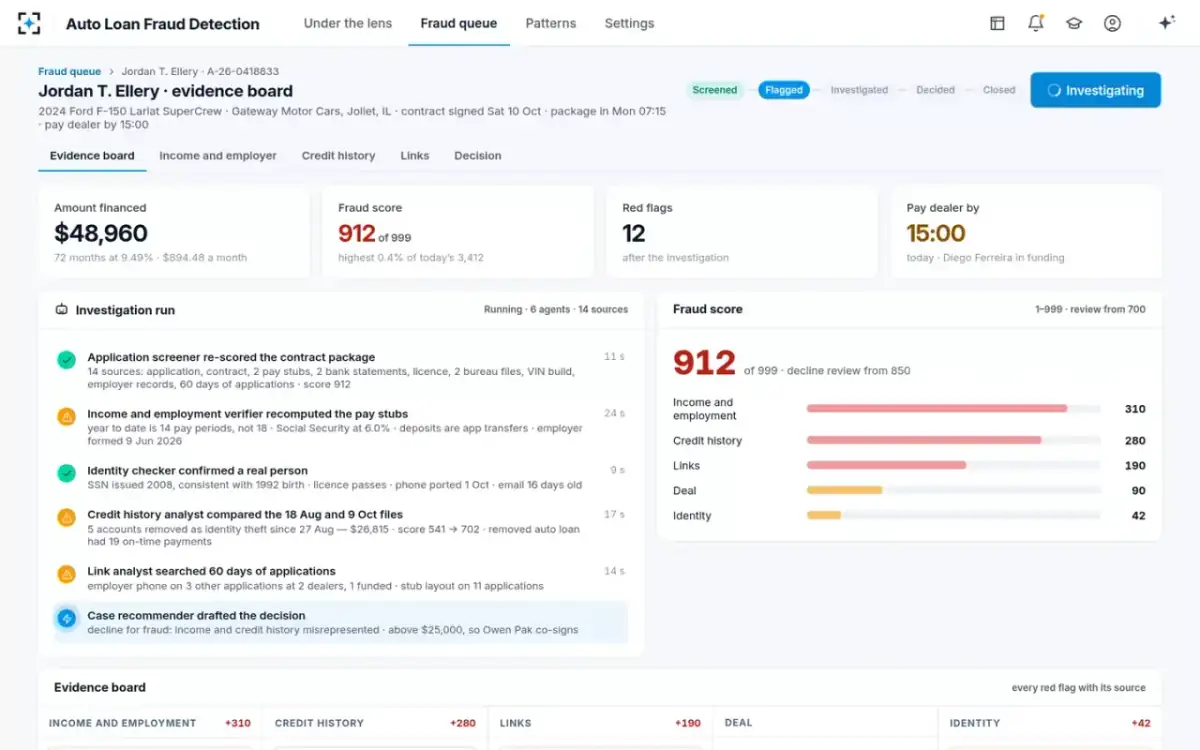
In Auto Loan Fraud Detection six components carry six limits. The screener never declines an application, and every score lists its top signals. The income and employment component never treats the applicant's own phone number as proof, and never telephones the employer itself. The identity component never decides identity theft on one signal, and a fraud alert always means a call first. The credit history component never treats a documented identity-theft victim as a suspect, and a police report or a creditor's confirmation reopens a case. The link component never accuses a dealership, and sends patterns to a review feed. The case component never declines, files or moves money, and every reason it drafts names its evidence.
Read that list as a design rather than as a disclaimer. Each limit is there because the alternative produces a decision somebody cannot defend: a score that declines produces an insufficient reason, a component that calls an employer destroys the independence of the call, a rule that treats every identity-theft block as a sign of washing injures the victims it was built to protect, and a system that accuses a dealership ends a relationship on evidence that cannot distinguish three explanations.
Six components, fourteen sources, and nothing decided
False positives have a victim
Every conversation about a fraud system's threshold is a conversation about how many real people it will inconvenience, and it is usually conducted as though the cost sat with the lender.
It does not. A wrongly flagged applicant is a person who signed for a car on Saturday, was told the finance was approved, and is telephoned on Tuesday to be asked for documents they have already given or to be told the deal is unwound. The populations that produce the most false positives are also the ones with the least slack: thin files, recent arrivals, people rebuilding after somebody else's fraud, people paid by transfer because they work for a three-person firm.
Two practical consequences follow. First, price false positives from your own pilot rather than from a vendor's benchmark, and price them in the applicant's terms as well as in analyst hours. Second, build the reopen path before you build the threshold: the asymmetry is that a missed fraud costs money a lender can quantify, and a wrongly declined applicant costs something the lender never sees. What the evidence says about applicants whose files carry the marks of fraud is worth reading before setting any identity threshold, because it points the opposite way to the instinct.
What to put on the audit trail, and three questions to ask about autonomy
The audit trail is the only artefact that still exists when the case, the analyst and the vendor have all moved on. Six items make it useful rather than voluminous: every component step with what it read and what it found; every finding with the document line, page or record behind it; the rule version in force at the time; who decided, what they decided and when; the reasons that went on the notice, traceable to findings; and, where a threshold or rule changed, who approved the change.
That last item is the one the identity-theft programme's own guidelines ask for in almost those words: oversight should include "assigning specific responsibility for the Program's implementation", "reviewing reports prepared by staff regarding compliance", and "approving material changes to the Program as necessary to address changing identity theft risks" (16 CFR 681, Appendix A VI(a)). A fraud rule set that nobody approves is a programme that has quietly stopped corresponding to its own document.
And three questions, to be asked of any vendor and answered on a real file rather than on a slide.
Show me a decline notice this system produced, and trace each reason to a finding and each finding to a document line. If any link in that chain is a confidence percentage, the notice is not defensible.
What does each component refuse to do, and where is that written? A system with no published limits has not decided where its authority stops, which means your analysts will decide it case by case under time pressure.
Who may change a threshold, and what does the change leave behind? If the answer involves the vendor, or a release, the thresholds are not your policy — and thresholds are policy, because they determine how many real customers get a phone call.
The signature, and the four things it sets in motion
If you are comparing systems, the twelve questions to ask before you buy cover the commercial half of this. To see the components, their limits and the signed decision together, start from Auto Loan Fraud Detection.
Questions people ask
Who is accountable when AI gets a fraud decision wrong?
The creditor, and inside the creditor the person who signed. Nothing in Regulation B contemplates a decision without a decider: the reasons an applicant receives must accurately describe the factors actually considered, and where a person reviewed the record the reasons must relate to what that person reviewed. A lender that cannot name the human being behind a decline has a compliance problem long before it has an accuracy problem.
What is a false positive rate in fraud detection, and what is a good one?
It is the share of applications the system flags that turn out, on review, to be fine — and there is no good number that travels. It depends on your threshold, your dealer channels, your credit tiers and the mix of document types you receive, so a rate measured on another lender's book predicts nothing about yours. Measure it in a pilot on closed files, then measure what each false positive costs in analyst time and in applicant experience, and set the threshold from those two numbers.
Does the supervisory guidance on model risk cover an agentic fraud system?
Not as of the revised interagency guidance of 17 April 2026, which states that generative and agentic AI models "are not within the scope of this guidance" while saying the lender's own risk management and governance practices should determine appropriate controls for tools the document does not cover. The practical reading is that the governance of the agent-shaped parts is yours to design, and that the binding constraints come from Regulation B and from your identity-theft programme rather than from a model-risk template.
What should a person check before a fraud decline goes out?
Four things, and none of them take long. That each reason on the notice is a factor they actually reviewed. That each finding opens the document line or record behind it. That anything the applicant could still satisfy was asked for, in writing, with a reasonable time to respond. And that no documented identity-theft victim is being treated as a suspect — which is the one error that compounds, because it adds a second injury to a person already carrying somebody else's fraud.
Can a lender automate an approval but not a decline?
That is the common and defensible shape, and the asymmetry is in the consequences rather than in the rule. An approval creates no notice obligation and no statement of reasons; a decline creates both, and the reasons must be specific and relate to what was relied on. A lender can automate declines where the reasons are themselves specific and verifiable — but the test is whether it could answer the applicant's telephone call in terms it tested, which is a higher bar than a threshold.
Is it enough to say the decision was reviewed by a human?
No, and this is where a great many governance papers stop one sentence early. The interpretation asks for reasons relating to "those factors in the applicant's record actually reviewed by the person making the decision" — so a review that consisted of looking at a score and a clock produces no usable reasons at all. What makes human review real is that the reviewer had findings tied to evidence in front of them, which is a property of the system rather than of the reviewer.