Third-party fraud is committed with somebody else's identity; first-party fraud is committed with your own. That single distinction decides which rules apply, who the victim is, what notice the applicant gets, where the loss is recorded and — most consequentially for an auto lender — whether anybody is looking. The identity-theft framework an American lender is obliged to maintain is written entirely about the third-party case. Botminds' Auto Loan Fraud Detection is built the other way round: it verifies identity and then tests the position a real applicant has claimed, because in auto finance most of the money is lost to applicants who are exactly who they say they are.
The examples below are sample data in Auto Loan Fraud Detection, on a fictional applicant, employer and dealer. The rules and the research are quoted and linked where they appear.
The same loss, from two directions
Third-party fraud: Somebody else’s, without authority — stolen, or assembled from pieces
First-party fraud: The applicant’s own. Name, Social Security number and licence all verify
Third-party fraud: A consumer, who will find out and is owed protection
First-party fraud: The lender, and nobody else. There is no consumer to notify
Third-party fraud: The Red Flags Rule, the FCRA’s blocks and alerts, the whole identity-theft apparatus
First-party fraud: None of them. The conduct is a false statement on an application, not identity theft
Third-party fraud: Usually at application: an alert on the file, an identity element that does not correlate, or the real consumer calling
First-party fraud: At the first missed payment, about 45 days after funding — if anybody goes back to the application
Third-party fraud: Identity data: the number, the date of birth, the device, the address history
First-party fraud: Documents and arithmetic: the stub, the deposits, the employer’s formation date, the payment history of a blocked account
Third-party fraud: As fraud, in a fraud total somebody reports on
First-party fraud: As a credit loss, in the delinquency line, where no fraud report will find it
Third-party fraud: A decline, and often a referral for their own protection
First-party fraud: A decline with adverse action reasons about verification — which is all the lender has established
What is first-party fraud, and what is third-party fraud?
First-party fraud is a misrepresentation an applicant makes about their own position in order to get credit they would otherwise be refused, or on terms they would otherwise not be offered. Inflating income. Inventing an employer. Claiming a car will be a personal vehicle when it is going straight into commercial use. Signing for a vehicle somebody else will keep and pay for. Stripping real defaults off a credit file with a false identity-theft claim.
Third-party fraud is the use of another person's identifying information. Regulation V puts it precisely: identity theft is "a fraud committed or attempted using the identifying information of another person without authority" (12 CFR 1022.3(h)), and "identifying information" is defined broadly enough to cover the whole application header — "any name or number that may be used, alone or in conjunction with any other information, to identify a specific person, including any … name, social security number, date of birth, official state or government issued driver's license or identification number" (12 CFR 1022.3(g)).
"Identity theft means a fraud committed or attempted using the identifying information of another person without authority."
12 CFR 1022.3(h), Regulation V
Read that definition with a first-party case in mind and the gap is obvious. A real applicant using their own Social Security number to apply for their own car has used nobody else's information without authority. Whatever else they have done, they have not committed identity theft, so nothing in the identity-theft framework is engaged.
First, second and third party fraud: what each word is doing
The numbering is positional and it describes who is acting, not how serious the conduct is.
First party is the customer: the person on the contract, acting in their own name, misrepresenting their own position. Third party is an outsider: somebody using the identity of a consumer who has no idea the application exists. Second party is the term with the least agreement behind it, and it is worth defining before using it in a policy document. Most often it means fraud committed with the knowing participation of someone inside the transaction — a relative or friend who lends their identity willingly, or an employee or dealer representative who helps a file through. A straw purchase, where a creditworthy person signs with permission for somebody who cannot, is usually put here: the identity is not stolen, it is borrowed.
For an auto lender the practical taxonomy is simpler than the vocabulary. There are two questions: is the person real and are they who they say they are, and is the position they have claimed true. The first question is identity. The second question is everything else, and it is where the detection work and the losses both live.
First-party fraud examples in an auto deal
Five patterns cover most of what an auto fraud desk sees from applicants acting in their own name.
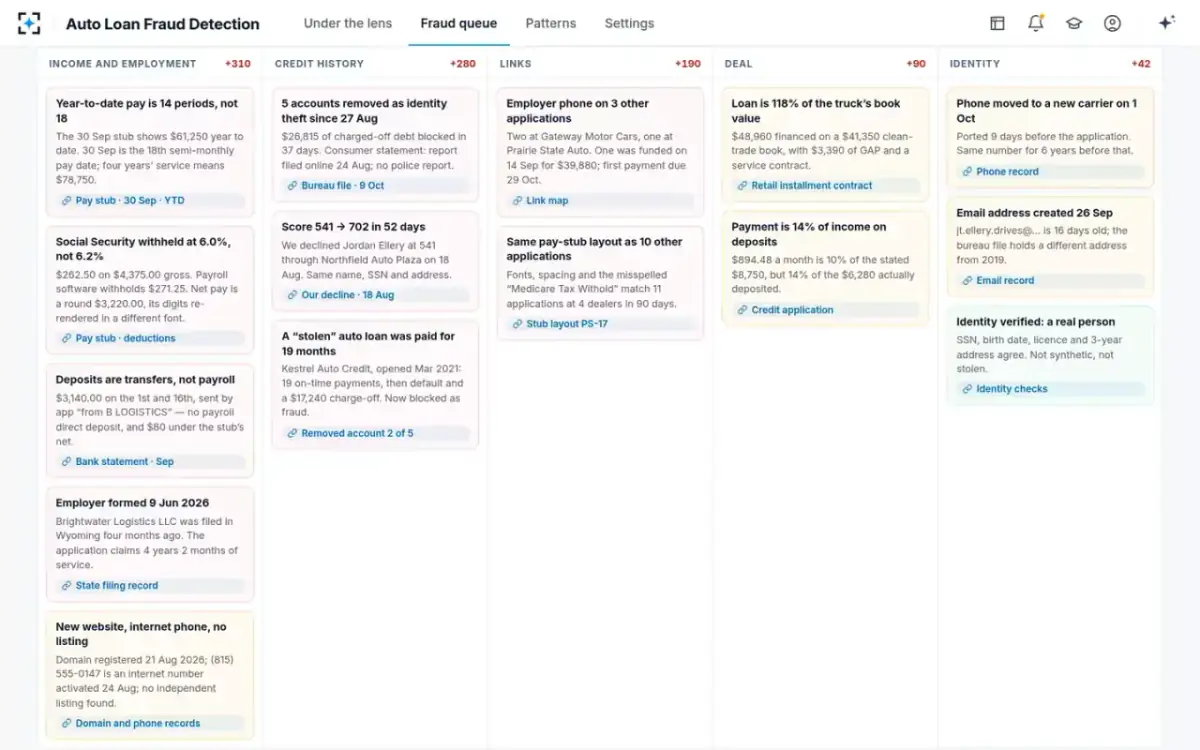
Income and employment misrepresentation. A stated income the documents do not support, or an employer that was registered after the job is said to have started. In the sample case the application states $8,750 a month, the deposits total $6,280, and the fictional employer was formed in Wyoming four months before an application claiming four years and two months of service. The arithmetic test is four calculations on one pay stub, and it is the same test whoever produced the document.
Credit washing. Real defaults removed from a bureau file by a false identity-theft claim. It is first-party fraud that wears third-party clothing, which is what makes it hard: the claim it rests on is an identity-theft claim, so it arrives inside the apparatus built for the other kind of fraud. How a block strips charged-off debt in four business days is the mechanism.
Straw purchases and undisclosed payers. The person on the contract is real and creditworthy; the person driving and paying is neither. Nothing in the documents is false except the implicit claim about who the car is for.
Collateral and deal misrepresentation. An inflated vehicle value, options that are not on the car, a trade-in that does not exist, or a down payment that never changed hands. In the sample case the loan is 118% of the truck's book value and the payment is 14% of income measured on deposits — neither of which is fraud on its own, and both of which change what the other findings mean.
Loan stacking. Several applications at several lenders inside the window before any of them sees the others on a bureau file. Each application may be individually true; the omission is the undisclosed intent.
What the Red Flags Rule covers, and why first-party fraud is not in it
The Red Flags Rule requires a written program "designed to detect, prevent, and mitigate identity theft in connection with the opening of a covered account or any existing covered account", and an automobile loan is named in its definition of a covered account (16 CFR 681.1). Its 26 illustrative red flags are a catalogue of signs that somebody is not who they claim: a fraud alert on the report, an SSN that has not been issued, "a lack of correlation between the SSN range and date of birth", a phone number "the same as the number provided on a fraudulent application".
One example in the list touches the first-party case, and only after the money has gone: red flag 20(b), where "the customer fails to make the first payment or makes an initial payment but no subsequent payments". It sits in the category headed "unusual use of, or suspicious activity related to, the covered account", as an example for new revolving accounts that an installment lender can adopt, and it is the rule's own acknowledgement that the first missed payment carries information about the application. Most lenders route it to collections.
So a lender whose fraud programme is its identity theft prevention program has, by design, built a careful apparatus around one of its two problems. That is not a criticism of the rule, which does what it says; it is an argument for not mistaking a compliance artefact for a fraud strategy. What the program must contain, element by element, sets out the rest of it.
Where first-party fraud is booked as a loss, and why nobody finds it there
A third-party loss is recorded as fraud because somebody has to be told: a consumer is a victim, a report may be owed, a fraud total gets reported upward. A first-party loss has no victim to notify and no report to trigger, so it is recorded as what it looks like — a borrower who stopped paying.
That accounting choice is the whole problem, because it is self-concealing. Fraud losses are measured against the fraud controls, and credit losses are measured against the credit model. A loss that is fraud but is written into the credit line makes the credit model look slightly worse and the fraud controls look rather better than either deserves, and nothing in the reporting ever corrects it.
Fourteen red flags on one application, and what they actually evidence
By lane, as the evidence board sorts them
- Income and employment · 6 · 42.9%
- Credit history · 3 · 21.4%
- Links · 2 · 14.3%
- Deal · 2 · 14.3%
- Identity · 1 · 7.1%
By which fraud they evidence
- First-party conduct · 11 · 78.6%
- Either, or neither · 3 · 21.4%
The sample case makes the point in miniature. Six findings concern income and employment, three the credit history, two the links to other applications, two the deal itself, and one the identity — and the identity card is the green one. A fraud apparatus pointed at identity would have cleared this application in seconds, correctly, and funded $48,960.
Five lanes, and the green card that settles which fraud this is
Is first-party fraud a crime?
Often, and under a different statute from the one lenders expect. There is no federal offence of first-party fraud. What there is, for applications to certain institutions, is 18 U.S.C. §1014: knowingly making "any false statement or report … for the purpose of influencing in any way the action of" a federally insured bank, a federal credit union or an insured state-chartered credit union, "upon any application, advance, discount, purchase, purchase agreement, repurchase agreement, commitment, loan, or insurance agreement", punishable by a fine of up to $1,000,000 and up to 30 years (18 U.S.C. §1014).
Read the institution list before relying on it. The section reaches banks and credit unions; it does not reach a stand-alone finance company, which has to look to the general mail and wire fraud statutes instead. A captive lender and a credit union looking at identical false stubs are not in the same position, and that difference shows up in what each can tell a dealer.
For a fraud analyst the criminal question is almost never the operative one. The decision in front of them is whether to fund, and the useful posture is the narrow one: state what was tested and what did not verify, and leave the characterisation of the conduct to whoever is equipped to make it.
How do banks detect first-party fraud?
By testing the claim rather than the claimant, and the three strongest tests all use evidence the applicant did not write.
Arithmetic on the applicant's own documents. Year to date against the pay calendar, payroll taxes against their statutory rates, net pay against the deduction column. These do not care who produced the document.
Data the applicant cannot edit. Bank deposits, payroll data, an IRS transcript, a state business registry's formation date, a domain registration date, a phone line type. In the sample case the single most load-bearing fact in the file is a formation date on a public register.
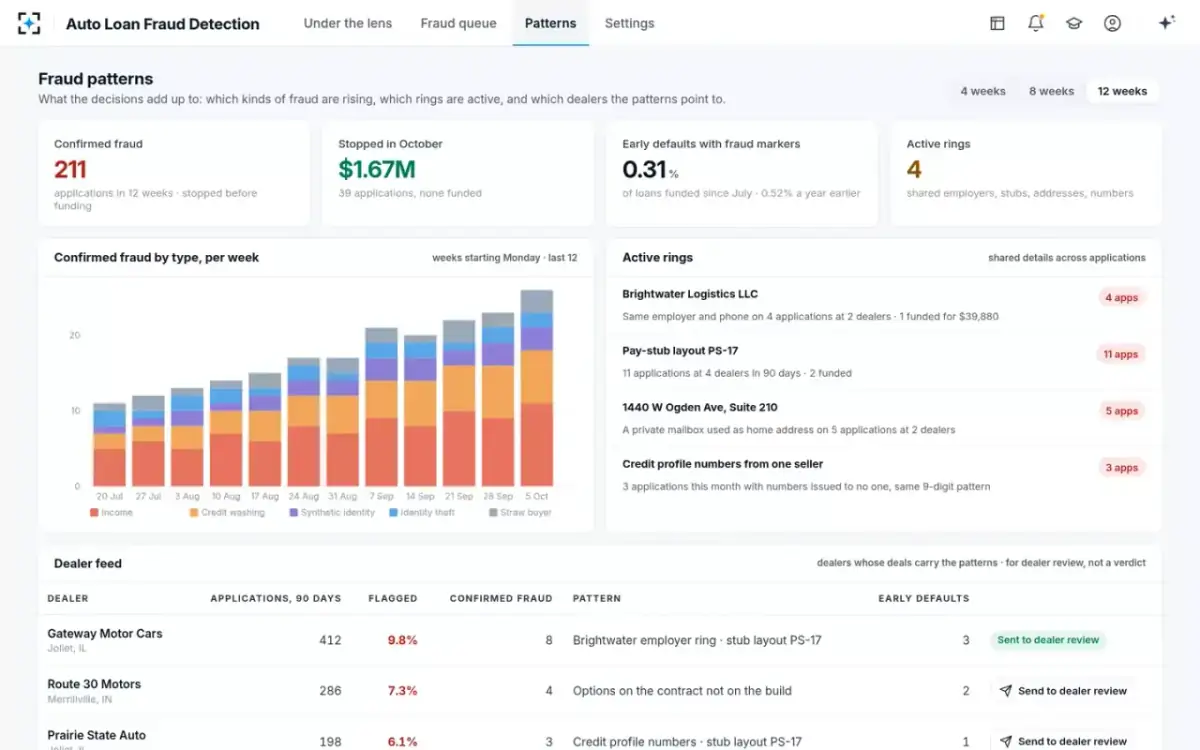
Patterns across applications. First-party fraud repeats, because the person who made one false stub has the template. The same employer and phone appear on three other applications at two dealers in 60 days in the sample data, and the same stub layout — misspelling included — on 11 applications at 4 dealers in 90 days.
There is also real academic support for the humblest signal of all. In a peer-reviewed study of marketplace loans, Vesa Pursiainen found that "inaccurate borrower-provided information in marketplace loans is informative about credit risk", using an index built from "the consistency of loan amount with outstanding credit balance, roundness of reported income, and roundness of chosen loan amount", and that the additional default risk "is not compensated by higher interest". A loan at the top of that index was "five-percentage-points more likely to default than an otherwise similar loan" at the bottom — "a 25% increase relative to the unconditional mean default rate in the sample" (Review of Corporate Finance Studies, 2026).
What is known, and from where
5pts
extra default probability at the top of an inaccuracy index built partly from round income figures, against the bottom
25%
that gap as an increase on the sample’s mean default rate
3.00%
of auto loan balances flowed into serious delinquency in one quarter, against 2.93% a year earlier
$211bn
of auto loans originated in the same quarter, on a $1.71 trillion book
One careful note on the research, because it is easy to over-read. A Federal Reserve Bank of Philadelphia working paper on Canadian consumer insolvency found that a policy change which raised required repayments "causes them to strategically manipulate the data they report to creditors", and — counter-intuitively — that "those debtors who manipulate income have a lower probability of default on their repayment plans, consistent with having access to hidden income", with the manipulation costing creditors "12% to 36% of their total payout per filing" (Philadelphia Fed WP 22-35). Misreporting is not a proxy for weak credit. It is a proxy for an incentive, and the loss it causes is the terms the lender would not otherwise have given.
Synthetic identity sits between the two
A synthetic identity is assembled rather than stolen: a real Social Security number joined to a name and a date of birth that never belonged together, or a number issued to nobody. It behaves like first-party fraud operationally — the "applicant" services the account, builds history, is never reported by a victim — and like third-party fraud legally, in that identifying information has been used without authority.
The definitional awkwardness is real. Identity theft under Regulation V requires "the identifying information of another person"; where the composite belongs to no person, there is an argument that no person's information has been misused. The practical consequence is that a synthetic case produces no victim to notify, no block to unwind and no consumer complaint — which is exactly why the losses sit undiscovered for so long. The rule's illustrative list still reaches the mechanism from the data side: an SSN that "has not been issued, or is listed on the Social Security Administration's Death Master File", "a lack of correlation between the SSN range and date of birth", and an SSN "the same as that submitted by other persons opening an account".
When each fraud becomes visible, in days from the application
- Day 0stopped
- Days 0–45application and funding
- Day 45first payment missed
- Day 7530 days past due
- Around day 180charged off
The duties diverge: the report, the notice and the bureau
Once the two cases are separated, the obligations that follow are almost entirely different — and that is the strongest practical reason to classify a case correctly before acting on it.
What each kind of case obliges a lender to do
| The duty | Third-party case | First-party case |
|---|---|---|
| The consumer | A victim exists and may be owed protection: a fraud alert obliges a user of the report to form a reasonable belief it knows who is asking, and to call the number the consumer gave | No victim. The applicant is the counterparty, and the only thing owed them is a correct notice |
| The adverse action notice | Reasons must still be specific and accurate about what was relied on | The same rule, and harder to honour: the reasons must be about what did not verify, not about suspected fraud. A score is expressly insufficient |
| The bureau | A block under §605B removes the information; a furnisher that receives an identity theft report may not keep furnishing it unless it knows the information is correct | Nothing to block. Where a block was obtained on a misrepresentation, the bureau — not the lender — may rescind it |
| The suspicious activity report | Filed where the institution is subject to the duty, within 30 calendar days of initial detection and in no case more than 60 | The same duty, on the same clock. The conduct is the test, not the category |
| The loss record | Fraud | Credit, unless the lender deliberately re-attributes it |
| The dealer | A pattern, not a finding: the deals behind it go for relationship review | The same, and more often, because first-party templates repeat across a dealer’s deals |
The notice row is the one that catches lenders out. Regulation B requires the statement of reasons to "be specific and indicate the principal reason(s) for the adverse action", and says that statements that the action was based on "the creditor's internal standards or policies" or that the applicant "failed to achieve a qualifying score on the creditor's credit scoring system are insufficient" (12 CFR 1002.9(b)(2)). In a first-party case the honest reasons are usually "unable to verify income" and "unable to verify credit references" — which is why the arithmetic matters: it is what makes those reasons true and defensible rather than a polite way of saying the score was high.
How one desk tests for both at once
The architecture that follows from all this is: verify identity first and completely, then stop asking about identity and start testing the claim. That is the order the six agents in Auto Loan Fraud Detection run in. The identity checker confirms a real person — the number's issue date against the date of birth, the licence barcode and photo, phone and email age, address history — and it is barred from deciding identity theft on one signal. Once identity is settled, the weight shifts to the income and employment verifier, the credit history analyst and the link analyst, which is where a first-party case lives.
The link analyst is the one that crosses the boundary usefully, because repetition is the common tell of both frauds: shared phones, employers, emails, addresses and document layouts across applications and dealers. Its limit is deliberate — it never accuses a dealer, and patterns go to a dealer feed for relationship review rather than as a finding.
Confirmed fraud by type, and the patterns behind it
To see the identity check, the income tests and the links on one case, start from Auto Loan Fraud Detection.
Questions people ask
Is first-party fraud the same as credit abuse or bust-out?
They overlap and are not identical. A bust-out is a particular first-party pattern: build a credit position deliberately, draw it down, and stop paying. First-party fraud is the broader category of misrepresenting your own position to obtain credit, and the misrepresentation can be at application rather than at the end. In auto lending the distinction is practical: a bust-out is spotted in servicing behaviour, while most first-party auto fraud is provable from the application documents.
Which is more expensive for an auto lender?
Nobody can answer that honestly from public data, and be sceptical of anyone who does: the published figures circulating about the split come from vendors with a product to sell. What is defensible is the structural point. Third-party losses are counted because somebody is required to count them, and first-party losses are recorded as credit losses unless a lender deliberately re-attributes them — so any comparison drawn from fraud reporting understates the first-party side by construction.
Does a fraud score catch first-party fraud?
It can rank it, and it cannot evidence it. A score built on shared attributes, application velocity and data inconsistency will put a first-party case high in a queue. What it cannot do is produce the sentence a decline needs — because the reasons an applicant is owed have to describe the factors actually relied on, and "the score was high" is not one of them. The gap between ranking and evidencing is the whole argument for reading the documents.
Where does a straw purchase fall?
Usually in the middle, and the classification depends on consent. Where a creditworthy person signs knowingly for somebody else, the identity is borrowed rather than stolen: the application's identity data is true and the misrepresentation is about who the vehicle is for. Where the signer's identity was used without their knowledge, it is third-party fraud and a consumer is a victim. The first question to ask is therefore not about documents but about whether the person on the contract knows the contract exists.
Should a first-party case be referred for a suspicious activity report?
That depends on the conduct and the institution, not on the label. For a bank, the reporting test is whether a transaction involving at least $5,000 is one the institution "knows, suspects, or has reason to suspect" involves illegal funds, is designed to evade requirements, or "has no business or apparent lawful purpose", with a report due no later than 30 calendar days after initial detection. A false income document on a funded loan can meet that test; the category of fraud is not what decides it.
How should a lender report fraud losses so first-party cases stop disappearing?
By attributing at the cause rather than at the symptom. That means a mandatory read-back of the original application for every loan that misses an early payment, a fraud marker that can be set on a loan already booked as delinquent, and a weekly report that shows confirmed fraud by type rather than one total. Without the read-back the attribution never happens, because by the time the loss is measured the application has been closed for months.