An identity theft prevention program is the written program the Red Flags Rule requires of every financial institution and creditor that holds covered accounts — and an automobile loan is named in the rule's own definition of one. The rule asks for four things: identify the red flags relevant to your accounts, detect them, respond appropriately, and keep the program current. Auto lenders generally write a good program and then cannot show the second element, because the red flags they listed live in documents nobody reads under time pressure. Botminds' Auto Loan Fraud Detection is the detection half: six agents that read every funding package against the lender's own rules and hand a fraud analyst the findings, each one tied to the line or record it came from.
Everything below is the rule's own text, linked where it appears, with the auto signal beside each red flag. Where a figure comes from Auto Loan Fraud Detection it is sample data on a fictional lender, and says so.
What the rule actually asks for
4
elements a written program must have: identify, detect, respond, update
5
categories of red flags a program should draw from, as appropriate
26
illustrative red flags in Supplement A, of which about half are visible in an auto application
9
responses the guidelines list, one of which is deciding that no response is warranted
What is an identity theft prevention program?
It is a written document, approved at board level, that says how an institution will spot and handle signs of identity theft in the accounts it opens and holds. The rule's sentence is worth reading once in full: each covered institution "must develop and implement a written Identity Theft Prevention Program (Program) that is designed to detect, prevent, and mitigate identity theft in connection with the opening of a covered account or any existing covered account", and the program "must be appropriate to the size and complexity of the financial institution or creditor and the nature and scope of its activities" (16 CFR 681.1(d)(1)).
Three words in that sentence do most of the work. Written means an examiner reads a document, not a description of a practice. Implement means the document has to correspond to something that happens. And appropriate to the size and complexity means there is no template that satisfies it: a credit union doing 40 indirect deals a month and a captive finance company doing 40,000 are both compliant with programs that look nothing alike.
The rule defines a red flag with equal economy: "Red Flag means a pattern, practice, or specific activity that indicates the possible existence of identity theft" (16 CFR 681.1(b)(9)). Note "possible". A red flag is not a finding and a program is not a decision engine; the rule is asking for attention, not for verdicts.
Does an auto lender need an identity theft prevention program, and who else does?
Yes, and so does almost everybody else in an indirect auto deal. The duty attaches to "financial institutions and creditors" that offer or maintain covered accounts, and the Federal Trade Commission's own business guide puts the reach plainly: "Anyone who lends money — like a payday lender or automobile title lender — is covered by the Rule" (FTC, Fighting Identity Theft with the Red Flags Rule).
In an indirect deal that means three parties, not one. The lender buying the contract holds the covered account. The dealership that arranges financing and takes the credit application is a creditor in its own right under the rule — which is why "identity theft prevention programs must oversee the dealership's service providers" is a question people actually type. And the lender's own vendors fall inside its program through the service-provider duty in §681.1(e)(4), which is set out further down this page.
What the rule does not do is tell any of them what to look for. It names five categories of red flags and appends illustrative examples; the selection is each institution's, and that selection is the part an examiner can most easily disagree with.
What is a covered account under the Red Flags Rule?
A covered account is an account held "primarily for personal, family, or household purposes, that involves or is designed to permit multiple payments or transactions, such as a credit card account, mortgage loan, automobile loan, margin account, cell phone account, utility account, checking account, or savings account" (16 CFR 681.1(b)(3)(i)). An auto loan is on the list by name, so there is no argument to be had about scope for retail installment contracts.
The second limb is the one lenders forget. A covered account is also "any other account that the financial institution or creditor offers or maintains for which there is a reasonably foreseeable risk to customers or to the safety and soundness of the financial institution or creditor from identity theft, including financial, operational, compliance, reputation, or litigation risks". Commercial and fleet paper is not personal, family or household — but if identity theft on it is reasonably foreseeable, it is covered by the second limb, and the rule asks for a periodic risk assessment to decide.
That assessment has three stated inputs: "the methods it provides to open its accounts", "the methods it provides to access its accounts", and "its previous experiences with identity theft" (§681.1(c)). For an indirect auto lender, the first of those is the whole argument: applications arrive from third parties, on documents the lender never collected, with the applicant not present. Any honest assessment of that channel produces a longer red-flag list than a direct-lending one.
The four elements, and the requirements of an identity theft prevention program
The program "must include reasonable policies and procedures to: (i) Identify relevant Red Flags for the covered accounts that the financial institution or creditor offers or maintains, and incorporate those Red Flags into its Program; (ii) Detect Red Flags that have been incorporated into the Program; (iii) Respond appropriately to any Red Flags that are detected … to prevent and mitigate identity theft; and (iv) Ensure the Program (including the Red Flags determined to be relevant) is updated periodically, to reflect changes in risks" (16 CFR 681.1(d)(2)).
The four elements, and the question an examiner asks about each
- Identify — which red flags are relevant to your accounts, and why these
The rule names five categories and offers 26 examples. The examiner’s question is not "did you list enough" but "does your list match how your applications actually arrive".
- Detect — how each listed red flag is actually seen
For every flag on the list, what reads the thing it would appear in? This is the element auto programs most often cannot answer for document-based flags.
- Respond — what happens, graded to the risk
The guidelines list nine responses and say they should be "commensurate with the degree of risk posed". A single response for every flag is not a graded response.
- Update — how the list changes when the fraud does
The rule names five triggers: your own experience of identity theft, changes in methods of theft, changes in detection methods, changes in the accounts you offer, and changes in your business arrangements.
Alongside the four elements sit the administration duties, and they are not optional extras: board or board-committee approval of the initial written program, board, committee or senior-management involvement in oversight and administration, training "as necessary, to effectively implement the Program", and "appropriate and effective oversight of service provider arrangements" (§681.1(e)).
The 26 illustrative red flags, and which ones an auto deal can show
Supplement A to Appendix A lists 26 examples, grouped into the five categories. They are illustrative, not mandatory, and an institution "may consider incorporating into its Program, whether singly or in combination," those that fit. The table below takes the ones an auto application and its funding package can actually show, and names the evidence each would appear in.
Red flags from the rule's own list, and where an auto deal shows them
| Red flag, as the rule words it | Where it shows in an auto deal | What has to read it |
|---|---|---|
| 1. "A fraud or active duty alert is included with a consumer report." | The bureau pull at application | The bureau response, plus a rule that a fraud alert means a call before credit |
| 4(d). "An account that was closed for cause or identified for abuse of account privileges by a financial institution or creditor." | The bureau file — unless it has been blocked out of it | A comparison with the lender’s own earlier pulls, not today’s file alone |
| 5. "Documents provided for identification appear to have been altered or forged." | The licence scan or photo in the funding package | Barcode and photo checks against the state record where the state allows it |
| 6. "The photograph or physical description on the identification is not consistent with the appearance of the applicant." | The licence image, against the state’s own | An image comparison, and a person’s judgement on the result |
| 9. "An application appears to have been altered or forged, or gives the appearance of having been destroyed and reassembled." | The pay stub, the bank statement, the credit application itself | A forensics read of the file: fonts, compression, objects, file history |
| 10(b). "The Social Security Number (SSN) has not been issued, or is listed on the Social Security Administration’s Death Master File." | The application’s identity block | An identity check against the issuing record, with consent |
| 11. "there is a lack of correlation between the SSN range and date of birth." | The application’s identity block | An issue-date test — valid only for numbers issued before randomisation |
| 12(b). "The phone number on an application is the same as the number provided on a fraudulent application." | Across applications, not within one | A search of the lender’s own recent applications |
| 13(b). "The phone number is invalid, or is associated with a pager or answering service." | The applicant’s and the employer’s numbers | A line-type check, and the rule that the application’s own number is never proof |
| 14. "The SSN provided is the same as that submitted by other persons opening an account or other customers." | Across applications and dealers | A link search across 60 to 90 days of applications |
| 15. "The address or telephone number provided is the same as or similar to the address or telephone number submitted by an unusually large number of other persons opening accounts." | Across applications and dealers | The same link search, with a threshold the lender sets |
| 20(b). "The customer fails to make the first payment or makes an initial payment but no subsequent payments." | After funding — the first missed payment | A review that goes back to the application, not only to collections |
Two rows deserve a note. Red flag 4(d) — the account closed for cause — is the one a blocked bureau file silently removes, which is why comparing today's file with your own earlier pull is the only way to detect it. And red flag 20(b), the missed first payment — given in the rule as an example for new revolving accounts, and adopted here for an installment contract because the list is illustrative — is the only one on the list that arrives after the money has gone; a program that treats it as a collections event rather than a detection event has quietly dropped it.
Detection is where auto programs fail
Identification is a writing task and most lenders do it well. Response is a policy task and most lenders do it well. Detection is an operations task, and it is where a program that reads beautifully stops corresponding to anything.
The reason is arithmetic rather than negligence. In the sample lender's queue there are 47 open flagged deals carrying $1.94M of financing, and 19 of them have contracts the dealers expect paid before a 15:00 cutoff. A document-based red flag — an altered stub, a reassembled application, a licence photo that differs from the state's — is detected only if somebody opens the document. With 47 cases and a cutoff, a desk samples.
The same red-flag list, in two lenders
A program on paper: Listed. Detected when an analyst happens to open the file and notices something
A program that reads: Every stub, statement and licence in the package is read for re-set text, regions saved at a different compression and editing objects, before the case is opened
A program on paper: Listed. Read from today’s bureau file, which no longer contains blocked accounts
A program that reads: Today’s file set against every earlier pull the lender holds, with each removed account and its payment history listed
A program on paper: Listed. Detected when two analysts happen to discuss two deals
A program that reads: A standing search across 60 days of applications and dealers, including document layout
A program on paper: Treated as delinquency, and never routed back to the application
A program that reads: A review that reopens the original package and the links to other deals
A program on paper: The document, and an account of how the desk works
A program that reads: The document, and for each deal the findings, their sources, who decided and when
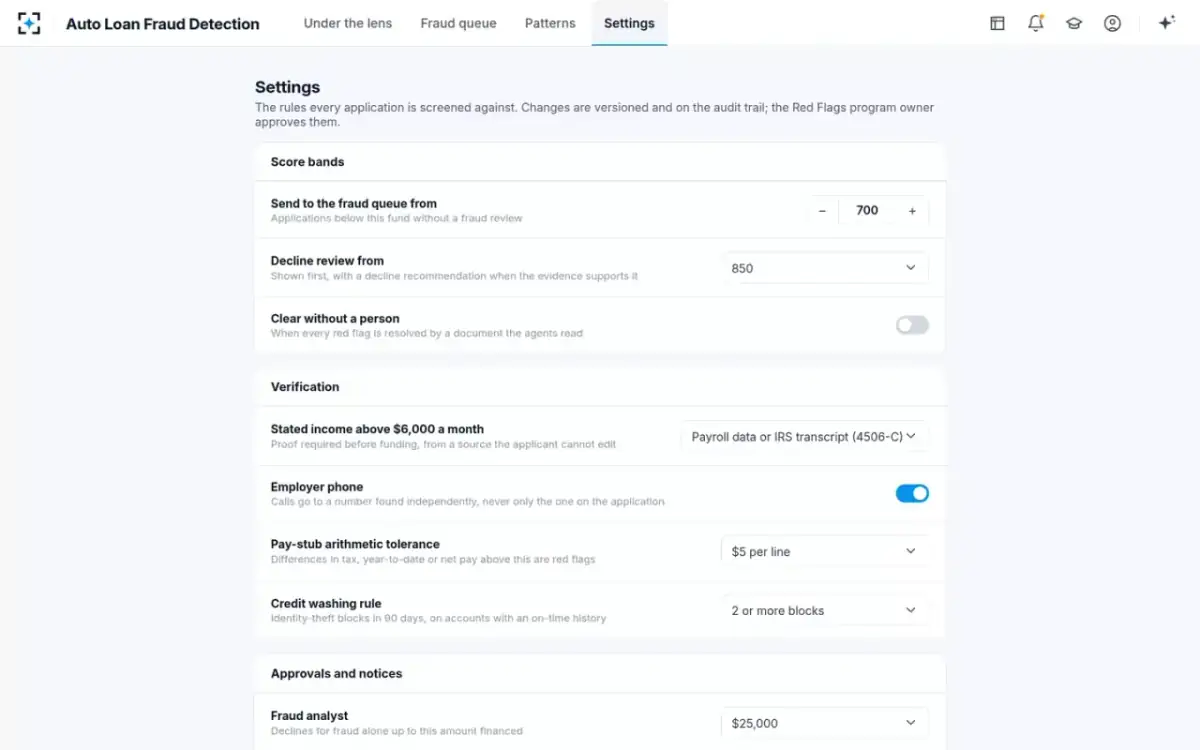
The program's rules, as settings a person can change
What do you do when you detect a red flag?
Respond in proportion. The guidelines ask for responses "commensurate with the degree of risk posed", and tell an institution to weigh aggravating factors such as a data incident that exposed the customer's records. They then list nine: "(a) Monitoring a covered account for evidence of identity theft; (b) Contacting the customer; (c) Changing any passwords, security codes, or other security devices …; (d) Reopening a covered account with a new account number; (e) Not opening a new covered account; (f) Closing an existing covered account; (g) Not attempting to collect on a covered account or not selling a covered account to a debt collector; (h) Notifying law enforcement; or (i) Determining that no response is warranted under the particular circumstances" (16 CFR 681, Appendix A IV).
"Determining that no response is warranted under the particular circumstances."
16 CFR 681, Appendix A IV, the ninth permitted response
That ninth response is the most useful sentence in the rule for a fraud desk, and the most often forgotten. A red flag that has been looked at and explained is a red flag that has been responded to. What the rule will not forgive is a flag that nobody reached a view on — which is why the record of who decided, and on what, matters more than the decision itself.
For an auto lender, the responses that do the work are (b), (e) and (h): call the customer, do not open the account, refer where it is warranted. Two other duties sit alongside them in Appendix A VII: filing a suspicious activity report "in accordance with applicable law and regulation" where the institution is subject to that duty, and implementing the requirements that govern extending credit when a fraud alert is detected. A bank's reporting obligation arrives with its own clock — a report no later than 30 calendar days after initial detection, with a 60-day outer limit, and five years of supporting records (31 CFR 1020.320) — and the fraud alert duty obliges a user of the report to "form a reasonable belief that the user knows the identity of the person making the request", and to call the number the consumer gave if they gave one (15 U.S.C. §1681c-1(h)).
One flagged deal, from package to signature, with each limit named
Agent
Application screenerScores the application at submission and again when the contract and stipulations arrive, and ranks the queue by score and funding cutoff.
Never: Declines an application. Every score lists its top signals
Agent
Income and employment verifierReads each stub and statement under a forensics lens, recomputes every line, looks for payroll deposits, and dates the employer from its filing, domain and phone.
Never: Treats the applicant’s own phone number as proof, or contacts the employer itself
Agent
Identity checkerChecks the licence barcode and photo, the issue date against the birth date, phone and email age, and address history.
Never: Decides identity theft on one signal. A fraud alert always means a call first
Agent
Credit history analystSets today’s bureau file against every earlier pull, listing accounts removed or blocked since, dispute bursts and score moves.
Never: Treats a documented identity-theft victim as a suspect
Agent
Link analystSearches recent applications across dealers for shared phones, employers, emails, addresses and document layouts.
Never: Accuses a dealer. Patterns go to dealer review
Agent
Case recommenderBuilds the evidence board, recommends clear, verify or decline, and drafts the adverse action reasons, the dealer notice and the referral.
Never: Declines, files or moves money. Every reason names its evidence
A person decides
Fraud analystDecides every flagged application before funding, and signs.
Never: —
A person decides
Fraud managerCo-signs a decline above the analyst’s limit and every referral, and owns the program that approves each rule change.
Never: —
Who approves an identity theft prevention program, and what the annual report says
The initial written program is approved by "either its board of directors or an appropriate committee of the board of directors", and where a creditor has no board, the rule substitutes "a designated employee at the level of senior management" (§681.1(e)(1) and (b)(2)(ii)). Oversight, development, implementation and administration must involve the board, a committee or that senior employee.
Reporting is annual at a minimum. Staff responsible for the program "should report to the board of directors, an appropriate committee of the board, or a designated employee at the level of senior management, at least annually, on compliance", and the report "should address material matters related to the Program and evaluate issues such as: The effectiveness of the policies and procedures … in addressing the risk of identity theft in connection with the opening of covered accounts and with respect to existing covered accounts; service provider arrangements; significant incidents involving identity theft and management's response; and recommendations for material changes" (16 CFR 681, Appendix A VI(b)).
Service providers are covered by contract rather than by hope: a creditor "could require the service provider by contract to have policies and procedures to detect relevant Red Flags that may arise in the performance of the service provider's activities, and either report the Red Flags to the financial institution or creditor, or to take appropriate steps to prevent or mitigate identity theft" (Appendix A VI(c)). For an indirect lender, the service providers that matter are the ones touching the funding package, and the contractual question to ask them is the detection question: what, specifically, reads each document, and what does it hand back.
Does the Red Flags Rule cover first-party fraud?
No, and this is the most consequential limit of the whole framework. The rule's subject is identity theft, and Regulation V defines that as "a fraud committed or attempted using the identifying information of another person without authority" (12 CFR 1022.3(h)). A real applicant who inflates their own income, invents their own employer, or signs for a car somebody else will drive has used nobody else's information. There is no red flag for it, because there is no identity theft in it.
So a lender whose entire fraud apparatus is its identity theft prevention program is, by construction, watching the smaller half of its problem — and the difference between first-party and third-party fraud decides where the loss is booked as well as which rulebook applies. Some of the detection work overlaps happily: the arithmetic that finds an altered stub finds it whoever altered it, and the four tests on one pay stub serve both cases. The response does not overlap. A first-party case produces a credit decision, a notice with verification reasons, and sometimes a referral; it produces no victim to protect and no block to unwind.
Every flag, with the line it rests on
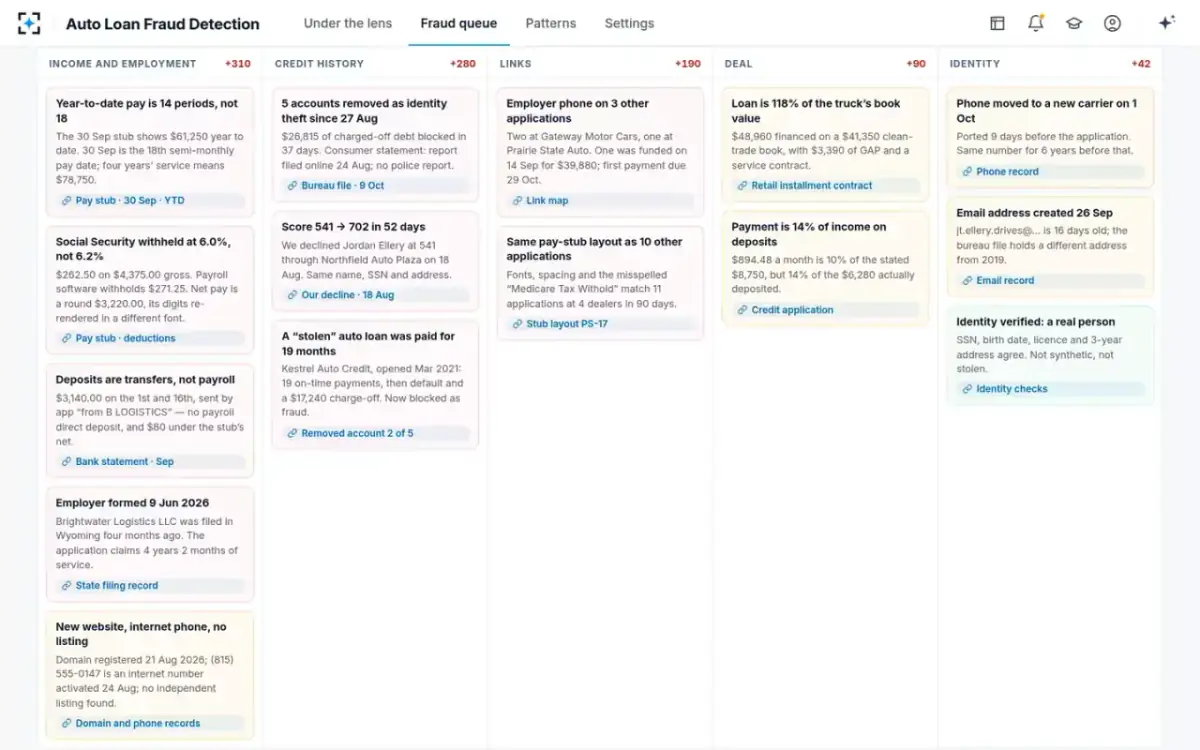
To see the rules as settings, the detection step and the signed decision together, start from Auto Loan Fraud Detection.
Questions people ask
How many red flags should a program include?
The rule sets no number. It names five categories and says a program "should include relevant Red Flags from the following categories, as appropriate", with 26 illustrative examples appended. A short list that matches how your applications arrive is stronger than a long one copied from a template: the examiner's question is whether each listed flag is detected, so every flag you add is a detection commitment you have made.
Is a fraud score a red-flag detection method?
Partly, and not for the document flags. A score can carry the signals that are structured — a shared phone across applications, an address that does not match the bureau file, an identity element that does not correlate. It cannot carry "documents provided for identification appear to have been altered or forged", because nothing in a score has looked at the document. A program that answers the detection element with "we score every application" has answered it for some flags and not for others.
Does a dealership need its own identity theft prevention program?
A dealership that arranges financing and takes credit applications is a creditor within the rule's reach, and the Federal Trade Commission's business guidance is explicit that lenders of money are covered. The practical consequence for the lender buying the paper is the service-provider duty: oversight of arrangements with anyone performing an activity connected to its covered accounts, which the guidelines suggest handling by contract.
How often does the program have to be updated?
Periodically, with five named triggers rather than a calendar: the institution's own experience of identity theft, changes in the methods of identity theft, changes in the methods to detect and mitigate it, changes in the types of accounts offered, and changes in business arrangements including mergers and new service providers. A new dealer channel or a new funding system is an update trigger as much as a new fraud pattern is.
What does "respond appropriately" actually require?
A response graded to the risk, chosen from a list that includes doing nothing. The guidelines offer nine responses and expressly permit "determining that no response is warranted under the particular circumstances", so the requirement is a considered view rather than an action. In practice the defensible position is a record for each detected flag of who looked at it, what they concluded and what they did — which is also what makes a case survive a second signature.
Who owns the program day to day?
The rule requires board or senior-management oversight and assigns specific responsibility for implementation, but it does not name a role. In the sample lender in Auto Loan Fraud Detection the fraud manager owns it: every change to a score band, a tolerance or an approval limit is versioned, approved by the program owner and on the audit trail, and declines above the analyst's limit carry that manager's second signature.