Federal Reserve cash ordering is how a bank or credit union buys currency from its Reserve Bank office: it orders for each endpoint, for example through FedLine Web, in standard bundles of 1,000 notes, and its Federal Reserve account is debited on the day the notes are released to its armored carrier. Two published policies put a price on how it orders. The Uniform Cash Access Policy charges $35 for each access beyond the free level, and the Currency Recirculation Policy charges $8.00 a bundle, from 1 January 2026, for fit $10s and $20s a bank deposits and orders back in the same business week and zone, above an exemption of 875 bundles a quarter. Botminds' ATM & Branch Cash Forecasting sizes each Federal Reserve order in full bundles and checks it against both rules before a manager approves it.
The rules and fees on this page are quoted from the Federal Reserve's own pages and the 2006 Federal Register notice that created the policy. The worked costs are our arithmetic and say so; the product example comes from a fictional sample bank, Corvane National Bank.
What a quarter of Federal Reserve cash ordering can cost in fees, per zone
Cross-shipping fee
(cross-shipped bundles − 875) × $8.00
Cross-shipped each week = the lesser of fit deposits and orders of $10s or $20s, Monday to Friday, in one zone or sub-zone. The 875-bundle exemption is per quarter; unused bundles expire.
Currency Recirculation Policy; 2026 fee schedule
Access fee
extra accesses × $35
Deposits or orders beyond one free of each a week per designated endpoint, unless the access is 20 bundles or more.
Uniform Cash Access Policy
How does Federal Reserve cash ordering work?
A depository institution orders currency from the Reserve Bank office that serves each of its endpoints, for example through the FedLine Web solution, and the notes travel on its armored carrier. The Federal Reserve provides currency only to depository institutions; the public gets it from them. Money moves on the Reserve Bank's books at each handover: "When currency is ordered, a debit is passed to the institution's Federal Reserve account for the amount of the order on the day that the currency is released by the Federal Reserve to an armored carrier," and a deposit is credited once the Reserve Bank has verified it against the institution's notification (Federal Reserve Financial Services, Currency).
The service has a standard rhythm and a standard unit. "For each endpoint, normal cash service is one deposit and one order of currency per week," and the Reserve Bank "may, at our discretion, reduce cash orders to maintain currency inventories" (FedCash currency depositing and ordering). A strap is 100 notes and a standard bundle is 1,000 notes in ten straps, so a bundle of $20s is $20,000 and a bundle of $100s is $100,000; $1 to $20 notes are deposited in full bundles, $50s and $100s in full straps or bundles.
What comes back is fit currency: notes the Reserve Banks have counted, checked for authenticity and fitness, and judged good enough to pay out again; on average about 15% of notes deposited fail and are destroyed (Federal Reserve Financial Services). That processing is the cost the cross-shipping fee recovers.
What is cross-shipping in banking?
Cross-shipping is sending fit notes to the Federal Reserve and ordering the same notes back within days. The Reserve Banks define it precisely: "Cross–shipping occurs when a DI deposits fit currency and orders the same denomination within the same business week (Monday–Friday) and within the same Federal Reserve zone or sub–zone. Cross-shipping is calculated as the lesser of fit deposits or orders" (Recirculation Policy FAQs).
The Reserve Banks' own example: in the first week of March, Bank X deposits 500 bundles of fit $10s with the Federal Reserve Bank of Boston and orders 230 bundles of $10s from it; Bank X has cross-shipped 230 bundles. The everyday version in a bank is less tidy: the central vault deposits the fit $20s that came in from retail customers on Tuesday, and the carrier orders $20s for the ATM network on Thursday. The Federal Reserve names that case and says what it expects instead.
Reserve Banks expect that an institution will use currency generated from one business channel to meet the needs of another channel (e.g. use $20s from the deposits of retail customers to fill ATM canisters rather than having the central vault deposit and the armored carrier order $20s).
Federal Reserve Financial Services, Recirculation Policy FAQs
The Reserve Banks look at the whole institution, not one vault: they aggregate "all of the orders and deposits that a chartered financial institution makes in a Federal Reserve Bank zone or sub-zone, even if this activity occurs under different 9-digit ABAs or 13-digit endpoints" (Recirculation Policy FAQs). A deposit from one hub and an order for another hub in the same zone and week are cross-shipping, even if no one person saw both.
How much is the Federal Reserve cross-shipping fee in 2026?
The fee is $8.00 a bundle. The FedCash Services 2026 Fee Schedule lists $8.00 per bundle for cross-shipping, the same for a cross-shipping adjustment and for a cross-shipping circumvention fee, and states: "Depository institutions are charged a $8.00 fee per bundle on cross-shipped orders or deposits," effective 1 January 2026 (FedCash Services 2026 Fee Schedule). The schedule adds that the fees "will not be reflected until April 2026 billing statements", because cross-shipping is billed quarterly.
The fee is not a penalty set by policy; it is a cost recovery set by arithmetic. It "is based on Federal Reserve costs to receive, store, process and ship currency", includes only costs that vary with volume, is "the same for all Federal Reserve Offices", is reviewed annually, and changes "will be announced 30 days in advance" (Recirculation Policy FAQs). In 2006 the Board expected it to be "approximately $5 per bundle" (71 FR 14694).
How the cross-shipping fee changed from the 2003 proposal to the 2026 schedule
Proposed in 2003, as described in 2006: "$5 to $6 per bundle of cross-shipped currency", based on Reserve Bank costs then.
Adopted in 2006, as charged in 2026: Approximately $5 expected in 2006; $8.00 in the 2026 fee schedule.
Proposed in 2003, as described in 2006: $5, $10 and $20 notes.
Adopted in 2006, as charged in 2026: $10 and $20 notes only; cross-shipping in all denominations is still monitored and reported.
Proposed in 2003, as described in 2006: 1,000 bundles a quarter.
Adopted in 2006, as charged in 2026: 875 bundles of $10s and $20s combined, per zone or sub-zone, each quarter.
Proposed in 2003, as described in 2006: Proposal.
Adopted in 2006, as charged in 2026: Fees assessed beginning July 2007.
How is cross-shipping calculated? Week, zone, quarter
Cross-shipping is measured weekly, netted against an exemption quarterly, and charged per zone. Each business week, Monday to Friday, the Reserve Banks take the lesser of the institution's fit deposits and its orders of each covered denomination in each zone or sub-zone. Fitness is estimated: the Reserve Banks apply the institution's monthly average fitness rate to its weekly deposits to determine how much it cross-shipped (Recirculation Policy fact sheet).
At the end of the quarter, "the first 875 bundles of combined $10s and $20s that an institution cross–ships in a given Federal Reserve Bank zone or sub–zone each quarter is not subject to the recirculation fee," and "any unused exemption expires at the end of the quarter and is not transferable" (Recirculation Policy FAQs). Reports come monthly through FedLine Web; fees and the exemption are applied quarterly.
Zones and sub-zones matter more than most cash teams expect. Sub-zones are large metropolitan areas far from a Reserve Bank office, and they are counted separately from the rest of the zone; the current list includes Columbus, Ohio, served from Cincinnati, and Indianapolis, served from Chicago (Recirculation Policy FAQs). A bank with vaults in both counts its cross-shipping, and its 875-bundle exemption, separately in each. The fee may also be waived during "extraordinary events, which might include natural disasters, new note series introductions (involving covered denominations) and specified holiday currency ordering periods."
Why the Federal Reserve put a price on cross-shipping
7.2 bn
fit $10 and $20 notes deposited in 2004 and ordered back the same week, same area
71 FR 14694
39%
of all notes deposited in those two denominations that year
71 FR 14694
~40
of the Reserve Banks' more than 8,000 currency customers did about 90% of the cross-shipping
71 FR 14694
What are the Federal Reserve cash ordering limits?
There is no dollar cap on an order in the published policies; the limits are on frequency and on price. Under the Uniform Cash Access Policy, "for each ten designated endpoints, the UCAP allows one free deposit and one free order weekly without any volume restrictions. Any additional accesses must meet the twenty bundle threshold to qualify as a free access" (UCAP FAQs). An access that does not qualify costs $35 in 2026 (FedCash 2026 fees).
The details decide the bill. Legitimate endpoints are "the head office, branch offices and any cash operation center(s) or vault(s)", up to ten free ones per institution; an institution with three endpoints in a Reserve Bank office's territory gets three, and unused free access cannot be transferred, sold or carried into another week. The access day "is the day the currency shipment leaves from or is received onto the Federal Reserve dock." And the Reserve Bank may reduce cash orders to maintain its inventories, which is why a forecast that leaves no margin for a short Monday delivery is fragile.
One quarter of cross-shipping, costed line by line
Take an illustrative bank with one hub vault in one zone. Every Tuesday the hub deposits 150 bundles of fit $20s from branch deposits; every Thursday it orders 120 bundles of $20s for the ATM network. Each week it has cross-shipped 120 bundles, the lesser of the two, and over a 13-week quarter it pays the fee on everything above the exemption.
An illustrative bank's quarter of Federal Reserve cash ordering, costed
| Line | Calculation | Result |
|---|---|---|
| Fit $20s cross-shipped a week | Lesser of 150 bundles deposited and 120 ordered | 120 bundles |
| Cross-shipped in the quarter | 120 × 13 weeks | 1,560 bundles ($31.2 million of notes) |
| Exemption | 875 bundles a quarter in this zone | − 875 bundles |
| Billable bundles | 1,560 − 875 | 685 bundles |
| Cross-shipping fee | 685 × $8.00 | $5,480 |
| Extra accesses | Four weeks with a second, small order under 20 bundles: 4 × $35 | $140 |
| Federal Reserve fees for the quarter | $5,480 + $140 | $5,620 |
$5,620 a quarter is not a large number for a bank that moves $31 million of $20s through the Federal Reserve in the same period, and it would be a mistake to present the fee as the main prize. Its real use is as a price signal: it says what one bundle of Reserve Bank processing costs, so a bank can decide, bundle by bundle, whether to keep notes or send them.
Recirculate or ship? The three-and-a-half-day question
Recirculating avoids the fee but means holding the notes until they are needed, and holding cash has a cost too. The 2006 notice put the trade-off in one sentence: "Vault cash holdings do not earn interest. If, however, an institution deposits currency with a Reserve Bank, it receives credit to its account at the Federal Reserve" (71 FR 14694). The question a forecast answers is how long the notes would sit.
Carrying one bundle of $20s costs more than the $8.00 fee after about three and a half days
Applied to the illustrative quarter, the answer is not "never cross-ship". The 875 exempt bundles cost nothing in fees, so the cheapest plan cross-ships up to them, recirculates the 685 bundles above them by holding Tuesday's fit $20s for Thursday's ATM order, two days at about $4.49 a bundle or about $3,080 for the quarter against $5,480 in fees, and deposits only what will not be needed within about three and a half days. The Reserve Banks state that the exemption exists for small currency businesses, fitness discrepancies and "unanticipated swings in customer demand", so a bank that plans to it should do so knowingly.
The calculation turns on one forecast: how many of this week's fit $20s will the ATMs and tellers need, and by when. That is the question ATM cash demand forecasting on one machine answers at the level of a single cassette, and the vault forecast adds up.
What is a custodial inventory?
A custodial inventory lets a bank keep $10s and $20s in its own vault while they sit on the Reserve Bank's books, which takes away much of the carry that makes recirculating expensive. In the Federal Reserve's words, the program "is a component of the Recirculation Policy whereby participating institutions can hold inventory in their vaults, but on the books of a servicing Federal Reserve Bank" (Recirculation Policy FAQs).
The rules are specific. The operator keeps one day of average daily payments in $10s and $20s on its own books first; the cap is four days of average daily payments, recalculated weekly, so a site paying out $5 million a day can hold up to $20 million. A site must show it can recirculate at least 200 bundles of $10s and $20s a week. The Federal Reserve charges no fee to operate one, but the bank must segregate the notes, meet the Reserve Banks' physical security guidelines, allow unannounced audits, and sign a separate agreement for each location.
Why moving the order day does not avoid the cross-shipping fee
Shifting deposits and orders into alternate weeks moves the activity out of the definition but not out of the policy. The Reserve Banks answer the point directly: if an institution "circumvents the Recirculation Policy by reducing its reported cross–shipping volume without increasing recirculation, such as would be the case if it alternated the weeks in which it orders and deposits currency, the Reserve Banks will apply the recirculation fee to fit notes in such deposits" (Recirculation Policy FAQs). The 2026 schedule lists a circumvention fee of $8.00 a bundle for exactly that.
The legitimate version of the same outcome is a forecast. An order placed in a new business week because the notes deposited last week were genuinely surplus is not cross-shipping; an order timed to dodge the week while the vault ships and re-orders the same $20s is. The difference shows in the deposits: recirculation shrinks them.
How ATM & Branch Cash Forecasting checks a Federal Reserve order
The solution treats the Federal Reserve order as its own decision with its own approval. Its Limits agent sizes the order in full bundles, checks it against the cross-shipping rule and the Reserve Bank holiday calendar, and shows the hub vault's balance through the week the delivery lands in; the manager approves it separately from the routes.
A Federal Reserve order with its cross-shipping and holiday checks
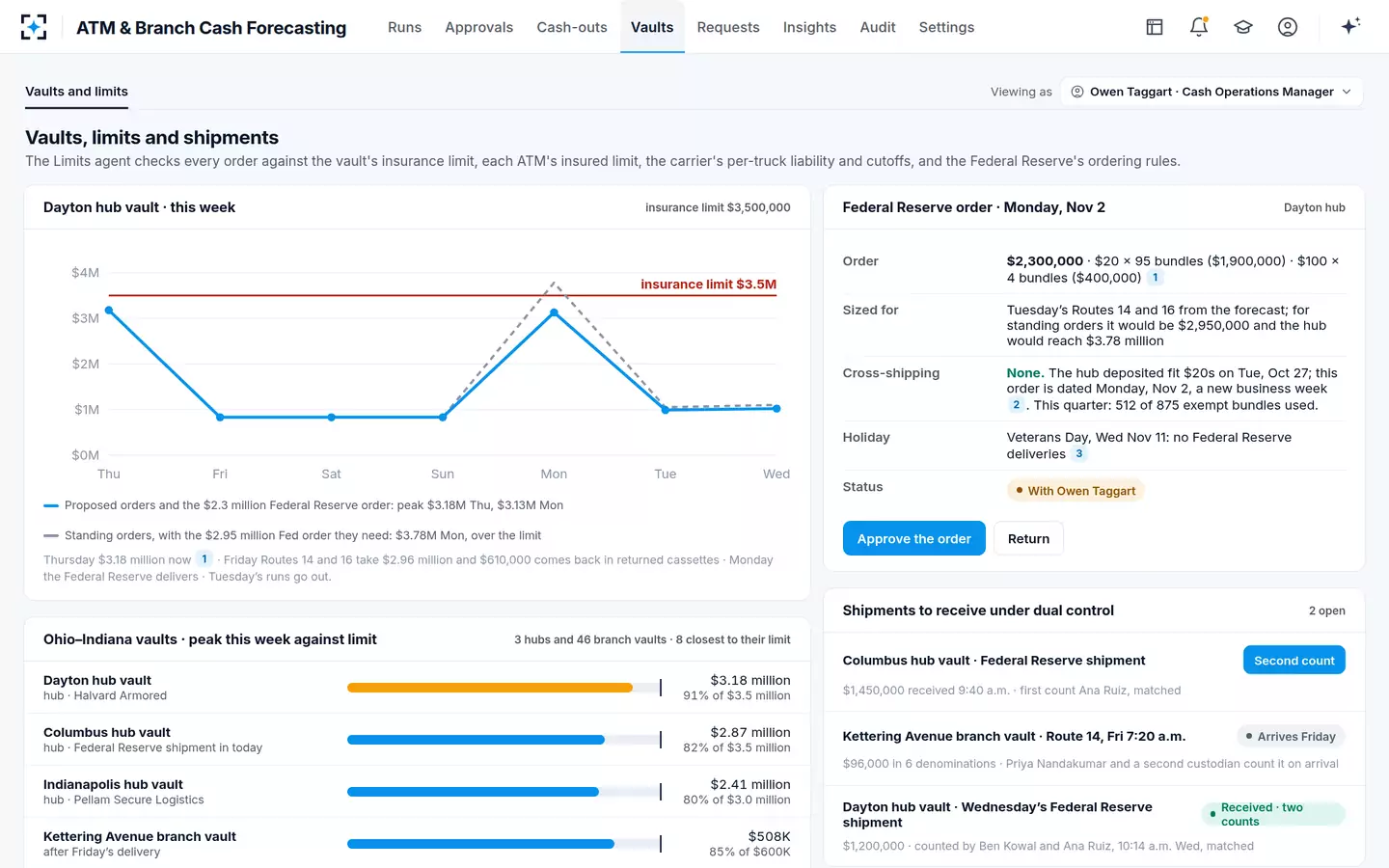
At the sample bank, Monday's order for the Dayton hub is $2,300,000: 95 bundles of $20s and 4 of $100s, sized for Tuesday's routes. On standing orders it would have been $2,950,000, and the hub would have reached $3.78 million against a $3.5 million insurance limit. The fit $20s went in on Tuesday, October 27; the order is dated Monday, November 2, a new business week, so it does not cross-ship, and the quarter has used 512 of its 875 exempt bundles. The $100s are outside the fee entirely.
The route behind the order: every load by denomination
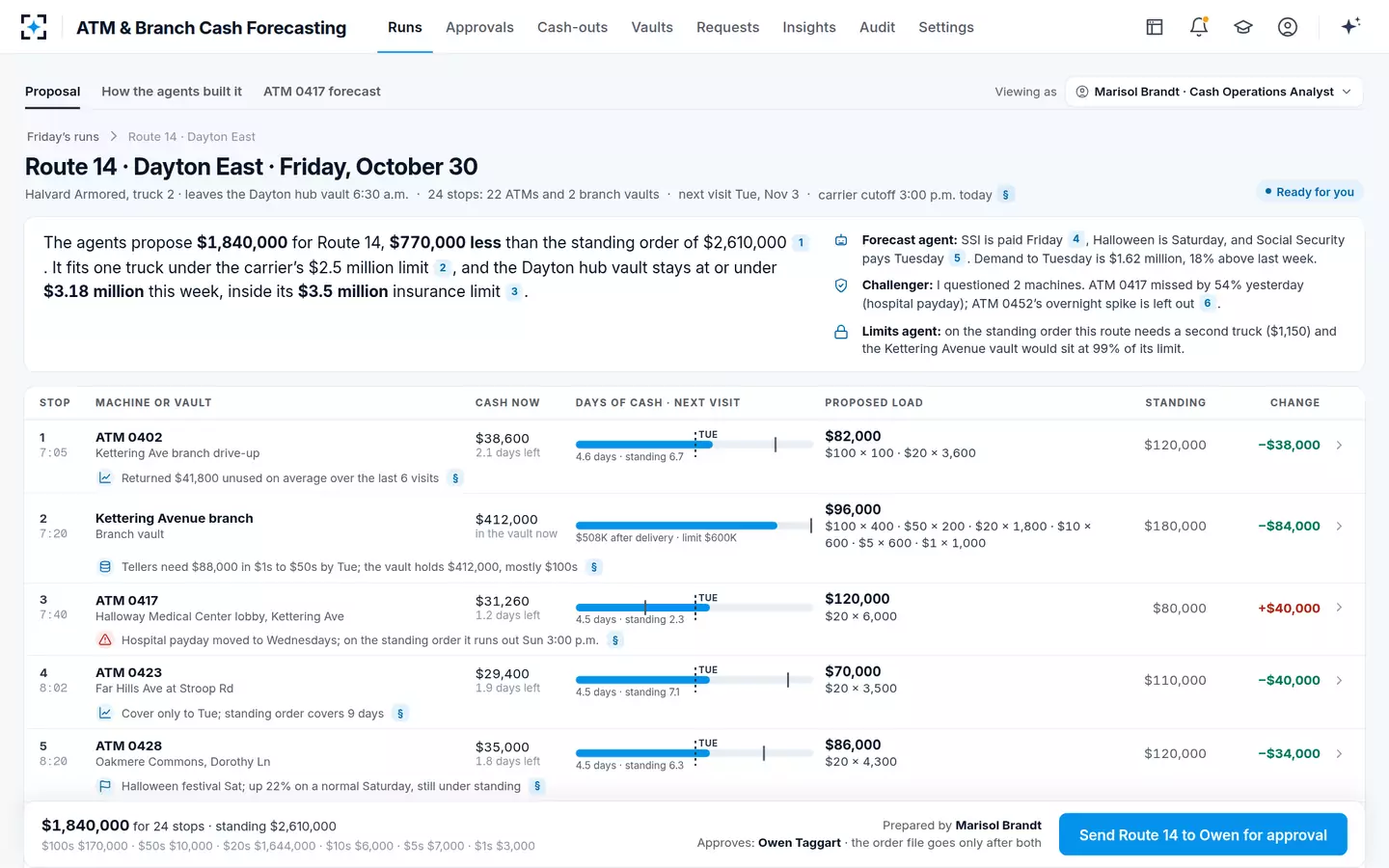
The design choice worth copying is that the check sits on the order, not in a quarterly report. Cross-shipping reports arrive monthly and fees quarterly, by which time the week that caused them is long gone. The other Federal Reserve numbers a cash team watches, from ATM withdrawals to the $20s now paid into circulation, are in cash usage statistics for ATM withdrawals. The full solution starts from ATM & Branch Cash Forecasting.
Questions people ask
Which denominations have cross-shipping fees?
Only $10 and $20 notes. The Reserve Banks monitor cross-shipping in every denomination through their reports, but fees above the exemption are assessed only on $10s and $20s, and only those two denominations may be held in a custodial inventory.
What is the de minimis exemption for cross-shipping?
The first 875 bundles of $10s and $20s combined that an institution cross-ships in a zone or sub-zone each quarter are not charged. The exemption is subtracted at the end of the quarter, expires if unused, and cannot be moved between zones or institutions.
How do banks order cash from the Federal Reserve?
A depository institution orders through FedLine Web for each endpoint, such as a branch or cash vault, and its armored carrier collects the notes. Normal service is one deposit and one order per endpoint per week; the account is debited the day the notes leave the Reserve Bank.
Does the cross-shipping fee apply to unfit or surplus notes?
No. The 2006 policy says the fee "will not be assessed on deposits of unfit or surplus fit currency," and defines surplus fit currency as fit currency the institution does not need within the business week of its deposit.
When did the cross-shipping fee start?
The Board adopted the Currency Recirculation Policy in March 2006, and fees were assessed beginning in July 2007. The 2006 notice expected about $5 a bundle; the 2026 schedule charges $8.00.
Can a bank avoid the fee by depositing and ordering in different weeks?
Not by timing alone. The Reserve Banks say that alternating order and deposit weeks without increasing recirculation is circumvention, and the 2026 schedule lists an $8.00-a-bundle circumvention fee.