ATM cash management software decides how much cash each ATM, teller cash recycler and branch vault receives on the next armored-carrier run, checks the order against every limit, and prepares the files that move the money. The hard part is not the arithmetic; it is doing it for hundreds of machines before a carrier cutoff, around paydays and benefit dates, without letting any order past a vault, ATM or truck limit. Botminds' ATM & Branch Cash Forecasting splits the work among seven agents, each with things it may never do, and keeps the decision with a cash operations analyst who prepares each route and a manager who approves it.
The examples come from a fictional sample bank, Corvane National Bank, as its Ohio–Indiana region runs through the solution; names, routes and limits are invented. Rules and published figures are linked where they appear.
Seven agents in ATM & Branch Cash Forecasting: what each does, and what it may never do
| Agent | What it does | What it may never do |
|---|---|---|
| Forecast agent | Forecasts every ATM, recycler and vault by hour and denomination from 24 months of withdrawals, paydays, Social Security and SSI dates, holidays, weather and local events. | Use a forecast under 70% confidence without a person; forecast from a pattern the Challenger excluded. |
| Challenger agent | Compares yesterday's forecasts with actual withdrawals every morning and questions any machine whose miss is above 15%. | Override the Forecast agent (it asks); record the outcome of a fraud referral. |
| Load planner | Turns each forecast into a load that reaches the next visit with safety stock, in whole straps and cassettes, and explains every change from the standing order. | Round below the safety stock. |
| Limits agent | Checks each order against vault insurance limits through the week, each ATM's insured limit, the truck's liability, the carrier cutoff, Federal Reserve bundle units, cross-shipping and holidays. | Let an order past a limit; approve an exception. |
| Cash-out watcher | Reads ATM monitoring every 15 minutes, predicts each cash-out, and proposes an emergency run when a machine will run out before its visit and the run costs less than the empty hours. | Book a run without a manager; load a machine that is out of service. |
| Order file agent | After both approvals, sends the carrier order file and the Federal Reserve order, checks the confirmations and drafts the general ledger entries. | Send anything that lacks two approvals; send a file twice. |
| Cost reporter | Computes the monthly cost of cash by region: carry at the bank's cost of funds, insurance, transport and emergency runs. | Change anything; it only reports. |
What is ATM cash management software, and what is it not?
ATM cash management software is the planning layer between the machines and the money: it forecasts demand, plans replenishment, checks limits, watches for cash-outs and sends the orders. It reads the machines' balances and faults from the bank's ATM monitoring system, and the standing orders, vault balances and limits from its cash management system; it does not run the machines.
That boundary answers a question people often type next to this one: which software runs in the ATM itself? The terminal runs its own device and transaction software, and a card network or switch authorises each withdrawal. Cash management software never touches a withdrawal or a card. In the solution, card and account numbers are never read or stored, and the carrier order file carries one line per machine by denomination and nothing about any customer.
Nor is it treasury management software. Searches for "cash management system" mix the two, but treasury systems manage a company's bank balances and payments; ATM cash management software manages physical notes in cassettes and vaults. A buyer comparing products should check which of the two a vendor means.
How does ATM cash management software work? One route from 6:00 a.m. to the carrier file
It works as a daily cycle that starts with overnight balances and ends with an approved order file. In the sample bank's run the agents start at 6:00 a.m. from the overnight ATM monitoring balances, refresh at 10:30 a.m. with the latest, and hand each route to the analyst with its exceptions; every step carries its agent's version, its sources and a confidence.
How ATM & Branch Cash Forecasting builds one route's order
Agent
Forecast agentReads the route's 24 cash points and 24 months of withdrawals, then applies the calendar: SSI on Friday, Halloween on Saturday, Social Security on Tuesday.
Agent
Challenger agentFinds 20 of 22 machines within 15% of yesterday's forecast; questions a hospital ATM that missed by 54% and leaves an overnight spike out of demand.
Never: overrides the forecast
Agent
Load planner and Limits agentSizes 24 loads to Tuesday's visit, $1,840,000 in all, and checks the truck, the hub vault, the branch vault and every ATM.
Never: rounds below safety stock or passes a limit
A person decides
Cash operations analystReviews four exceptions, confirms a low-confidence load for a new machine, and sends the route.
A person decides
Cash operations managerApproves after one check line: one truck, hub vault at or under $3.18 million, every ATM under $200,000, file before the cutoff.
Agent
Order file agentSends the carrier file and drafts the cash-in-transit entry; the Federal Reserve order stays a separate approval.
Never: sends without two approvals
The order of the steps matters as much as the steps. The Challenger checks the forecast before the Load planner uses it, so a bad assumption is questioned before it becomes a load; the Limits agent checks the load before a person sees it, so the analyst reviews exceptions rather than arithmetic; and the file goes last, after both people.
Ten steps, each with its agent, version, sources and confidence
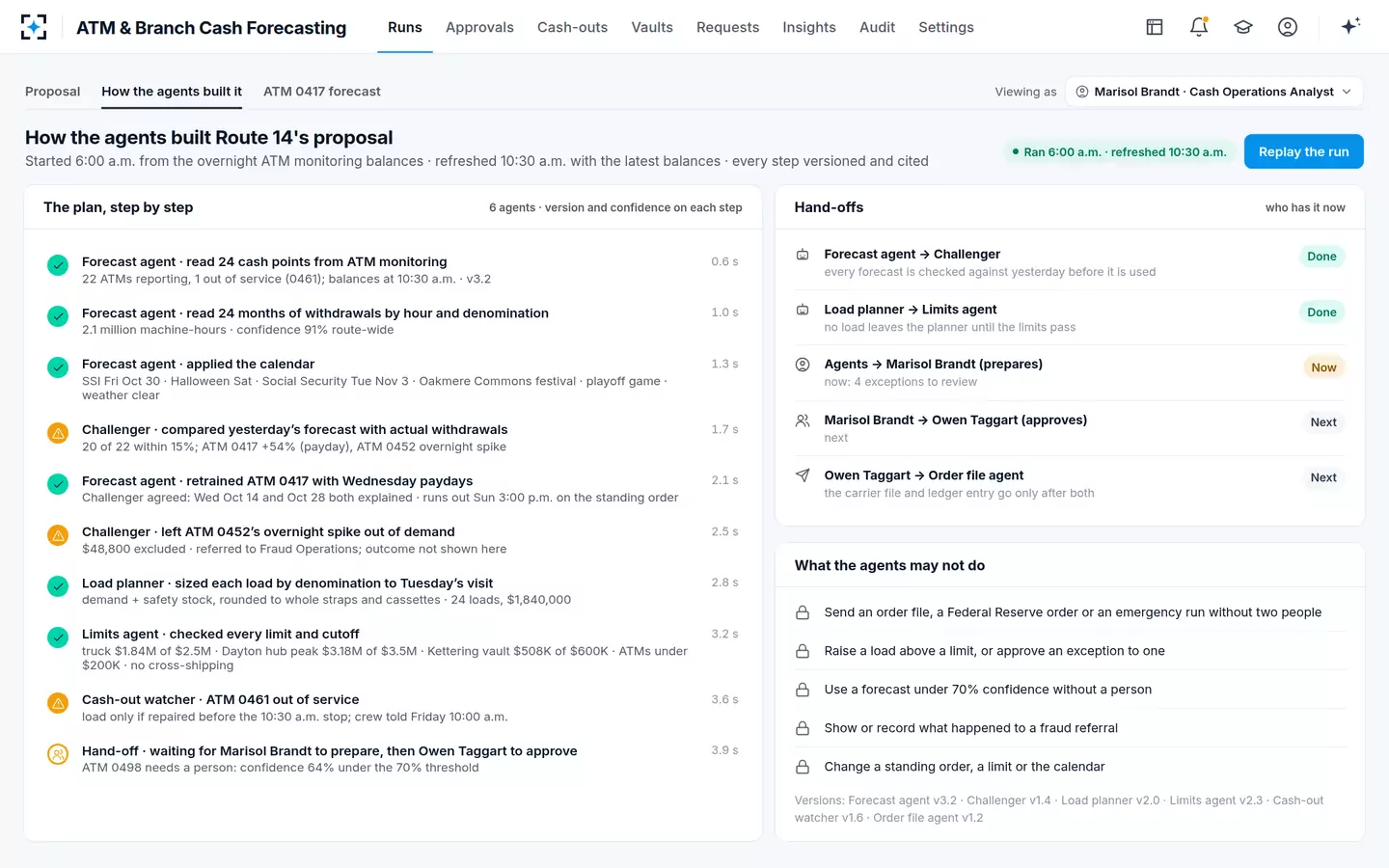
What may the agents never do?
The agents may never move money, cross a limit or decide an exception: those stay with people. Every "never" in the table above exists because one of those three would otherwise be possible. The Order file agent cannot send a file without two approvals; the Limits agent can stop an order but cannot approve its way past a limit; the Cash-out watcher can propose an emergency run but never books one.
The other limits protect the forecast itself. A forecast under 70% confidence is not used without a person, as with the sample bank's ATM 0498, installed in September, whose load the analyst confirms. A withdrawal pattern the Challenger excluded cannot creep back in. And the Challenger asks; it does not overwrite. We found no guidance from a U.S. banking regulator specific to AI in cash forecasting, so these boundaries are the bank's to set, built on the dual-control logic examiners already test in the vault.
What limits apply to ATM cash orders?
An ATM cash order must fit at least six limits at once: the machine's insured limit, the cassettes' physical capacity, the vault's insurance limit on every day of the week, the truck's liability limit, the carrier's order cutoff, and the Federal Reserve's units and calendar. Most of them are contract terms rather than public rules, so each bank's software has to hold its own.
The vault limit is the one most often checked wrong, because it has to hold on every day, not on the day of the order. The sample bank's Dayton hub vault is insured to $3.5 million. Sized for the agents' orders it peaks at $3.18 million on Thursday and holds $3.13 million on Monday after the Federal Reserve delivery; sized for standing orders it would reach $3.78 million on Monday, over the limit, with no single order looking unusual.
The Federal Reserve sets two more: units and days. Notes come in straps of 100 and bundles of 1,000, and $1 to $20 notes are deposited in full bundles (Federal Reserve Financial Services), so the sample bank's Monday order is 95 bundles of $20s and 4 of $100s. The Reserve Banks close on federal holidays, including Veterans Day, Wednesday, November 11, 2026 (FedCash holiday schedule), which is why the Limits agent flags that no Federal Reserve delivery comes that day.
One more "ATM limit" is often confused with these. The FDIC's procedures ask whether "the bank's ATMs limit the amount of cash and the number of dispense transactions during a specified period for each account" (FDIC RMS Manual, section 22.1). That is a card control on customers, not a cash-supply limit, and it lives in the card system, not in cash management software.
One route in ATM & Branch Cash Forecasting, against its standing order
$1.84M
proposed for Route 14, against a standing order of $2.61 million
1truck
under the carrier's $2.5 million limit; the standing order needs two
$3.18M
peak in the hub vault this week, against a $3.5 million limit
24stops
each with its change from the standing order explained
Who approves ATM cash orders?
A person other than the one who prepared the order approves it. In the sample bank's settings the analyst prepares and the cash operations manager approves every route order, emergency run, standing-order change and Federal Reserve order; a manager who changes an order hands it to the Head of Cash Operations; and bulk approval is allowed only for routes with no exceptions.
The manager approves with one check line, and the file goes only after both
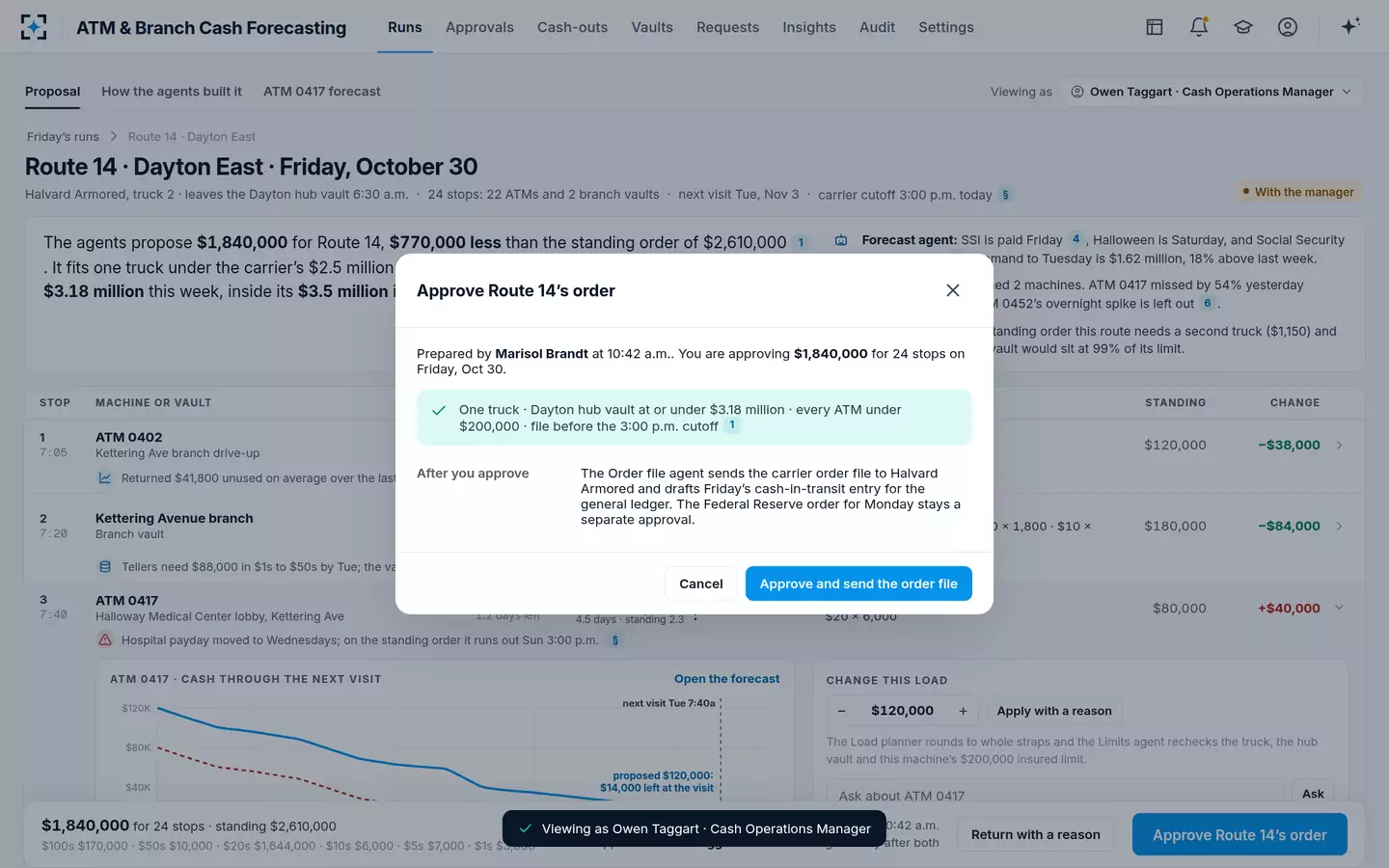
Can software order cash automatically?
Software can be set up to build and send an order file without a person. Whether it should is a control question, not a technical one. An order file moves money onto a truck, and a bank that lets software send it alone has removed the second person from the one step where examiners expect two.
ATM & Branch Cash Forecasting automates everything up to that step and nothing after it. The agents forecast, size, check and draft; the analyst prepares; the manager approves; the Order file agent sends. The time saved is in the preparation, which the solution's own estimate puts at close to five hours per route by hand, and not in skipping the approval.
How does ATM cash management software prevent cash-outs without overloading machines?
It prevents cash-outs by forecasting each machine to its next visit, not to an average day, and by deciding emergency runs on cost rather than alarm. Overloading is the usual cure for cash-outs, and the expensive one: the sample bank's standing orders sent back 41% of loaded cash unused in July.
The Cash-out watcher's rule has two conditions. The machine must run out before its next visit, and the empty hours must cost more than the carrier's fee for a run, $475 at the sample bank. ATM 2214 in Columbus runs out at 6:40 p.m. on a Thursday, its busiest evening, and is not visited until Saturday morning; the watcher counts about 14 hours empty and about 310 customers turned away, proposes a run and waits for the manager. ATM 3108 in Indianapolis runs out at 1:10 a.m., ten hours before its visit, but only about $1,900 of withdrawals fall in that window and another machine is 0.4 miles away, so the watcher proposes no run. Agreeing to no run is logged too.
Cash-outs and machines out of service, each with the watcher's proposal
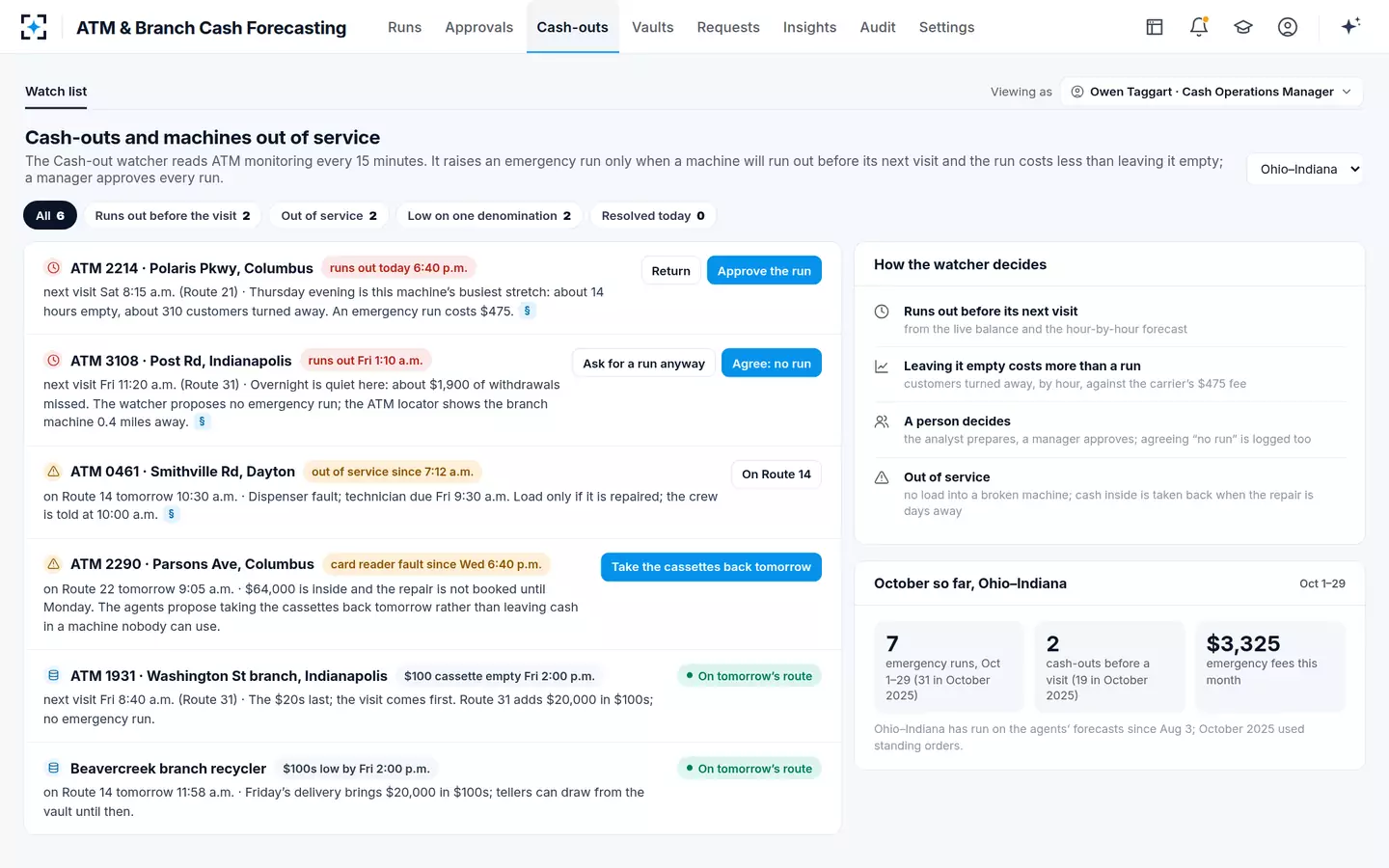
Machines out of service follow a stricter rule: the watcher never loads one. ATM 0461 on Route 14 has a dispenser fault with a technician due at 9:30 a.m., so the crew loads it only if it has been repaired. ATM 2290 has $64,000 inside and no repair booked until Monday, so the agents propose taking the cassettes back rather than leaving cash in a machine nobody can use.
What happens to an unusual withdrawal pattern?
The software should keep it out of the forecast and pass it to the people whose job it is, without becoming a fraud system itself. At the sample bank, ATM 0452 paid out $61,700 overnight against a forecast of $12,900. The Challenger left the $48,800 spike out of demand, so it does not inflate next week's order, and referred it to fraud operations.
What the solution does next is deliberately nothing. It shows that the pattern was excluded and referred; the referral's outcome, and any report that follows, is never shown, recorded or exported in the cash systems. A cash analyst needs to know the spike is not demand; she does not need, and should not have, the investigation.
Rules-based replenishment or agents with limits?
Replenishment by rules sets each machine's load from a standing order or a minimum-and-maximum level, adjusted by hand; it is the starting point the sample bank describes, with standing orders set months ago and corrected in spreadsheets. Agents differ in that they forecast each machine for the days ahead and explain each change. The comparison below is about the method, not any vendor.
Two ways ATM cash management software sets a load
Rules: standing order or min–max: A fixed amount or a refill to a maximum, reviewed every few months.
Agents with limits, as in ATM & Branch Cash Forecasting: Forecast to the next visit by hour and denomination, plus safety stock, rounded to whole straps and cassettes.
Rules: standing order or min–max: Added by hand, if someone remembers.
Agents with limits, as in ATM & Branch Cash Forecasting: Applied from the calendar, each driver shown with its effect and its source.
Rules: standing order or min–max: Checked by hand, usually on the order day only.
Agents with limits, as in ATM & Branch Cash Forecasting: Checked for every vault through the week, every ATM, every truck and the cutoff, before a person sees the route.
Rules: standing order or min–max: Found when a machine runs out or comes back full.
Agents with limits, as in ATM & Branch Cash Forecasting: Questioned the next morning against actual withdrawals.
Rules: standing order or min–max: The order is the order.
Agents with limits, as in ATM & Branch Cash Forecasting: Each change from the standing order carries a reason the analyst can read and dispute.
Rules: standing order or min–max: Depends on the product and the bank's set-up.
Agents with limits, as in ATM & Branch Cash Forecasting: Analyst prepares, manager approves, file goes after both.
What to look for when you buy ATM cash management software
Look for the controls first and the forecasting second: a forecast that cannot be checked, explained and stopped is a liability however accurate it is. Then ask for proof on your own machines. The checklist below is the one we would use, including for our own product.
Ten questions for any ATM cash management software
- Does it forecast by machine, hour and denomination?
A dollar total per machine cannot tell a vault full of $100s from one short of $20s.
- Does it explain each change from the standing order?
An analyst who cannot see why will override the forecast, or worse, stop reading it.
- Does it check every vault limit through the week?
A limit checked only on the order day misses the Monday the Federal Reserve delivery lands.
- Does it check the truck limit and the carrier cutoff?
An oversized route can need a second truck; a late file moves the run.
- Does it size Federal Reserve orders in bundles and check cross-shipping?
Fit $10s and $20s deposited and ordered back the same week cost $8.00 a bundle above the exemption.
- Can anyone approve their own order?
The answer should be no, and an approver who changes an order should not approve it.
- What happens below its confidence threshold?
A new machine has no history; a person should confirm its load.
- Will it run on your last closed quarter before go-live?
Replaying known withdrawals is the only fair test of a forecast.
- What does it keep, and for how long?
Every forecast, change, approval and file should be on a record an auditor can export.
- Does it read or store card or account data?
It has no need to; the order file needs machines and denominations only.
Question 8 deserves its own page: how to backtest ATM cash forecasting on a closed quarter sets out the protocol, the error measures and the day types to score. Question 5 is worked through in Federal Reserve cash ordering and the cross-shipping fee.
Where ATM & Branch Cash Forecasting fits, and where it does not
The solution fits a bank or credit union that runs its own cash operations: routes served by armored carriers, branch vaults and hub vaults, orders from the Federal Reserve, and standing orders that someone adjusts by hand. It reads the systems the bank already has, ATM monitoring, the cash management system, carrier portals, Federal Reserve ordering and the general ledger, and writes back only drafts and approved files.
It does not replace those systems. It does not monitor device health, authorise withdrawals, plan the carrier's truck paths, settle or balance ATMs after a visit, or investigate fraud. Visit days come from the carrier's routes and are an input. A bank whose cash is fully outsourced to a carrier that forecasts and orders for it would use the solution differently, to check the carrier's orders rather than to prepare its own. To see the routes, limits and approvals on your own data, start from ATM & Branch Cash Forecasting.
Questions people ask
What is the best ATM cash management software?
The best one for a bank is the one that forecasts its own machines well and keeps its controls intact, and only a replay on the bank's own closed quarter shows the first. Ask each vendor to forecast last quarter's withdrawals without seeing them, then compare misses by day type, idle cash and cash-outs.
Is ATM cash management software the same as ATM monitoring?
No. ATM monitoring reports each machine's balances, faults and withdrawals; cash management software uses those readings to forecast and order. In the solution, the Cash-out watcher reads ATM monitoring every 15 minutes but changes nothing in it.
What is an ATM emergency run?
An emergency run is an unscheduled carrier visit to refill a machine that will run out before its next scheduled visit. In the sample bank's settings one costs $475, and the solution proposes it only when the empty hours would cost more, with a manager approving every run.
Does ATM cash management software handle teller cash recyclers?
Good software treats recyclers and branch vaults as cash points alongside ATMs, each with its own limit and denominations. The sample bank insures recyclers to $250,000 and ATMs to $200,000, and the solution checks both before an order goes.
What does ATM cash management software cost?
There is no public price list, so compare quotes with what cash already costs you. At the fictional sample bank, carrying, insuring and moving one region's cash cost $346,242 in September and $410,912 in July, the last month on standing orders; that monthly figure is the right yardstick for any licence.
Does ATM cash management software need customers' card data?
It should not. Forecasting and ordering need withdrawals by machine, hour and denomination, not by customer. In the solution card and account numbers are never read or stored, and the carrier file lists machines and denominations only.