ATM replenishment is the daily decision of how much currency each ATM, teller cash recycler and branch vault receives on the next armored-carrier run, sized to last until the following visit within the machine's insured limit and the carrier's limits. Government benefit dates are the part of that demand a bank can know years ahead. Social Security pays on the second, third or fourth Wednesday by the insured worker's birth date, some recipients on the 3rd, and SSI on the 1st, each moved to the business day before a weekend or federal holiday. When those dates land just before a weekend or stack on one day, a load sized from a standing order runs short at the machines older and rural customers use. Botminds' ATM & Branch Cash Forecasting builds the benefit calendar into every machine's forecast as a separate driver, sizes each load to the hours before the next truck, checks it against every limit and leaves the approval to the cash operations manager.
This guide is for the cash operations manager who signs the orders and the branch network leader who answers for cash-outs and idle cash. The product examples use a fictional sample bank; the payment rules come from the federal regulations and the Social Security Administration's schedule.
Benefit payment dates for cash planning, November 2026 to December 2027
| Month paid for | SSI (the 1st) | Paid on the 3rd | 2nd, 3rd, 4th Wednesdays |
|---|---|---|---|
| Nov 2026 | Fri, Oct 30 (1st is a Sunday) | Tue, Nov 3 | Tue Nov 10 (Veterans Day), Nov 18, 25 |
| Dec 2026 | Tue, Dec 1 | Thu, Dec 3 | Dec 9, 16, 23 |
| Jan 2027 | Thu, Dec 31, 2026 | Thu, Dec 31, 2026 | Jan 13, 20, 27 |
| Feb 2027 | Mon, Feb 1 | Wed, Feb 3 | Feb 10, 17, 24 |
| Mar 2027 | Mon, Mar 1 | Wed, Mar 3 | Mar 10, 17, 24 |
| Apr 2027 | Thu, Apr 1 | Fri, Apr 2 (3rd is a Saturday) | Apr 14, 21, 28 |
| May 2027 | Fri, Apr 30 (1st is a Saturday) | Mon, May 3 | May 12, 19, 26 |
| Jun 2027 | Tue, Jun 1 | Thu, Jun 3 | Jun 9, 16, 23 |
| Jul 2027 | Thu, Jul 1 | Fri, Jul 2 (3rd is a Saturday) | Jul 14, 21, 28 |
| Aug 2027 | Fri, Jul 30 (1st is a Sunday) | Tue, Aug 3 | Aug 11, 18, 25 |
| Sep 2027 | Wed, Sep 1 | Fri, Sep 3 | Sep 8, 15, 22 |
| Oct 2027 | Fri, Oct 1 | Fri, Oct 1 (3rd is a Sunday) | Oct 13, 20, 27 |
| Nov 2027 | Mon, Nov 1 | Wed, Nov 3 | Nov 10, 17, 24 |
| Dec 2027 | Wed, Dec 1 | Fri, Dec 3 | Dec 8, 15, 22 |
What is ATM replenishment, and what decides each load?
A replenishment load is the cash a machine needs from this visit to the next one, plus safety stock, rounded to cassettes and denominations, and capped by limits. On a top-up, what is already in the machine comes off the load; on a cassette swap, it goes back to the vault instead. Four constraints bind every order: the machine's insured limit, the carrier's liability per truck, the carrier's order cutoff, and the hub vault's insurance limit across the week. At the sample bank those are $200,000 for any ATM, $250,000 for a teller cash recycler, $2.5 million a truck with a 3:00 p.m. ET file cutoff for the first carrier, and $3.5 million for each of two hub vaults.
One machine's load, worked on the sample bank's hospital lobby ATM
Base demand to the next visit
Same four days over the last 8 weeks
$76,600, Friday to the Tuesday 7:40 a.m. visit.
Calendar drivers
Payday + SSI Friday + Halloween + Social Security Tuesday
$16,400 + $5,300 + $6,100 + $1,600 = $29,400.
Forecast to the visit
$76,600 + $29,400
$106,000.
Load
Forecast + safety stock on a cassette swap, in $20s, rounded to cassettes
$120,000, leaving about $14,000 at the visit; the $80,000 standing order would run out Sunday at 3:00 p.m.
The calendar drivers are only a quarter of the forecast here, and the benefit days are the smaller part of them. That is typical: what matters is not the size of the benefit effect in general but how much of it falls inside this machine's visit window, which is why the Tuesday Social Security payment adds only $1,600 at a machine visited at 7:40 that morning. ATM cash demand forecasting on one machine builds every driver in detail.
The payment rules a cash team needs
Social Security's day depends on the insured worker's birth date: "Insured individuals born on the 1st through the 10th of the month will be paid on the second Wednesday of each month" (20 CFR 404.1807), the 11th to 20th on the third Wednesday and later dates on the fourth. Beneficiaries entitled on records from applications before May 1, 1997, and later ones who also receive SSI, are paid on the 3rd. SSI is paid on the 1st, and when the 1st is a weekend or legal holiday, on the last business day before (20 CFR 416.502).
The shift rule is the one that moves cash demand: "If the day regularly scheduled for the delivery of your benefit payment falls on a Saturday, Sunday, or Federal legal holiday, you will be paid on the first preceding day that is not a Saturday, Sunday, or Federal legal holiday." For replenishment, a payment moved from a Sunday to a Friday is the worst case, because it lands at the start of a weekend when many machines will not be visited until Monday or Tuesday.
Which 2026–27 dates stack, and which land before a weekend?
Six dates in the table deserve a manual look before the route is approved. They are the days when two payment groups land at once, when SSI moves to a Friday before a weekend, or when a holiday moves a Wednesday payment.
Benefit dates to review by hand, November 2026 to December 2027
Oct 30, 2026
November SSI on a Friday, with Halloween on Saturday and 3rd-of-month payments the next Tuesday
Nov 10, 2026
second-Wednesday payments on Tuesday, because Veterans Day closes the Federal Reserve on Wednesday
Dec 31, 2026
January SSI and 3rd-of-month payments together, on New Year's Eve before a Fed holiday
Oct 1, 2027
SSI and 3rd-of-month payments together on a Friday
The months with two SSI days follow from the same rule. When SSI moves into the previous month, that month carries two SSI payments and the next one none: in 2027, April has SSI on the 1st and the 30th and May has none; July has the 1st and the 30th and August none. A replenishment plan that assumes one SSI day per month will be wrong in both.
Which machines feel benefit days most?
Machines used by older, rural and lower-income customers, because those customers use the most cash. The Federal Reserve's 2026 diary of consumer payments counted cash payments per person per month in 2025: ten for people 55 and older against two for ages 18 to 24, nine for rural residents against six in urban and suburban areas, and seven in households under $25,000 against five above $150,000 (2026 Findings from the Diary of Consumer Payment Choice).
Cash payments a month in 2025, by age, place and income
The same customers come to the teller line. The FDIC's 2023 household survey found that "almost one-third of households without a high school diploma (32.4 percent) and a similar percentage of households aged 65 or older (30.4 percent) used bank tellers as their primary method of account access" (FDIC, 2023 National Survey of Unbanked and Underbanked Households). A benefit day reaches the branch vault and the recyclers as well as the lobby ATM, so the calendar belongs in branch orders too.
We found no government or academic study that measures the benefit-day effect on US ATMs, so the size of the effect has to come from each machine's own withdrawal history. That is where it should come from regardless: a machine near a retirement community and one on a university campus will show opposite answers, and a network average would be wrong for both.
How should a replenishment schedule handle a benefit day?
By counting only the demand that falls before the next visit, and by moving the visit or the load when a payment lands just before a long gap. A Friday SSI date at a machine next visited on Tuesday carries a weekend of benefit demand; the same date at a machine visited daily barely changes a single load. The decision is per machine and per route, not per network.
A route proposal with the calendar drivers cited
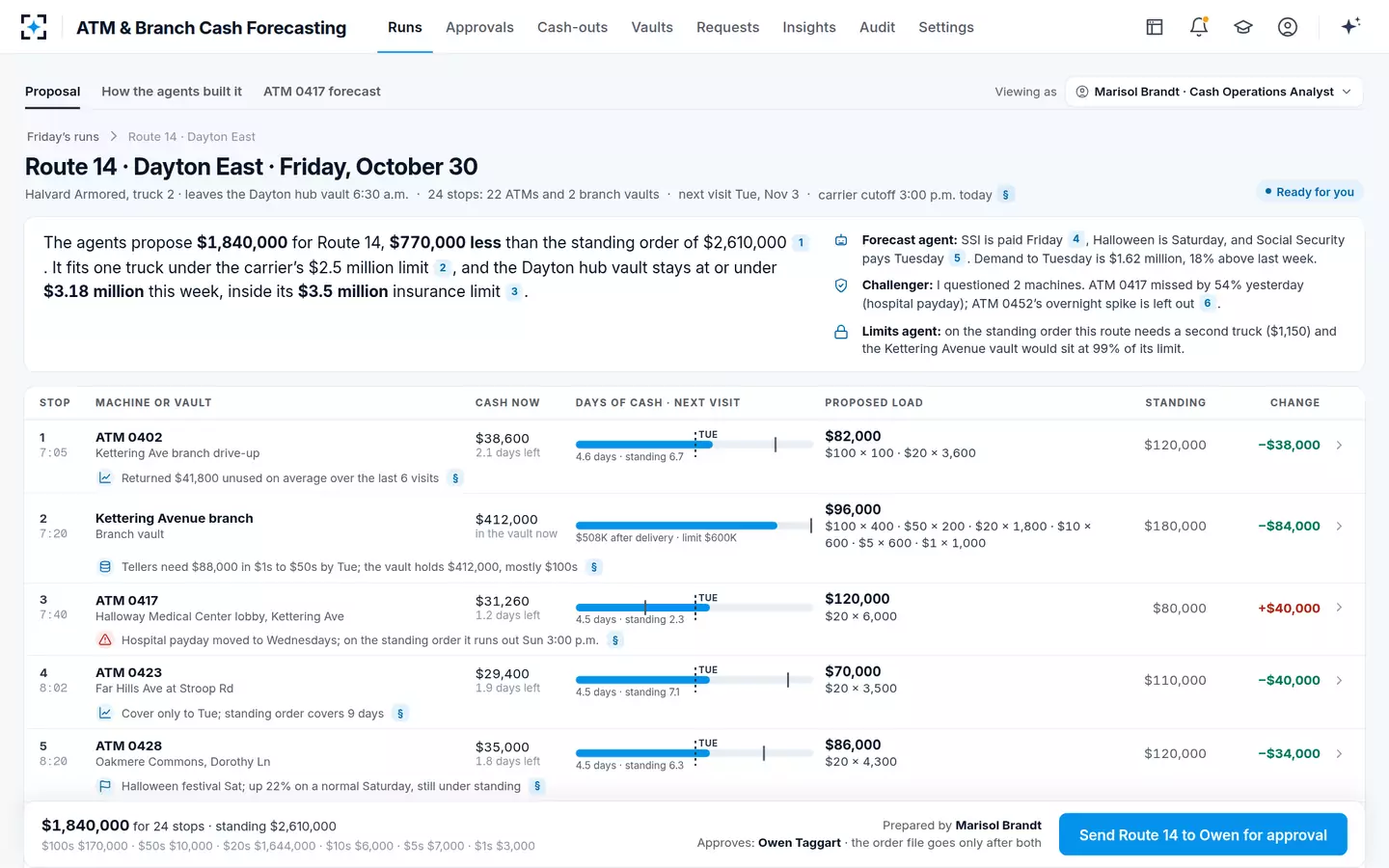
The route above shows both directions at once. The agents proposed $1,840,000 for 24 stops against a $2,610,000 standing order: a drive-up ATM that had returned $41,800 unused on average over its last six visits got $82,000 instead of $120,000, while the hospital ATM got more. On the standing order the route would also have needed a second truck, $1,150, and one branch vault would have sat at 99% of its limit. A benefit-day plan that only adds cash misses the larger saving.
Federal Reserve holidays and the vault
Federal holidays move benefit payments earlier and close the Federal Reserve's cash services, so the vault plan needs the FedCash calendar, not just the federal one. The Reserve Banks publish their schedule with two rules: "For holidays falling on Saturday, Federal Reserve Banks and Branches will be open the preceding Friday," and "For holidays falling on Sunday, Federal Reserve Banks and Branches will be closed the following Monday" (FedCash holiday schedule).
FedCash holidays that matter for benefit-day vault planning
| Date | Holiday | What it means for cash |
|---|---|---|
| Wed, Nov 11, 2026 | Veterans Day | Second-Wednesday payments move to Tuesday; no Fed deliveries Wednesday |
| Fri, Dec 25, 2026 | Christmas Day | Fed closed the week before January's stacked Dec 31 payments |
| Fri, Jan 1, 2027 | New Year's Day | Fed closed the day after Dec 31's two payment groups |
| Mon, Jul 5, 2027 | Independence Day (Sunday holiday) | Fed closed Monday after Friday's 3rd-of-month payments |
| Thu, Nov 25, 2027 | Thanksgiving Day | Fed closed the day after the fourth-Wednesday payments |
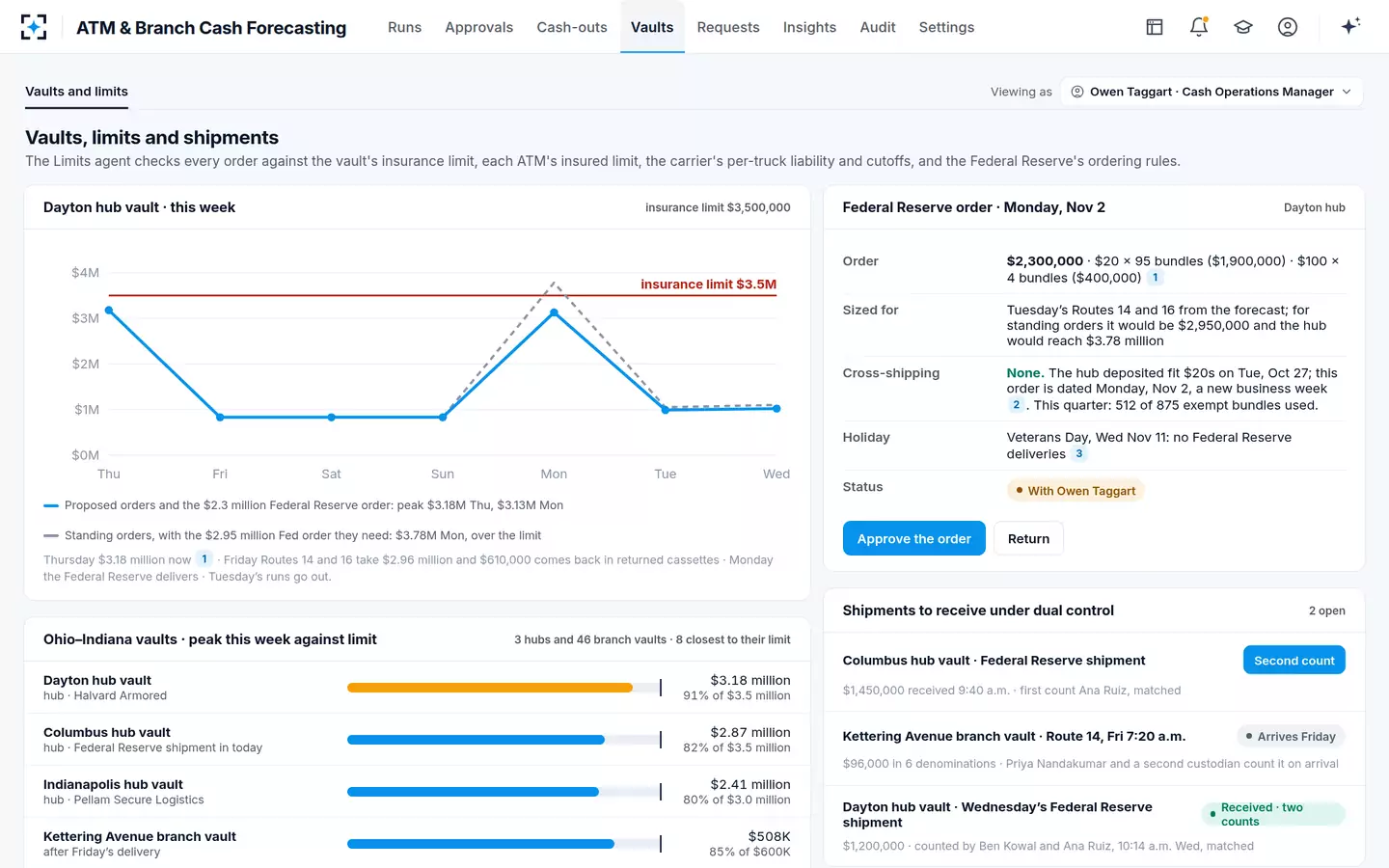
The vault constraint is the one most often broken around holidays, because cash ordered early to cover a closure sits in the vault through the busiest days. At the sample bank, the hub vault peaks at $3.18 million on Thursday against its $3.5 million insurance limit; sized for standing orders it would have reached $3.78 million. Monday's $2.3 million Federal Reserve order was placed so that it would not cross-ship, which Federal Reserve cash ordering and the cross-shipping fee explains.
Vault limits through the week, with the Federal Reserve order
What getting benefit days wrong costs
A cash-out on a benefit day costs the customers least able to go elsewhere, plus an emergency run; an overload costs carry, insurance and transport on cash that comes back unused. The sample bank's rule for an emergency run is that the machine would run out before its visit and the empty hours cost more than the carrier's fee. Both costs are visible only per machine: the hospital ATM would have run out on Sunday afternoon of a stacked weekend, while the drive-up ATM on the same route was returning about a third of its standing-order load unused.
A benefit-day replenishment calendar, in seven checks
- Generate SSI and 3rd-of-month dates with the shift rule
They move before weekends and federal holidays, sometimes into the previous month.
- Generate the three Wednesdays and move any on a holiday
In 2026 only November 11; none in 2027.
- Flag stacked days and Friday SSI dates
Dec 31, 2026 and Oct 1, 2027 carry two groups; Apr 30 and Jul 30, 2027 move SSI to a Friday.
- Measure each machine's own benefit effect
From its withdrawal history, by hour, not a network average.
- Count only the hours before the next visit
A payment the morning of a visit barely touches the load before it.
- Add FedCash closures to the vault plan
Saturday holidays open the Friday before; Sunday holidays close the Monday after.
- Confirm computed dates against the SSA schedule
Before the year's first loads; the SSA publishes each year's schedule.
Approvals and the audit trail
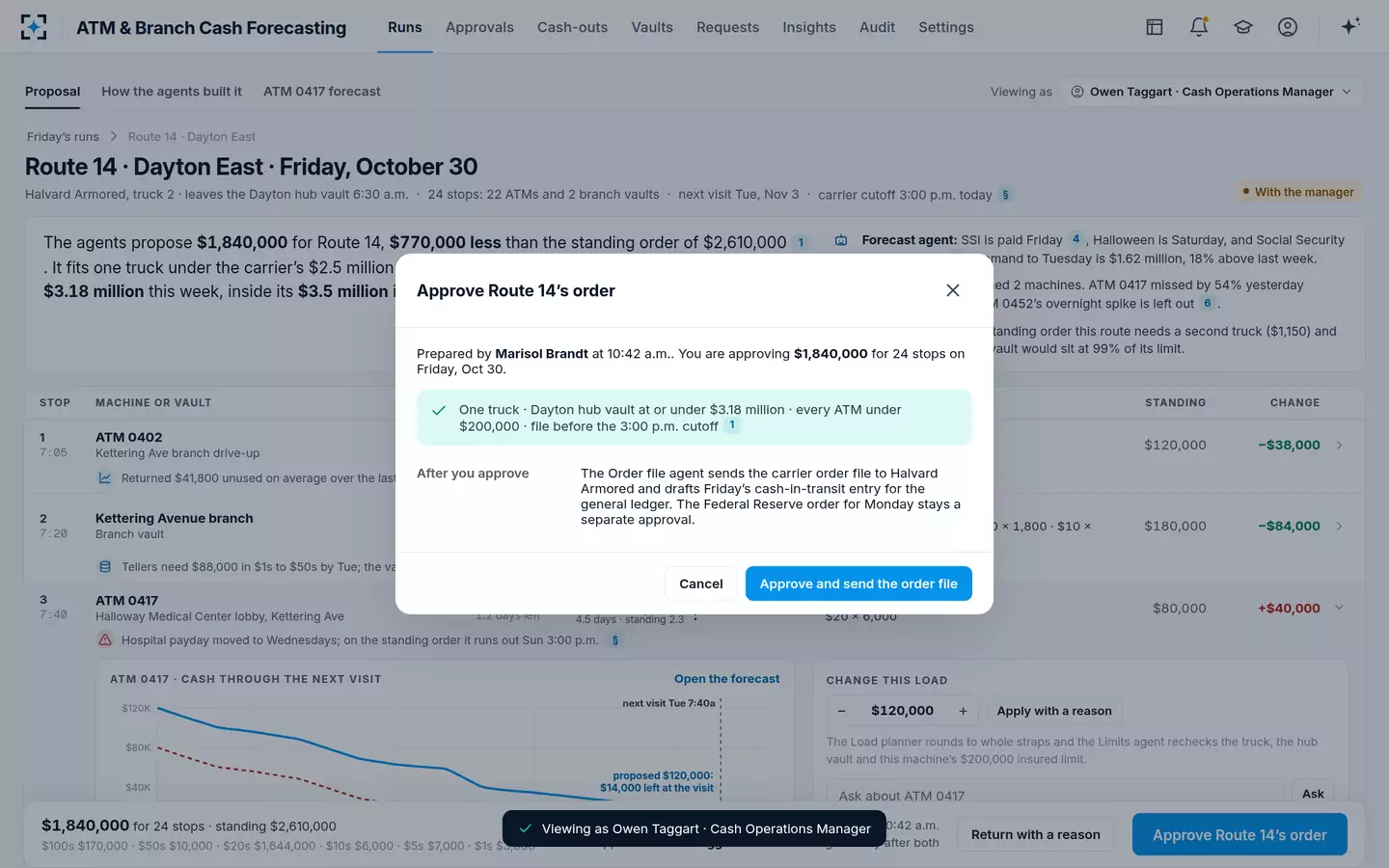
A benefit-day load is still an order someone signs. At the sample bank the analyst sends each route with its exceptions summarised, the cash operations manager approves it after one check line, one truck, the hub vault at or under its peak, each ATM under $200,000 and the file before the cutoff, and a manager who changes a load sends the approval up to the head of cash operations. The order file goes to the carrier only after both approvals, and every step, including any overnight spike left out of demand and referred to fraud operations, stays on a trail kept five years.
The manager approves the route and its order
Backtesting ATM cash forecasts by day type shows how to score benefit days separately from ordinary days before trusting a forecast with them.
Questions people ask
How often should an ATM be replenished?
As often as demand and cost require; no rule sets it. Most banks visit busy machines several times a week and quiet ones weekly. The load, not the visit frequency, is where benefit days usually belong: size it to the hours before the next truck.
When is SSI paid when the 1st falls on a weekend?
On the last business day before, under 20 CFR 416.502. That puts November 2026's SSI on Friday, October 30, and May and August 2027's on Fridays, April 30 and July 30, giving April and July 2027 two SSI days each.
Do Social Security Wednesday payments ever move?
Only when the Wednesday is a federal holiday. In 2026 that happens once: November 11, Veterans Day, moves second-Wednesday payments to Tuesday, November 10. In 2027 Veterans Day is a Thursday, so no Wednesday moves.
Is the Federal Reserve open when a holiday falls on a weekend?
The FedCash schedule says Reserve Banks are open the Friday before a Saturday holiday and closed the Monday after a Sunday holiday. In 2027, Independence Day falls on a Sunday, so the Reserve Banks close on Monday, July 5.
Do benefit days raise branch cash demand as well as ATM demand?
Yes, where customers rely on tellers. About 30% of households aged 65 or older used a teller as their main way to reach their account in 2023, so branch vault and recycler orders need the same calendar as the ATMs.
How much do benefit days add to ATM withdrawals?
It depends on the machine and must be measured from its history; we found no public study for US ATMs. At the sample bank's hospital ATM, SSI on a Friday added $5,300 to a four-day forecast, and Social Security on the following Tuesday morning added $1,600.