Cash forecasting software for ATMs predicts how much currency each ATM, teller cash recycler and branch vault will pay out before its next armored-carrier visit, and turns the forecast into orders. It needs five kinds of data that a bank already holds, scattered across systems: withdrawal history by machine, hour and denomination; the loads, returns and counts from each visit; vault balances, denominations and limits; a calendar of paydays, Social Security and SSI dates, holidays and events; and the carrier's and the Federal Reserve's rules. Botminds' ATM & Branch Cash Forecasting reads all five from the systems that hold them, and its first job at a new bank is a replay on the bank's own routes, standing orders and withdrawal history.
A note on the search itself. "Cash forecasting software" usually means treasury software that forecasts a company's bank balances. This page is about the other kind, which forecasts notes in machines. The product examples come from a fictional sample bank, Corvane National Bank, in the solution; research is linked where it appears.
Two products called cash forecasting software
Treasury cash-flow forecasting: A company's bank balances: receipts and payments by day or week.
ATM and branch currency forecasting: Notes paid out by each ATM, recycler and vault until the next carrier visit.
Treasury cash-flow forecasting: Dollars in accounts.
ATM and branch currency forecasting: Notes by denomination, in straps, bundles and cassettes.
Treasury cash-flow forecasting: Receivables, payables, payroll, bank statements.
ATM and branch currency forecasting: Withdrawals by machine and hour, loads and returns, vault counts, calendars, carrier routes.
Treasury cash-flow forecasting: A borrowing decision or idle balances.
ATM and branch currency forecasting: An empty machine, idle cash on a truck, a second truck, a Federal Reserve fee.
Treasury cash-flow forecasting: Corporate treasurers.
ATM and branch currency forecasting: A bank's cash operations analysts and managers.
Treasury cash-flow forecasting: Credit lines and covenants.
ATM and branch currency forecasting: Vault and ATM insurance limits, truck liability, carrier cutoffs, Federal Reserve units.
What is cash forecasting software for ATMs, and how is it different from cash-flow forecasting?
Cash forecasting software for ATMs is demand forecasting for physical currency. It answers how many $20s, $100s and smaller notes each cash point will pay out between two carrier visits, and it must answer in units the carrier and the Federal Reserve accept. Cash-flow forecasting answers a different question, how much money an organisation will have in its accounts, and its inputs are invoices and payroll rather than machine logs.
The difference matters to a buyer because the two share vocabulary and little else. A tool that forecasts balances well has no idea what a cassette holds, that a branch vault full of $100s can still be short of $20s, or that a route over its truck limit needs a second truck. Ask any vendor which of the two it builds, and ask to see a load by denomination.
What data is needed for cash forecasting?
Five data sets, each with an owner and a home. The table below is the list ATM & Branch Cash Forecasting works from; most banks hold all five, but rarely in one place.
The five data sets cash forecasting software for ATMs needs, and where each lives
| Data | Where it usually lives | How much | What goes wrong without it |
|---|---|---|---|
| Withdrawals by machine, hour and denomination | ATM monitoring system; recycler and teller systems | 24 months in the solution | No weekly or yearly pattern; no hour a machine runs out |
| Loads, returns and cassette counts | Cash management system; carrier settlement | The same period | No measure of idle cash; demand on cash-out days understated |
| Vault balances, denominations and limits | Cash management system; cash limits policy; insurance terms | Current, plus history for the backtest | Orders that break a limit on a day nobody checked |
| The calendar | Not in one system: Social Security and SSI rules, Federal Reserve holidays, branch notes on paydays and events | Forward-looking, kept current | Benefit days and paydays treated as ordinary days |
| Carrier and Federal Reserve rules | Carrier agreements and portals; FedCash policies | Current terms | Late files, second trucks, cross-shipping fees |
How much history do you need to forecast ATM cash?
About two years of daily withdrawals per machine is the standard the research uses, and it is what the solution reads: 24 months, by hour and denomination. The NN5 competition, the shared benchmark of the ATM forecasting studies cited on these pages, gave forecasters "roughly two years of daily cash money withdrawal amounts (735 data points)" for each of 111 ATMs and asked for the next 56 days (Ben Taieb et al., arXiv preprint).
Two years is not arbitrary. One NN5 entry, published in the International Journal of Forecasting, separated three seasonal patterns, by day of the week, day of the month and month of the year (Andrawis, Atiya and El-Shishiny, 2011). A weekly pattern needs only weeks to estimate; a month-of-year effect needs at least one full year, and a yearly holiday needs two to be seen more than once. A machine with six months of history can still be forecast, but its confidence should be lower and a person should confirm its load.
New machines are the hard case. At the sample bank, ATM 0498, installed in September, scores 64% confidence, under the 70% threshold, so the analyst confirms its $66,000 load, noting that the nearest machines agree. Research points to the same remedy: grouping machines with similar weekly patterns improved forecasts on the NN5 data, and the clustered approach did better than forecasting every machine alone (Venkatesh et al., 2014).
Withdrawals by machine, hour and denomination: why daily totals are not enough
Daily totals tell you how much a machine pays; hourly data tells you when it runs out, and denomination data tells you which cassette empties first. Both decide whether a load works. The sample bank's ATM 3108 runs out at 1:10 a.m., ten hours before its visit, but only about $1,900 of withdrawals fall in that window; a daily total could not tell that from a machine that empties at 6:40 p.m. on its busiest evening.
Denominations decide the rest. A machine can empty its $100 cassette while its $20s last, as the sample bank's ATM 1931 does by 2:00 p.m. on a Friday. A branch vault can hold $412,000, mostly in $100s, and still be unable to give its tellers $88,000 in $1s to $50s. The FDIC's procedures ask examiners whether the bank keeps records showing vault cash by amount and denomination (FDIC RMS Manual, section 22.1); a forecast that ignores denominations ignores the record examiners ask for.
One machine opened in place: cassettes, notes per cassette, and the curve to the next visit
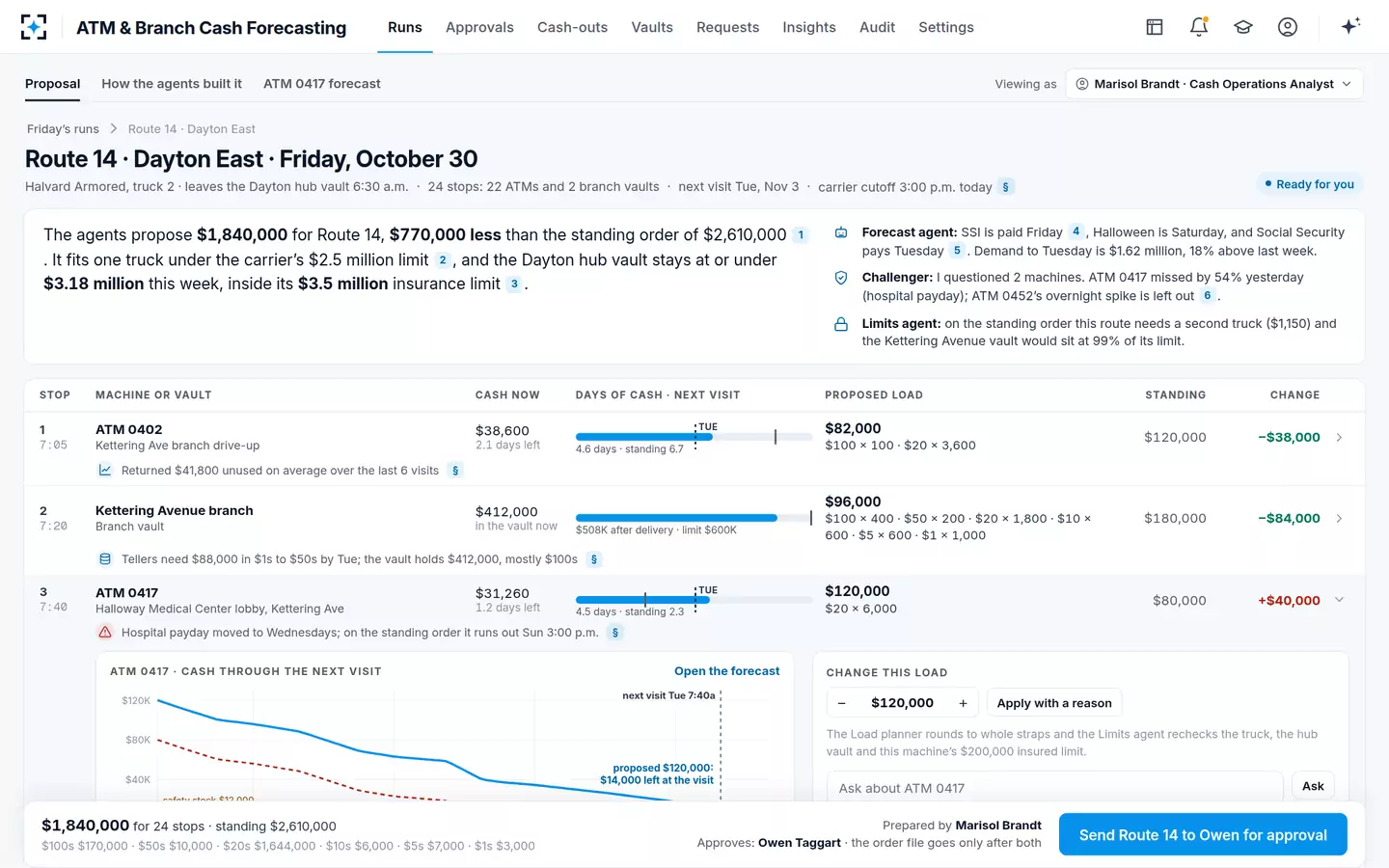
Loads, returns and cassette counts: the record of unused cash
What a machine was loaded with, and what came back, measures the cost of the current method. It is also the only way to see idle cash, which is invisible in withdrawal data. The sample bank's standing orders sent back 41% of loaded cash unused in July; its ATM 0402 at a branch drive-up returned $41,800 unused on average over its last six visits, the reason the agents cut its load from $120,000 to $82,000.
Returns matter to the vault forecast too. On the sample bank's Friday run, $610,000 comes back to the Dayton hub in returned cassettes, money that lands in the vault that day and counts against its insurance limit. And load records mark the days a machine was empty, which a backtest needs so that a cash-out is not mistaken for low demand.
Vault balances, denominations and limits: the constraints in writing
The forecast says what is needed; the vault data says what is already there and how much more is allowed. That means current balances by denomination for every hub vault, branch vault and recycler, and the written limits: the bank's cash limits policy, the insured limits for vaults and ATMs, and any limit per teller or office.
Limits should come in as settings with an owner, not as numbers in a spreadsheet tab. In the solution each limit is a setting that the cash systems administrator proposes and the head of cash operations approves, on the record. At the sample bank that means $3.5 million for the Dayton and Columbus hubs, $3.0 million for Indianapolis, $450,000 to $750,000 by branch vault, $200,000 for any ATM and $250,000 for teller cash recyclers.
The scale ATM & Branch Cash Forecasting works at on the sample network
2,150
ATMs, plus 640 branch vaults and recyclers, across 14 states
$310.4M
average cash held in them in September
486
machines and vaults forecast by hour and denomination in one region
24months
of withdrawal history read for each machine
The calendar: the data set no core system holds
The calendar is the input most likely to be missing, because no single system holds it. It has four parts, and each comes from a different place.
Benefit dates follow published rules. Social Security is paid on the second, third or fourth Wednesday according to the insured person's birth date, on the 3rd for some recipients, and SSI on the 1st, each moved to the preceding business day when it falls on a weekend or federal holiday (20 CFR 404.1807); the dates can be generated years ahead. Federal Reserve holidays come from the FedCash holiday schedule (Federal Reserve Financial Services). Employer paydays near a machine come from the branch, which is why a branch manager's note about a hospital's new Wednesday payday belongs in the forecast. Local events and weather come from the region: the sample bank's Friday forecast includes a local festival and a playoff game.
Each part should be switchable by region and dated. In the sample bank's settings, Social Security and SSI dates, holidays and Federal Reserve closures, employer paydays, local events and weather are on, while tax refunds and state benefit dates are off until February. ATM replenishment around benefit days lists the 2026–27 dates and the ones that move.
Does cash forecasting software need the carrier schedule?
Yes: the carrier's schedule sets the horizon of every forecast, and its terms set two of the limits. A machine visited on Friday and Tuesday needs a four-day forecast; the same machine on a daily route needs one day. The software needs the routes and visit days, each carrier's order cutoff, its value limit per truck and its fee for an emergency run.
The Federal Reserve's rules come in alongside. Orders and deposits are made in straps of 100 and bundles of 1,000 notes, with $1 to $20 notes deposited in full bundles (FedCash currency depositing and ordering), and fit $10s and $20s ordered back in the same week as they were deposited are charged a fee. None of this is forecasting; all of it decides whether a forecast becomes an order that can be sent.
What the data turns into: the carrier order file, one line per machine by denomination
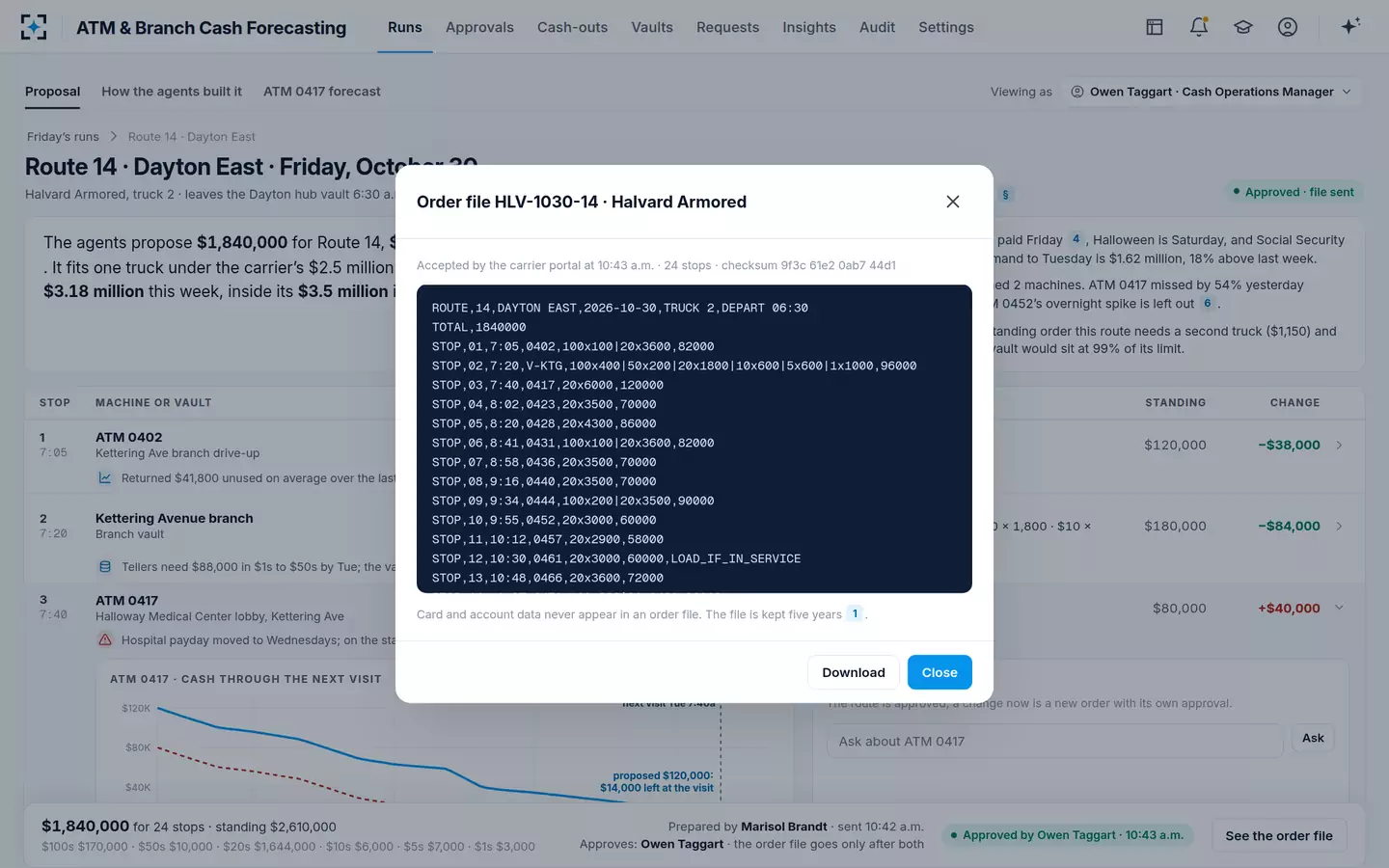
Can cash forecasting software use Excel data?
It can start from spreadsheets for the parts that live in them, such as standing orders, limits lists and event calendars, but withdrawal history should come from the system that records it. A spreadsheet is a fine import and a poor source of truth: it has no owner, no version and no approval, and the limit in one tab may not be the limit in the policy.
The practical sequence is to import what is in spreadsheets once, turn each limit and driver into a setting with an owner, and read withdrawals, balances and returns directly from the monitoring and cash management systems from then on. Every later change then goes through a proposal and an approval rather than an edited cell.
How long does cash forecasting software take to set up?
Set-up time depends mostly on how quickly 24 months of withdrawals, loads and returns can be extracted, and on how many limits and calendars exist only in people's heads. We do not publish a standard timeline, because the data work differs by bank. What should be fixed is the order of steps: extract the data, replay a closed quarter, run in shadow, then let the forecast size loads with people reviewing every change.
The replay is where the data is proved, not just the forecast. Gaps show up as machines with low confidence, vaults whose denominations do not reconcile, or events the calendar missed. How to backtest ATM cash forecasting on a closed quarter sets out the protocol.
What to look for when you buy cash forecasting software for ATMs
Look for software that reads your systems rather than asking you to re-key them, shows its inputs for every number, and tells you which machines it is unsure of. The checklist below is about data, the part of a purchase that decides whether the rest works.
Data questions to ask any vendor of cash forecasting software for ATMs
- Which systems does it read, and which does it write to?
Reading monitoring and cash management directly beats file uploads; writing should be limited to drafts and approved files.
- Does it forecast by hour and denomination?
Daily dollar totals cannot show when a machine empties or which cassette goes first.
- How does it treat a machine with little history?
It should say so, borrow from similar machines, and ask a person.
- Where does its calendar come from, and who maintains it?
Benefit rules can be generated; paydays and events need a named owner at the branch or region.
- Are limits settings with an owner and an approval?
A limit in a spreadsheet tab is a limit nobody can prove was in force.
- Can every figure show its source?
In the solution each number opens the passage it came from: monitoring, the cash system, the carrier agreement or the policy.
- Does it need customer data?
It should not; machines, hours and denominations are enough.
- Will it replay a closed quarter on your data before go-live?
The replay is also the data audit.
The controls side of the same purchase, from approvals to what agents may never do, is covered in ATM cash management software: seven agents and the limits they keep. To replay a quarter on your own routes, standing orders and withdrawal history, start from ATM & Branch Cash Forecasting.
Questions people ask
What is the best cash forecasting software for ATMs?
The one that reads your own systems, forecasts by hour and denomination, and beats your standing orders on a replay of your last closed quarter. There is no public benchmark for U.S. banks, so a vendor's accuracy claim has nothing to be checked against except your own data.
What is denomination-level forecasting?
Forecasting how many notes of each denomination a cash point will pay out, not just how many dollars. It is what lets an order fill the cassette that will empty first, and send a branch vault the $20s its tellers need rather than more $100s.
Can you forecast a new ATM with no history?
Yes, with less confidence. Studies on the NN5 data found that grouping machines with similar weekday patterns improved forecasts, and the solution asks a person to confirm any load under its confidence threshold, as for the sample bank's ATM 0498, installed in September.
Does ATM cash forecasting need weather data?
It can use it as one driver among many, switched on or off by region. On the sample bank's hospital ATM the forecast shows clear weather at 54°F and no effect, which is the common case; weather matters most where it closes roads or keeps people home.
Who owns the data for ATM forecasting?
The bank does, and different teams hold each part: ATM operations the withdrawals, cash operations the vault balances and limits, the branches the local calendar, and procurement the carrier terms. Naming an owner for each before a project starts saves most of the set-up time.