Branch cash management is the daily work of deciding how much currency each teller drawer, branch vault, teller cash recycler and ATM holds, ordering it in time for the next armored-carrier visit, and keeping every location inside its limits. It is hard because one order crosses five seats that rarely sit in one room: the analyst who forecasts it, the manager who approves it, the custodians who count it under dual control, the carrier who moves it and the Federal Reserve office that ships it, each holding a different limit. Botminds' ATM & Branch Cash Forecasting is built for the first two seats: agents forecast every machine and vault, size each load and check it against every limit, and the analyst and manager prepare and approve what goes on the truck.
The examples on this page come from a fictional sample bank, Corvane National Bank, as its Ohio–Indiana region runs through the solution; its people, routes, carriers and limits are invented. The research figures come from the FDIC, the Federal Reserve and the Bureau of Labor Statistics, linked where they appear.
One route's cash order, seat by seat, in ATM & Branch Cash Forecasting
Agent
Forecast and sizeForecasts every ATM and vault on the route to its next visit, by hour and denomination, and sizes each load in whole straps and cassettes.
Never: uses a forecast under the confidence threshold without a person
Agent
Check every limitTests the route against each vault's insurance limit through the week, each ATM's insured limit, the truck's liability and the carrier cutoff.
Never: approves an exception to a limit
A person decides
Cash operations analystReads every change from the standing order, adjusts with a reason, and sends the route for approval.
A person decides
Cash operations managerApproves what someone else prepared, before the carrier's cutoff. A route the manager changes goes one level up.
Agent
Send the order fileSends the carrier order file only after both approvals, and drafts the cash-in-transit entry.
Never: sends a file twice
A person decides
Vault custodiansReceive the shipment and count it under dual control: the second count by a different person.
What is branch cash management? Four stocks of cash and one schedule
Branch cash management is the management of four stocks of physical currency: what tellers hold in their drawers, what the branch vault holds behind them, what sits in ATMs and recyclers, and what a central or hub vault holds to refill all three. Each stock is refilled on a schedule set by the armored carrier's routes, so the real question is never "how much cash" but "how much cash, in which notes, until the next truck".
Examiners treat the limits on those stocks as a control, not a preference. The FDIC's examination procedures for cash on hand ask examiners to "determine whether each office and teller maintains currency within pre-established cash limits" (FDIC RMS Manual, section 22.1). No federal rule sets the number. The bank sets it, writes it down and keeps to it, which is why a forecast that ignores the limit is not a forecast a cash operations manager can use.
The schedule is the other half. A route that visits a machine on Friday and next on Tuesday has to carry that machine through a weekend, and through whatever the weekend holds: a benefit payment, a holiday, a local event. A load sized for an ordinary four days is either too large, and sits idle at the bank's cost, or too small, and the machine runs dry before the truck returns.
Who orders cash for a bank branch?
In the set-up this page follows, a central cash operations team orders the cash: an analyst prepares each route's order and a manager approves it, while the branch requests what it needs and its head teller or vault custodian receives it. At a smaller bank one or two people may hold all of those seats. The seats still exist; they are simply held by fewer hands.
The branch's own role is closer to the cash than the order. The Bureau of Labor Statistics describes the head teller's part plainly: "Head tellers also go to the vault (where larger amounts of money are kept) and ensure that other tellers have enough cash to cover their shift" (BLS, Occupational Outlook Handbook: Tellers). That makes the branch the best source of what the forecast cannot see, such as a local employer's new payday, and the worst place to keep a request: before the solution, the sample bank's branch manager sent hers by email, where they were lost.
The four people ATM & Branch Cash Forecasting serves, before and after
Today
Adjusts standing orders in spreadsheets and checks vault, truck and cutoff limits by hand before 3:00 p.m.
With agents
Opens each route already sized and checked, reads why each machine changed, and sends the rest.
Still theirs: every change to a load, with its reason
Today
Approves every route order, emergency run and Federal Reserve order without seeing the limits behind them.
With agents
Approves from one queue with the checks summarized, and approves clean routes together.
Still theirs: the approval, and the escalation of anything changed
Today
Hears from customers when the hospital ATM is empty, and her requests get lost in email.
With agents
Her note on the hospital's new payday reaches the forecast; she sees only her branch's stops and requests.
Still theirs: local knowledge and the branch's requests
Today
Asks every month what idle cash cost the bank, and why it moved.
With agents
Signs off carry, insurance, transport and emergency runs by month, and exports them for finance.
Still theirs: the monthly cost-of-cash sign-off
The analyst's seat: one route, 24 stops, a 3:00 p.m. cutoff
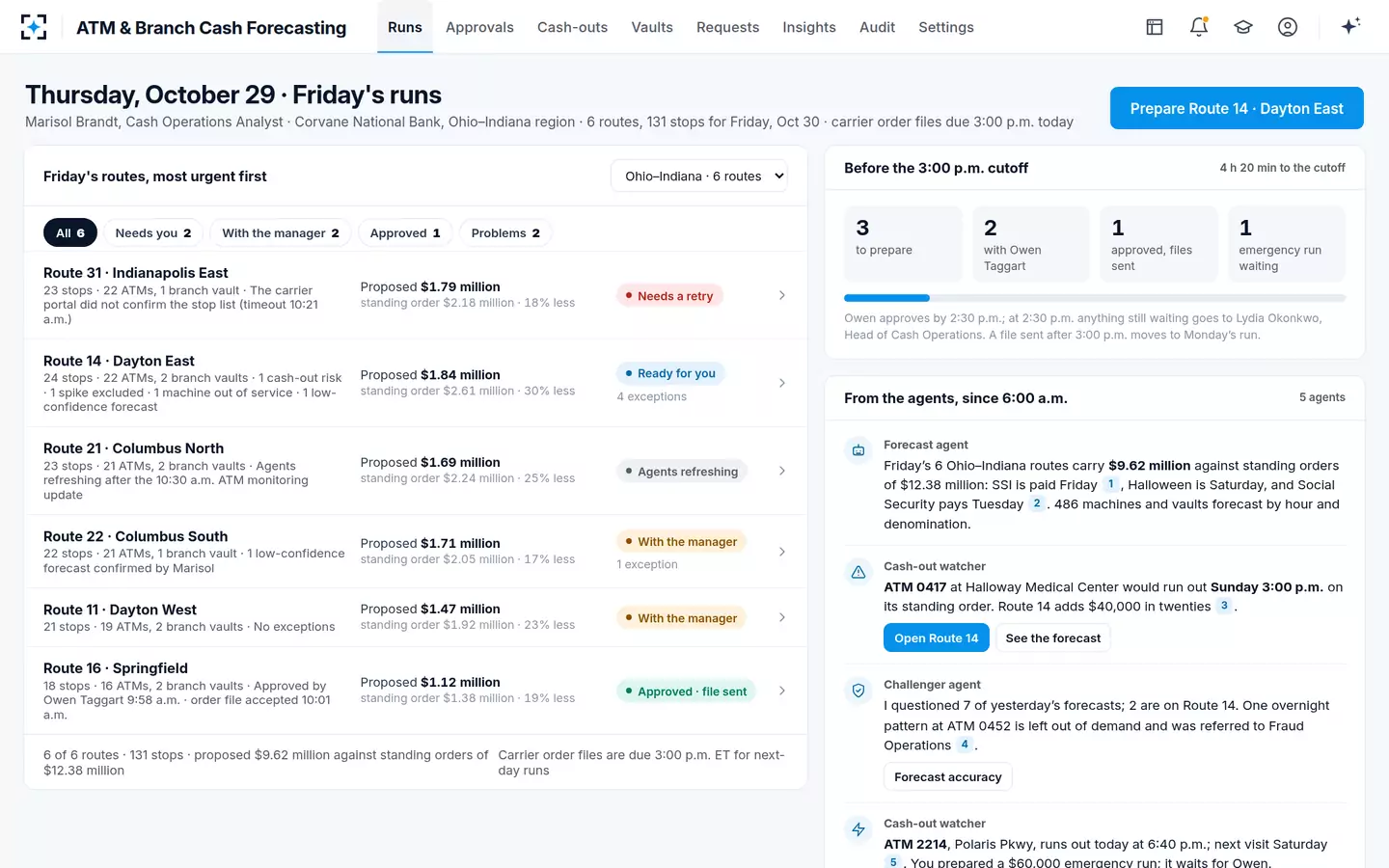
The cash operations analyst turns forecasts into orders, route by route, against the carrier's deadline. At the sample bank the analyst covering Ohio–Indiana prepares six routes and 131 stops for Friday, and the carrier's order files are due by 3:00 p.m. Eastern; a file sent after the cutoff moves the run to Monday.
One route shows the scale of the job. Route 14 leaves the Dayton hub vault at 6:30 a.m. with 24 stops, 22 ATMs and 2 branch vaults, and returns on Tuesday. On its standing order it would carry $2,610,000; the agents propose $1,840,000, and every line that differs carries its reason. ATM 0402 at a branch drive-up gets $82,000 instead of $120,000 because it returned $41,800 unused on average over its last six visits. ATM 0417 in a hospital lobby gets $120,000 instead of $80,000, because the hospital moved its payday to Wednesdays and the standing order would run dry on Sunday afternoon.
Where an analyst's hours on one route go, by hand and with the agents
- Pull balances and withdrawals0.5 h
- Adjust for paydays, benefits, holidays1.5 h
- Size by denomination1 h
- Check limits and cutoff1 h
- Approval, file, general ledger0.75 h
- Pull
- Adjust, 0.25 h
- Size
- Limits
- Approval, file, general ledger, 0.25 h
The adjustment row is the one to read. An hour and a half goes on correcting standing orders for the calendar: paydays, Social Security and SSI dates, holidays and events, machine by machine. That is the work a forecast should do, and it is also where the analyst's judgment is worth most, because a branch's note about a new payday is something no withdrawal history contains. How one machine's forecast is built from those drivers is worked through in full on its own page.
The manager's seat: approve what someone else prepared
The cash operations manager approves orders that someone else prepared, and may not approve an order he changed. That separation is the maker-checker principle applied to cash, and it carries the same logic the FDIC applies to the vault, where dual control makes two people equally answerable for what is in it, so that only the two acting together could get round it (FDIC RMS Manual, section 4.2).
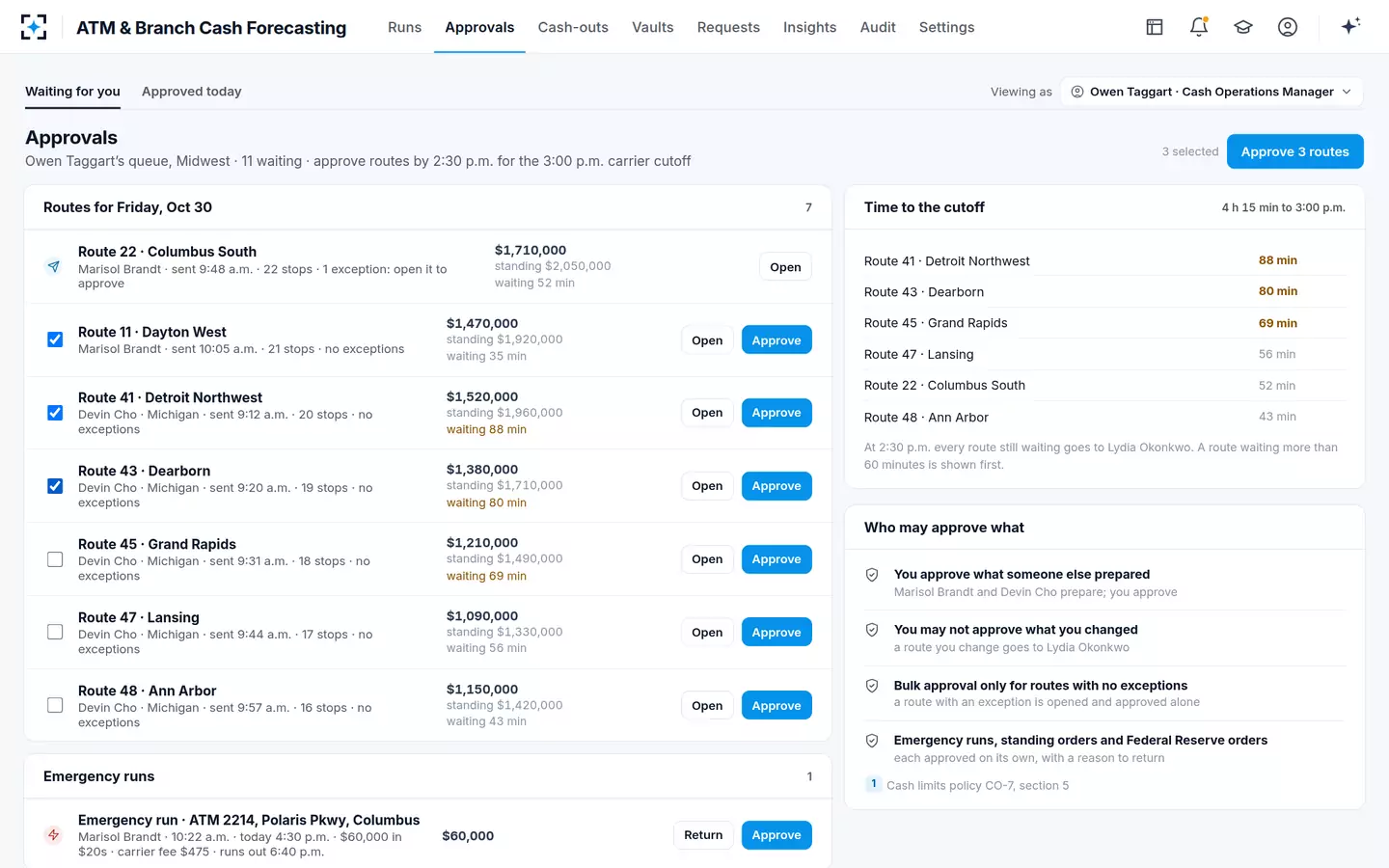
The manager's constraint is time. At the sample bank the manager approves by 2:30 p.m. so the files reach the carrier by 3:00; anything still waiting at 2:30 goes to the Head of Cash Operations. Routes with no exceptions can be approved together; a route with an exception is opened and approved on its own. Emergency runs, standing-order changes and the Federal Reserve order are each a separate approval.
The manager's queue: every route, emergency run and Federal Reserve order in one place
How is vault cash controlled? Dual control, counts and records by denomination
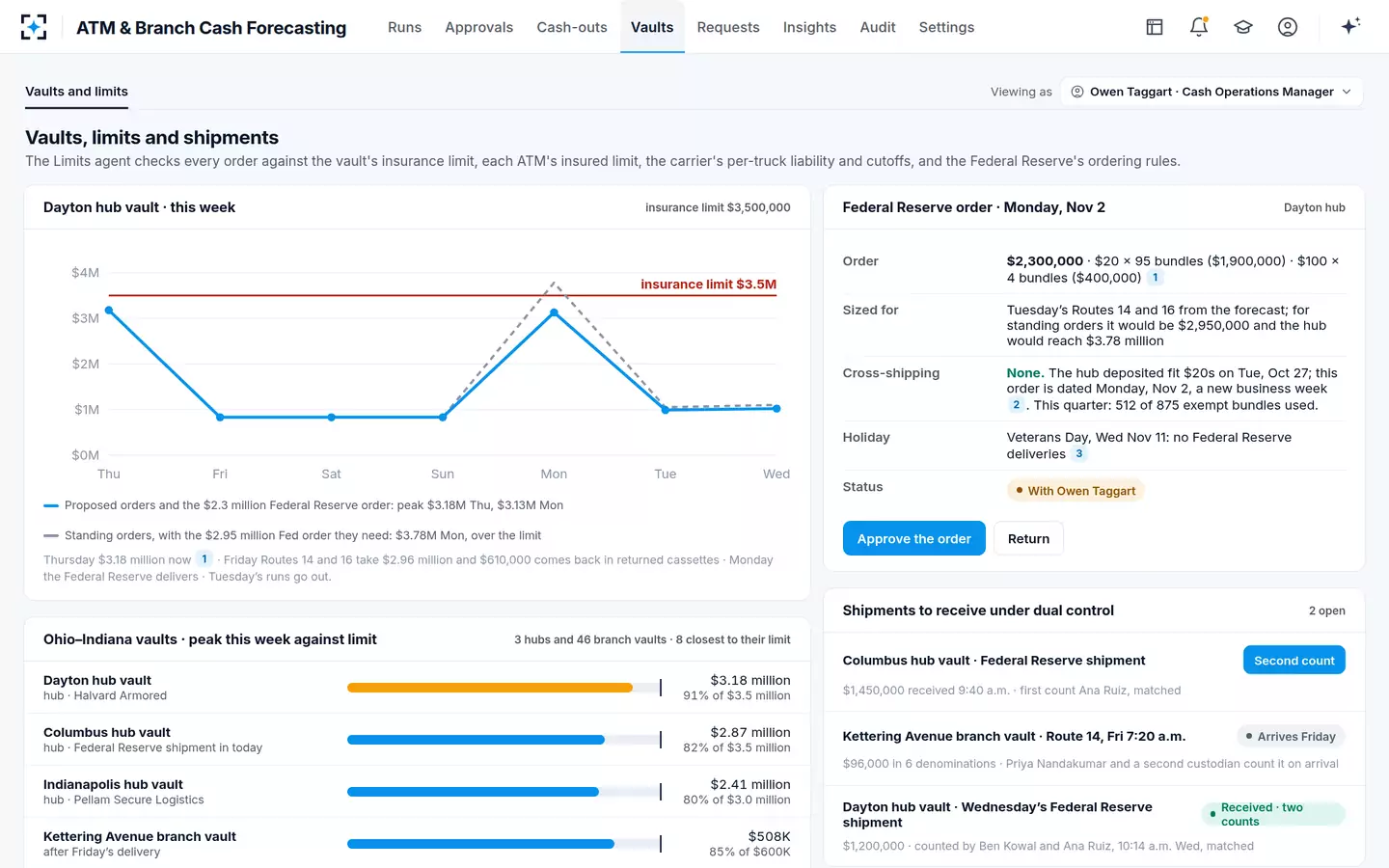
Vault cash is controlled by keeping two people on every step that touches it and by keeping records that show what it holds, note by note. The FDIC's procedures ask examiners to check four things: that duplicate keys and combinations are held under dual control, that opening and closing the vault takes two people, that the bank records vault cash by amount and denomination, and that currency shipments are counted by two people when they leave and when they arrive (FDIC RMS Manual, section 22.1; the custody items are taken one by one in dual control in banking, and the full branch list in the bank branch audit checklist).
The denomination record is the one forecasting leans on. A vault's total can look healthy and still be wrong for the week. The sample bank's Kettering Avenue branch vault holds $412,000, mostly in $100s, while its tellers need $88,000 in $1s to $50s before Tuesday. The standing order would have sent $180,000 more and left the vault at 99% of its $600,000 limit; the agents send $96,000 in six denominations, and the vault ends the week at $508,000.
Vaults against their limits through the week, and shipments waiting for a second count
The carrier's seat: a truck limit and an order cutoff
The armored carrier sets two limits the bank must plan around: how much one truck may carry, and when the order file must arrive. Both are contract terms, so there is no public figure to look up; the source is the bank's own carrier agreement. At the sample bank one carrier allows $2.5 million a truck with files due by 3:00 p.m. Eastern, and a second allows $2.0 million with files due by 2:00 p.m.
The truck limit is where an oversized standing order shows its cost. Route 14's standing order of $2,610,000 would not fit under the $2.5 million limit and would need a second truck, which the sample carrier charges $1,150. The agents' $1,840,000 fits one truck. A forecast that is too generous does not only tie up cash; it can buy transport the route never needed.
The Federal Reserve office: one deposit and one order a week
The Federal Reserve sits at the top of the chain and supplies currency only to depository institutions. Its standard service is one deposit and one order of currency per endpoint each week (Federal Reserve Financial Services, Currency Depositing and Ordering). Accesses beyond the free level cost $35 each in 2026, and fit $10s and $20s deposited and ordered back in the same business week are charged $8.00 a bundle above an exemption (FedCash Services 2026 Fee Schedule).
Orders come in fixed units. A strap is 100 notes and a bundle is 1,000, so a bundle of $20s is $20,000 and a bundle of $100s is $100,000, and $1 to $20 notes are deposited in full bundles. The sample bank's Monday order for its Dayton hub, $2,300,000, is 95 bundles of $20s and 4 of $100s. How Federal Reserve cash ordering and the cross-shipping fee work, with one quarter costed line by line, has its own page.
Who sets branch cash limits? Eight limits, eight owners
Branch cash limits are set by the bank, but not all by the same part of it, and two come from outside. Policy sets teller and office limits; insurance sets vault and ATM ceilings; the carrier agreement sets truck and cutoff limits; and the Federal Reserve's published policies set the cost of ordering. A forecast has to respect all eight at once, which is why checking them by hand takes the analyst an hour per route.
Who sets each limit a branch cash order must respect
| Limit | Who sets it | Where it is written | The sample bank's setting |
|---|---|---|---|
| Teller and office cash limit | The bank | Cash policy; examined under FDIC section 22.1 | Set by branch in the cash limits policy |
| Branch vault limit | The bank, within its insurance | Cash policy and insurance terms | $450,000 to $750,000 by branch |
| Hub vault limit | The bank, within its insurance | Insurance terms | $3.5 million Dayton and Columbus; $3.0 million Indianapolis |
| ATM and recycler limit | The bank, within its insurance | Insurance terms | $200,000 any ATM; $250,000 teller cash recyclers |
| Value per truck | The carrier | Carrier agreement | $2.5 million or $2.0 million, by carrier |
| Order file cutoff | The carrier | Carrier agreement | 3:00 p.m. or 2:00 p.m. Eastern, by carrier |
| Federal Reserve accesses | The Federal Reserve Banks | Uniform Cash Access Policy | One free deposit and one free order a week per endpoint; $35 beyond |
| Cross-shipped $10s and $20s | The Federal Reserve Banks | Currency Recirculation Policy | 875 bundles a quarter exempt per zone; $8.00 a bundle above |
How much cash should a branch keep?
A branch should keep enough cash, in the right denominations, to reach its next delivery with a safety margin, and no more than its limit. No regulator publishes a figure, because the right amount depends on the branch's own demand and its delivery schedule; what examiners look for is that the limit exists and is kept.
The arithmetic is the same for a vault, a recycler or an ATM. Forecast what will be paid out between this delivery and the next, add a safety stock, subtract what is already there, and round to the units the carrier and the Federal Reserve use. The sample bank sets its safety stock at half a day of a machine's busiest hours; for the hospital ATM that is $12,000, and the agents' load leaves $14,000 at the Tuesday visit. The denomination check comes last and catches what a dollar total hides: a vault full of $100s is short of cash for a teller who needs $20s.
Fewer tellers, the same vault
The people who hold the branch end of the chain are fewer every year, but the cash they hold still has to be counted, controlled and ordered. Branch use has fallen without disappearing, which is the hardest pattern to plan for: demand that is smaller on average and lumpier day to day.
The branch end of branch cash management, in four numbers
339,200
teller jobs in the United States in 2025
BLS
−13%
projected change in teller employment, 2025 to 2035
BLS
67.9%
of banked households used a teller at least once in 2023, down from 76.4% in 2019
FDIC
79.2%
of banked households used an ATM at least once in 2023
FDIC
Every one of those households is a withdrawal somewhere in the chain. The same FDIC survey found that close to a third of households aged 65 or older, and of households without a high school diploma, used a teller as their main way to reach their account in 2023 (FDIC, 2023 household survey). Those are the customers a branch runs out of cash on, and the reason a branch's cash limit is a service question as much as a control.
Where ATM & Branch Cash Forecasting fits, and where people stay
The solution takes the mechanical work from the first two seats and leaves every decision with them. The agents forecast, size, check limits and draft the carrier file; the analyst prepares the route and changes any load with a reason; the manager approves; the order file goes only after both. Below a 70% confidence threshold, as for a machine installed last month, a person confirms the load before it counts.
The analyst's morning: Friday's routes, most urgent first, against the cutoff
The custodians, the carrier and the Federal Reserve office keep their seats unchanged. What changes is what reaches them: an order sized to the week, inside every limit, approved by two people and on the record. The agents and their limits are set out in detail in what ATM cash management software should and should not do, and the whole solution starts from ATM & Branch Cash Forecasting.
Questions people ask
What does a cash operations analyst do?
A cash operations analyst forecasts how much cash each ATM, recycler and vault needs before its next carrier visit, prepares the orders route by route and checks them against vault, ATM, truck and cutoff limits. The role has no Bureau of Labor Statistics occupation code of its own, so it is best described by the work: at the fictional sample bank, six routes and 131 stops before a 3:00 p.m. carrier cutoff.
What does a head teller do with the vault?
The head teller goes to the vault, where larger amounts of money are kept, and makes sure the other tellers have enough cash for their shift, in the Bureau of Labor Statistics' description. Vault opening, closing and shipments are under dual control, so the head teller works alongside a second custodian rather than alone.
Who approves an ATM cash order?
Under maker-checker, someone other than the preparer approves it, usually a cash operations manager. In the sample bank's settings, a manager who changes an order cannot approve it, and it goes to the Head of Cash Operations; emergency runs and Federal Reserve orders are each approved on their own.
Is there a regulatory limit on how much cash a branch can hold?
No federal rule sets a dollar figure. The FDIC's examination procedures ask whether each office and teller keeps currency within pre-established cash limits, so the bank must set limits and keep to them; insurance terms and carrier agreements set the other ceilings.
How often can a bank order cash from the Federal Reserve?
The Federal Reserve's normal service is one deposit and one order of currency per endpoint per week. Under its Uniform Cash Access Policy, accesses beyond the free level cost $35 each in 2026, though additional accesses of at least 20 bundles can still qualify as free.
Is branch cash management the same as treasury cash management?
No. Treasury or cash management services are products a bank sells business clients to manage their balances and payments; branch cash management is the bank's own handling of physical notes in drawers, vaults and machines. The two share a word and little else, which is why searches for one often return the other.