ATM cash optimization means loading each ATM, recycler and branch vault with the least cash that will carry it to its next armored-carrier visit without running dry, because every idle dollar costs carry, insurance and transport and every empty machine costs a customer and an emergency run. The load can be set three ways: by standing orders, fixed amounts per visit set months ago; by an analyst who adjusts those amounts in a spreadsheet for paydays, benefit dates and holidays; or by an AI forecast that learns each machine's own pattern and the calendar around it, forecasts the days to its next visit and sizes the order. The question is not whether AI is clever but whether it leaves less cash idle without running more machines dry, inside every limit, with people still approving. Botminds' ATM & Branch Cash Forecasting is built to be judged on exactly that, on a bank's own routes, standing orders and withdrawal history.
A note on words: "cash forecasting" also describes treasury tools that forecast a company's bank balances. This page is about physical currency in machines and vaults. Product figures come from a fictional sample bank, Corvane National Bank, in the solution; they are sample data and design targets, not a customer's results.
Three ways to set tomorrow's ATM cash order
| Standing orders | Analyst's spreadsheet | AI forecast with limits, as in ATM & Branch Cash Forecasting | |
|---|---|---|---|
| How the load is set | A fixed amount per machine per visit, reviewed every few months | The standing order, adjusted by hand for known events | A forecast to the next visit by hour and denomination, plus safety stock |
| Paydays and benefit dates | Ignored, or built in as permanent padding | Added where the analyst knows of them | Applied from the calendar to every machine, each with its own effect |
| Machines covered each day | All, without looking | As many as the hours before the cutoff allow | All, with exceptions sent to a person |
| Limits | Checked by hand, if at all | Checked by hand on the order day | Checked for every vault through the week, every ATM, truck and cutoff |
| When it is wrong | A cash-out or a full machine shows it | The analyst notices, eventually | Questioned the next morning against actual withdrawals |
| Explanation | None: the order is the order | In the analyst's head or a cell comment | A reason and a source for every change |
| Typical failure | Idle cash on quiet days, cash-outs on busy ones | Fatigue and inconsistency across routes | Over-trust, or a pattern learned from bad data, without controls |
What is ATM cash optimization, and where does AI forecasting fit?
Optimization is the trade-off; forecasting is what makes it possible. Hold too much and the cost of cash rises month after month; hold too little and machines run dry, usually on the busiest days. The forecast is demand forecasting for notes, done machine by machine and refreshed daily, and the order is sized from it with a safety stock the bank chooses. The "AI" can be anything from combined statistical models to neural networks; the peer-reviewed ATM studies cited on these pages found that combining models and grouping machines with similar patterns improved forecasts. In ATM & Branch Cash Forecasting it is a set of agents: one forecasts, one challenges yesterday's forecasts against actual withdrawals, one sizes loads, one checks limits, one watches for cash-outs, one sends files after approval, and one reports the cost.
Forecasting is not a new use of AI in finance: the U.S. Treasury's 2024 report names it among the long-established uses, beside credit underwriting, trading and customer service (U.S. Treasury, Artificial Intelligence in Financial Services, 2024). We found no statement from a U.S. banking regulator specific to AI in ATM cash forecasting, so the controls are the bank's own to design and to show.
What is a standing order for ATM cash?
A standing order is a fixed amount a machine receives at each scheduled visit, set when the machine's pattern was last checked and left in place until someone changes it. It is simple, predictable for the carrier, and wrong in both directions: too much on ordinary weeks and too little when a payday, a benefit date or an event lands before the next visit.
Because a cash-out is visible and idle cash is not, standing orders drift upwards. The sample bank's starting point shows the result. In July, its last month on standing orders, 41% of loaded cash in the Ohio–Indiana region came back unused, and its hospital ATM's $80,000 standing order would still have run dry on a Sunday afternoon after the hospital moved its payday. Route 14's standing order of $2,610,000 would have needed a second truck.
Is AI better than spreadsheets for cash forecasting?
At scale, usually; machine by machine, not necessarily. A good analyst with a spreadsheet can forecast a dozen machines well, because she knows that the hospital changed its payday and the high school has a playoff game. What she cannot do is forecast 486 machines and vaults by denomination for four days ahead, before a 3:00 p.m. cutoff, every day. The solution's own estimate puts preparing one 24-stop route by hand at close to five hours, most of it adjusting standing orders and checking limits.
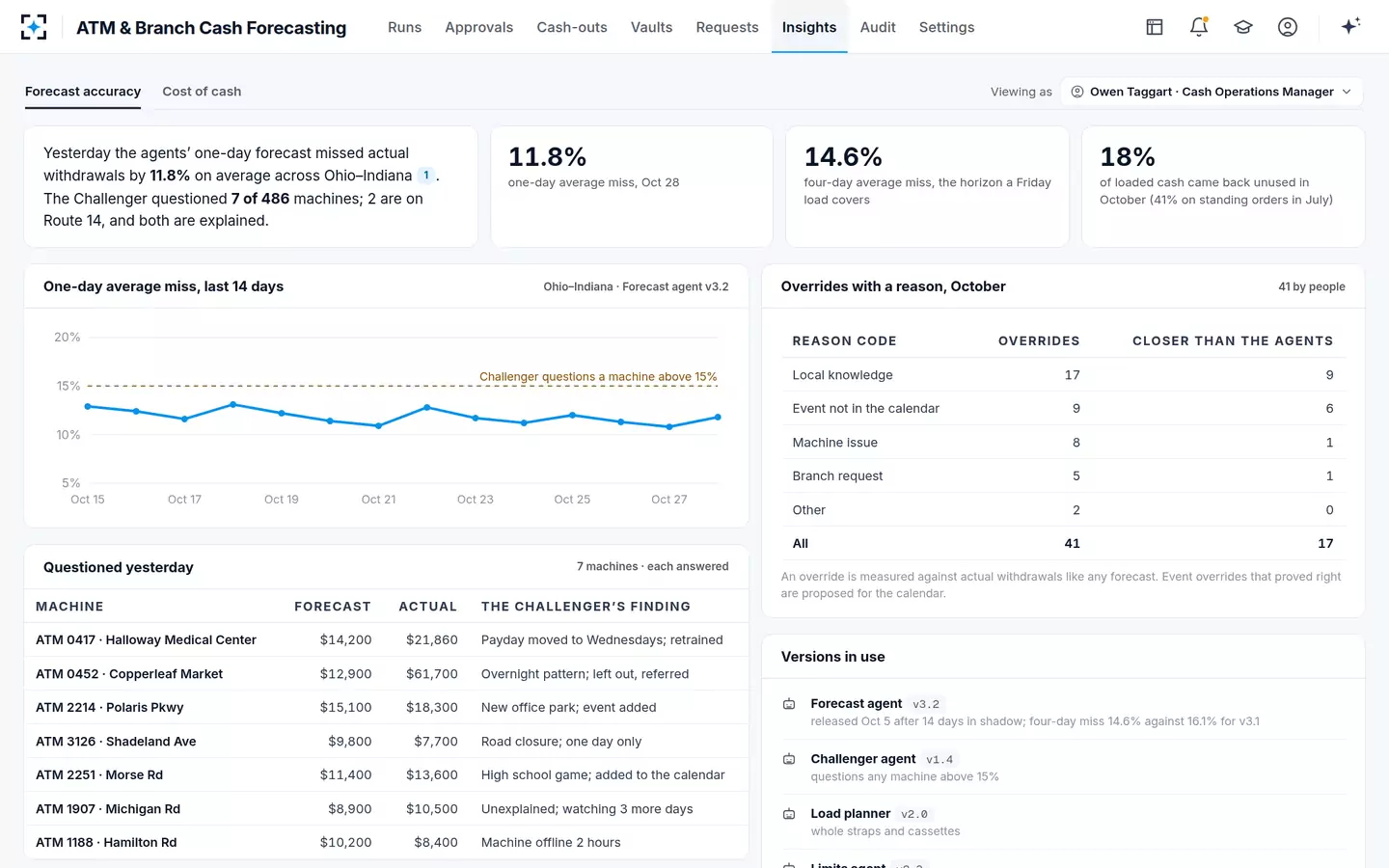
The best evidence for keeping both is the sample bank's own scoring. In October its analysts overrode the agents 41 times with a reason, and 17 of those overrides turned out closer to actual withdrawals than the agents had been, most on local knowledge or events missing from the calendar. The research points the same way about method: on the NN5 data, clustering ATMs with similar weekday patterns gave a symmetric error of 18.44%, better than forecasting them all without clustering (Venkatesh et al., 2014), and a study of 2,040 ATMs found the same gain from clustering (Rafi et al., 2021). Neither study compared a model with an analyst; that comparison has to be run on your own machines.
Overrides scored against actual withdrawals, the same way as the agents
What does ATM cash optimization save, and what does the software cost?
What it saves is measured in the cost of cash: carrying, insuring and moving the currency a bank holds in machines and vaults, plus emergency runs. What it costs is a licence and the work of connecting the data, for which there is no public price list. The business case is the difference, and the savings side can be measured on a replay before anything is bought.
The monthly cost of cash, as ATM & Branch Cash Forecasting's Cost reporter computes it
Carry
average cash × cost of funds ÷ 12
Sample bank: $41.2 million × 4.10% ÷ 12 = $140,767 in September.
treasury finance
Insurance
per the bank's policy terms
Sample bank: $8,652 in September.
insurance contract
Transport
carrier stops and trucks
Sample bank: $192,548 in September.
carrier agreement
Emergency runs
runs × carrier fee
Sample bank: $4,275 in September, at $475 a run.
cash operations
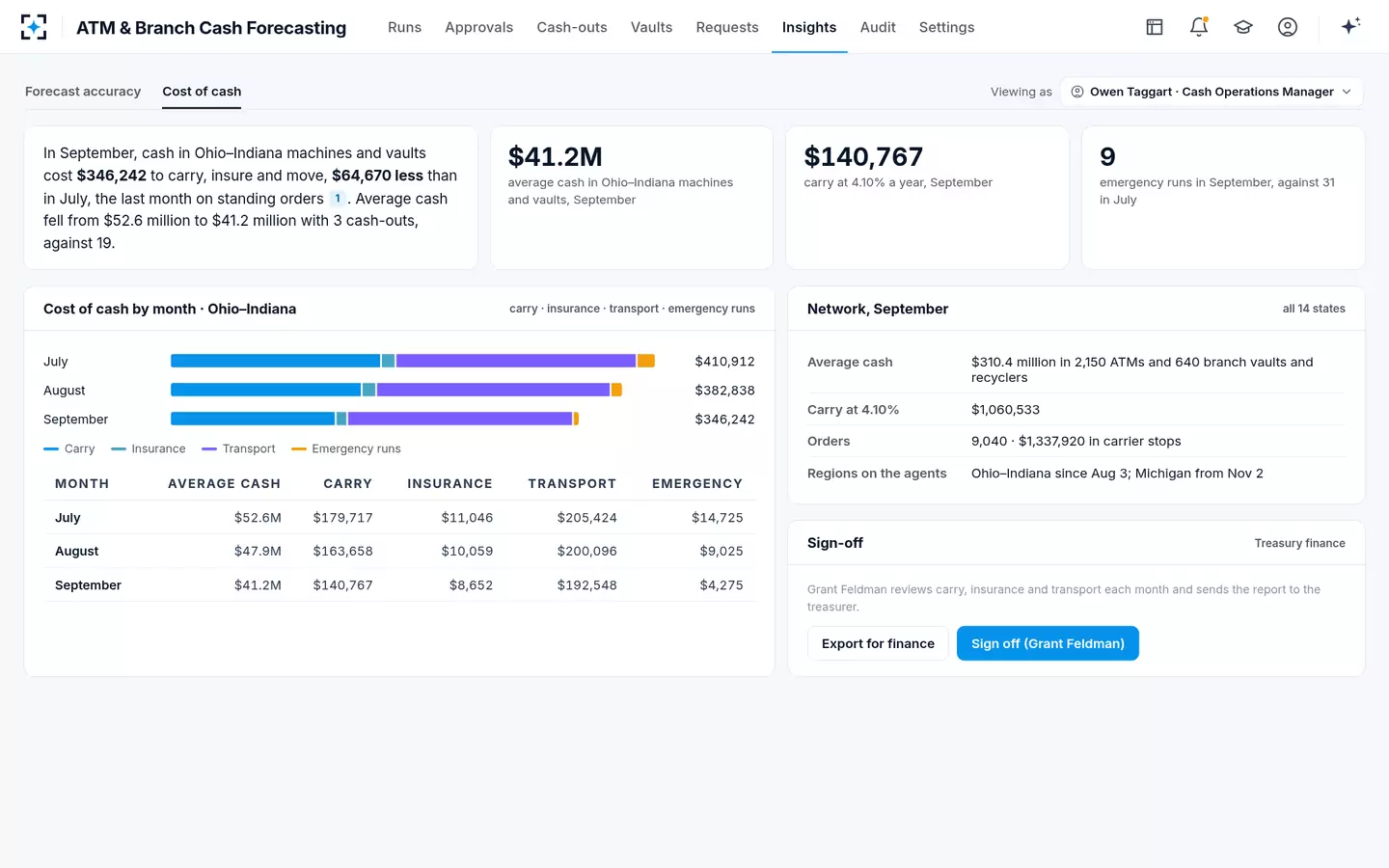
The sample bank's region shows the arithmetic over the switch. July, on standing orders, cost $410,912; September, on the agents' forecasts, cost $346,242, $64,670 less. Most of the difference is carry, because average cash fell from $52.6 million to $41.2 million, about 22%, which is also the solution's design target for idle cash. Transport fell less, from $205,424 to $192,548, because the routes still run; emergency runs fell from $14,725 to $4,275.
One sample region's cost of cash, the last month on standing orders and two months on the agents
| Month | Average cash | Carry at 4.10% | Insurance | Transport | Emergency runs | Total |
|---|---|---|---|---|---|---|
| July (standing orders) | $52.6M | $179,717 | $11,046 | $205,424 | $14,725 | $410,912 |
| August | $47.9M | $163,658 | $10,059 | $200,096 | $9,025 | $382,838 |
| September | $41.2M | $140,767 | $8,652 | $192,548 | $4,275 | $346,242 |
The cost of cash by month, signed off by treasury finance
Payback is the one-time cost of the project divided by the monthly saving, and the saving depends on two numbers only the bank has: its cost of funds and how much idle cash its standing orders leave today. A bank with a low cost of funds and lean standing orders will save less than the sample; one with padded orders and many emergency runs will save more. The replay described below measures both before any contract.
What are the risks of AI cash forecasting?
Four risks matter, and each has a control that can be checked. The first is an order nobody understood: a forecast that changes a load without a reason. The second is automation past the people: software sending files or booking runs on its own. The third is learning from bad data: a fraud-driven spike or a cash-out day taught to the model as demand. The fourth is over-trust: a new machine or a changed neighbourhood forecast with confidence it has not earned.
Four risks of AI cash forecasting and the control for each
The risk: A load changes and nobody can say why, so analysts stop reading or start overriding blindly.
The control in ATM & Branch Cash Forecasting: Every change from the standing order carries a reason; every figure opens its source.
The risk: Files sent or emergency runs booked without approval.
The control in ATM & Branch Cash Forecasting: Nothing is sent without two approvals; no run without a manager; a manager who changes an order cannot approve it.
The risk: A fraud spike or a cash-out day becomes "demand".
The control in ATM & Branch Cash Forecasting: The Challenger leaves unusual patterns out of demand and refers them; the referral's outcome is never shown in cash systems.
The risk: A forecast for a new machine treated like one with two years of history.
The control in ATM & Branch Cash Forecasting: Under 70% confidence a person confirms the load; new versions run in shadow first.
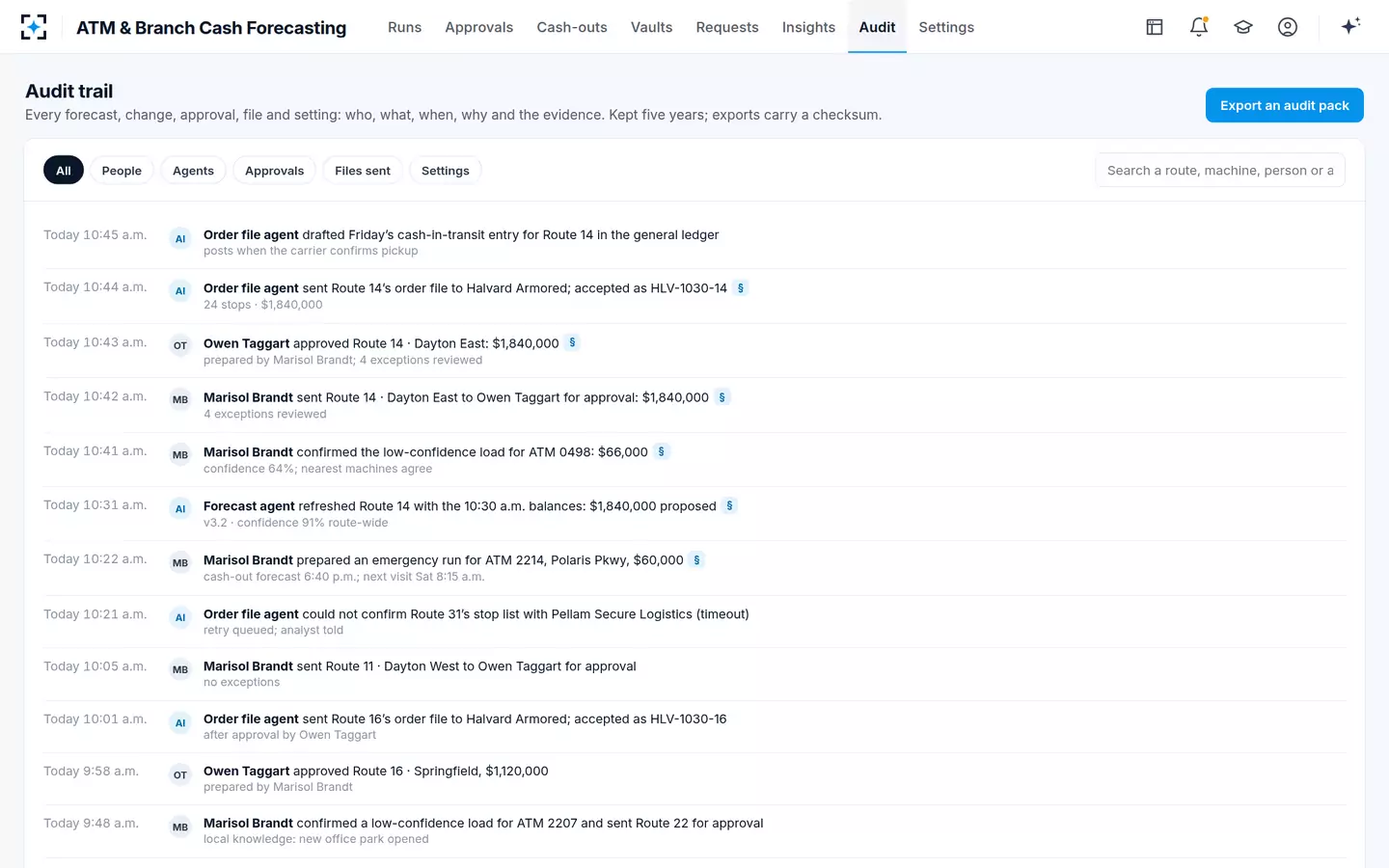
Each control is an old one applied to a new tool. The FDIC's examination manual treats dual control as making two people equally accountable, so that only collusion can get round it (FDIC RMS Manual, section 4.2); an order that needs an analyst and a manager is the same idea. And every forecast, change, approval and file sits on an append-only trail that internal audit can search and export.
People and agents on one audit trail
How do you compare cash forecasting methods on your own machines?
Replay the same closed quarter three ways, on the same region, and compare money, not accuracy alone. Run the standing orders as they were actually sent; run an analyst's adjustments if they were recorded; run the AI forecast with only the data it would have had each day. Then score idle cash, would-be cash-outs, emergency runs, limit breaches and analyst hours for each.
A fair three-way test of AI cash forecasting, standing orders and spreadsheets
- One region, one closed quarter, every machine and vault
Small enough to inspect by hand, long enough to include paydays, benefit dates and a holiday.
- The same loading rules for all three
Same safety stock, cassettes, straps and visit days, so only the forecast differs.
- No hindsight in the AI replay
Each day forecast from data dated before it.
- Mark the days machines were empty
Recorded withdrawals understate demand on cash-out days.
- Score money first
Idle cash at the bank's cost of funds, emergency runs, trucks and Federal Reserve fees.
- Score limits and people
How many orders would have broken a limit, and how many hours each method takes.
- Then run in shadow before going live
Forecast live without sizing loads, and compare again.
The protocol, the error measures and the day types to score are in forecast backtesting for ATM cash, and the data the replay needs is listed in cash forecasting software for ATMs: the data you bring.
Can AI forecast cash for branches and ATMs together?
It should, because they share vaults, trucks and Federal Reserve orders, and a forecast that sizes ATMs alone can break a vault limit nobody was watching. In the sample bank's region the agents forecast 486 machines and vaults together: ATMs, teller cash recyclers, branch vaults and hub vaults.
Branches and ATMs forecast together in ATM & Branch Cash Forecasting
$96,000
to a branch vault in six denominations, not the $180,000 standing order
$3.18M
peak in the hub vault this week, against a $3.5 million limit
95bundles
of $20s in Monday's Federal Reserve order, with 4 of $100s
$9.62M
for six routes on Friday, against $12.38 million of standing orders
The branch vault is where denomination forecasting earns its keep: the sample bank's Kettering Avenue vault holds $412,000, mostly in $100s, while its tellers need $88,000 in smaller notes. The hub vault is where the week matters: sized for standing orders it would reach $3.78 million on Monday, over its limit, though no single order looked large. A spreadsheet can catch either; catching both, for every vault, every day, is the case for software.
Who ATM & Branch Cash Forecasting is for, and who it is not for
It fits a bank or credit union with its own cash operations: carrier routes, branch and hub vaults, Federal Reserve orders, and standing orders that someone adjusts by hand. It reads the ATM monitoring system, the cash management system, carrier portals, Federal Reserve ordering and the general ledger, and writes back only drafts and approved files. The analyst prepares each route, the manager approves it, and nothing moves without both.
It is not treasury cash-flow forecasting, ATM monitoring, a carrier's routing system, ATM settlement or a fraud system, and it will not make a small, stable network much cheaper to run: where standing orders already fit the demand, there is little idle cash to recover. Its value is largest where machines are many, demand is uneven, and analysts' hours go on adjusting orders rather than judging them. To replay a quarter of your own routes, start from ATM & Branch Cash Forecasting.
Questions people ask
How long until AI cash forecasting pays back?
Divide the one-time cost by the monthly saving in carry, insurance, transport and emergency runs. At the fictional sample bank one region's cost of cash fell by $64,670 a month between July and September; a bank's own figure depends on its cost of funds and how padded its standing orders are, which a replay measures.
Does AI cash forecasting replace the cash analyst?
No. It takes the arithmetic and the limit checks, which the solution's estimate puts at most of the close to five hours a route takes by hand, and leaves the analyst the exceptions, the local knowledge and the preparation of every route. At the sample bank, 17 of 41 analyst overrides in October beat the agents.
Can AI cash forecasting start from our standing orders?
Yes, and it should: the standing order is the baseline every proposed load is compared with. In the solution each line shows the standing order, the proposed load and the change, with its reason.
Is AI cash forecasting the same as treasury cash-flow forecasting?
No. Treasury tools forecast an organisation's bank balances from invoices and payroll; ATM and branch cash forecasting predicts notes paid out by machines and vaults, by denomination, until the next carrier visit. Search results mix the two.
What accuracy should we expect from AI cash forecasting?
The peer-reviewed ATM studies cited on these pages report average symmetric errors from about 6% to about 18%, on data and horizons that do not compare with each other or with any one bank. The useful expectation is relative: less idle cash than your standing orders, no more cash-outs, on a replay of your own quarter.