The ALM process in a bank is the recurring cycle that measures interest rate and liquidity risk and puts it in front of the people who manage it. Each month, after the general ledger closes, treasury loads loan, deposit and securities balances into the ALM model, reconciles them to the general ledger, runs net interest income and economic value of equity under rate scenarios, tests the assumptions on deposit betas, decay and prepayments, compares every measure with its board limit, and writes a package the asset/liability committee can decide from. The FDIC expects the inputs reconciled "by having experienced personnel reconcile the balances to the general ledger," assumption changes approved "before they occur," and board review at least quarterly. At a community bank the work around the model typically takes about eight business days of spreadsheets and slides. Botminds' ALCO Reporting puts agents on the reconciling, page-building and explaining, and keeps every approval, assumption change and limit decision with a named person.
This guide is for the treasurer and CFO who own the process and the ALM manager who runs it. The worked month comes from a fictional $3.4 billion community bank as it runs through the solution; day counts are our estimates, and the shorter cycle is a design target.
The monthly ALM process, step by step
A person decides
Close and extractFinance closes the month; treasury receives the core, investment and partner extracts and the final trial balance.
Agent
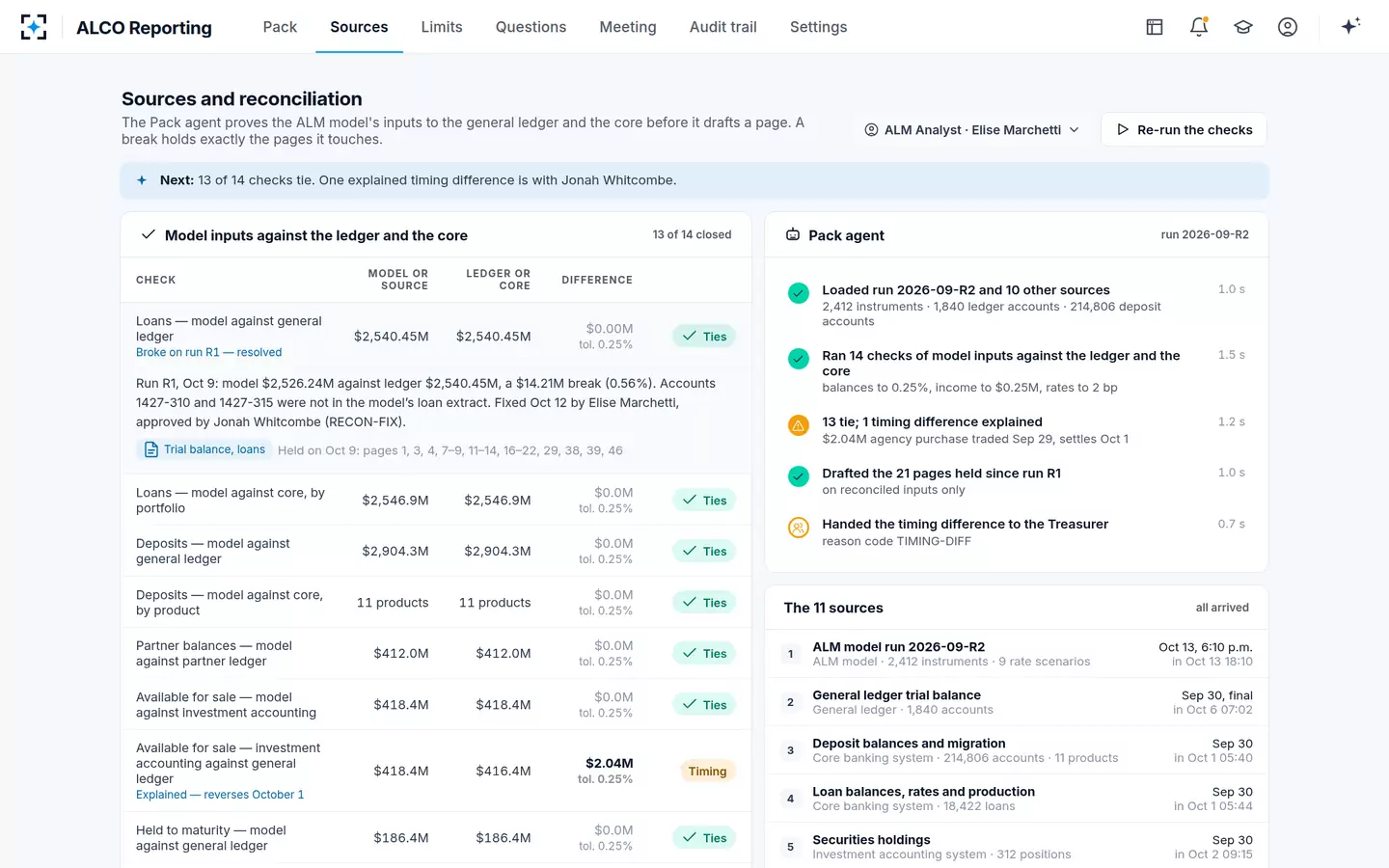
Load and reconcileLoads the model run and other sources and runs balance, income and rate checks against the general ledger and the core.
Never: Never drafts a page that depends on an input outside tolerance
A person decides
Fix breaksThe ALM analyst corrects the model input; the treasurer approves the fix with a reason.
Agent
Draft pages and explain changesBuilds the pages and writes what changed since the last meeting, by driver, with each note cited and the notes summing to the change.
Agent
Check limits and assumptionsCompares every measure with its board limit and early-warning level; shows an assumption change's effect beside its back-test.
A person decides
Approve and releaseThe treasurer approves page by page as checker; exceptions and assumption changes are decided by the people the policy names.
A person decides
Meet, minute, follow upALCO decides; minutes record decisions and owners; actions carry into next month.
What is the ALM process in banks?
It is the measurement and governance cycle that turns the balance sheet into decisions about rates, funding and hedges. The FDIC's examination manual describes its parts: comprehensive systems for measuring and monitoring interest rate risk, reporting detailed enough to inform senior management and the board, risk limits, and internal controls and independent review (FDIC RMS Manual, section 7.1, Sensitivity to Market Risk). The ALCO "should actively monitor the IRR profile" and "should have sufficient representation across major functions (e.g., lending, investment, and funding activities)."
The process has two clocks. The committee's, usually monthly at community banks, set by the meeting calendar. And the board's: "The board or an appropriate board committee should review sensitivity to market risk information at least quarterly." The monthly package feeds both, which is why errors in it travel. How often ALCO must meet sets out what the rules require.
Who does what in the ALM process?
Treasury measures, the committee decides, the board sets limits, and an independent reviewer checks the measurement. The FDIC draws the line between the last two precisely: the independent reviewer "should not perform any of the routine internal control functions such as reconciling data inputs, developing assumptions, or performing variance analysis." Those three are the ALM team's job. NCUA's interest rate risk guidance for credit unions likewise separates the people who take the risk from those who measure it (12 CFR Part 741, Appendix A).
The seats in the monthly ALM cycle, and what each one owns
Today
Pulls extracts, proves totals by eye, builds pages in spreadsheets and writes commentary late in the week.
With agents
Starts from pages drafted on inputs that already tie; accepts or edits the change notes with a reason.
Still theirs: Preparing every page; proposing assumption changes
Today
Reviews the package in rounds by email and checks limits by hand.
With agents
Approves page by page as checker; decides exceptions with the evidence on screen.
Still theirs: Approval of pages, fixes and exceptions
Today
Reads the package the weekend before the meeting.
With agents
Reads pages as they are approved, with the causes of each move cited.
Still theirs: The recommendation to ALCO
Today
Email questions and get answers without sources.
With agents
Ask on the page; answers come back cited within a business day.
Still theirs: The committee's decisions
Today
Rebuilds the reconciliation from extracts to test it.
With agents
Reads every check, fix and approval on the trail.
Still theirs: The independent opinion
Where the eight business days go
Most of the cycle is mechanical, and the step the committee reads most, what changed and why, is written last. By our estimate for a monthly community-bank package, one day goes on pulling data into the model, one on proving inputs to the general ledger, two on building pages, a day and a half on writing what changed, one on limits and exceptions, and a day and a half on the treasurer's and CFO's review and corrections.
One monthly package: eight business days by hand, three as the target
- Pull data1
- Prove inputs1
- Build pages2
- Explain changes1.5
- Limits1
- Review1.5
- Pull0.5
- Prove
- Build0.5
- Explain0.5
- Limits
- Review1
The calendar is fixed at both ends. In the sample month, the core extracts arrived on October 1, September's final trial balance on October 6, the package was due to members on Friday the 16th and the committee met on Tuesday the 20th. Eight working days fit between the trial balance and the due date with nothing to spare, so any break found late eats into the review.
Reconciliation: why the order of the work matters more than its speed
Inputs should be proved before pages are built, because a break found afterwards means rebuilding every page it touches. The FDIC's standard is explicit: "Institutions should verify system inputs by having experienced personnel reconcile the balances to the general ledger. This is often done using automated software that can identify and report exception items." Examiners are told to focus on "the procedures for inputting and reconciling system data" and "ensuring the completeness of account data."
One break, found before drafting
$14.21M
loans in the general ledger missing from the model run
0.56%
break, against the bank's 0.25% tolerance for balances
21 of 46
pages held because they depend on loans
In the sample month the 14 checks ran on a Friday afternoon. The participations were added to the model the following Monday, the treasurer approved the fix with a reason code, and the rerun tied on thirteen of fourteen checks with one explained timing difference. The 25 pages that did not depend on loans had been drafted in the meantime. Found after the margin and NII pages were built, the same break would have meant rebuilding 21 pages. Following one loan balance to the page traces the check hop by hop.
Which rate scenarios belong in the monthly ALM run?
A set wide enough to show basis, yield curve and option risk, not only parallel shocks of 200 basis points. The interagency Advisory on Interest Rate Risk Management (Federal Reserve SR 10-1, January 2010) says that "static interest rate shocks consisting of parallel shifts in the yield curve of plus and minus 200 basis points may not be sufficient," and that institutions "should regularly assess IRR exposures beyond typical industry conventions, including changes in rates of greater magnitude (e.g., up and down 300 and 400 basis points) across different tenors to reflect changing slopes and twists of the yield curve."
The advisory lists four kinds of stress to include, depending on the bank's profile: instantaneous rate shocks, "substantial changes in rates over time (prolonged rate shocks)", changes in the relationship between key market rates (basis risk), and changes in the slope and shape of the curve. Scenarios should be "severe but plausible in light of the existing level of rates and the interest rate cycle," which means the set is reviewed, not fixed: a scenario that was severe at zero rates may be routine at 4%.
For the monthly process this has two consequences. The scenario set is itself an approved input, so a change to it goes through the same approval as an assumption change and is shown to the committee. And the package reports the measures in the scenarios the limits are written on, here NII at +200 bp and EVE at +400 bp, together with the non-parallel and basis scenarios that carry no limit but show where the exposure actually sits. A bank whose EVE looks comfortable in parallel shocks and poor in a flattener has learned something its limit table does not show.
The checks run before any page is drafted
Assumptions and back-testing: the step examiners weigh most
Assumptions drive the results more than the arithmetic does, and the rules expect them governed. The FDIC asks that "management should establish procedures for reviewing the reasonableness of assumption changes and for approving those changes before they occur," and that variance analysis, comparing projected with actual results, "be done periodically and no less frequently than annually." The OCC's interest rate risk booklet ranks non-maturity deposit assumptions among the most important in an IRR model (OCC, Interest Rate Risk booklet).
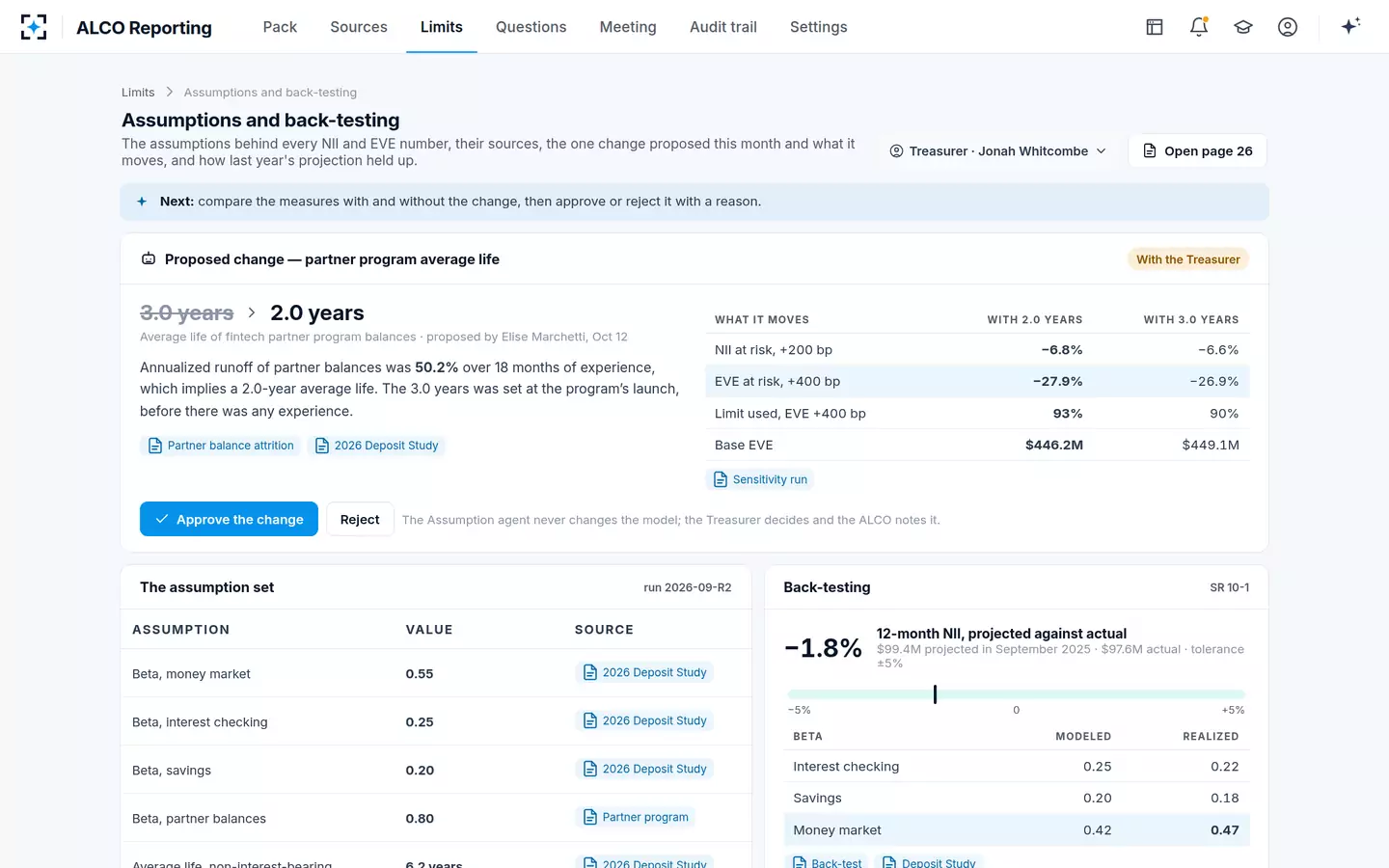
In the sample month the ALM analyst proposed shortening the average life of partner deposit balances from 3.0 to 2.0 years, on 50.2% annualised runoff over 18 months. The effect sat beside the evidence before anyone approved: EVE at +400 bp moved from −26.9% to −27.9%, from 90% to 93% of its limit, and NII at +200 bp from −6.6% to −6.8%. The back-test below it showed $99.4 million of NII projected against $97.6 million actual, a 1.8% miss.
An assumption change shown with its effect and its back-test
Limits and exceptions: decided before the meeting
Every measure is compared with its board limit and an early-warning level, and any exception arrives at the meeting with a cause, a plan and an owner. The FDIC wants limits "neither so high that they are never breached, nor so low that exceeding the limits is considered routine and unworthy of action," and tells examiners to "review follow-up actions and communication relevant to any material breaches in board-approved limits."
The sample month's limits, and what each status required
| Status | Count | Example | What happens |
|---|---|---|---|
| Within | 21 | NII at +200 bp: −6.8% against −10%, 68% of the limit | Reported; no action |
| Watch | 1 | A measure past the 80% early-warning level | Noted with a trend and an owner |
| Over | 1 | One program partner at 5.20% of deposits against a 5.00% single-partner limit, $5.8 million over | Exception note with cause and plan, approved by the treasurer before release |
The exception was drafted by the agents from the deposit data, submitted by the ALM analyst and approved by the treasurer, so members read the cause and the proposed remedy before the meeting rather than hearing about the breach at it. ALCO limits across 791 banks shows where the sample bank's limits sit against peers.
Liquidity in the same cycle: funding sources that have been tested
The monthly ALM process measures liquidity as well as rate risk, and since 2023 the regulators have asked for evidence that backup funding works, not only that it exists. The July 2023 interagency addendum on contingency funding plans says institutions "should be aware of the operational steps required to obtain funding from contingency funding sources, including potential counterparties, contact details, and availability of collateral," and "should regularly test any contingency borrowing lines to ensure the institution's staff are well versed in how to access them and that they function as envisioned."
The discount window gets its own paragraph. If it is part of the plan, operational readiness "includes establishing borrowing arrangements and ensuring collateral is available for borrowing in an amount appropriate for a depository institution's potential contingency funding needs," and banks "should also consider conducting small value transactions at regular intervals." The addendum also warns that "during times of stress, contingency lines may become unavailable," naming repo lines as the example. For credit unions it restates NCUA's tiers under 12 CFR 741.12: at $250 million or more in assets, documented access to at least one contingent federal liquidity source, through the Central Liquidity Facility or the discount window.
In the monthly package that becomes a short, checkable page: each source with its committed or estimated capacity, the collateral pledged and its haircut value as of month-end, the date each line was last tested and by whom, and the funding concentrations that matter for the plan. The sample bank's single-partner exception above is one of those concentrations. A source with no test date in the last year is a source the committee should treat as untested.
Explaining what changed: the page the committee reads
A move has to be explained by its drivers, with amounts that add up to it. On the sample bank's margin page, net interest margin fell 9 basis points to 3.21%; the notes attributed −6 bp to deposit mix, −3 bp to partner repricing and 0 bp net to asset yields, and the agent checked the notes summed to the change. A remainder would have shown as unexplained and held the page.
Each note cites its source. The −6 bp opened the core's deposit migration report: 2,912 customers moved $61,004,318 from non-interest-bearing demand into money market at a weighted 3.15%. The −3 bp cited the program agreements: $412.0 million of partner balances stepped from 3.40% to 3.65%. Net interest margin analysis by driver works the method through.
How often must the board review interest rate risk, and what should it see?
At least quarterly, under the FDIC manual quoted above, and with enough detail to judge both the exposure and the assumptions behind it. SR 10-1 puts the responsibility plainly: the board "should understand and be regularly informed about the level and trend" of the institution's exposure, and the board or its committee "should oversee the establishment, approval, implementation, and annual review of IRR management strategies, policies, procedures, and limits." Reports to the board "should provide aggregate information and supporting detail that is sufficient to enable them to assess the sensitivity of the institution to changes in market rates and important assumptions underlying the metrics used."
The last clause is the one most board packs miss. A table of NII and EVE against limits tells directors the level; it does not tell them that the result depends on a deposit average life the ALM analyst shortened last month. The advisory singles out non-maturity deposits: their assumptions "are critical, particularly in market environments in which customer behaviors may not reflect long-term economic fundamentals," and rate-sensitive deposits such as brokered and internet deposits "would reflect higher decay rates than other types of deposits."
A board-level page from the monthly cycle therefore carries four things: each limit with its trend over at least four quarters, every exception and its follow-up, every assumption change since the last board report with its effect on the limited measures, and the latest back-test. That page is built from the same approved material as the committee's package, so the board reads nothing the committee did not, and the annual policy and limit review has a year of evidence to start from.
What examiners review in the ALM process
The FDIC lists what an independent review should cover, and examiners read the same things: the measurement system's capabilities, the accuracy of inputs, the "reasonableness and documentation of material assumptions," the usefulness of reports, and the "adequacy of periodic variance analysis." Examiners also "review the presentations or analyses provided to senior management, board members, and the ALCO, as well as any relevant meeting minutes."
Examiner questions, and the evidence the process should leave
| Question | Weak evidence | Strong evidence |
|---|---|---|
| Were inputs reconciled to the general ledger? | A tick on a checklist | Each check, its tolerance, any break and its approved fix |
| Were assumption changes approved before use? | Minutes mention a change | The proposal, its effect, the back-test and the approver, dated before the run |
| Is variance analysis done at least annually? | A spreadsheet on a share drive | Projected against actual NII with causes of material differences |
| Were limit breaches followed up? | A red cell in the package | Cause, plan, owner and the next month's status |
| Does the board see enough to judge management? | The same package, quarterly | Board-level summary with limits, exceptions and assumption changes |
| Is the reviewer independent? | Reviewer also reconciles | Reviewer reads a trail they did not create |
The FDIC also asks banks to weigh "the extent to which the model uses automated versus manual processes; whether the model has automated interfaces with the bank's core systems." Spreadsheets between the model and the package are where inputs are retyped and pages rebuilt, so they are the part of the process most likely to carry an error to the committee. AI beside the ALM model covers how agents work around the model without replacing it.
Questions people ask
What are the steps of the ALM process?
Close and extract data; load the ALM model and reconcile its inputs to the general ledger; run NII and EVE under rate scenarios; review and back-test assumptions; compare each measure with its board limit; write and approve the ALCO package; meet, minute decisions and follow up. The board reviews the results at least quarterly.
How long does the monthly ALM cycle take?
No rule sets a duration. At a community bank, the work around the model typically takes about eight business days by our estimate, most of it pulling, proving and rebuilding pages. ALCO Reporting's design target is three.
Who reconciles ALM model inputs?
The ALM team, as a routine control. The FDIC expects experienced personnel to reconcile balances to the general ledger and says the independent reviewer should not perform routine functions such as reconciling inputs, developing assumptions or variance analysis.
How often must ALM assumptions be back-tested?
The FDIC says variance analysis should be done periodically and no less frequently than annually. Many banks back-test deposit assumptions more often when rates move fast, and the FDIC expects assumption changes to be approved before they are used.
Who sits on ALCO?
Senior management from the functions that influence interest rate risk: the FDIC names lending, investment and funding. Typically the CEO, CFO, treasurer, chief credit officer and heads of retail and commercial banking, with the ALM analyst preparing the package.
Does the ALM model produce the ALCO package?
The model produces the numbers; the package is built around them. Reconciliation, explanation of changes, limit checks, exception notes and approvals usually happen in spreadsheets and slides, which is the work ALCO Reporting moves to agents while people approve.