A total loss unit is the team in an auto carrier's claims operation that handles a car once it is declared a total: it sets the actual cash value, makes the offer, pays the lender and the owner, collects the title, obtains a salvage title, reports the car to the federal title system and sells the wreck. Carriers organise it differently, but the work falls into five seats: the total loss adjuster; a title, payoff and salvage specialist; a supervisor holding higher authority; customer contact; and compliance. Each seat answers to a clock it does not control, from the claim-handling deadlines in state unfair-claims rules to a lender's payoff letter and a state title office. The unit's hard problem is that most of its days go to chasing people outside the carrier rather than deciding anything. Botminds' Total Loss Claims Management gives that chasing to agents and leaves each seat its decisions: each person receives one request at a time, with its evidence, to approve or send back.
The rules and figures here come from the NAIC's model regulation, state statutes, the CFPB and regulators, linked where they appear. The desk, people and limits come from the solution's fictional sample carrier, Pecan Valley Mutual in Austin.
One sample adjuster's book, on a Monday
46
open total losses on one adjuster’s book
11
past their stage target
16
cars in yards that bill storage
$720/day
storage running across those 16 cars
What is a total loss unit?
It is the set of people, rules and authority limits that carry a totaled car from the decision to the sale, and it is defined by the work, not by an org chart. Some carriers run title, payoff and salvage as three jobs, others as one specialist role, and some hand parts of it to salvage auctions or vendors. No public benchmark describes the split. What every version shares is the sequence: a value the owner can check, a payment that splits between lender and owner, a title that has to come in, and a car that has to leave a yard.
The value sets the standard for the rest. NAIC Model Regulation 902, the template many states adapted, builds a cash settlement from two or more comparable cars in the local market within the last 90 days, plus taxes and transfer fees, and requires every deduction to be "itemized and specified as to dollar amount" (NAIC Model 902). The UK's Financial Conduct Authority, reviewing 12 motor insurers, found that "some firms reported average settlement values that were lower than the available guide prices" (FCA, 2024). A unit's first control is a value build someone else can read.
Five seats, and the decision and clock each one owns
Each seat owns a different kind of decision and works against a different clock. The split below is the one built into the solution, where title, payoff and salvage sit with one specialist; carriers set their own.
Five seats, five kinds of decision, five clocks
What the seat decides: Total or repair; the value; the offer; payments within the adjuster’s limit.
The clock it works against: Acknowledge a claim within 15 days, accept or deny within 21 days of proof of loss, pay within 30 days once liability is clear (NAIC Model 902).
What the seat decides: Payoff requests, title notices, the salvage-title filing, moves out of billing yards, sales at or near reserve.
The clock it works against: The payoff letter’s good-through date; in Texas, no salvage title in the insurer’s name until day 30 after payment and two written notices.
What the seat decides: Anything over the adjuster’s limit; borderline totals; payee and bank-detail changes; disputes and the appraisal clause.
The clock it works against: Dispute replies, appraiser deadlines, and the 35-day window in which an owner who cannot buy a comparable car may reopen the claim.
What the seat decides: Nothing about money. Explains the offer, the split and what is still needed.
The clock it works against: A written status letter at 45 days and every 45 days after (Model 902), and every call in between.
What the seat decides: State rule changes and the federal total-loss report.
The clock it works against: A monthly report of total losses to the National Motor Vehicle Title Information System (28 CFR § 25.55).
The adjuster seat: the money decisions
The adjuster owns the call that the car is a total, the value, the offer and, within a dollar limit, the payment. The test is economic: repair estimate against pre-loss value, with expected salvage proceeds in the sum in formula states, so a borderline car can go either way on a few hundred dollars of any input. The value build the adjuster approves is the page the owner sees, which means explaining it later is reading it, not reconstructing it.
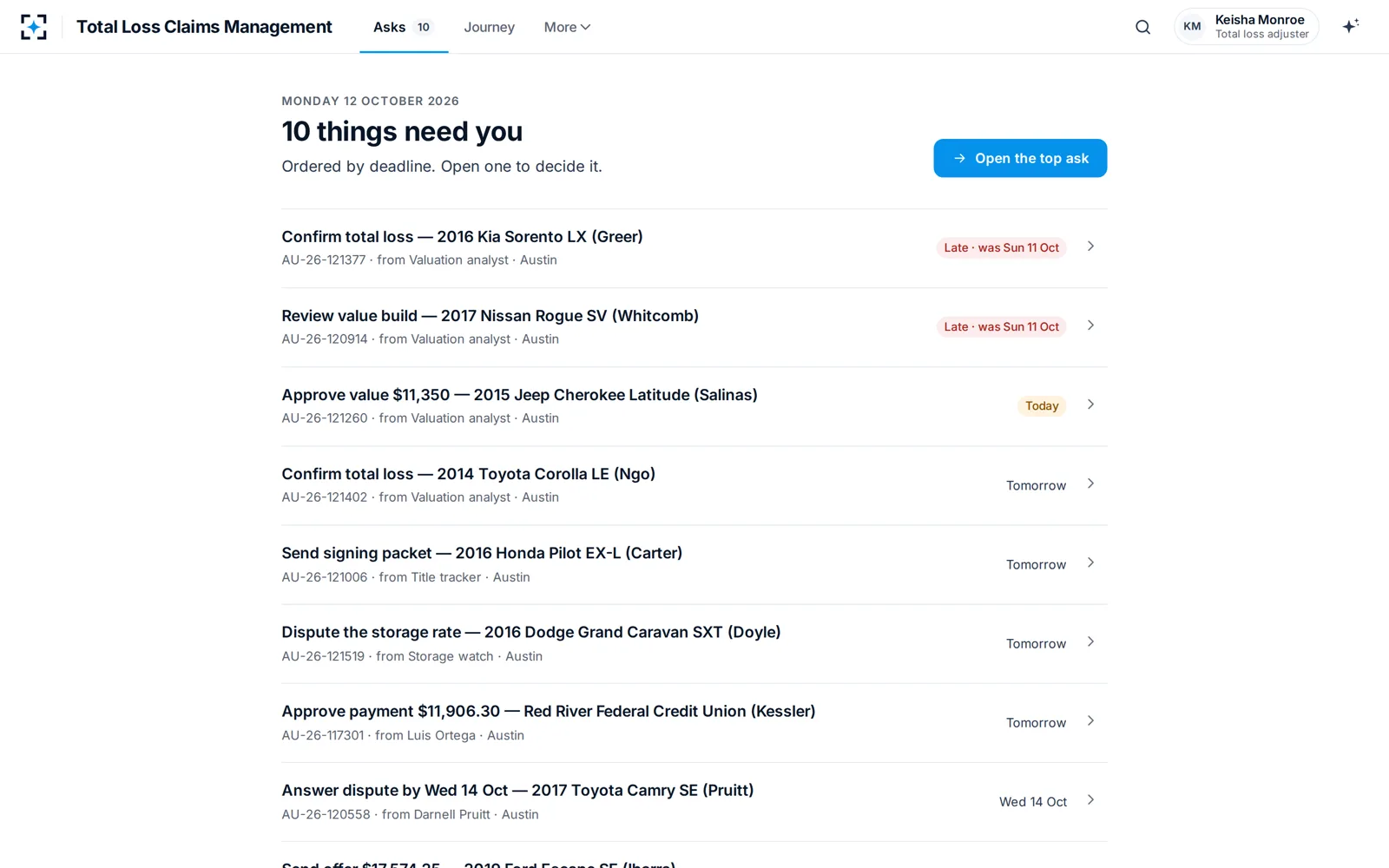
On a hand-run desk the adjuster's day is reactive: a claims system, an inbox, voicemail and a valuation tool, and a stuck car announces itself when the yard's bill arrives. In the sample desk, the adjuster's Monday opens on ten requests ordered by deadline. Each names who raised it, an agent or a colleague, and opens on the same checklist with its evidence: the vehicle and coverage, the value and who approved it, the deductions and the photos behind them, the payee and the lien.
The adjuster's Monday: ten requests, each with who asked and why
Why is the title and payoff seat the slowest stretch?
Because almost every step waits on someone outside the carrier, and the state sets the pace. Texas lets an insurer that paid the claim but cannot get the title apply for one in its own name only "not earlier than the 30th day after the date of payment of the claim," with a statement that it sent "at least two written notices" asking for it (Tex. Transp. Code § 501.0925). A first notice sent late moves the earliest filing date, and every one of those days is a day of storage.
The loan makes it harder. The CFPB found that 11.6% of vehicle loans in its 2018–2022 data rolled negative equity from an earlier car into the new loan, with an average loan-to-value of 119.3% at signing; loans with no trade-in averaged 101.6% (CFPB, 2024). A car financed above its value can be totaled for less than is owed, which brings in gap waivers and owner shortfalls. Every payoff letter also expires, and a payment against an expired letter can leave the loan short by the interest accrued since.
The specialist's title and payoff queue, with tracking and addresses already read
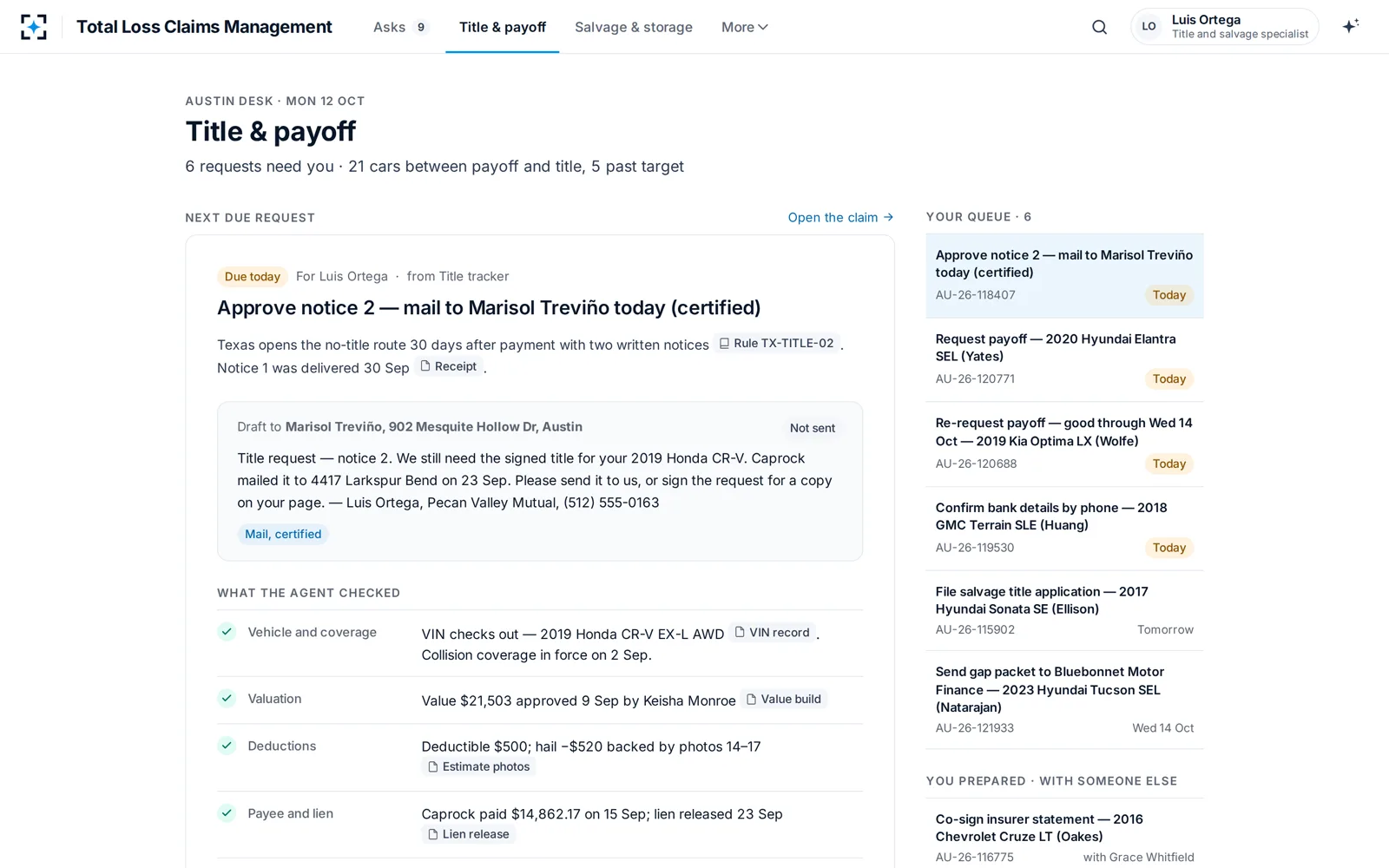
In the sample desk, the title tracker read the mail tracking for a 2019 CR-V, found that the lender had mailed its title to the owner's former address, and drafted the second written notice Texas requires before the no-title route opens. The title delay case study follows that car through its 28 days at Title received.
Supervisor and customer contact: the seats that answer exceptions and "why"
The supervisor's queue is the unit's exceptions, each sent up by a rule. In the sample desk, the supervisor's Monday holds eight requests: co-signing a Texas insurer statement under penalty of perjury, a salvage sale 16% under reserve, a borderline total, a $44,860 value over the adjuster's $40,000 limit, a VIN hold, a payee change to an estate, a yard bill, and naming the carrier's appraiser for a disputed value.
Customer contact answers the owner's two questions, when will I be paid and why that number, and those are the questions that become complaints. Of the 2,167 complaints the Massachusetts Division of Insurance closed in 2025, auto claim delay was the largest single topic at 349, and auto total loss was in the top ten on its own with 127 (Massachusetts DOI). A contact agent who can read the owner the offer line by line, with each comparable and adjustment and the lender's share, can answer "why" on the first call. In the solution, that seat can read every claim in its region and cannot approve money.
Who approves what? The authority ladder on a total loss
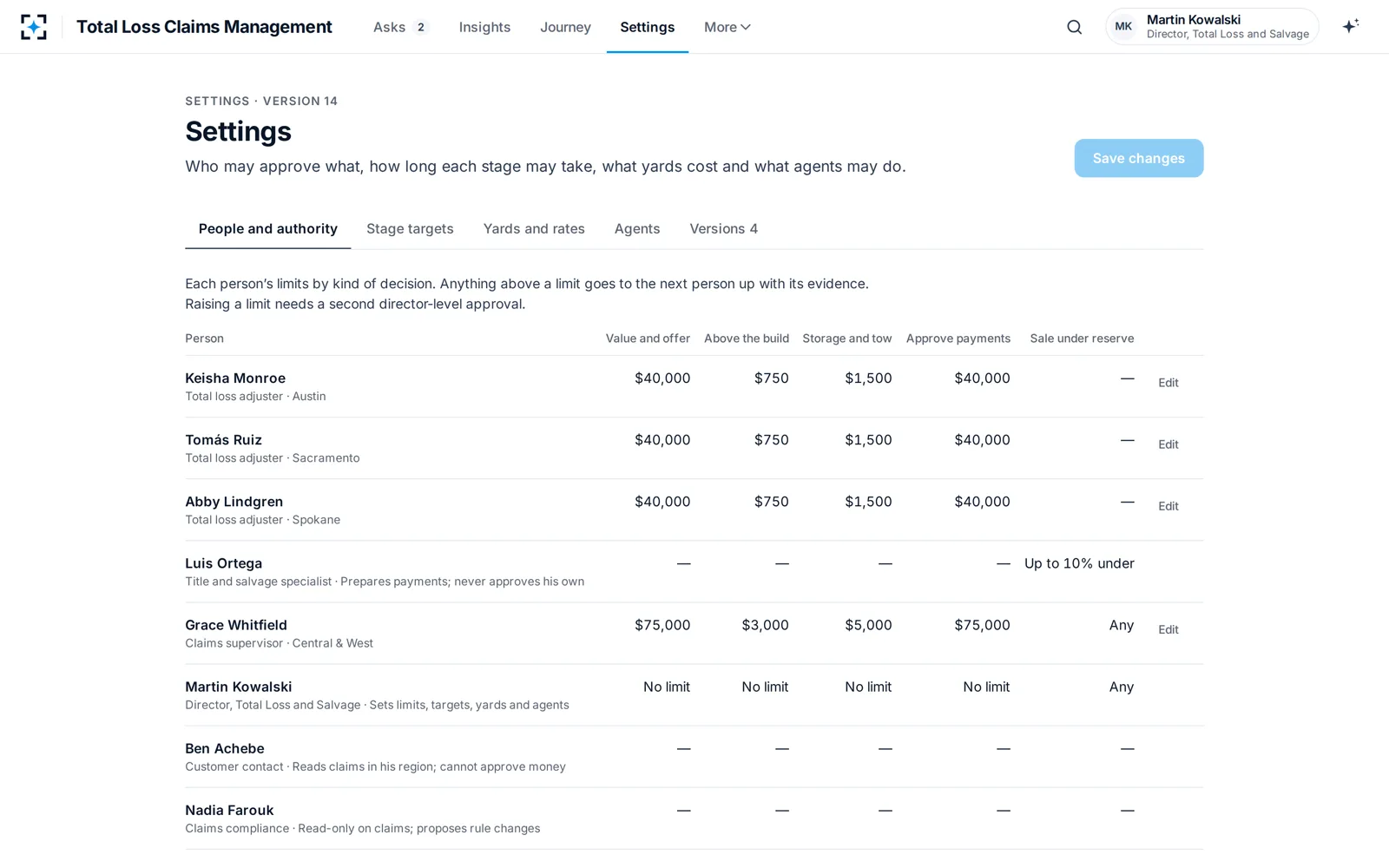
Authority on a total loss unit is a ladder of dollar limits plus a short list of decisions that always need a second person. In the sample desk's settings, an adjuster approves values and payments to $40,000, may add up to $750 above the value build, and pays storage and tow bills to $1,500. The supervisor's limits are $75,000, $3,000 and $5,000; the director has none. The specialist prepares payments but never approves his own, and may sell a salvage car at reserve or up to 10% under it.
The sample desk's authority ladder, decision by decision
| Decision | Adjuster | Supervisor | Specialist |
|---|---|---|---|
| Value and payment | To $40,000 | To $75,000 | Prepares, never approves own |
| Above the value build | Up to $750 | Up to $3,000 | No |
| Storage and tow bills | To $1,500 | To $5,000 | No |
| Salvage sale | No | More than 10% under reserve | At reserve or up to 10% under |
| Payee or bank-detail change | No | Always | No |
| Raising a limit | No | No | No: needs a second director-level approval |
Authority as a setting, per person, enforced on every request
Controls on payments: three hands on one lien payment
The rule that matters most is not a dollar figure. The person who prepared a payment never approves it, a payee or bank-detail change always goes to the supervisor, and a payment against an expired payoff letter is refused. An emailed payoff letter carrying new bank details is exactly the case the second rule exists for.
One lien payment, three hands
Agent
Lien payoff agentReads the payoff letter, the good-through date and the daily interest, and checks the bank details against those already on file for the lender.
Never: Never trusts bank details from an emailed PDF alone
A person decides
SpecialistPrepares the split: lender first, the remainder to the owner.
A person decides
AdjusterApproves within her limit; a larger payment goes to the supervisor.
Never: Never approves a payment she prepared
When a vendor holds a seat
Some seats are not staffed by the carrier at all. Salvage auctions offer payoff and title retrieval to the insurers that consign cars to them, independent appraisers prepare valuations, and staffing firms supply desk adjusters when volume spikes. Each takes work off the unit; none takes the obligation with it. The federal monthly total-loss report is placed on "any individual or entity acting as an insurance carrier" (28 CFR § 25.55), and state unfair-claims rules judge the carrier's practice, whoever keyed it.
Five things to settle before a vendor holds a seat on the unit
- Which decisions the vendor may make, and up to what amount
Preparing a payoff request is not approving a payment; write the limit per decision, not per contract.
- Who the second person is
If the vendor prepares payments or federal reports, someone at the carrier approves them, never the preparer.
- Where the evidence lives
A payoff letter, tracking scan or title image the carrier cannot open is not evidence it can show an examiner.
- How bank details are verified
Against the lender details the carrier holds, by call-back, never against a PDF that arrived by email.
- Who talks to the owner
Consent and opt-outs apply per channel whoever sends the message; an owner with a lawyer is contacted through counsel.
Measuring the unit: stage targets and stopped cars
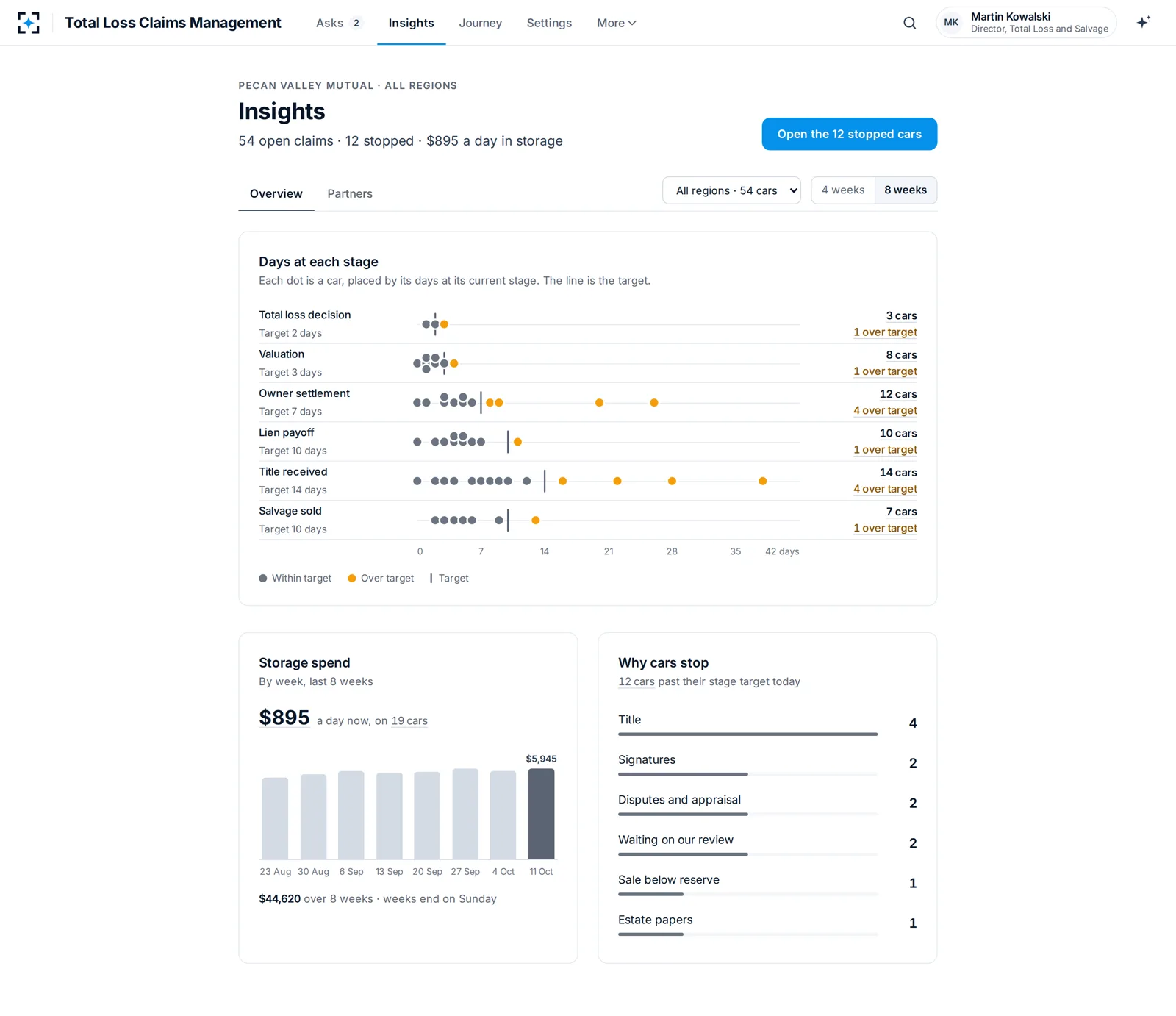
A unit is measured on what happens after the decision: days at each stage against a target, the reason each stopped car is waiting, and what storage costs per car this morning. In the sample book of 54 open claims, the director's view places each car by its days at its current stage against the stage target, and title is the most common reason a car has stopped. That view tells a manager which seat needs help this week, which a monthly cycle-time average cannot.
Where the days go after the decision, for the unit's director
Automation has so far reached the decision more than the tail. In the NAIC's survey of large auto insurers, 96 companies said they used AI in claims mostly "as an informational resource for adjusters," and "few companies are using AI/ML claims models for claims approvals (9) and none are using them for claims denials" (NAIC, 2022). The NAIC's model bulletin on AI says an insurer's actions "must not violate" the unfair-claims rules "regardless of the methods the Insurer used" (NAIC model bulletin). A decision in the unit still needs someone who can be asked why.
Where Total Loss Claims Management fits in the unit
The solution takes the reading and chasing off each seat: agents read every incoming document and say what is missing, find and adjust comparable listings, draft the offer letter, request and re-request payoff letters, read mail tracking, draft title notices and the salvage-title application, collect salvage bids and price every storage day each morning. Each agent task is set to watch, propose or act; money and customer-facing steps are locked to propose, and a task people override more than 5% of the time in 30 days drops back from act to propose by itself.
The decisions stay with the seats that answer for them. Agents never pay, move a car, file with a state or send to an owner or lender on their own. The agents on a total loss claim sets out each agent and its limits, and total loss frequency explains why the unit's volume keeps growing.
Questions people ask
What does a total loss unit do?
It takes a car from the total-loss decision to the salvage sale: the actual cash value and offer, the split payment to lender and owner, the title and salvage title, the monthly federal report to the National Motor Vehicle Title Information System, and the sale, while storage bills accrue.
How is a total loss unit usually staffed?
Around five kinds of seat: total loss adjusters; a title, payoff and salvage role; a supervisor with higher authority; customer contact; and compliance. Some carriers split title, payoff and salvage into three jobs, and some give parts to salvage auctions or vendors; no public benchmark describes a standard split.
Who approves a total loss payment?
Someone other than the person who prepared it, within their dollar limit. Payee and bank-detail changes should always go to a supervisor, and a payment against an expired payoff letter should be refused, since it can leave the loan short by the interest accrued since.
Why do totaled cars sit in storage after the owner is paid?
Because the car's side waits on the title, the lender's lien release and the state. In Texas an insurer that cannot get the title may apply for one in its own name only from the 30th day after payment, after at least two written notices.
Can a carrier outsource title and payoff work?
Yes, to auctions or vendors, but not the obligations. The federal total-loss report binds any entity acting as an insurance carrier, and state unfair-claims rules judge the carrier's practice; the contract should set decision limits, a second approver and how bank details are verified.
What status letters does a total loss claim need?
Under the NAIC's Model 902, a written status letter at 45 days and every 45 days after while the claim remains open; states adopted their own versions. The same model gives the owner 35 days to reopen if no comparable car can be bought for the payment.