The SBA PLP eligibility checklist is the set of eligibility tests a Preferred Lender must run, document and certify on every 7(a) loan it approves under its own delegated authority, because SBA does not look at the analysis before it issues the loan number and reads it only at guaranty purchase or in an oversight review. The tests do not shrink with the lender: ownership traced to 100%, citizenship, CAIVRS, OFAC and SAM.gov for every required party, size with affiliates, the 19 ineligible business types and credit elsewhere. More than half of all 7(a) lenders made five loans or fewer in FY2025, so for most of them the checklist is a document they use a few times a year under rules that change several times a year. Botminds' SBA Eligibility Screening runs the checklist from the application package and keeps the rule set current, so the officer at a small lender signs a cited file rather than rebuilding one.
The lender counts below are our computation from SBA's own 7(a) loan data; the worked examples come from a fictional sample bank running the solution, and every cost figure is labelled as an estimate with its assumptions.
Most SBA lenders are occasional; most SBA loans come from a few
7(a) lenders by FY2025 volume (1,336 lenders)
- 5 loans or fewer · 711 · 53.2%
- 6 to 99 loans · 531 · 39.8%
- 100 or more · 94 · 7%
7(a) loans by lender rank (78,078 approvals)
- Top 10 lenders · 50.2%
- Lenders 11–100 · 32.3%
- All other lenders · 17.5%
What is the SBA PLP eligibility checklist?
It is the PLP lender's own evidence that every eligibility requirement in SOP 50 10 8.1 was tested and met before the loan number was issued. Under PLP, "the Agency does not review the Lender's analysis of the credit or structure of the loan or line of credit prior to issuing a loan number," and "The PLP Lender's analysis is subject to SBA's review and determination of adequacy when the Lender requests SBA to purchase its guaranty or when SBA is conducting lender oversight activities" (SOP 50 10 8.1, Section B, Ch. 1). The checklist is how the lender shows, years later, that the analysis was adequate.
SBA does not issue a PLP eligibility form. What it sets is the content: the requirements of Section A, Chapter 1 of the SOP, the SAM.gov search list in Chapter 4, and the data the lender must put into the SBA Loan System, including "100% of the total direct and indirect ownership of the Applicant," where "The ownership percentages of all listed owners must equal 100%." Most lenders build the checklist from the SOP; the risk at a small lender is that it was built from an earlier SOP and not rebuilt.
The scale a small PLP lender is measured against
711
of 1,336 lenders made five or fewer 7(a) loans in FY2025
64.1%
of FY2025 7(a) loans were made under PLP authority
103,817
Form 1919 responses a year, by SBA’s 2026 estimate
3,100+
lenders, development companies and intermediaries SBA’s credit risk office oversees
What a PLP eligibility file must hold
A PLP file has two halves: what goes into the SBA Loan System, and what stays in the lender's file for SBA to read later. The first half is small and structured. The second is where eligibility is proven, and it is the half a small lender most often thins out.
The SBA PLP eligibility checklist: what goes to SBA, and what the file keeps
| Requirement | Entered in the SBA Loan System | Kept in the lender’s file |
|---|---|---|
| Ownership | 100% of direct and indirect owners, adding to exactly 100% | Entity documents behind each percentage, to the last person |
| Citizenship and residency | The lender’s certification that no owner or required guarantor is an Ineligible Person | Each owner’s certification; evidence of status for any U.S. National |
| Borrower information | The information on Form 1919, not the form | The signed Form 1919 |
| Prior loss and federal debt | Nothing beyond the application data | CAIVRS documentation for the applicant, guarantors and associates; any clearance |
| Exclusions | Nothing beyond the application data | SAM.gov evidence, “for example, a screenshot,” for each required party |
| Sanctions | Nothing beyond the application data | An OFAC check of the business and owners at application |
| Size, affiliation, business type | NAICS code and size data on the application | The affiliation analysis with each affiliate’s returns; the business-type conclusion |
| Credit elsewhere | The lender’s certification, by submitting | The credit memo’s reasons and owner liquidity test |
The right-hand column is the one that decides a purchase. SBA's servicing SOP says a full denial of liability "is justified if a delegated Lender made an ineligible 7(a) Loan," and 13 CFR 120.524 lets SBA recover money already paid if it later finds a material failure (13 CFR 120.524). The full SBA eligibility checklist walks through each test; this page is about what it takes to keep that column full when SBA loans are an occasional product.
How many SBA loans does a small lender make?
Usually very few. In FY2025, 711 of the 1,336 lenders in SBA's 7(a) data made five or fewer loans and 94 made a hundred or more; the top ten lenders made half of all loans and the top hundred made 82.5%.
Ten lenders make half the 7(a) loans; seven hundred make five or fewer each
That shape has a consequence the SOP does not address. A lender making a hundred SBA loans can staff an eligibility specialist who reads every notice the week it appears. A lender making five cannot, and the rulebook does not slow down for it: SOP 50 10 8.1 alone folded in nine policy and procedural notices issued under SOP 50 10 8 in its fifteen months (SBA Information Notice 5000-880695), among them the citizenship change of March 2026 that made green-card holders ineligible owners.
How much does SBA eligibility review cost per loan?
No regulator publishes a per-loan cost for eligibility review, so any figure is an estimate; what can be shown is its structure. Part of the cost is per file: reading the agreements, tracing owners, running the screens, testing size. Part is fixed: keeping the checklist current with the SOP and notices, keeping CAIVRS and SAM.gov access and the SAM.gov checks on the lender's own SBA staff, agents and service providers before their first day, and training whoever signs. The fixed part is what makes the smallest lenders' cost per loan the highest.
What one SBA eligibility determination costs a lender
File work
hours to trace, screen and test one file × loaded hourly cost
Rises with entity owners and affiliates, not with loan size.
SBA underwriter
Second look
hours to review cleared hits × loaded hourly cost
Only on files with a CAIVRS, OFAC or Form 1919 issue.
Compliance
Rule upkeep
hours a year to track SOPs and notices ÷ SBA loans a year
Fixed; divided by five at a small lender, by five hundred at a large one.
SBA lending manager
Access and staff checks
(system access + staff and agent SAM.gov checks + training) ÷ SBA loans a year
Also fixed.
Operations
A worked illustration shows how the fixed part moves the total. Assume a file takes three days by hand, the midpoint of our own estimate of two to four days of eligibility work before credit analysis, and assume rule upkeep of 60 hours a year, a figure we chose for illustration rather than measured. At five SBA loans a year, upkeep adds 12 hours to every file; at 25 loans it adds 2.4; at 100 it adds 0.6. The small lender pays half as much again per file for the same determination, before any mistake.
Estimated eligibility hours per loan, by lender volume (illustration)
The fixed-cost problem is not unique to SBA lending. Harvard Business School researchers found that "high search costs and high transaction costs have made small dollar loans less profitable," and that "The process of underwriting small business loans is often inherently inefficient" (Mills and McCarthy, HBS Working Paper 15-004). Eligibility is the SBA-specific layer on top of that, and the layer most exposed to a rule the lender did not know had changed.
What is the difference between PLP and non-delegated processing?
Under non-delegated processing SBA makes the eligibility and credit decision; under PLP the lender does, and SBA checks it later. For a small lender the choice is made once, not file by file: SBA's notice issuing SOP 50 10 8 told delegated lenders they "must process all loan applications using their delegated authority" (SBA Information Notice 5000-866746), with narrow exceptions such as same-institution refinancing. A lender without the volume to sustain a reliable PLP checklist is really deciding whether to hold delegated authority at all.
PLP and non-delegated processing: who decides eligibility, and when SBA looks
Non-delegated (standard 7(a)): “SBA will make the final determination as to the eligibility and creditworthiness of the Applicant”
PLP (delegated): The lender, under its delegated authority
Non-delegated (standard 7(a)): Before approval, with the application and attachments
PLP (delegated): At guaranty purchase, or in an oversight review
Non-delegated (standard 7(a)): When the application is accepted for SBA processing
PLP (delegated): On the date the lender approves the loan
Non-delegated (standard 7(a)): Waits on SBA’s review
PLP (delegated): The lender’s own timetable
Non-delegated (standard 7(a)): 4.2%
PLP (delegated): 64.1% (SBA Express, also delegated, made up most of the rest)
Do small lenders get SBA oversight reviews?
Yes. SBA's Office of Credit Risk Management "is responsible for the oversight and supervision of the SBA operations of over 3100 7(a) Lenders, Certified Development Companies ('CDCs'), and Microloan Intermediaries," through diagnostic, limited-scope and targeted reviews, and estimates 3,541 responses and 13,195 hours a year for the reviews (90 FR 42496). The reviews ask about "information on loans approved as exceptions to policy" and about SAM.gov checks on agents.
The consequences scale up formally. A violation of loan program requirements is a default under the lender's agreement with SBA, and SBA's formal actions include a portfolio guaranty dollar limit and "Suspension or revocation of delegated authority (including, but not limited to, PLP, SBA Express, or PCLP delegated authorities)" (13 CFR 120.1500). For a small lender, losing PLP authority means every future SBA loan waits on SBA. OIG's latest challenges report also asks SBA to "Enhance the oversight of third-party service providers, including loan agents who lenders place significant reliance on" (SBA OIG Report 26-01), which matters to the small lender that outsources its SBA files.
Is SBA lending worth it for small banks?
That depends on whether the bank can keep its eligibility work as reliable at five loans as a large lender is at five hundred; the guaranty is only as good as the file behind it. A small bank has three ways to do it. It can keep eligibility in-house with a checklist rebuilt at every SOP change, which costs upkeep hours it may not have. It can use a lender service provider, which buys expertise and adds a party SBA expects the lender to oversee, including SAM.gov checks on the provider's staff. Or it can use software that reads the package and carries the current rules, which removes most of the upkeep but not the signature.
Where SBA Eligibility Screening fits: it does the file work in minutes, carries the rules with their effective dates, and hands the officer a checklist with every line cited, so a bank that makes few SBA loans signs the same quality of file as one that makes many. Where it does not: it will not make a lender's SBA program profitable on its own, it does not replace the officer or the credit judgement, and a lender making one or two SBA loans a year should weigh any tool's cost against the simpler option of not holding delegated authority and letting SBA decide.
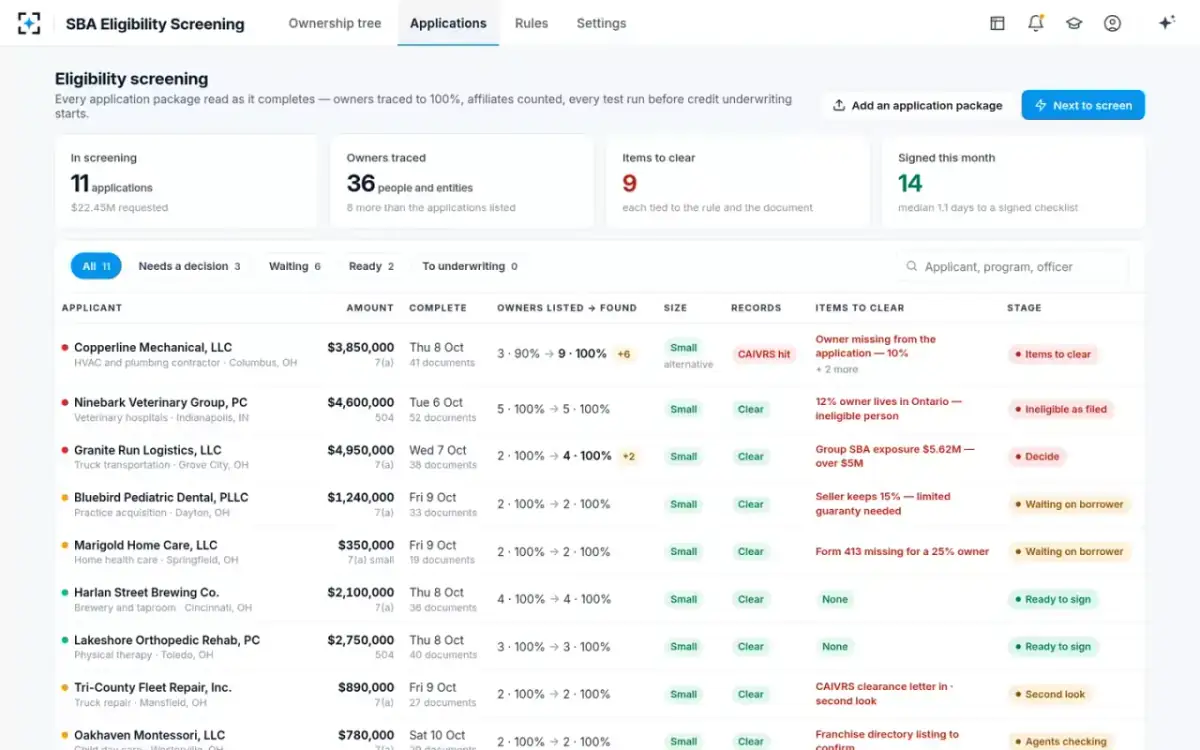
The queue a small lender sees: owners listed against owners found
Setting the checklist once, as rules a small desk can trust
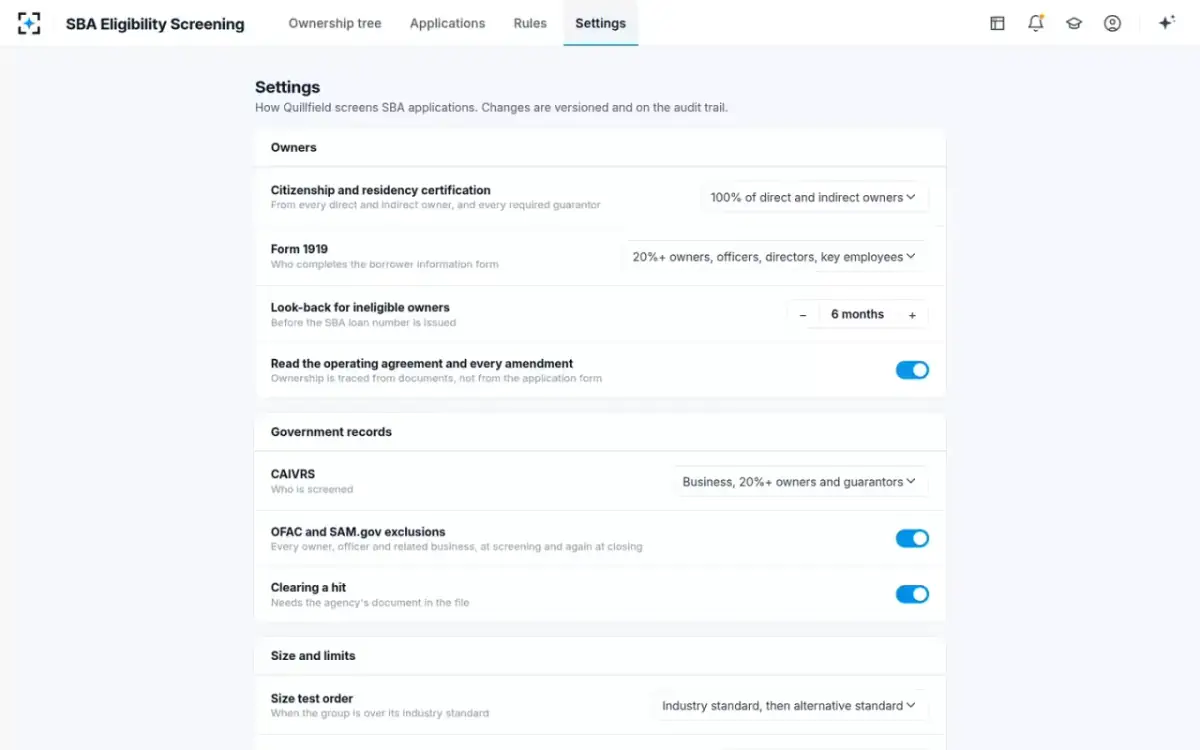
The cheapest control for a small lender is to write its eligibility policy as settings, not as a memo someone has to remember. In the solution each choice the SOP leaves to the lender is a setting with a version history: who completes Form 1919, who CAIVRS screens, the six-month look-back, the order of the size tests, who takes the second look. The SOP's own requirements, such as citizenship for 100% of owners, are fixed, not options.
The lender's eligibility policy as versioned settings
Two design targets are worth holding the solution to on a pilot: a signed checklist within one day of a complete package, and a cited source for every line. A small lender can test both on a handful of its own closed files, and the eight-week go-live plan shows how. The start is SBA Eligibility Screening, which hands the SBA underwriter a cited checklist to sign.
Questions people ask
Does SBA require PLP lenders to use a specific eligibility checklist?
No. SOP 50 10 8.1 sets the requirements and the data the SBA Loan System collects, and the lender documents compliance in its own file. Older SBA eligibility checklist forms circulate among lenders, but a checklist built on an earlier SOP will miss the 2026 citizenship and trust rules.
What is the Form 1919 burden?
SBA's February 2026 notice estimates 103,817 responses and 32,850 hours a year for Form 1919, and adds questions on owners' date of birth, citizenship status, entity type and a spouse who is also an owner. The lender keeps the signed form; only its information goes into the SBA Loan System.
How many SBA lenders are there?
SBA's FY2025 7(a) loan data names 1,336 lenders, by our count, of which 711 made five or fewer loans and 94 made a hundred or more. SBA's credit risk office oversees over 3,100 lenders, development companies and microloan intermediaries across its programs.
Can a PLP lender submit a loan non-delegated?
Generally not. SBA's notice issuing SOP 50 10 8 told delegated lenders they "must process all loan applications using their delegated authority," keeping non-delegated processing for narrow cases such as same-institution refinancing. A lender should check SBA's current guidance before planning on non-delegated review for a hard file.
When is size measured on a PLP loan?
On the date the lender approves the loan. SOP 50 10 8.1 says that for applications processed under delegated authority "the size of the small business is determined as of the date of approval of the loan by the SBA Lender," and later growth does not affect eligibility.