An SBA eligibility review officer is the lender's person who decides, and signs, that an applicant meets the 7(a) or 504 eligibility rules: for-profit, located in the U.S., small with every affiliate counted, not an ineligible business type, owned 100% by U.S. citizens or nationals living in the U.S., clear of federal debt, prior losses and exclusions, and unable to get the credit elsewhere. The work is hard because the answers sit in the owners' documents, not on the application, and since June 1, 2025 SBA no longer makes the call for the lender. Botminds' SBA Eligibility Screening exists for that seat: its agents read the application package, trace every owner and affiliate, run the government checks and hand the officer a cited checklist, and the officer still decides and signs.
The examples come from a fictional sample bank, Quillfield Community Bank, screening a fictional applicant, Copperline Mechanical, as the file runs through the solution. Rules and research are linked where they appear.
The eligibility call moved twice in two years
73,302
7(a) loans whose eligibility SBA itself determined, Aug 2023 to Dec 2024
$32B
in those loans, questioned by SBA’s inspector general
64.1%
of FY2025 7(a) loans made under PLP delegated authority
4.2%
processed non-delegated, where SBA makes the final eligibility call
What does an SBA eligibility review officer do?
The officer turns an application package into an eligibility determination the lender can defend at guaranty purchase. In practice that means four jobs: finding every direct and indirect owner and every business they hold, testing each person and business against SBA's lists and limits, documenting each test with the evidence SBA expects to see, and signing the result before credit underwriting starts. SOP 50 10 8.1 puts the timing plainly: the determination "is a required and critical step in the SBA loan process and should be completed and documented by the Lender as early as practicable" (SOP 50 10 8.1, Section A, Ch. 1).
The SOP does not use the title. "Eligibility review officer" is a lender's job name, and at most lenders the seat is an SBA underwriter or credit analyst who carries eligibility alongside the credit memo. The SOP's own vocabulary is the Lender, the Agent, the Lender Service Provider and the Packager; the person who signs is whoever the lender's credit policy names. That is why the useful question is not the title but the chain: who traces, who tests, who clears a hit, who signs and who certifies in the SBA Loan System.
The rule also runs past the signature. The same paragraph of the SOP says "The Applicant must meet all core requirements at the time of application and throughout loan closing and disbursement." An owner admitted after the screening, a federal debt that turns delinquent, or a sanctions listing before the first draw is still the officer's problem, which is why the checks are run again at closing.
Who determines SBA eligibility since June 1, 2025?
The lender does. SBA's notice issuing SOP 50 10 8 described the change as "re-affirming that SBA Lenders determine whether the Applicant is eligible for a loan guaranteed by SBA" (SBA Information Notice 5000-866746). The SOP took effect for applications issued an SBA loan number on or after June 1, 2025, and SOP 50 10 8.1, in force since October 1, 2026, keeps the rule.
The exception is non-delegated processing. When a lender sends a standard 7(a) application to SBA for a decision, "SBA will make the final determination as to the eligibility and creditworthiness of the Applicant" (SOP 50 10 8.1, Section B, Ch. 1). Under PLP the opposite holds: "the Agency does not review the Lender's analysis of the credit or structure of the loan or line of credit prior to issuing a loan number," and that analysis is "subject to SBA's review and determination of adequacy when the Lender requests SBA to purchase its guaranty." In FY2025 almost two loans in three went the PLP route, and SBA Express, delegated by design, took most of the rest.
Who carried SBA eligibility, then and now
August 2023 to May 2025: SBA, through its Risk Mitigation Framework, which validated applicant data in real time and returned error codes to the lender
Since June 1, 2025: The lender, for every delegated loan; SBA only for non-delegated applications
August 2023 to May 2025: Uploaded documents to clear each error code in E-Tran and waited for SBA to issue the loan number
Since June 1, 2025: Traces owners, tests every requirement, documents the evidence and certifies in the SBA Loan System
August 2023 to May 2025: If SBA had verified eligibility and later found it wrong, it could not use that to deny or repair the guaranty
Since June 1, 2025: Reviews the lender’s analysis for adequacy and may deny liability or seek a repair
August 2023 to May 2025: With SBA, for the tests its framework ran
Since June 1, 2025: With the lender, for every test, every owner and every affiliate
The 22 months SBA made the call, and what they left behind
For loans approved between August 1, 2023 and May 31, 2025, SBA ran eligibility itself, and its inspector general found the screen incomplete. The framework "did not screen to determine whether a small business (1) was organized for profit, (2) met SBA's size requirements, or (3) was an ineligible business type," and for business type it checked "five of the 19" (SBA OIG Report 26-07). OIG questioned the full $32 billion and recommended that SBA flag all 73,302 loans for review at guaranty purchase. SBA agreed.
That matters to today's officer in two ways. First, any 2023–24 loan in the portfolio that defaults will be read again, and the questions will be the ones the framework skipped: size with affiliates, business type, for-profit status. The replay of the 2023–2025 files is a project in its own right. Second, the report is a warning about the officer's own tools. SBA's screen cleared 62 affiliation error codes in OIG's sample without the source documents behind the lender's analysis; a lender's checklist that records "affiliation reviewed" without the return or the operating agreement behind it has the same weakness.
The earlier record points the same way. Before SBA built its screen, OIG found 5,044 7(a) loans worth $4.5 billion made to borrowers with unresolved PPP or COVID-19 EIDL fraud or eligibility holds, from a period in which "The 7(a) lenders who have delegated approval authority approved 92 percent" of the loans (SBA OIG Report 24-17). Delegated authority has always meant the lender's file is the control.
What is a PLP lender's certification?
A PLP lender certifies by submitting. Under 13 CFR 120.101, "Submission of an application to SBA by a Lender or CDC constitutes certification by the Lender or CDC that it has examined the availability of credit to the applicant, has based its certification upon that examination, and has substantiation in its file to support the certification" (13 CFR 120.101). The officer's file is the substantiation.
Citizenship adds an explicit certification. Since March 1, 2026, "SBA Lenders must certify in the SBA Loan System that, to the best of their knowledge, no direct or indirect owner or SBA-required guarantor is an 'Ineligible Person'," and the lender "must enter into the SBA Loan System 100% of the Applicant's direct and indirect owners" (SBA Procedural Notice 5000-876626, carried into SOP 50 10 8.1). "To the best of their knowledge" is a standard of diligence, not a shield: knowledge the file could have produced is knowledge a purchase reviewer will assume.
Size is the one place the rules let the lender lean on the applicant. A lender processing under delegated authority "may accept as true the size information provided by an Applicant, unless credible evidence to the contrary is apparent" (13 CFR 121.303). The catch is the last clause. A holding company's partnership return in the package that lists a 70% subsidiary in the applicant's own industry is credible evidence, and an officer who did not read it has not met the standard.
The file is the certification. Whatever the officer signs, SBA will read it as a claim that the evidence is in the file.
Five signatures on one SBA eligibility file
On a well-run file, five people touch eligibility and each signs for something different. The sample bank's chain shows the pattern: the business development officer brings the package, the SBA underwriter determines eligibility, a compliance officer takes a second look at any cleared hit, the loan processor certifies ownership in the SBA Loan System, and the SBA lending manager owns the rules and the queue.
SBA Eligibility Screening: the people who carry one application
Today
“I spend a day finding the owners and ten minutes deciding whether they’re eligible.”
With agents
Starts from an ownership tree traced to 100%, with every test on its node and three items that need judgement.
Still theirs: The eligibility determination and the signature.
Today
“A cleared hit needs the agency’s letter in the file, not a phone call.”
With agents
Receives each cleared CAIVRS, OFAC or Form 1919 issue with the agency’s document attached.
Still theirs: The second look on every cleared hit.
Today
“I can only certify what someone has proven to me.”
With agents
Certifies 100% of direct and indirect ownership after both signatures, from a checklist where each owner points to a page.
Still theirs: The certification in the SBA Loan System.
Today
“If SBA finds an owner we missed at purchase, the guaranty is gone.”
With agents
Sees owners listed against owners found on every application in screening.
Still theirs: The rules the desk applies, exceptions and the queue.
Today
“Tell me exactly what to ask the borrower for — once.”
With agents
Is copied on one request listing each missing item and the rule behind it.
Still theirs: The borrower relationship and the conversation.
The split exists because each signature answers a different question. The underwriter answers "is this applicant eligible?" The compliance officer answers "was this hit cleared with the agency's document, not a borrower's explanation?" The processor answers "does what we certify to SBA match what we proved?" At a lender making a handful of SBA loans a year the first three can be one person, and the PLP eligibility checklist at a small bank deals with what that does to the cost of each file. What cannot collapse is the evidence behind each answer.
What each signature means, in words that survive a purchase review
A signature is only as strong as the sentence it signs. "Reviewed" says nothing a purchase reviewer can test; a sentence that names the documents and the rules does. The table sets out a wording for each seat, with what has to be in the file for the words to be true.
Each signature on the eligibility file, what it says and what must stand behind it
| Seat | What the signature should say | What must be in the file |
|---|---|---|
| SBA underwriter | “I have reviewed the documents and find the applicant eligible under the SOP and notices in force for this application.” | Ownership traced to 100% from entity documents; size with affiliates from returns; each 13 CFR 120.110 test; credit elsewhere in the credit memo |
| Compliance officer | “Each cleared hit is supported by the issuing agency’s document.” | CAIVRS screens and agency clearance letters; OFAC match analysis; corrected Form 1919 where an answer changed |
| SBA loan processor | “The owners certified in the SBA Loan System equal 100% and match the traced schedule.” | The traced ownership schedule, signed by the borrower; the signed Form 1919 retained in the file |
| SBA lending manager | “The desk applied the rules in force on the governing date for this file.” | The rule set with effective dates; any exception request and SBA’s answer |
| Business development officer | “The borrower was told every missing item and the rule behind it.” | The request to the borrower, dated, and each document that answered it |
The manager's line deserves a second read. Which SOP governs a file is less obvious than it sounds: SBA's notices for SOP 50 10 8.1 describe the trigger in different words, and the March 2026 citizenship change used the loan-number date for delegated loans and the E-Tran "R1 status" for non-delegated ones. A desk that writes down, on each file, which rules it applied and why will not be arguing about it at purchase.
What does SBA review at guaranty purchase?
At purchase SBA reviews whether the lender made, closed, serviced and liquidated the loan by the rules, and eligibility is the first thing it can test. The release events in 13 CFR 120.524 include that "The Lender has failed to comply materially with any Loan Program Requirement" and that its "improper action or inaction has placed SBA at risk," and if SBA finds one "at any time," it "is entitled to recover any moneys paid on the guarantee plus interest from the Lender" (13 CFR 120.524).
Credit elsewhere is the eligibility test reviewers have long found weakest. In FY2016, "Over 40 percent (17 of 40)" of SBA's on-site lender reviews found noncompliance with it (GAO-18-421). The SOP now says what must be in the credit memo: the liquidity of every 20% owner, the specific reasons the applicant fails conventional policy, and never a credit-score policy as the sole reason.
The purchase reviewer reads the file the officer built, often years later and without the officer in the room. A determination that cites its sources lets the reviewer agree in an hour. One that does not invites the reviewer to rebuild it, and the reviewer will rebuild it with whatever the file lacks counted against the lender.
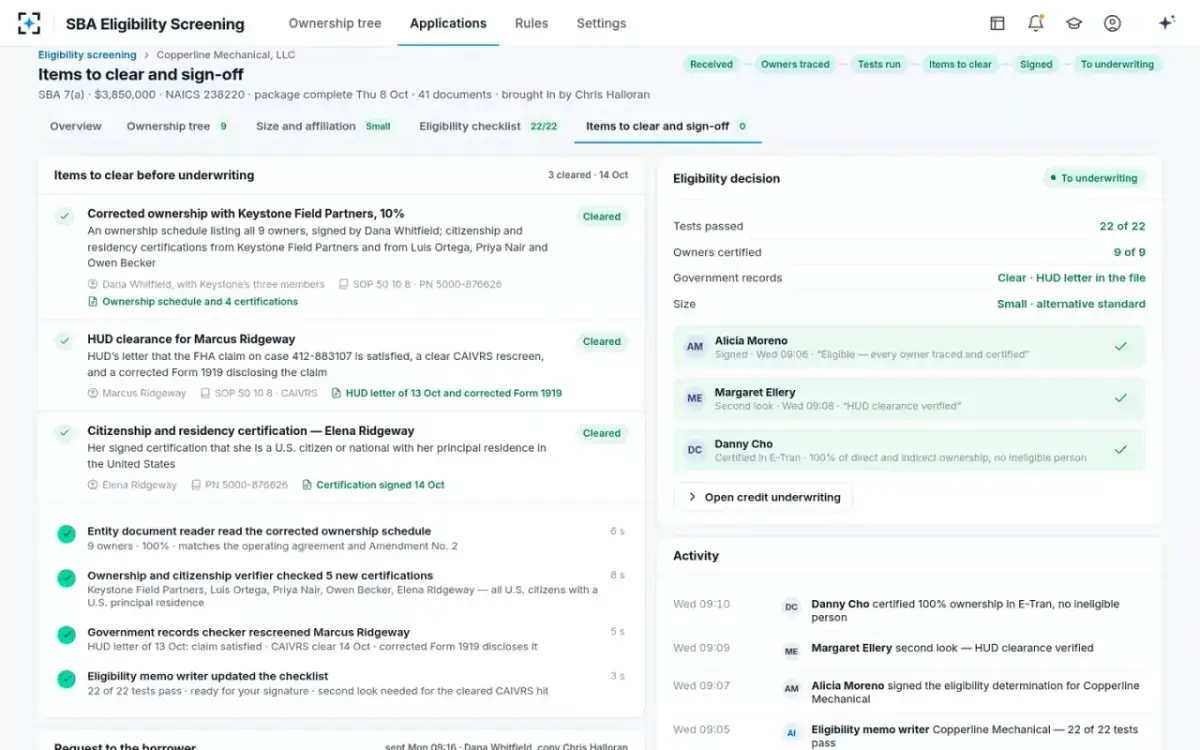
A signed determination, a second look and a certification, in that order
Where the eligibility review officer sits: underwriting, second line or a processing desk
There is no single right place, but there is a wrong one: wherever the person signing never reads the source documents. Lenders tend to choose among three models. In the first, the SBA underwriter determines eligibility as the opening part of the credit analysis, which keeps judgement close to the credit but spends underwriter hours on document tracing. In the second, a processing desk assembles the evidence and the underwriter signs, which is cheaper but invites signatures on summaries. In the third, a second-line officer re-performs eligibility on a sample of files after signature, which catches patterns but not the file in hand.
Volume decides more than philosophy. A lender making a few SBA loans a year rarely has enough files to keep a dedicated eligibility seat busy, so the work falls to whoever underwrites, and the rulebook changes faster than an occasional reader can follow: two SOP versions and at least nine binding notices took effect between June 2025 and October 2026. A lender making hundreds can afford a specialist, and its risk is the opposite, that the specialist becomes a stamp on a summary prepared by someone else.
The eligibility chain in SBA Eligibility Screening: agents trace and test, people decide and sign
Agent
Entity document readerTraces ownership to 100% from the operating agreement, amendments, owner entities’ agreements and K-1s.
Never: Adds an owner without a document or assumes a percentage.
Agent
Ownership and citizenship verifierChecks each owner’s citizenship and residency certification, Forms 1919 and 413, and conflicts between documents.
Never: Decides citizenship from a name or an address.
Agent
Government records checkerRuns CAIVRS, OFAC and SAM.gov exclusions on the business and its people, and again at closing.
Never: Clears a hit without the agency’s clearance.
Agent
Eligibility memo writerWrites the checklist, one line per test with its rule and source page, and drafts the request to the borrower.
Never: Signs, or certifies in the SBA Loan System.
A person decides
SBA underwriterDecides each item that needs judgement and signs the eligibility determination.
A person decides
Compliance officer and loan processorSecond look on every cleared hit; certification of 100% ownership after both signatures.
What SBA Eligibility Screening hands the officer, and what it never signs
The solution moves the tracing and the testing off the officer's desk and leaves the decisions on it. In the sample file, the application listed three owners adding to 90%. The agents read 41 documents and returned nine owners at 100%, an affiliate found on a holding company's partnership return, a HUD claim on a 21% guarantor and a citizenship certification nobody had collected. The officer, Alicia, spent her time on the three items that needed judgement. Then Alicia signs the eligibility determination, the compliance officer takes the second look on the cleared CAIVRS hit, and the processor certifies.
Three items, each with its rule, and one request the officer chooses to send
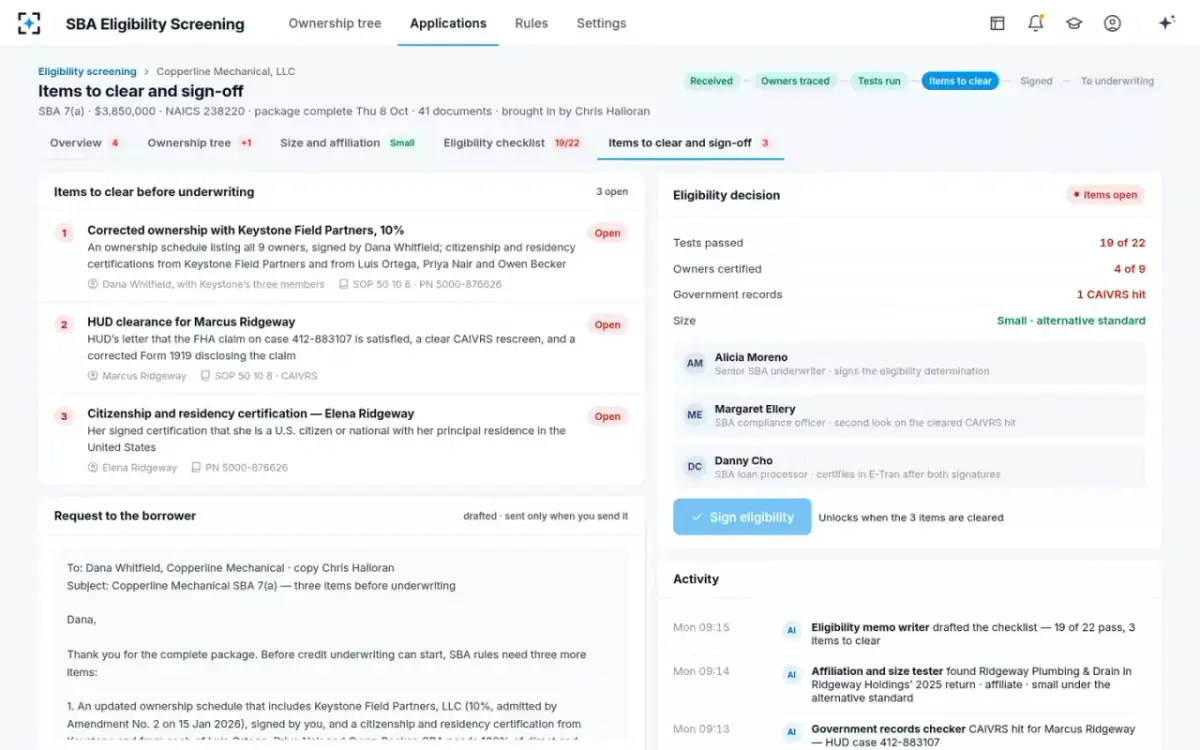
Two design targets frame what the officer should expect: a signed eligibility checklist within one day of a complete package, and every finding one click from its rule and source page. On the sample data the six agents read the 41 documents and ran 22 tests in 71 seconds. None of that moves the signature. The agents recommend; the officer decides, and the SBA eligibility checklist the agents run sets out which decisions they may never make. To see the chain on a live file, start from SBA Eligibility Screening.
Questions people ask
Who signs the SBA eligibility checklist?
SBA does not name a seat; the lender's credit policy does. Most lenders have the SBA underwriter or credit officer sign the determination, with a second reviewer for cleared government-record hits. Whoever signs, 13 CFR 120.101 makes the lender's submission itself a certification backed by "substantiation in its file."
Is the lender responsible for SBA eligibility?
Yes, for every delegated loan. SOP 50 10 8 re-affirmed that lenders determine eligibility from June 1, 2025, and SOP 50 10 8.1 keeps that rule. SBA makes the final call only on non-delegated applications, 4.2% of FY2025 7(a) loans.
When did eligibility go back to lenders?
On June 1, 2025, with SOP 50 10 8. From August 1, 2023 SBA had determined eligibility itself through its Risk Mitigation Framework; OIG later found it checked only five of the 19 ineligible business types and never tested size or for-profit status.
Does SBA re-check eligibility on PLP loans?
Not before the loan number. Under PLP, SBA does not review the lender's analysis before numbering the loan, and reviews it for adequacy when the lender requests purchase or during oversight reviews. A missed owner or affiliate typically surfaces then, when a denial or repair costs the most.
Can one person be the underwriter, the second look and the processor?
At a small lender, often yes, because the SOP prescribes duties, not seats. The weakness is that a second look by the same person who cleared the hit is not a second look; lenders that cannot separate the roles can at least require the agency's document in the file for every cleared CAIVRS, OFAC or Form 1919 issue.
What does an eligibility review officer check first?
Ownership, because almost every other test depends on it. Citizenship, CAIVRS, SAM.gov exclusions, guaranties and affiliation all run person by person and business by business, so a missing 10% owner leaves a gap in each of them.