OFAC screening software compares names against the Treasury Office of Foreign Assets Control's sanctions lists, the Specially Designated Nationals list and the consolidated non-SDN lists, and helps a compliance team decide whether a potential match is real. SBA requires that check: lenders "must determine that the applicant business and owners are not listed on the OFAC sanctions lists at the time of application." But it is one test among about twenty on an SBA eligibility check, and it can only screen the owners someone has already found. Ownership traced to 100%, citizenship and residency, CAIVRS, SAM.gov exclusions, size with affiliates and the ineligible business types all sit outside what sanctions software is built to do. Botminds' SBA Eligibility Screening runs OFAC as one line of the SBA checklist, alongside the others, on every owner its agents trace from the application package, and leaves every hit for a person to clear.
Rules are quoted from SOP 50 10 8.1 and OFAC's own guidance; worked examples use fictional sample data in the solution.
The SBA eligibility check, test by test: OFAC screening is one line
- OFAC sanctions lists: the business and its owners
The one test sanctions software is built for, at the time of application.
- Ownership traced to 100%, direct and indirect
The input every person-level test needs, from the entity documents.
- Citizenship and principal residence of every owner and required guarantor
U.S. citizens or nationals living in the U.S., since March 1, 2026.
- Six-month look-back for ineligible owners
Anyone who owned in the six months before the loan number.
- CAIVRS: prior loss to the government
The applicant, and businesses owned, operated or controlled by it or its associates.
- CAIVRS: delinquent federal debt
The applicant, guarantors and associates; 90 days past due is delinquent.
- SAM.gov exclusions
The applicant, 20% owners, officers, directors, key employees and entity owners, with evidence kept.
- No existing SBA loan more than 29 days past due
Checked when the new loan number issues.
- Character: associates incarcerated or under indictment
And a continuity plan for an owner on parole or probation.
- For-profit, operating, organized and located in the U.S.
From the organizing documents and returns.
- Not one of the 19 ineligible business types
Including passive, speculative, lending and packaging businesses.
- Franchise on the SBA Franchise Directory, if it is one
Read the agreement, not its label.
- Small, with every affiliate counted
Industry standard, or $20 million net worth and $6.5 million average net income.
- No minor owning 20% or more; trusts at 20% guarantee
Spouses and minor children combined.
- Credit not available elsewhere
Owner liquidity and an identifiable weakness in the credit memo.
- Eligible use of proceeds and loan limits
Across the applicant and its affiliates.
- No exports to prohibited countries; no sanctioned transaction
The program-level sanctions test beyond the name screen.
- Customer identification program
Under 31 CFR 1020.220, which SBA requires of every lender.
What is OFAC screening software?
OFAC screening software matches the names in a transaction or onboarding file against OFAC's lists and scores potential matches for review. OFAC publishes the data itself through its Sanctions List Service, which offers "the most up-to-date Sanctions Lists and Sanctions list data ready for immediate download," and runs a free search tool that "employs fuzzy logic on its name search field to look for potential matches" on the SDN list and the non-SDN consolidated list (OFAC Sanctions List Service). Commercial tools add batch screening, list updates, case management and often lists from other agencies.
OFAC itself is clear that a hit is the start of the work, not the answer. "Many potential matches identified through screening are false positives," its guidance says, and the reviewer should "compare all of the details in the OFAC listing with the information available to you," such as date of birth, nationality and identification numbers (OFAC FAQ 5, Assessing OFAC Name Matches). Screening tools, it adds, "often screen against OFAC's sanctions lists as well as lists of potentially restricted persons maintained by other government agencies, screening software vendors, or internal lists."
Does OFAC screening cover SBA eligibility?
It covers the OFAC line and part of one other. SBA's OFAC requirement is a name check of "the applicant business and owners ... at the time of application" (SOP 50 10 8.1, Section A, Ch. 1, Para J), and SBA's definition of an ineligible person includes "An individual, business concern, or entity on the Office of Foreign Assets Control (OFAC) sanctions list." The SOP also bars a loan to a business that "directly or indirectly exports to a foreign country which is listed as a prohibited country ... or if the transaction would be prohibited under any of the sanctions programs administered by OFAC," which a name screen alone does not test.
Everything else on the checklist above draws on other sources. CAIVRS is a HUD-hosted federal database; SAM.gov exclusions is a GSA system; citizenship rests on certifications and documents; size and business type rest on returns and agreements. A sanctions vendor that adds "other government lists" may include some exclusion data, but it will not tell a lender whether a business is small with its affiliates, or whether an owner lives in Ontario.
OFAC screening software and an SBA eligibility file
What OFAC screening software does: The names it is given
What the SBA file also needs: Every direct and indirect owner, traced from the documents first
What OFAC screening software does: OFAC SDN and non-SDN lists; often other agencies’ lists
What the SBA file also needs: OFAC, CAIVRS for prior loss and federal debt, SAM.gov exclusions for a defined set of parties
What OFAC screening software does: None beyond sanctions
What the SBA file also needs: Citizenship and principal residence for every owner and required guarantor
What OFAC screening software does: Name and sometimes address
What the SBA file also needs: For-profit, U.S., not an ineligible type, small with affiliates, franchise on the Directory
What OFAC screening software does: Match scores and case notes
What the SBA file also needs: Each test’s source in the loan file: a SAM.gov screenshot, CAIVRS documentation, the returns behind size
What OFAC screening software does: At onboarding and on list changes
What the SBA file also needs: At application, and core requirements again through closing and disbursement
A sanctions screen is only as complete as the list of owners it is handed. On an SBA file, building that list is most of the work.
Who must be checked against OFAC for an SBA loan?
The applicant business and its owners, at the time of application. Because SBA's ownership rule reaches every direct and indirect owner, the practical answer is everyone on the traced ownership tree: the entity owners and the people behind them. A name screen run on the three owners an application lists, when the documents name nine, has screened a third of the people the rule covers.
OFAC's own rules add a reason to trace. OFAC treats some entities as blocked "by operation of law" because of who owns them, under what it calls the 50 Percent Rule, and its guidance tells reviewers to escalate when an alert "implicates some other potential nexus to OFAC sanctions" of that kind (OFAC FAQ 5). A screen of an entity's name cannot see a blocked owner two layers up; an ownership tree can.
Who each SBA eligibility list must cover
| Check | Who | What the file keeps |
|---|---|---|
| OFAC sanctions lists | The applicant business and its owners | The result at application; any potential match investigated and recorded |
| SAM.gov exclusions | Applicant; 20% owners, officers and directors; LLC managing members; general partners; key employees; living trustor; entity owners of 20%; EPC and OC | Evidence of each search, “for example, a screenshot of the search results” |
| SAM.gov exclusions (once) | The lender’s SBA staff, agents and lender service providers | A search before the first day of work on SBA business |
| CAIVRS | The applicant; guarantors; associates; businesses they own, operate or control | Documentation of the check; how any prior loss or debt was satisfied |
| Citizenship and residency | Every direct and indirect owner and SBA-required guarantor | Certifications; evidence for any U.S. national |
| SAFER (FMCSA carriers) | Applicants that need a USDOT number | An active USDOT number in good standing and a matching physical address |
What is CAIVRS, and why sanctions software does not run it?
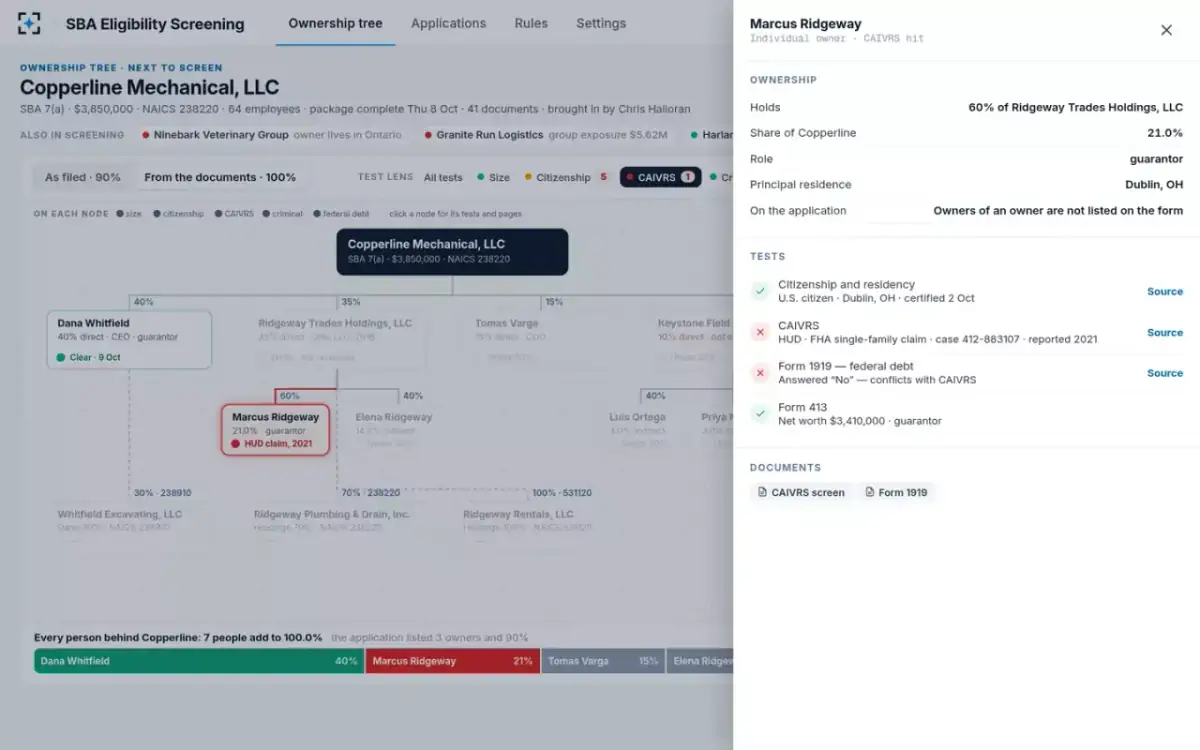
CAIVRS, the Credit Alert Verification Reporting System, is a federal database of people and businesses with delinquent federal debts or federal claims, hosted by HUD and checked by lenders in several federal programs. SBA requires it for two eligibility tests: whether "the Applicant or a business owned, operated, or controlled by the Applicant or any of its Associates has a Prior Loss," and whether "the Applicant, or any guarantor or Associate of the Applicant, has any Delinquent Federal Debt," which is debt unpaid 90 days past its due date. "SBA Lenders must retain documentation of the CAIVRS check in the loan file" (SOP 50 10 8.1, Section A, Ch. 1, Para E).
It is not a sanctions list, so sanctions tools are not built around it, and a hit means something different. An OFAC match may require blocking; a CAIVRS hit means the applicant is ineligible until the debt or loss is resolved and the lender documents "how the loss has been fully satisfied." SBA's own history shows why it matters: OIG found 5,044 7(a) loans, $4.5 billion, made to borrowers with unresolved PPP or COVID-19 EIDL fraud or eligibility holds before SBA added that screen (SBA OIG Report 24-17).
Where an OFAC screen sits in an SBA eligibility check
1
of about twenty SBA eligibility tests is the OFAC name screen
3
federal lists an SBA file must show: OFAC, CAIVRS and SAM.gov exclusions
90 days
past due that makes a federal debt delinquent for SBA
10 days
business days to report a blocked or rejected transaction to OFAC
How do you clear an OFAC false positive?
By comparing the listing's details with the applicant's and recording why the match is or is not valid. OFAC's guidance sets out steps: decide whether the alert is against an OFAC list or another agency's; whether it is a name match or another kind of sanctions nexus; evaluate the quality of the match against full names, aliases, dates of birth, nationality, identification numbers and addresses; then, for a valid match, determine whether to block or reject, and "Report valid matches to OFAC and maintain required records."
An OFAC hit on an SBA applicant: what an agent prepares and what a person decides
Agent
Government records checkerRuns each traced owner and entity against OFAC’s lists and records every potential match with the listing’s details.
Never: Dismisses a match as a false positive.
Agent
Ownership and citizenship verifierSets the applicant’s own identifiers beside the listing: date of birth, citizenship, address, ID, from the certifications and Form 1919.
Never: Infers a person’s identity or nationality from a name.
A person decides
Compliance officerDecides whether the match is valid under the bank’s sanctions procedures, and escalates any block, rejection or report to OFAC.
A person decides
SBA underwriterTreats a valid match as an ineligible person on the application, and records the cleared result in the eligibility file.
A cleared hit belongs in the eligibility file as well as the sanctions case. If a purchase reviewer finds a name that resembles a listed party, the file should show who decided it was not a match, on what evidence and when. In the solution every cleared CAIVRS, OFAC or Form 1919 issue needs its supporting document in the file and a second look from the compliance officer before the file moves on.
One test at a time across the whole ownership tree
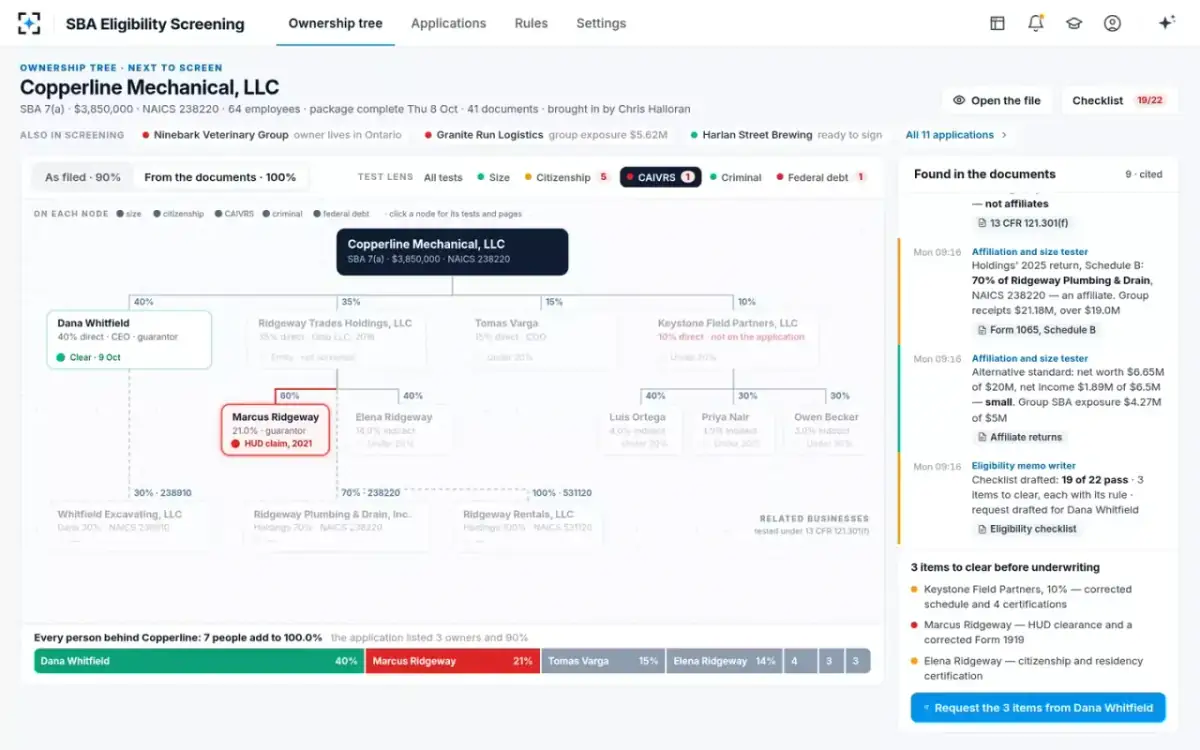
Buying OFAC screening software for SBA lending: what to look for
A bank buying for its SBA desk should decide first what the tool is for. If it is the bank's enterprise sanctions program, judge it on list coverage, match quality, update speed and case management, and expect it to run on payments and onboarding across the bank. If it is for SBA eligibility, judge it on whether it produces evidence for every line of the SBA checklist, because the OFAC line is the least likely to be the one that fails a purchase review.
The record supports that ranking. When SBA's inspector general examined 77 eligibility error codes SBA had cleared without support, 62 were affiliation and two were CAIVRS; none was sanctions (SBA OIG Report 26-07). The tests that fail are the ones that need documents read, which is why the SBA eligibility stack has to combine list checks with ownership tracing.
Where SBA Eligibility Screening fits beside an OFAC tool, and where it does not
It fits as the SBA layer, not the sanctions layer. It runs OFAC, CAIVRS and SAM.gov on every owner and business its agents trace, beside the citizenship, size, business-type and credit-elsewhere tests, and writes one checklist with a source for every line. Where it does not: it is not a bank-wide sanctions system, it does not screen payments, and it does not replace the bank's procedures for blocking, rejecting or reporting to OFAC. A bank with a sanctions platform it trusts keeps it; the question is what covers the other nineteen lines.
One owner, every list: a CAIVRS hit and the Form 1919 answer that contradicts it
What other checks does SBA require beyond the lists?
The checks that rest on documents rather than databases. Citizenship and principal residence rest on certifications and, for U.S. nationals, evidence of status. Size rests on the affiliates' returns. The business types in 13 CFR 120.110 rest on what the business does and how it earns, including thresholds such as more than a third of revenue from packaging SBA loans (13 CFR 120.110). Credit elsewhere rests on owner liquidity and the lender's own policy. None of those is a list a vendor can license.
The agents in SBA Eligibility Screening are built around that. The entity document reader traces the owners, so the list checks have complete inputs; the affiliation and size tester reads the owners' filings; the program rules checker reads business activity and revenue; the memo writer puts it all in one checklist. The citizenship test and the gap between KYB tools and SBA's 100% rule are the two places sanctions-led tools most often fall short. To see the whole check on a file, start from SBA Eligibility Screening.
Questions people ask
Is OFAC screening required for SBA loans?
Yes. SOP 50 10 8.1 requires lenders, including SBA lending companies, to comply with Treasury's OFAC regulations and to "determine that the applicant business and owners are not listed on the OFAC sanctions lists at the time of application." For 504 loans a development company may rely on a federally regulated third-party lender's annual certification.
Is the OFAC search tool enough for an SBA file?
OFAC's free Sanctions List Search can satisfy the OFAC line if the lender records the search and investigates any potential match. It does not cover CAIVRS, SAM.gov exclusions or any of the document-based tests.
What is SAM.gov exclusion screening?
A search of the System for Award Management's exclusion records for parties suspended, debarred or otherwise excluded by a federal agency. SBA requires it for the applicant, 20% owners, officers, directors, key employees and entity owners, with evidence such as a screenshot kept in the file.
Does an OFAC hit make an SBA applicant ineligible?
A valid match does: anyone on an OFAC sanctions list is an ineligible person, and no loan may be made if an owner or required guarantor is one. A potential match that the lender investigates and documents as a false positive does not.
When should OFAC be re-run on an SBA loan?
SBA's rule sets the check at application, but core requirements apply through closing and disbursement, so many lenders re-run OFAC and SAM.gov before closing. The sample bank in the solution re-screens every owner, officer and related business at closing.