An SBA loan is not available to a business with a green card holder among its owners: since March 1, 2026, every direct and indirect owner of a 7(a) or 504 borrower, and every SBA-required guarantor, must be a U.S. citizen or U.S. national whose principal residence is in the United States, and lawful permanent residents "will not be eligible to own any percentage interest." The rule bites hardest below the surface, because an owner of an owner counts, and a 3% indirect stake held by a green card holder is enough to make the business ineligible. Botminds' SBA Eligibility Screening exists to find those owners: its agents trace ownership to 100% from the application package and check each person's citizenship and residency certification, so the lender's officer knows before underwriting whether the March 1 line has been crossed.
SBA's notices are quoted and linked below. The worked examples come from a fictional sample bank's applications in the solution.
The SBA citizenship rule before and after March 1, 2026
Applications approved January 1 to February 28, 2026: Eligible owners and guarantors, with a U.S. principal residence
From March 1, 2026: Ineligible: may not own any percentage, directly or indirectly
Applications approved January 1 to February 28, 2026: Up to 5% in aggregate, with citizens, nationals or LPRs living abroad and conditional LPRs
From March 1, 2026: Ineligible; the 5% exception is rescinded
Applications approved January 1 to February 28, 2026: Within the 5% exception
From March 1, 2026: Ineligible as owners: principal residence must be in the U.S.
Applications approved January 1 to February 28, 2026: Ineligible persons
From March 1, 2026: Ineligible persons
Applications approved January 1 to February 28, 2026: Foreign nationals within the exception could be supplemental guarantors
From March 1, 2026: Any ineligible person except an undocumented alien may give a limited guaranty
Applications approved January 1 to February 28, 2026: SBA approval on or after January 1, 2026
From March 1, 2026: Loan number issued on or after March 1 (delegated); R1 status in E-Tran on or after March 1 (non-delegated)
Can green card holders get an SBA loan in 2026?
Not as owners of the borrowing business, for any loan numbered since March 1, 2026. SBA's policy notice, signed by Administrator Kelly Loeffler, says that "beginning with the Effective Date of this Notice, Legal Permanent Residents (LPRs) will not be eligible to own any percentage interest in an Applicant/Borrower, OC, or EPC" (SBA Policy Notice 5000-876441). The rule now sits in SOP 50 10 8.1: "SBA financing is limited to business Applicants with 100% direct and/or indirect owners and SBA-required guarantors, all of whom must be U.S. Citizens or U.S. Nationals who have their Principal Residence in the United States, its territories, or possessions" (SOP 50 10 8.1, Section A, Ch. 1, Para F).
"Any percentage" is meant literally. The rule counts indirect owners, so a green card holder who owns part of a holding company that owns part of the applicant makes the applicant ineligible, however small the multiplied share. And it reaches beyond the applicant: when other businesses report their taxes on the applicant's return, "all the businesses on the tax return are subject to these requirements," though affiliates that file their own returns are not.
The scale of the March 1 change
3,358
FY2025 SBA loans to businesses owned in part by a green card holder
4%
of SBA’s roughly 85,000 FY2025 loan approvals
0%
ownership a green card holder may now hold, directly or indirectly
6 months
look-back before the loan number for any ineligible owner
When did SBA bar green card holders?
On March 1, 2026, after two notices in ten weeks. SBA Procedural Notice 5000-872050, effective December 19, 2025 for applications approved from January 1, 2026, set the rule that "100% of the direct and/or indirect owners must be U.S. Citizens, U.S. Nationals, or Lawful Permanent Residents (LPRs)" living in the U.S., with a narrow exception for up to 5% (SBA Procedural Notice 5000-872050). On February 2, 2026, SBA published Policy Notice 5000-876441, effective March 1, which rescinded the exception and removed green card holders from the eligible owners. Procedural Notice 5000-876626, published February 11, wrote the new text into the SOP.
Who could own an SBA borrower, June 2025 to October 2026
- SOP 50 10 8 rules; green card holders eligibleJun–Dec 2025
- 5% exceptionJan–Feb 2026
- Citizens and U.S. nationals only, living in the U.S.Mar–Oct 2026
The effective date worked differently for delegated and non-delegated loans. The changes applied "to all 7(a) and 504 loans approved (i.e., issuance of the SBA loan number) under delegated procedures on or after March 1, 2026" and to non-delegated applications "that enter R1 status (as indicated in E-Tran) on or after March 1, 2026." Non-delegated applications with LPR ownership that reached R1 status by 11:59 PM Eastern on February 28 "will be processed by SBA" (SBA Procedural Notice 5000-876626). On March 9, SBA announced it was extending the ban to its Microloan and Surety Bond programs, effective 30 days after publication (SBA News Release 26-35).
What was the SBA 5% foreign ownership rule?
It was a two-month exception that let up to 5% of a borrower, in aggregate, be owned by people who would otherwise fail the residency test. Procedural Notice 5000-872050 allowed "(a) Individuals who are not U.S. Citizens, U.S. Nationals, or LPRs, and are not Ineligible Persons but are instead foreign nationals living outside the U.S.," "(b) U.S. Citizens, U.S. Nationals, or LPRs whose Principal Residence is outside the United States," and "(c) Aliens with Conditional LPR status," so long as together they held no more than 5%. It applied to applications approved from January 1, 2026 and was rescinded from March 1.
The same December notice tightened the rule in other ways that survived. It made citizens of the People's Republic of China and Hong Kong ineligible persons, required entity owners to be organized in the U.S., and defined principal residence by IRS Publication 523. A lender reading a file approved in January or February 2026 should test it against that notice, not today's rule: at guaranty purchase, SBA "will apply the requirements of SOP 50 10 in effect when the Loan was approved" (SOP 50 57 4, Ch. 24).
One indirect owner who fails the rule makes the whole applicant ineligible. The question is never “are the owners eligible?” but “have we found all of them?”
Who counts as an eligible owner now, and who does not
SOP 50 10 8.1 names three kinds of eligible person and a list of ineligible ones. The list is not limited to immigration status: a U.S. citizen who lives abroad is an ineligible person as an owner, and so is anyone on an OFAC sanctions list.
Eligible and ineligible owners under SOP 50 10 8.1
| Person | Owner of an SBA borrower? | What the lender documents |
|---|---|---|
| U.S. citizen living in the U.S. | Eligible | The citizenship and residency certification |
| Naturalized U.S. citizen | Eligible; “not subject to any special restrictions” | Nothing further if shown as a U.S. citizen on the application |
| Naturalized citizen with dual citizenship | Eligible | Where the other country would make the loan ineligible, confirmation that it no longer regards the person as a citizen |
| U.S. national (American Samoa, Swains Island) | Eligible | Evidence of status, such as a birth certificate or passport; the SSN entered in the SBA Loan System |
| Green card holder, permanent or conditional | Ineligible | May give a limited guaranty only |
| U.S. citizen living abroad | Ineligible as an owner | Principal residence tested under IRS Publication 523 |
| Visa holder, asylee, refugee, DACA recipient | Ineligible | May give a limited guaranty only |
| Citizen of the PRC or Hong Kong | Ineligible | May give a limited guaranty only |
| Entity organized outside the U.S. | Ineligible | Every entity owner’s formation documents |
| Undocumented alien | Ineligible, and may not be an officer, director or employee | No guaranty of any kind |
Can a green card holder be a guarantor?
Only as a limited or supplemental guarantor. SBA's FAQ notice answers directly: "SBA does not restrict a Lender's ability to obtain additional supplemental guarantees so long as the non-owner individual is not an undocumented alien who is in the United States illegally" (SBA Information Notice 5000-877673). The SOP frames it as an exception for a limited guaranty "required by the Lender for their approval, or by SBA to support the pledge of jointly held required collateral."
An SBA-required guarantor, as opposed to a supplemental one, must pass the citizenship test. If any required guarantor is an ineligible person, the applicant is ineligible. In E-Tran, SBA tells lenders to enter a green card holder giving a supplemental or limited guaranty by selecting "Lawful Permanent Resident Alien" under both citizenship and country of citizenship.
Does the ban apply to existing loans?
Not to loans already made, but it constrains what the lender can do with them. SBA's FAQ says lenders "may continue to perform servicing actions in accordance with SOP 50 57," but "may not increase an existing loan if the Applicant is not eligible under the revised citizenship and residency requirements on or after March 1, 2026," and changes of ownership or of required guarantors "may only be approved if the new individual meets the citizenship and residency requirements in place at the time the action is approved."
For a servicing desk that means the rule arrives with the next request, not on March 1. A borrower with a green card holder among its owners can keep its loan; it cannot get more of it, and any new owner or replacement guarantor must be a citizen or national living in the U.S. The FAQ also confirms that ownership on existing loans can be modified "so long as any new owners being added are not Ineligible Persons."
What an owner or a business development officer can do about an ineligible owner
The rule offers one route for an existing ineligible owner: complete divestment before the SBA loan number is issued. The FAQ says "A transaction may proceed if the Ineligible Person completely divests their direct and indirect ownership interest prior to issuance of the SBA loan number." The SOP's six-month look-back makes the applicant ineligible if any owner in the six months before the loan number was an ineligible person, "unless the Ineligible Person completely divests their ownership interest prior to the date of issuance of the SBA loan number."
Complete is the operative word. A green card holder who keeps 1% through a family entity has not divested. Naturalization is the other route for a green card holder who wants to stay an owner; a naturalized citizen is eligible on the same terms as any other citizen. Neither route is quick, which is why the business development officer's conversation about ownership belongs at the first meeting, not after the package is complete.
When an application has, or may have, a non-citizen owner
- Trace ownership to 100% before anything else
The citizenship test runs on every direct and indirect owner; an untraced share is an untested owner.
- Collect a signed citizenship and residency certification from each owner
SBA’s notices require the lender to collect the certifications until the revised Form 1919 is approved.
- Test principal residence, not mailing address
Principal residence follows IRS Publication 523; a citizen living abroad fails the test as an owner.
- Check the six months before the expected loan number
A former owner who was an ineligible person in that window must have divested completely.
- Separate required guarantors from supplemental ones
Only a limited or supplemental guaranty may come from an ineligible person.
- Document dual citizenship and U.S. national status
Confirmation from the other country; evidence of national status and the SSN.
- Record which rule applied and why
Loan-number date for delegated loans; R1 status for non-delegated ones.
How SBA Eligibility Screening tests the March 1 line on every owner
The solution's ownership and citizenship verifier runs after the entity document reader has traced ownership to 100%, so the test reaches every owner the documents name, not only those the application lists. It checks each person's certification, ID, principal residence and Form 1919 answers, and reports anyone without a certification or with an answer that conflicts with another document. It never decides citizenship from a name or an address; it asks.
A missing certification for an indirect owner, with the rule it rests on
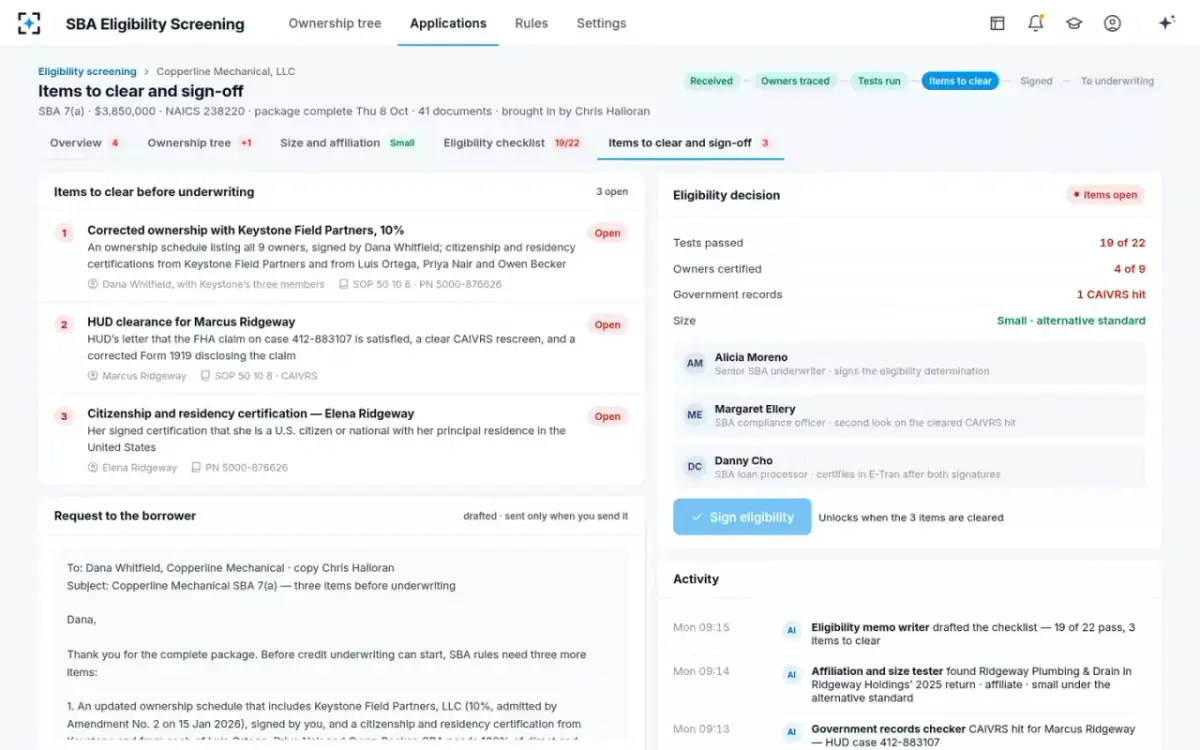
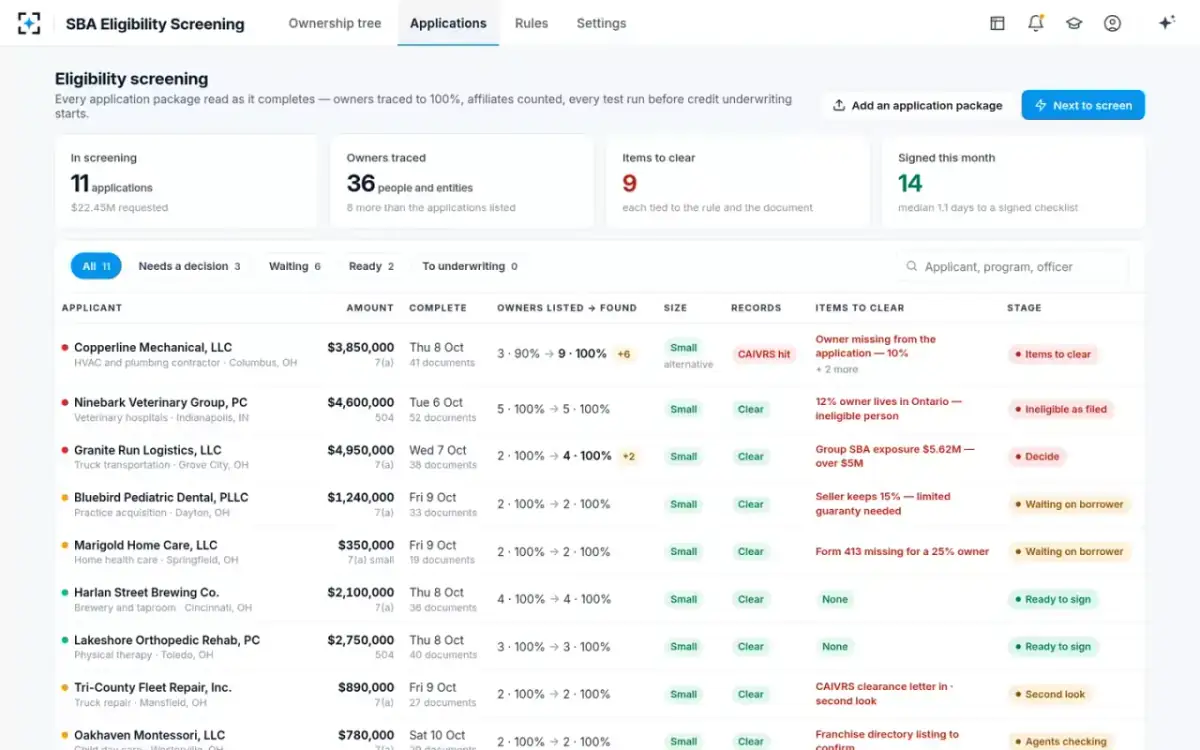
On the sample bank's queue the same test caught a harder case. A veterinary group's application listed its owners correctly at 100%, but one, with 12%, has a principal residence in Ontario. Under the rule in force that makes the application ineligible as filed, whatever the owner's citizenship. The solution flags it and cites the rule; the decision about what to tell the borrower stays with the officer and the business development officer.
Ineligible as filed: a 12% owner who lives in Ontario
The rule changed twice in ten weeks, so the solution keeps each version with its effective date and its trigger, and a file is tested against the version that governs it. SBA's revised Form 1919, which adds owners' citizenship status and date of birth, was still going through public comment in February 2026 (91 FR 8567); until it is approved, the lender attaches the signed certifications. The ownership arithmetic covers how the indirect shares are found, and the signatures on the file cover who certifies the result. The starting point is SBA Eligibility Screening.
Questions people ask
Are dual citizens eligible for SBA loans?
Yes, a naturalized U.S. citizen with dual citizenship is eligible. If the other citizenship is one that would make the transaction ineligible, such as the People's Republic of China, SBA's FAQ says the lender "should confirm that the country of origin no longer regards the individual as a citizen and document this in the loan file."
How many SBA loans had green card owners?
SBA says it approved 3,358 loans in FY2025 to businesses owned in part by a lawful permanent resident, about 4% of its roughly 85,000 approvals. Each of those ownership structures would fail the rule in force since March 1, 2026.
Can a business with a green card owner get an SBA microloan?
No longer. On March 9, 2026 SBA announced it was extending the ban to its Microloan and Surety Bond programs, effective 30 days after publication, so the citizenship rule now reaches all SBA-guaranteed lending.
Does a green card holder's spouse's share count?
Ownership of married spouses and minor children is combined when the lender enters owners in the SBA Loan System. A citizen spouse's share does not cure an ineligible spouse's share; each owner must meet the rule.
What happens to an application that was in process on March 1, 2026?
For delegated loans the rule applied by loan-number date, so a loan numbered on or after March 1 had to meet it. Non-delegated applications with LPR ownership that reached R1 status in E-Tran by 11:59 PM Eastern on February 28 were processed by SBA under the earlier rule.