The SBA eligibility checklist is the list of tests a lender must pass and document before an SBA 7(a) or 504 loan can be made: the business is for-profit, operating and located in the U.S., small with its affiliates, not one of the ineligible business types, owned 100% by U.S. citizens or nationals with a U.S. principal residence, clear of prior federal losses, delinquent federal debt, sanctions and exclusions, unable to get the credit elsewhere, and within SBA's loan limits. It is hard because nearly every test runs person by person and business by business, from documents the application does not contain. Botminds' SBA Eligibility Screening runs the checklist with six agents that read the package and cite every finding, and keeps every decision with the SBA underwriter who signs.
Examples come from a fictional sample bank screening a fictional HVAC and plumbing contractor, Copperline Mechanical, through the solution. Rules are quoted from SOP 50 10 8.1 and 13 CFR, linked where they appear.
What is on the SBA eligibility checklist?
SBA's checklist has six core requirements and a set of person-by-person checks. The six, as SBA's inspector general listed them from the SOP, are "An operating business, Organized for profit, Located in the U.S., Small under SBA size standards, Not an ineligible business type," and the ownership rules (SBA OIG Report 26-07). Around them sit the checks each owner, guarantor and related business must pass: citizenship and residency, CAIVRS for prior loss and delinquent federal debt, OFAC, SAM.gov exclusions, character, and the loan-level tests of credit elsewhere, use of proceeds and loan limits.
The checklist is not optional and not a formality. SOP 50 10 8.1 says the determination "should be completed and documented by the Lender as early as practicable," and that the applicant "must meet all core requirements at the time of application and throughout loan closing and disbursement" (SOP 50 10 8.1, Section A, Ch. 1). The word that matters is documented. A checklist line without the document behind it is the same line SBA's own screen produced for 73,302 loans that are now flagged for review.
Why the checklist is a document-reading job
19
ineligible business types in 13 CFR 120.110
5
of those types SBA’s own 2023–25 screen checked
100%
of direct and indirect owners entered in the SBA Loan System
20%
ownership line that triggers SAM.gov checks, guaranties and affiliation tests
What none of the agents may decide
The dividing line is simple to state: an agent may establish anything a document can settle, and may decide nothing that needs judgement or an agency's word. In practice each checklist test splits in two. The tracing and matching on the left of the matrix below is where the hours go; the decisions on the right are where the liability sits.
The SBA eligibility checklist in SBA Eligibility Screening: what agents establish, what an officer decides
Every direct and indirect owner, to 100%
Agents establishReads the operating agreement, every amendment, the owner entities’ agreements and K-1s; multiplies through to indirect shares
The officer decidesAccepts the traced schedule, or asks the borrower to explain a gap the documents leave
Citizenship and principal residence
Agents establishMatches each owner’s certification, ID and Form 1919 answers; flags anyone without a certification or with a conflicting address
The officer decidesDecides status where documents conflict; never inferred from a name or an address
CAIVRS, OFAC, SAM.gov exclusions
Agents establishRuns each person and business through each list and keeps the evidence
The officer decidesClears a hit only on the agency’s document; second look by compliance
Size with affiliates
Agents establishFinds every business an owner holds in the owners’ own filings, applies the ownership rules, sums receipts or tests the alternative standard
The officer decidesSigns the affiliation conclusion; requests a formal size determination if the case is close
Ineligible business type, passive business, franchise
Agents establishReads business activity, revenue mix, management agreements and the Franchise Directory listing
The officer decidesDecides edge cases: a revenue share near a threshold, a management agreement, an unlisted brand
Character
Agents establishCollects Form 1919 answers and any disclosed record, and flags a mismatch with other documents
The officer decidesMakes the character determination and decides on any continuity plan or added guaranty
Credit elsewhere
Agents establishTests owner liquidity against the request and drafts the reasons from the credit policy
The officer decidesWrites and owns the identifiable weakness in the credit memo
Exceptions and certification
Agents establishPrepares the checklist and the request to the borrower
The officer decidesRequests any exception from SBA, signs the determination, certifies in the SBA Loan System
Three limits carry most of the weight. No agent clears a CAIVRS, OFAC or SAM.gov hit: the hit stands until the issuing agency's document is in the file and a second person has looked at it. No agent infers citizenship: a name, a birthplace on a résumé or a foreign mailing address is a reason to ask, never an answer. And no agent signs or certifies: the underwriter signs the determination, and the processor certifies ownership in the SBA Loan System only after that signature.
The SBA 7(a) eligibility checklist, group by group
The 7(a) eligibility checklist reads best in five groups, because each group draws on different documents. The sample file in the solution runs 22 tests across the five: business, size, ownership, government records and the loan. The table names the groups, the rule each rests on and the document that settles it.
The SBA 7(a) eligibility checklist in five groups, with the rule and the document for each
| Group | Tests | Rule | Settled by |
|---|---|---|---|
| Business | For-profit; organized and operating in the U.S.; not an ineligible type; NAICS matches the activity; franchise on the Directory if it is one | 13 CFR 120.100, 120.110; SOP Ch. 1 Paras A–E, G | Articles, operating agreement, tax return’s business activity, franchise agreement |
| Size | Small under the industry standard with affiliates, or under the alternative standard; affiliates identified; group SBA exposure within limits | 13 CFR 121.301; SOP Ch. 1 Para D | Returns of the applicant and every affiliate; balance sheets |
| Ownership | 100% traced; citizenship and residency for every owner and required guarantor; six-month look-back; no minor owning 20% or more; trusts; guaranties from 20% owners | SOP Ch. 1 Para F; Appendix 3 | Entity documents to the last person; certifications; ID |
| Government records | CAIVRS prior loss and delinquent federal debt; OFAC; SAM.gov exclusions; no existing SBA loan over 29 days past due | 13 CFR 120.110(q); 31 CFR 285.13; SOP Ch. 1 Paras E, J; Ch. 4 Para B | Screens, saved with date and the names searched |
| Loan | Credit not available elsewhere; eligible use of proceeds; loan and guaranty within program limits; owner occupancy for real estate | 13 CFR 120.101; SOP Ch. 1 Para H | Credit memo; owner liquidity; use-of-proceeds schedule |
Two of the lines are newer than most checklists in circulation. The trust rule arrived with SOP 50 10 8.1: when trusts own 20% or more in aggregate, "each trust must provide an unlimited full guaranty," the trustor must guarantee too, and "All donors to the trust will be deemed to have Trustor status for eligibility purposes" (SBA Information Notice 5000-882227). The citizenship rule changed twice in three months, and the March 1, 2026 line for green card holders is now the one that applies.
Can software check SBA eligibility?
Software can gather and test almost all the evidence; it cannot own the conclusion, and SBA's own experience shows what happens when it tries without full coverage. From August 2023, SBA determined eligibility itself through a framework "using technology for real time validation of applicant data," drawing on "Treasury's Do Not Pay list, an online data compilation and analytics provider's evaluation of businesses and principals, and the business' credit" (SBA OIG Report 26-07). It did not screen for-profit status or size at all, and for business type it screened five of the 19, because, SBA told OIG, "the agency did not have all the data available electronically."
That last sentence is the design lesson. The data a size test needs is in the affiliates' tax returns, not in a database; the data an ownership test needs is in an amendment to an operating agreement, not in a credit bureau. A tool that reads only structured feeds will always leave those tests unrun. A tool that reads the package can run them, and must then show its work, which is why every line on the solution's checklist carries the rule and the source page.
SBA’s screen skipped size and business type because the data was not available electronically. It was available: in the package, on paper.
What is a character determination?
A character determination is the lender's judgement on whether an associate's criminal history makes the applicant ineligible or needs conditions. The bright lines are in 13 CFR 120.110(n): a business is ineligible if an associate "is currently incarcerated, serving a sentence of imprisonment imposed upon adjudication of guilty, or is under indictment for a felony or any crime involving or relating to financial misconduct or a false statement" (13 CFR 120.110).
Between the lines sits judgement. An owner on parole or probation may be eligible, but if the business depends on that person, "the Applicant must provide to the SBA Lender a plan for the continued operations of the business in the event of reincarceration," and the lender should consider requiring another guaranty (SOP 50 10 8.1, Section A, Ch. 1, Para E). That is a credit judgement about a person, and no agent should make it. What an agent can do is make sure the question is asked of every associate, that the Form 1919 answers are compared with any record in the file, and that a "No" that conflicts with another document is flagged. A false "no" is not hypothetical: a Kansas borrower who answered "no" to the legal-actions question while his company was a defendant got a $3.6 million 7(a) loan that cost SBA $2,173,766 when it defaulted (FDIC OIG, reproducing the Justice Department's release).
Is a brand not on the Franchise Directory eligible?
No, if the brand meets the FTC's definition of a franchise. SOP 50 10 8.1 is direct: "If the Applicant's brand meets the FTC definition of a franchise, it must be on the Directory in order to obtain SBA financing." The Directory came back with SOP 50 10 8, whose notice described "reinstituting the SBA Franchise Directory with streamlined procedures" (SBA Information Notice 5000-866746).
The judgement is in the first clause. A license, dealer or jobber agreement is not called a franchise, but SBA will treat it as one if it meets the FTC definition, so the officer has to read the agreement, not the label. The same reading answers the passive-business question. The 2023 affiliation rule removed control as a source of affiliation, but SBA still requires lenders to review management agreements for whether they give someone else "the sole discretion to manage the operations of the business," which "would cause the Applicant to be an ineligible passive business." The permitted structure is the Eligible Passive Company that holds property for an Operating Company; both are searched in SAM.gov, and the Operating Company guarantees.
Which SBA ineligible businesses a document can settle, and which need a person
Most of the 19 ineligible types can be settled from the package; a few need a person every time. A non-profit, a bank, a life insurer, or a business in which the SBA lender or one of its associates holds equity is visible in the entity documents. A packager earning more than a third of its revenue from SBA loans, a business earning more than 5% of gross revenue from prurient material, or one earning over 50% from lobbying is visible in the revenue breakdown, if someone asks for it.
The judgement cases are the ones with no threshold: whether an activity is speculative, whether a business is "primarily engaged" in lending or investment, whether a mixed-revenue business crosses a line in the year that matters. The checklist's job there is not to decide but to put the evidence and the rule side by side so that the officer decides once, in writing. SBA's own reviews of two lenders found 20 eligibility deficiencies over 18 reviews, including passive-business rules not met (SBA OIG Report 26-14); the pattern is not ignorance of the list, it is a file that does not show the test was run.
Before you sign the SBA eligibility checklist: eight things to see in the file
- An ownership schedule that adds to exactly 100%
Built from entity documents, with indirect shares multiplied through; the application’s own list is a claim, not evidence.
- A citizenship and residency certification for every owner and required guarantor
Including owners of owners; a limited guaranty from an ineligible person is the only exception.
- CAIVRS screens for the applicant, guarantors and associates
With any hit cleared by the agency’s letter, and a corrected Form 1919 where an answer was wrong.
- SAM.gov exclusion evidence for each required party
A screenshot or equivalent for the applicant, 20% owners, officers, directors, key employees and entity owners.
- An OFAC result at the time of application
For the business and its owners, with any potential match investigated and recorded.
- A size test that names every affiliate and its source
The return or agreement behind each related business, and the standard applied.
- The business-type and franchise conclusions in writing
With the revenue split or agreement that supports them.
- Credit elsewhere in the credit memo
Owner liquidity for 20% owners and the identifiable weakness; never a credit-score policy alone.
The checklist as evidence: one line per test, with the rule and the page
A checklist earns its keep at guaranty purchase, years after it was signed. The solution writes it the way a purchase reviewer reads: one line per test, the result, the rule cited and a link to the page it rests on. In the sample file the agents ran 22 tests; nineteen pass; three are to clear before credit underwriting starts.
SBA Eligibility Screening's checklist: each test with its result, rule and source
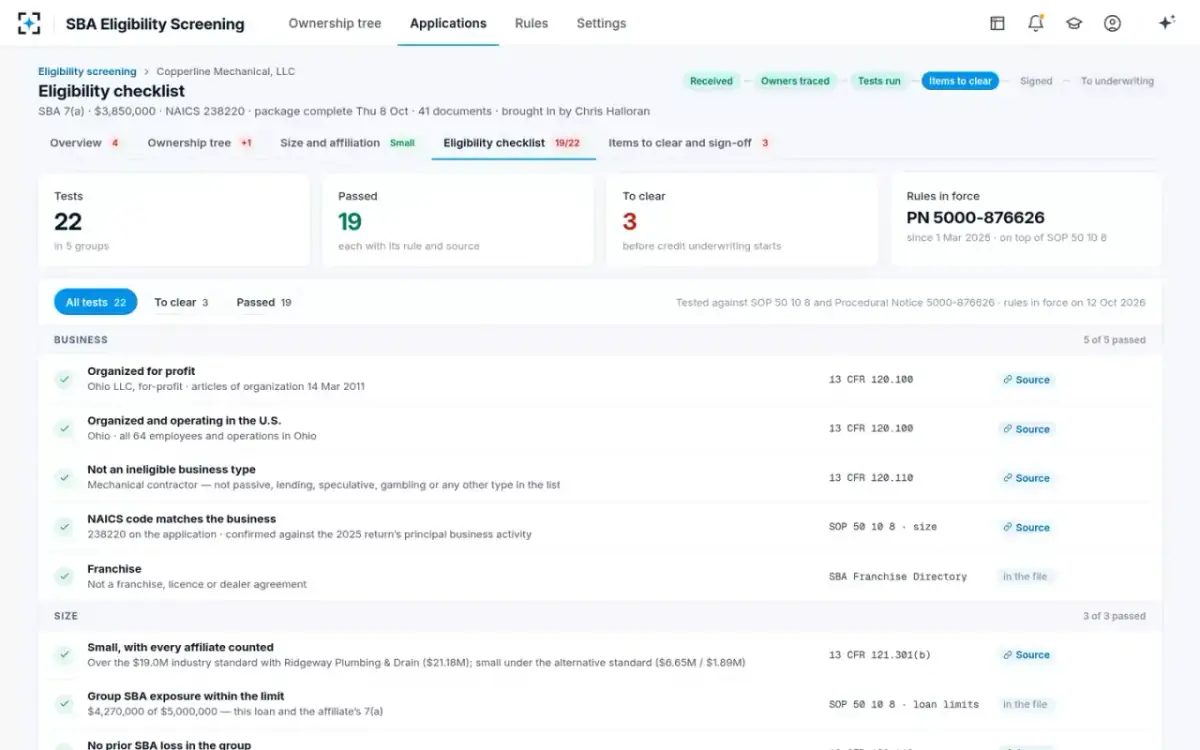
The three open items show where the checklist earns its time. One was an owner the application left out: a 10% member admitted by an amendment to the operating agreement. One was a HUD claim in CAIVRS on a guarantor whose Form 1919 said he had no federal debt. One was a missing citizenship certification for an indirect owner. None needed the officer's judgement to find; each needed it to resolve.
How SBA Eligibility Screening runs the checklist on one file
Six agents divide the checklist by the documents they read, then hand the officer one list. The order matters: ownership first, because citizenship, CAIVRS, SAM.gov, guaranties and affiliation all depend on knowing who the owners are.
One application through the SBA eligibility checklist
Agent
Entity document readerTraces ownership to 100% and reports every owner the application leaves out, with the document and page.
Never: Assumes a percentage.
Agent
Affiliation and size testerTests every business an owner holds for affiliation, then the industry and alternative size standards and the group’s SBA exposure.
Never: Changes the application’s NAICS code without flagging it.
Agent
Ownership and citizenship verifier, government records checkerCertifications, Forms 1919 and 413; CAIVRS, OFAC and SAM.gov exclusions for each person and business.
Never: Clears a hit without the agency’s clearance.
Agent
Program rules checkerIneligible business types, use of proceeds, owner occupancy, credit elsewhere, franchise and loan limits.
Never: Waives a rule.
Agent
Eligibility memo writerThe checklist, the items to clear and the request to the borrower.
Never: Signs or certifies.
A person decides
SBA underwriterResolves the open items, makes the judgement calls and signs the determination.
One owner's tests: two failures that trace to one federal debt
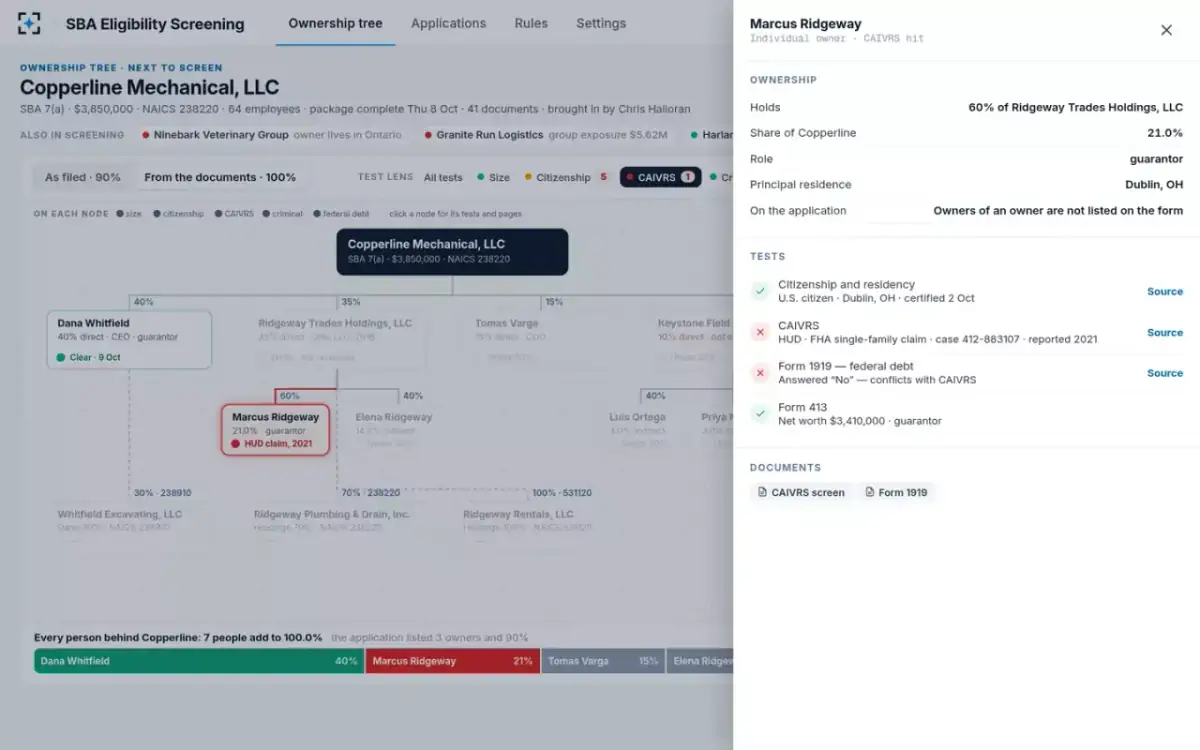
The agents' speed is not the point, though on the sample data six of them read 41 documents and ran the 22 tests in 71 seconds. The point is that the officer starts from a complete list rather than an empty one. The design target is a signed checklist within one day of a complete package. The affiliation decision tree and the government-records stack behind the screens go deeper on the two groups that take longest by hand, and the signatures on the file show what happens after the checklist. To see it run, start from SBA Eligibility Screening.
Questions people ask
Is there an official SBA eligibility checklist form?
SBA does not prescribe one checklist form for 7(a) lenders; the requirements are in SOP 50 10 8.1 and 13 CFR, and lenders build their own checklists from them. The SBA Loan System collects the ownership and certification data, and the lender keeps the signed Form 1919 and the evidence in its file.
What are SBA ineligible businesses?
The 19 types listed in 13 CFR 120.110, among them non-profits, lenders and investment businesses, passive businesses, speculative businesses, loan packagers earning over a third of revenue from packaging, businesses with an incarcerated or indicted associate, and businesses with a prior loss to the government. Some carry thresholds set in the SOP, such as 5% of gross revenue for prurient material and 50% for lobbying.
Who must sign a Form 1919?
The applicant business and its required individuals, commonly 20% owners, officers, directors and key employees. Only the form's information goes into the SBA Loan System; SOP 50 10 8.1 says the lender "must obtain and retain the signed form in its file."
What eligibility decisions must a person make?
Clearing any government-record hit, the character determination, borderline business-type and passive-business calls, the affiliation conclusion, the credit-elsewhere reasons and any request for an exception to policy. The signature on the determination is always a person's.
Can a minor own part of an SBA borrower?
Not 20% or more. SOP 50 10 8.1 says SBA "prohibits businesses where a minor child owns 20% or more of the business because minors are legally prohibited from providing a guaranty," and a minor's share is combined with the parents' when testing ownership.