SBA's ownership percentage requirements start with a sum: the lender "must list in the SBA Loan System 100% of the total direct and indirect ownership of the Applicant," and "The ownership percentages of all listed owners must equal 100%." Then the percentages decide the tests: every owner at any percentage must be a U.S. citizen or national living in the U.S., owners of 20% or more are searched in SAM.gov, give financial statements and guarantee the loan, and a majority stake or a 20% stake in the same industry creates affiliation. An application that adds to 90% has not missed 10% of the paperwork; it has missed an owner, and every test that owner should have faced. Botminds' SBA Eligibility Screening exists to close that gap: its agents read the operating agreement, every amendment and the owner entities' own agreements and multiply through to indirect percentages until every branch ends in a person, then put each person through the tests their share triggers.
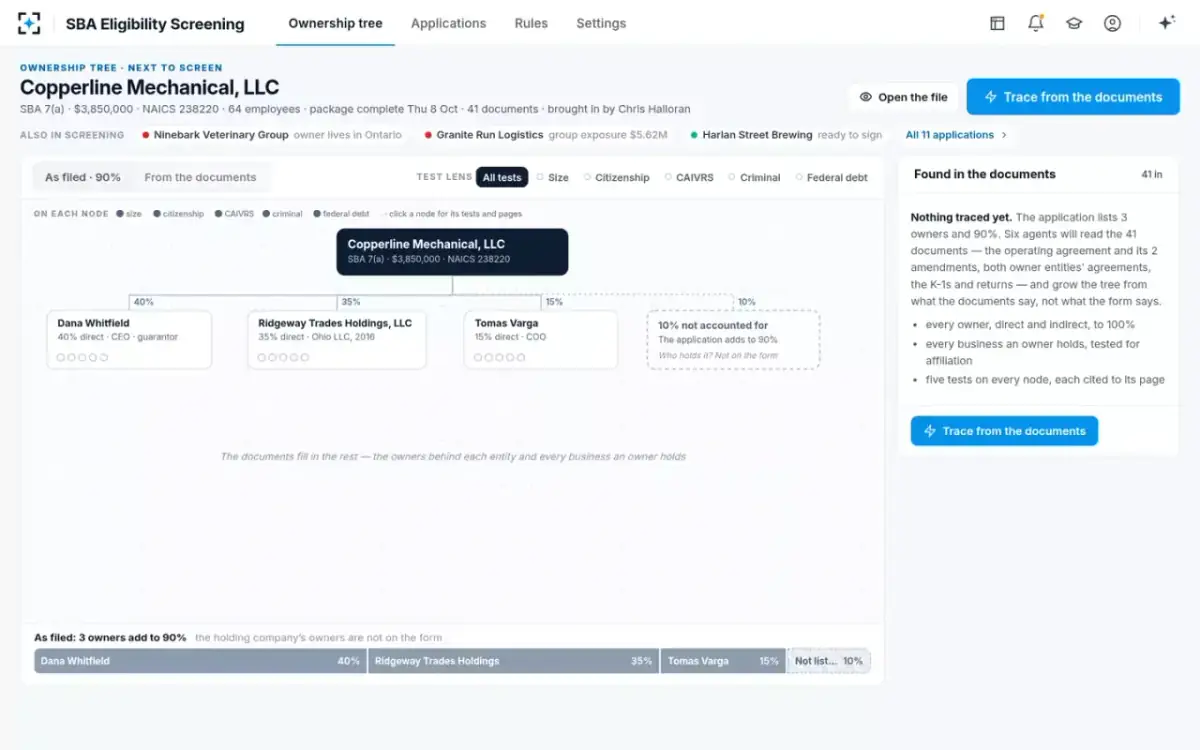
The worked file is fictional sample data in the solution: an HVAC and plumbing contractor whose application listed three owners at 90%.
SBA ownership percentage requirements in one file: 90% as filed, 100% from the documents
Dana Whitfieldon the application
ThroughDirect
Arithmetic40%
Share40.0%
Tomas Vargaon the application
ThroughDirect
Arithmetic15%
Share15.0%
Marcus Ridgewaynot on the application
ThroughRidgeway Trades Holdings (35% of applicant)
Arithmetic60% × 35%
Share21.0%
Elena Ridgewaynot on the application
ThroughRidgeway Trades Holdings (35% of applicant)
Arithmetic40% × 35%
Share14.0%
Luis Orteganot on the application
ThroughKeystone Field Partners (10% of applicant)
Arithmetic40% × 10%
Share4.0%
Priya Nairnot on the application
ThroughKeystone Field Partners (10% of applicant)
Arithmetic30% × 10%
Share3.0%
Owen Beckernot on the application
ThroughKeystone Field Partners (10% of applicant)
Arithmetic30% × 10%
Share3.0%
Seven people
As filed: 90.0% across three direct owners
100.0%
Do SBA owners have to add up to 100%?
Yes. SOP 50 10 8.1 says "The SBA Lender must enter into the SBA Loan System 100% of the Applicant's direct and indirect owners, which includes entity and individual owners with direct or indirect ownership," and in the application chapter, "The ownership percentages of all listed owners must equal 100%" (SOP 50 10 8.1, Section A, Ch. 1, Para F and Section B). The lender also certifies that, to the best of its knowledge, none of those owners is an ineligible person.
The 100% rule works at two levels, and both must close. The direct owners of the applicant, people and entities, must add to 100%: in the sample file that is Dana Whitfield, the holding company, Tomas Varga and the partnership that came in by amendment. And each entity owner must in turn be traced to the people behind it, so the people add to 100% as well. A file can close at the first level and still be open at the second, which is where most missing owners hide.
The four numbers in SBA ownership
100%
of direct and indirect owners entered, adding to exactly 100%
20%
line for SAM.gov searches, owner financial statements, guaranties and affiliation tests
50%
majority stake that creates affiliation either way
6 months
look-back for ineligible owners before the loan number
How is indirect ownership calculated for SBA?
By multiplying each owner's share in an entity by the entity's share in the applicant, layer by layer, and adding any direct stake. The SOP's example: "Jane Doe owns 15 percent of the Applicant, and she also owns 100 percent of Jane Doe, Inc. Jane Doe, Inc. owns 50 percent of the Applicant. SBA considers Jane Doe to own 65 percent of the Applicant." Spouses' and minor children's interests are combined before any threshold is tested.
The arithmetic is easy; the inputs are the problem. The multiplication needs each entity owner's own ownership, and the SBA application asks who owns the applicant, not who owns its owners. In the sample file, the holding company's Schedule A showed a 60/40 split between two siblings, which made one of them a 21% indirect owner, over the 20% line, and a guarantor. Neither appeared on the application. The application had not lied; it had answered the question it asked.
The application asks who owns the applicant. SBA asks who owns everything that owns the applicant.
What each SBA ownership line triggers
The percentage an owner holds decides which tests that owner faces. Below 20% the owner still faces the citizenship test and the look-back; at 20% the owner joins the group that is searched, examined and asked to guarantee; above 50% affiliation follows without any industry test.
SBA ownership percentage requirements: the tests at each line
| Owner’s share | What it triggers | Rule |
|---|---|---|
| Any share, direct or indirect | Entered in the SBA Loan System; U.S. citizen or national with a U.S. principal residence; six-month look-back; entity owners organized in the U.S. | SOP Ch. 1, Para F |
| Any share (with spouse and minor children combined) | Counted together; a minor child may not own 20% or more | SOP Ch. 1, Para F |
| 20% or more | SAM.gov exclusion search; personal financial statement (Form 413 or equivalent within 90 days); liquidity tested for credit elsewhere; guaranty | SOP Ch. 1, Para H; Ch. 4, Para B; Section B |
| 20% or more, held by trusts in aggregate | Each trust gives an unlimited full guaranty; the trustor guarantees too; donors are treated as trustors | SOP 50 10 8.1 (IN 5000-882227) |
| 20% or more, no majority owner | Affiliation if the owner is in, or owns over half of a business in, the applicant’s 3-digit NAICS subsector | SOP Ch. 1, Para D |
| 20% or more, held by a non-profit | Must guarantee, or the applicant is not eligible | SOP Ch. 1 |
| More than 50% | Affiliation with the owner, or with the business owned | SOP Ch. 1, Para D |
| Under 20% of a business with a prior SBA loss | May qualify for SBA’s non-controlling minority investor waiver | SOP Ch. 1, Para E (PN 5000-879464) |
Who has to guarantee an SBA loan?
Owners of 20% or more, as the SOP's guaranty rules require, and since October 2026 trusts that together own 20% or more, their trustors and, in effect, their donors. SBA's notice issuing the technical update says: "When one or more trusts (revocable or irrevocable) own, in the aggregate, 20% or more of the applicant, each trust must provide an unlimited full guaranty," "the Trustor must also personally guarantee the loan," and "All donors to the trust will be deemed to have Trustor status for eligibility purposes" (SBA Information Notice 5000-882227).
The guaranty question and the percentage question are the same question. An owner traced to 21% must guarantee; one traced to 19.9% need not, unless the lender requires it. That is why the indirect arithmetic cannot be rounded or estimated, and why a schedule that stops at the holding company is not a schedule. A guarantor who is required by SBA must also pass the citizenship test; only a limited or supplemental guarantor may be an otherwise ineligible person.
How are trusts treated under SOP 50 10 8.1?
As owners whose people must be found. A trust owning part of the applicant is an entity owner like any other, so its share goes into the SBA Loan System and the people behind it face the citizenship test; and if the living trustor is part of the ownership, SAM.gov must be searched for the "Living Trustor (if the Applicant business is owned by a trust)." The 8.1 change adds the guaranty layer: at 20% in aggregate, each trust guarantees, the trustor guarantees, and every donor is treated as a trustor for eligibility, which brings a donor's citizenship and record into the file.
For the person tracing ownership, that means a trust document is not a dead end. The trust agreement names the trustor and the trustee, and the gift history names the donors. A file that lists "Family Trust, 25%" and stops is open on every one of those people.
What is a straw owner?
A straw owner is a person named as an owner who has no real ownership interest, used to hide who actually owns or controls the borrower. The SBA cases are specific. In a hotel-flipping scheme prosecuted in Maryland, conspirators "created shell companies using co-conspirators as straw owners of the entities. These straw owners had no actual ownership interest in the entities," and misrepresented "the sellers' identity, familial relationships between parties, and the nature and amount of the equity injected" to obtain more than $35 million in SBA loans to buy hotels (U.S. Attorney, District of Maryland). The ringleader was sentenced to seven years (District of Maryland).
The other direction is hidden owners. A bank chief executive was sentenced in 2022 for taking bribes on SBA loans, where SBA rules "prohibited banks from extending such loans to any institution in which a bank officer held an interest," and he held such interests (U.S. Attorney, Southern District of New York). Neither scheme is caught by arithmetic alone, but both are harder to run against a lender that builds the ownership tree from operating agreements, amendments and returns and asks why the documents and the application disagree.
Can a lender use FinCEN BOI data to verify owners?
Not for U.S. owners. FinCEN's August 2026 final rule continues "to exempt reporting companies from having to report the BOI of U.S. person beneficial owners" (91 FR 52508), so there is no federal register of domestic owners to check. The bank's own customer due diligence record does not fill the gap either: it identifies individuals owning 25% or more, and since February 2026 banks may limit that identification to the customer's first account (FinCEN order FIN-2026-R001).
For an SBA file that leaves one source: the applicant's own entity documents, read to the last person. The ownership tree has to be built from the operating agreement and its amendments, each entity owner's agreement or schedule, and the K-1s that show who is actually paid as an owner. The K-1s are the cross-check, because a person receiving a share of profits who appears nowhere else is a question to ask.
As filed: three owners and a dashed node for the missing 10%
Why owners go missing between the application and the documents
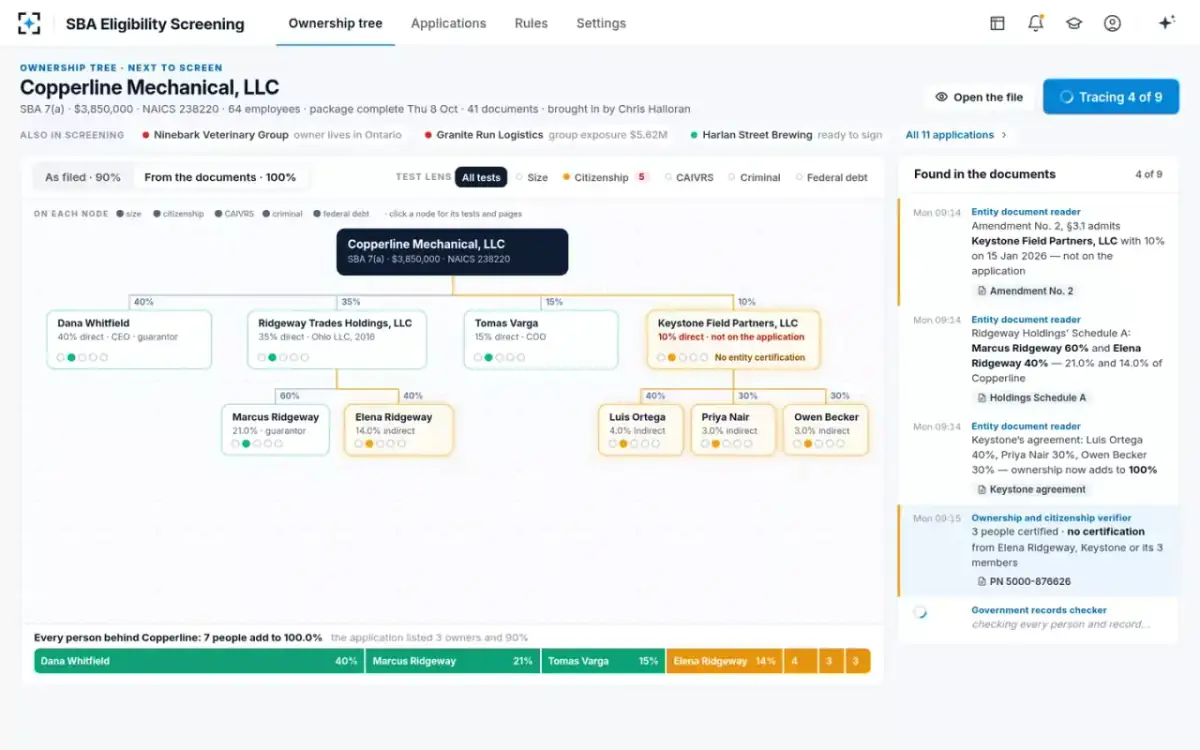
Owners go missing in predictable places, and each has a document that finds them. A member admitted by amendment after the business last updated its paperwork is in the amendment. The owners of a holding company are in its schedule or its own agreement. A spouse's interest is in the operating agreement or the K-1s. A trust's people are in the trust document. In the sample file the missing 10% came from an amendment, signed in January 2026, admitting a three-person partnership.
Owners the applications listed, and owners the documents named
Missing owners also explain a pattern in SBA's own reviews. When SBA cleared affiliation error codes from 2023 to 2024, 22 of the 62 unsupported files had "matters related to ownership percentage" without documents that "validated the percentage" (SBA OIG Report 26-07). The affiliation decision tree depends on these percentages, and so does the citizenship line for every owner.
Tracing from the documents: each owner found, with its page
Tracing SBA ownership to 100%: where to look
- The operating agreement and every amendment
Members admitted, transferred or redeemed since the original; the application may predate them.
- Each entity owner’s own agreement or schedule
Until every branch ends in a person.
- K-1s from the applicant and from entity owners
Who is paid as an owner; a stranger on a K-1 is a question.
- Trust agreements
Trustor, trustee and donors, all of whom now matter at 20% in aggregate.
- Options, convertible notes and merger agreements
SBA treats them as exercised for affiliation.
- The six months before the loan number
Any owner in that window who is an ineligible person must have divested completely.
- Spouses and minor children
Combined before testing any line; a minor at 20% or more is prohibited.
- The total, at both levels
Direct owners to 100%, and people to 100%; round nothing until the end.
How SBA Eligibility Screening traces owners to 100%
The entity document reader reads the operating agreement and every amendment, the owner entities' agreements and the K-1s, and multiplies through to indirect percentages until every branch ends in a person. It compares the result with the ownership the application declares and reports each owner left out, with the document and page. It never adds an owner without a document, and never assumes a percentage. When the documents disagree, it says so and leaves the answer to the officer.
From the documents: nine owners, seven people, 100%
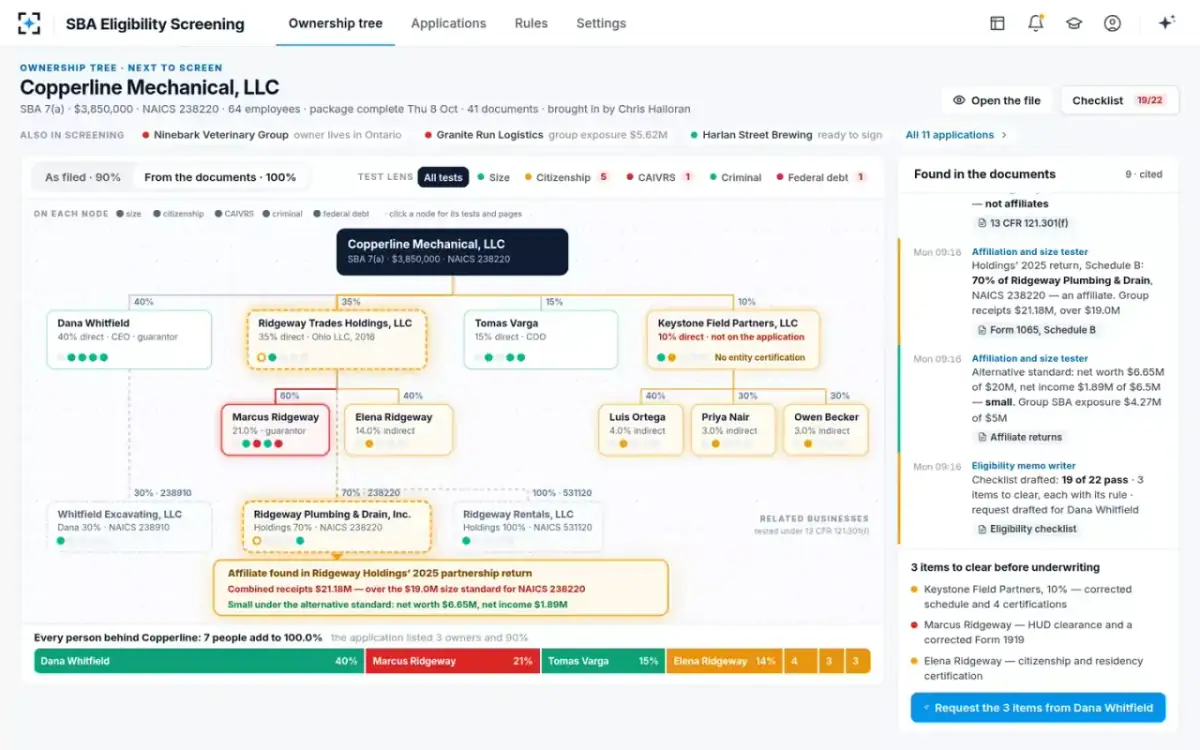
Once the tree closes, the percentages drive everything else: the citizenship verifier asks every node for its certification, the government records checker searches the 20% owners in SAM.gov and runs CAIVRS, and the affiliation tester follows each 20% owner's other businesses. The officer receives one request for the borrower naming what is missing, and decides what the answers mean. To trace your own files, start from SBA Eligibility Screening.
Questions people ask
Do I have to list owners under 20% in E-Tran?
Yes. SOP 50 10 8.1 requires 100% of direct and indirect owners in the SBA Loan System, which replaced E-Tran as the SOP's term, whatever their share. The 20% line changes which further tests apply, not whether the owner is listed.
What if the percentages do not add to 100%?
The file is not ready to submit: the SOP requires the listed percentages to equal 100%. A gap usually means an owner is missing, often one admitted by amendment or one behind an entity owner, and the fix is to trace and document that owner, not to adjust the numbers.
Do employee stock options count as ownership?
For affiliation SBA gives options, convertible securities and agreements to merge "present effect," treating them as exercised unless they are speculative or remote. A lender should test whether an option holder's would-be stake changes any line, especially 20% and 50%.
Can an owner reduce their share to avoid a guaranty?
SBA does not give present effect to an ability to divest to avoid affiliation, and the six-month look-back reaches owners who leave shortly before the loan number when they are ineligible persons. A genuine, documented transfer before the loan number changes the percentages; a paper transfer to a relative or a nominee is the straw-owner pattern prosecutors look for.
How many owners does a typical SBA applicant have?
No public SBA figure exists. In the fictional sample bank's queue of eleven applications, the documents named 36 people and entities against 28 on the applications, which is the gap the 100% rule is designed to close.