The SBA affiliation rules decide which other businesses count when an SBA loan applicant is measured against its size standard, and since SBA's 2023 rule they turn on ownership alone. Two businesses are affiliates when one owns more than 50% of the other, when a majority owner of the applicant also owns more than 50% of a business in the applicant's 3-digit NAICS subsector, or, where nobody holds a majority, when a 20% owner is itself in that subsector or owns more than 50% of a business that is. Control no longer creates affiliation. The rules are short; applying them is not, because the affiliates sit in the owners' own tax returns and agreements, which the application does not ask for. Botminds' SBA Eligibility Screening applies them to every business an owner holds, cites the document that shows each holding, and sizes the group, so the SBA underwriter signs an affiliation conclusion with its evidence attached.
The worked example is a fictional HVAC and plumbing contractor from the solution's sample data; the rules are quoted from SOP 50 10 8.1 and 13 CFR 121.301.
The SBA affiliation rules for 7(a) and 504 loans, as six questions
1
Does the applicant own more than 50% of another business?
YesThat business is an affiliate.
NoGo on.
2
Does a business own more than 50% of the applicant?
YesThe owner is an affiliate, and so is any other business it owns more than 50% of in the applicant’s 3-digit NAICS subsector.
NoGo on.
3
Does an individual own more than 50% of the applicant?
YesAny other business that person owns more than 50% of, in the same subsector, is an affiliate.
NoNo majority owner: test every 20% owner.
4
Is a 20%-or-more owner a business in the applicant’s subsector?
YesThe owner is an affiliate.
NoGo on.
5
Does a 20%-or-more owner own more than 50% of a business in the same subsector?
YesThat other business is an affiliate.
NoNo affiliation by ownership.
6
Are there options, convertible securities or agreements to merge?
YesTreat them as exercised, unless they are speculative or remote.
NoSize the applicant with every affiliate found.
What are the SBA affiliation rules?
For SBA business loans, the affiliation rules are the ownership tests in 13 CFR 121.301 as SOP 50 10 8.1 applies them, and a short list of present-effect rules for options and merger agreements. SOP 50 10 8.1 states the core test: "When the Applicant does not have an owner that owns more than 50 percent of the Applicant, if an owner of 20 percent or more of the Applicant is a business that operates in the same 3-digit NAICS subsector as the Applicant, the Applicant and the owner are affiliated" (SOP 50 10 8.1, Section A, Ch. 1, Para D). The majority-ownership tests sit beside it, and the decision tree above sets out the order.
Two counting rules decide most close cases. "Ownership interests of spouses and minor children must be combined when determining amount of ownership interest," and indirect ownership is counted pro rata: in the SOP's own example, Jane Doe owns 15% of the applicant directly and 100% of a company that owns another 50%, so "SBA considers Jane Doe to own 65 percent of the Applicant." Once the affiliates are known, the size test counts "the receipts, employees ... or the alternate size standard (if applicable) of the concern whose size is at issue and all of its domestic and foreign affiliates, regardless of whether the affiliates are organized for profit."
The numbers that decide SBA affiliation and size
50%
majority stake that makes two businesses affiliates
20%
owner stake that triggers the same-subsector tests when nobody holds a majority
3-digit
NAICS subsector that defines “same industry” for those tests
62 of 77
unsupported error-code clearances in OIG’s sample that were affiliation
Does control still create affiliation?
No, not for SBA business loans. SBA's final rule on Affiliation and Lending Criteria for the SBA Business Loan Programs, published April 10, 2023 and effective May 11, 2023, "removed the principle of control, both affirmative and negative control, as establishing affiliation between entities" (88 FR 21074, as SOP 50 10 8.1 summarises it). No later rule restored it; SOP 50 10 8 and 8.1 rolled back much of the 2023 lending-criteria changes but kept the ownership-only approach to affiliation.
Control did not disappear from the analysis; it moved. SBA still requires the lender to review franchise, license and management agreements "to determine whether they give someone other than the Applicant the sole discretion to manage the operations of the business, including decision-making over the employees, the finances and the bank accounts of the business, with no involvement by the owner(s) of the Applicant, because this would cause the Applicant to be an ineligible passive business." A management agreement that would once have created affiliation can now make the applicant ineligible outright.
What does and does not create SBA affiliation for a 7(a) or 504 loan
Creates affiliation: More than 50% either way between the applicant and another business
Does not, on its own: A minority stake of 50% or less in an unrelated subsector
Creates affiliation: The owner is a business in the applicant’s 3-digit subsector, or owns more than 50% of one
Does not, on its own: The owner’s other businesses outside the subsector, or stakes of 50% or less in businesses inside it
Creates affiliation: —
Does not, on its own: Affirmative or negative control, since the 2023 rule; but an outside manager with sole discretion makes the applicant an ineligible passive business
Creates affiliation: Given present effect, as if exercised
Does not, on its own: Agreements merely to negotiate, or options that are speculative or extremely remote
Creates affiliation: SBA “will not give present effect” to an ability to divest to avoid affiliation
Does not, on its own: A completed sale, documented by the contract
What is the 20% same-NAICS rule?
It is the test that applies when nobody owns more than half the applicant. An owner of 20% or more is checked twice: if that owner is a business in the applicant's 3-digit NAICS subsector, the owner is an affiliate; and if that owner, whether a person or a business, owns more than 50% of another business in the same subsector, that other business is an affiliate. A 3-digit subsector is broad: 238, specialty trade contractors, holds plumbers, electricians, roofers and excavators alike.
The rule has two thresholds, and both must be met. A 20% owner's 30% stake in a business in the same subsector does not create affiliation, because the second stake is not a majority. A 35% owner's 100% stake in a business in a different subsector does not either. The sample file shows both, and the third case that does.
One sample file through the SBA affiliation rules
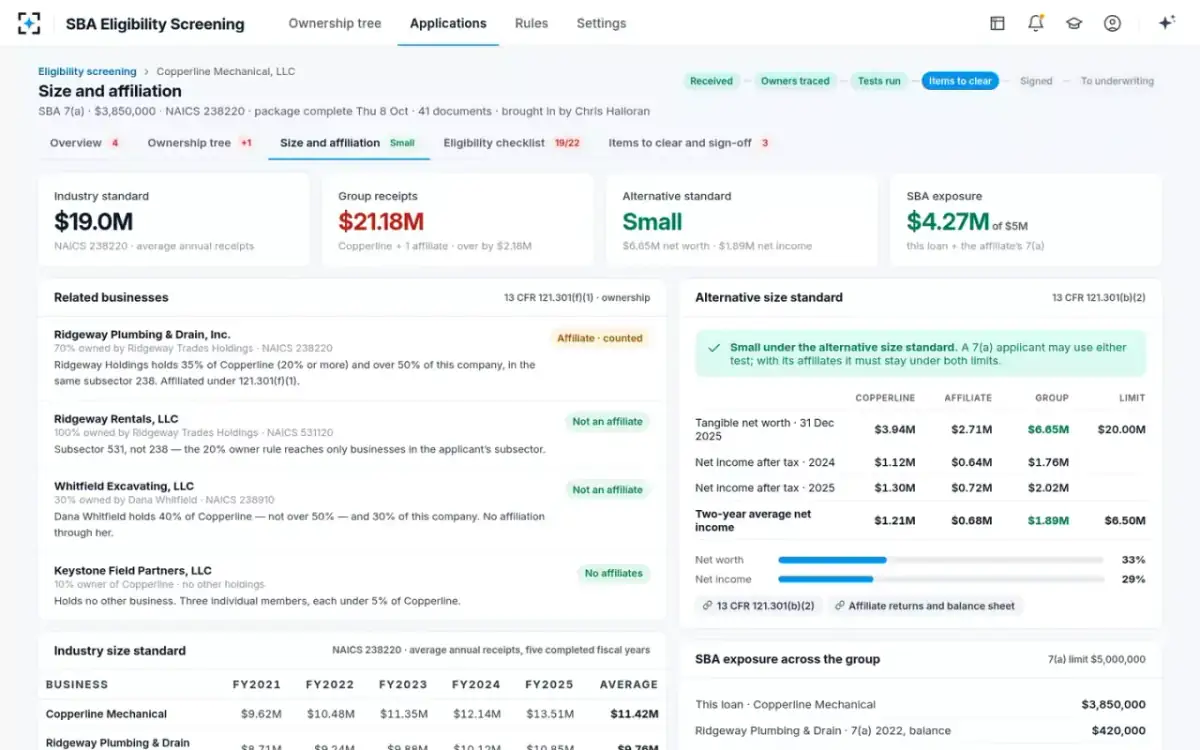
| Related business | Who holds it | Subsector | Result |
|---|---|---|---|
| Ridgeway Plumbing & Drain, Inc. | Ridgeway Trades Holdings owns 70%; Holdings owns 35% of the applicant | 238, the same as the applicant | Affiliate: a 20% owner holds more than 50% of a business in the subsector |
| Ridgeway Rentals, LLC | Ridgeway Trades Holdings owns 100% | 531, real estate | Not an affiliate: different subsector |
| Whitfield Excavating, LLC | Dana Whitfield owns 30%; she owns 40% of the applicant | 238 | Not an affiliate: her stake is not over 50% |
| Keystone Field Partners, LLC | A 10% owner of the applicant, with no other holdings | — | Not tested: under 20% and holds nothing else |
How does SBA calculate affiliation and size together?
Once affiliates are identified, the lender sizes the group two ways and the applicant needs to pass one. Under the industry standard, "The Applicant alone (without affiliates) must not exceed the small business size standard for the industry in which the Applicant is primarily engaged," and with its affiliates must not exceed the standard for the applicant's primary industry or the group's, "whichever is higher," with receipts calculated "based on Federal tax returns." Under the alternative size standard, the applicant with its affiliates must have tangible net worth of no more than $20 million and average net income after federal income taxes, excluding carry-over losses, of no more than $6.5 million for the two full fiscal years before the application (13 CFR 121.301).
In the sample file the affiliate tipped the group over its industry standard: combined receipts of $21.18 million against the $19.0 million standard the solution applied for NAICS 238220. The alternative standard then ran on the group: tangible net worth of $6.65 million and two-year average net income of $1.89 million, both well under the limits, so the applicant is small. A 7(a) applicant may use either test; with its affiliates it must stay under both limits of whichever it uses.
SBA Eligibility Screening's size and affiliation view: every related business, its rule and the figures
How is size measured for a PLP loan?
On the date the lender approves the loan. SOP 50 10 8.1 says that for applications under a lender's delegated authority, PLP, SBA Express and the others, "the size of the small business is determined as of the date of approval of the loan by the SBA Lender," and "subsequent increases in size will not affect eligibility." For non-delegated loans size is fixed when SBA accepts the application. For a change of ownership, "the combined size of the Applicant and the acquired business must meet applicable size standards."
Three further rules catch lenders out. The standards rise by 25% when the applicant agrees to use all the money in a labor surplus area designated by the Department of Labor. A lender under delegated authority "may accept as true the size information provided by an Applicant, unless credible evidence to the contrary is apparent," which makes a partnership return in the package listing an affiliate exactly the kind of evidence it cannot ignore. And size standards themselves are under review: SBA proposed new standards for 338 industries in August 2026 (Federal Register, August 20, 2026); a proposed standard is not a rule, and a file is tested against the table in force.
Where SBA's own affiliation reviews went wrong
Affiliation is the eligibility test most often cleared without evidence. When SBA ran eligibility itself from 2023, its framework raised error code 803, "Additional Business Affiliation," and SBA cleared it on the lender's credit memo. OIG reviewed 62 such clearances and found that "the files did not include source documentation to support the affiliation or size analysis" (SBA OIG Report 26-07).
Why 62 affiliation clearances could not be supported
Every bar is a missing document. The largest, ownership percentage, is the pro rata arithmetic of the SBA ownership percentage requirements, done without the agreements behind it. The size bar is affiliates' receipts with no returns. The sold-business bar matters because SBA "will not give present effect" to an ability to divest, so a divested affiliate needs the sale contract to drop out of the group. Those loans are now flagged for review at guaranty purchase, and the replay of 2023–2025 files starts with them.
How do you count indirect ownership for affiliation?
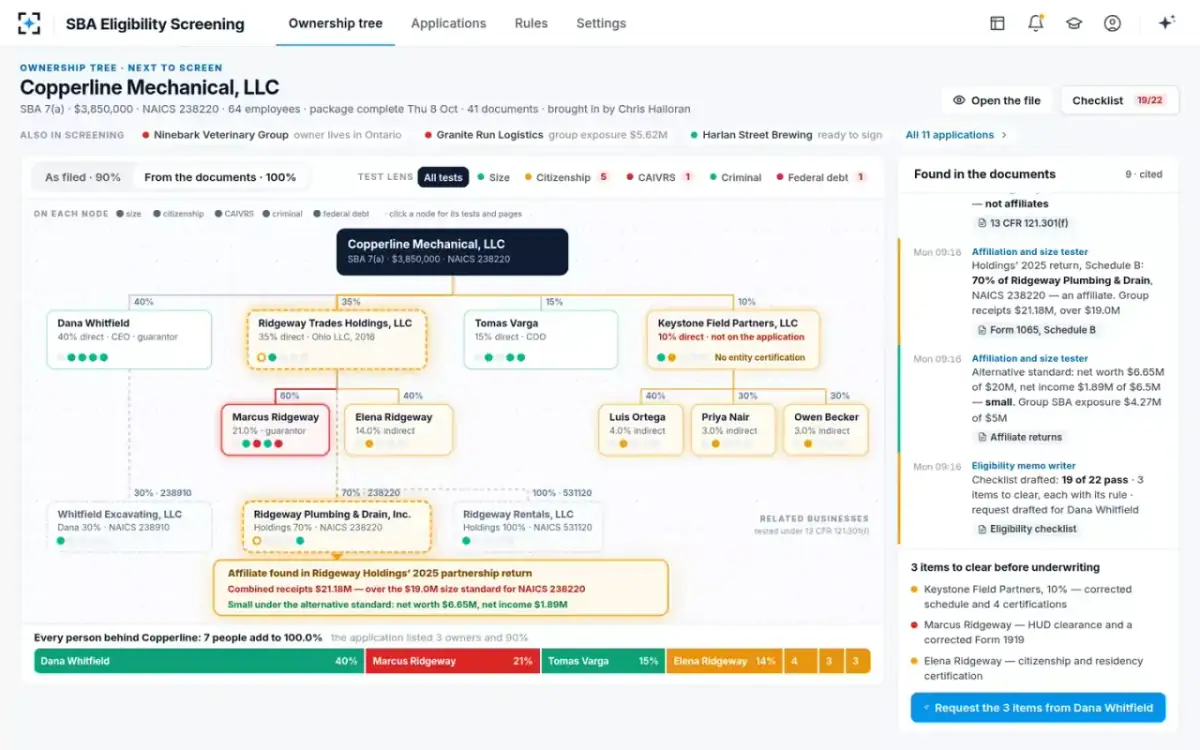
Multiply through each layer and add the paths. A person who owns 60% of a holding company that owns 35% of the applicant holds 21% of the applicant indirectly; if she also owns 5% directly, she holds 26%. The SOP's Jane Doe example does the same with a 100% holding company. The same arithmetic tells you whether an indirect owner crosses the 20% line that triggers the same-subsector tests, the SAM.gov search and a personal guaranty.
The trap is in what the multiplication needs: the holding company's own agreement, showing who owns it. The application asks who owns the applicant, not who owns the owners. In the sample file the holding company's schedule showed a 60/40 split between two people, making them 21% and 14% indirect owners; the first is over the 20% line, so his other businesses had to be checked for affiliation too.
The ownership tree with every related business tested
What an SBA affiliation conclusion needs in the file
- Every owner’s holdings, from their own filings
Partnership returns, K-1s, personal financial statements; not the borrower’s answer to a question.
- The NAICS code of each related business, with its source
The 3-digit subsector decides the 20% tests.
- The pro rata ownership arithmetic, through every entity
Spouses and minor children combined.
- A written conclusion for each related business
Affiliate or not, and which rule.
- The sale contract for any business sold
An ability to divest does not count; a completed sale does.
- Each affiliate’s returns behind the size figures
Receipts for the industry standard; net worth and net income for the alternative.
- Any option, convertible or merger agreement
Treated as exercised unless remote.
- Management agreements reviewed for passive-business risk
Control is no longer affiliation, but it can still make the applicant ineligible.
How SBA Eligibility Screening finds affiliates nobody was asked about
The solution's affiliation and size tester works from the ownership tree the entity document reader builds, so every owner, direct or indirect, is a starting point. Every business an owner holds becomes a node on the tree, found in the owners' own filings, and is tested under the ownership rules; each node carries its conclusion and its source. Then the tester runs the industry standard, the alternative standard if needed, and the group's SBA exposure across affiliates' existing SBA loans.
The agent has two limits worth knowing. It never changes the NAICS code on the application without flagging it, because a code chosen to fit a standard is a finding, not a fix. And it says why each related business is or is not an affiliate, so the officer can disagree with a reason in hand. The affiliation conclusion, and any request to SBA for a formal size determination in a close case, stay with the officer. To run it on your own files, start from SBA Eligibility Screening.
Questions people ask
What is the SBA alternative size standard?
An applicant, with its affiliates, is small under the alternative standard if its tangible net worth is no more than $20 million and its average net income after federal income taxes, excluding carry-over losses, for the two full fiscal years before the application is no more than $6.5 million. A 7(a) or 504 applicant may qualify under this or its industry standard.
Are SBA loan affiliation rules the same as PPP or contracting rules?
No. The ownership-only tests in SOP 50 10 8.1 apply to SBA's business loan, disaster loan and surety bond programs since the 2023 rule. PPP had its own affiliation guidance, and federal contracting uses broader tests in SBA's size regulations; the SOP lists no identity-of-interest test for 7(a) and 504.
Who can make a formal SBA size determination?
Before denying eligibility on size, the applicant or the SBA official with final authority may request one. SOP 50 10 8.1 says the request goes to the Government Contracting Area Director serving the area of the applicant's headquarters, wherever the parent or affiliates are located.
Do affiliates' SBA loans count toward the loan limit?
Yes. SBA's maximum loan and guaranty amounts apply to the applicant together with its affiliates, which is why an affiliation determination can matter even when size does not. In the sample file the affiliate's existing $420,000 7(a) loan brought the group's SBA exposure to $4.27 million against a $5 million limit.
Does a non-profit affiliate count?
Yes. Size counts all domestic and foreign affiliates "regardless of whether the affiliates are organized for profit," and if a non-profit affiliate owns 20% or more of the applicant but will not guarantee the loan, the applicant is not eligible.