A data migration RACI is the matrix that says, for each step of a migration, who does the work (Responsible), who answers for it and signs (Accountable), who must be asked first (Consulted) and who is told (Informed). On an insurance policy conversion, where an insurer moves its in-force book off a legacy policy administration system wave by wave, the matrix needs four accountable owners rather than one: the owner of the field and code map, the reader of the scanned forms the map cannot see, the owner of the renewal offer each converted customer will receive, and the signer of each wave. Conversions go wrong at the boundaries between those four, because a policy is not a row: its rating sits partly in fields, partly in free-text remarks and partly on paper. Botminds' Policy Data Conversion reads the legacy data and the scanned forms, re-rates every policy in the new system and traces each difference to its cause, so each accountable owner works from a queue of decisions with the evidence attached.
This guide is written for the people who own a conversion: the programme manager, the conversion lead, the heads of product and policy services, and whoever oversees the vendor doing the work. The worked example is a fictional sample: Larkhaven Mutual moving 214,860 in-force policies off HOMER, an in-house mainframe in service since 1994, one wave of renewals at a time.
One conversion wave at its third test load
18,412
homeowners policies in wave 3, in Iowa and Nebraska
17,596
matched the legacy premium to the cent; 309 more within the $1.00 rounding tolerance
472
differed, each needing a person to decide something
35
could not be converted without a person: missing data, bad addresses, estates pending
What is a data migration RACI?
A data migration RACI assigns each step of the migration to named roles in four ways, so that every decision has exactly one accountable owner and nobody learns of a change after it has reached a customer. Responsible is who does the work; Accountable is the one person who approves it and answers for it; Consulted is who must give input before the decision; Informed is who is told after it. The discipline is in the A column: one name per step.
Generic migration RACIs are written for extract, transform and load, and they put a single data migration lead in most of the A column. On a policy conversion that misses the point of the work. State examiners test the result, not the load: their market conduct standards check that the premium charged follows the filed rates and that each policy was issued or renewed accurately (NAIC Market Regulation Handbook). A conversion that loads every row and changes one rating input on a few hundred policies passes a row count and fails that test, and the steps that prevent it need owners who know rating, forms and renewals, not only data.
A data migration RACI for one policy conversion wave
The matrix below is written for one wave of a renewal-by-renewal conversion. It assumes an insurer-side programme with a conversion lead, a product and forms specialist, a policy services lead and a programme manager, and a vendor or systems integrator doing much of the technical work. The roles are those in the fictional sample; the split is the one a regulator would expect the insurer to be able to defend.
Data migration RACI for one policy conversion wave
| Step | Responsible | Accountable | Consulted | Informed |
|---|---|---|---|---|
| Set the wave: policies, renewal month, premium tolerances | Conversion lead | Programme manager | Policy services lead | Vendor, agencies |
| Extract and profile legacy data, including remarks | Vendor or IT | Conversion lead | Legacy system experts | Forms specialist |
| Map products, forms, fields and code values | Vendor or IT | Product and forms specialist | Rating and underwriting | Conversion lead |
| Read scanned forms the map cannot see | Forms reader | Product and forms specialist | Underwriting | Conversion lead |
| Load, re-rate and compare each policy | Vendor or IT | Conversion lead | Rating | Programme manager |
| Approve one fix per cause of difference | Conversion lead | Conversion lead | Forms specialist, rating | Policy services lead |
| Resolve policies that cannot convert | Policy services | Policy services lead | Agencies | Conversion lead |
| Renewal offers and notices on converted policies | Policy services | Policy services lead | Compliance | Agencies, producers of record |
| Sign the wave | Conversion lead, then policy services lead | Programme manager, last | Compliance, finance | Vendor, executive sponsor |
Two features of the matrix do most of the work. The vendor never holds an A: wherever it does the work, an insurer role answers for it. And the forms reader appears as its own row, because the scanned documents are where generic plans leave a gap. The steps run in a fixed order on every test load, and the Flow below shows them as the sample wave runs them.
Who touches a conversion wave, in order: people decide, agents read and compare
A person decides
Conversion leadSets the wave: which policies, which renewal month, the premium tolerance per policy and for the wave as a whole.
Agent
Legacy record readerReads the policy, coverage, rating, remark and claims extracts, profiles every field and links each policy to its scanned documents.
Never: writing to the legacy system, or cutting a remark line short
Agent
Document readerReads scanned declarations, endorsements, alarm certificates, inspection reports and appraisals, citing the page for each value.
Never: inventing a value it cannot read; unreadable pages go to a person
A person decides
Product and forms specialistDecides every mapping the agents propose below 95% confidence, with the sample policies in front of them.
Agent
Parity checkerConverts each policy and re-rates its current term in the new system at the legacy rate version, step by step.
Never: changing a premium, rate or coverage to force a match
A person decides
Conversion leadApproves one rule per cause of difference, after reading the evidence across every policy that shares it.
A person decides
Policy services lead, then programme managerOwn the policies that cannot convert and the renewal offers; sign the wave second and last.
Who is responsible for data migration when a vendor does the work?
The vendor may be responsible for the work, but the insurer stays accountable for the result. Many insurers hire the policy system vendor or a systems integrator to run the conversion, which moves the labour and not the duty. State market conduct examiners check that an insurer adequately monitors anyone acting on its behalf (NAIC Market Regulation Handbook), and the NAIC's Insurance Data Security Model Law, the template for state data security laws, provides that an insurer "shall exercise due diligence in selecting its Third-Party Service Provider" and require it to protect the information it holds (NAIC Model Law #668, §4.F).
A conversion vendor holds the whole in-force book, with names, addresses and claims history, for months. The RACI should therefore name an insurer-side owner for vendor oversight who reads the vendor's reconciliation and can challenge it, and every sign-off seat should sit inside the insurer. A matrix in which the vendor's project manager signs the wave has moved accountability somewhere the regulator will not follow it.
The map owner: accountable for every value with no clean target
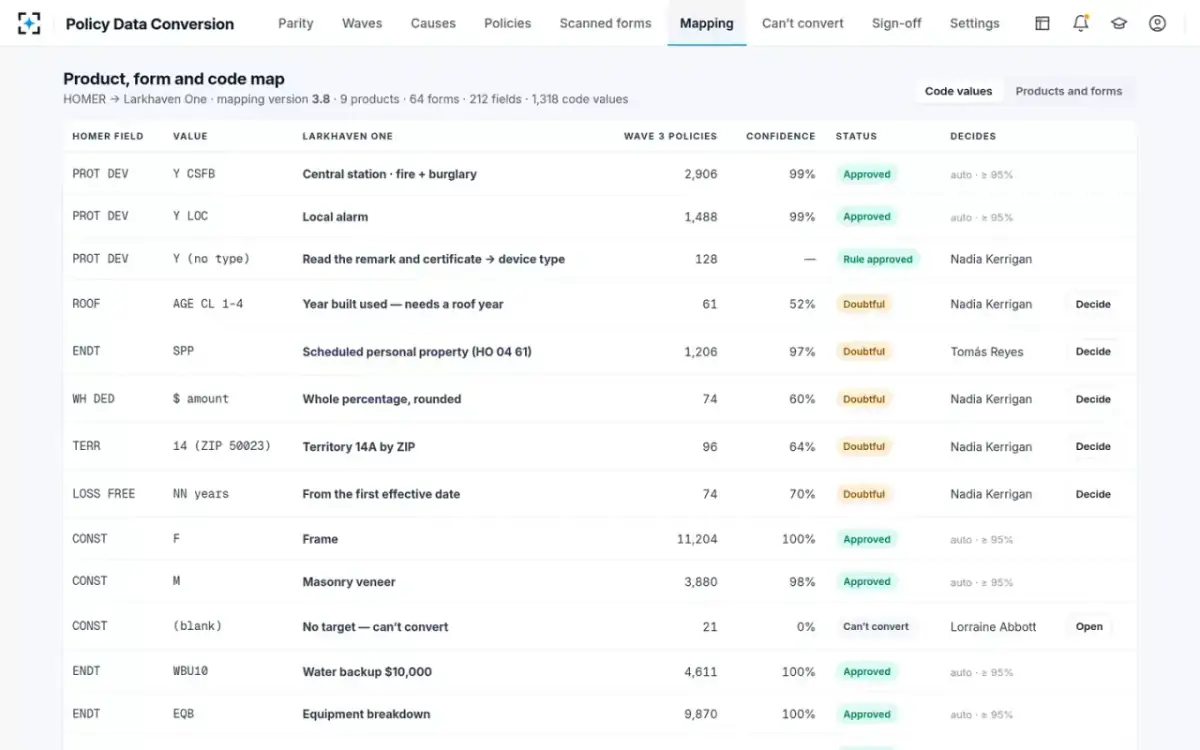
The map owner is accountable for how every legacy product, form, field and code value lands in the new system. In the sample conversion the map at version 3.8 covers 9 products, 64 forms, 212 fields and 1,318 code values. Most are mechanical: construction code F becomes Frame, endorsement code WBU10 becomes water backup at $10,000. The accountability matters on the rest.
The dangerous values raise no load error and each changes a premium. The legacy system stored a roof age class, not a year; the new system needs a year and, left alone, falls back to the year the house was built. It stored the wind and hail deductible in dollars; the new system wants a percentage and rounds. A territory code split in two. In the sample, values mapped at 95% confidence or more are approved on their own; the rest wait for a named person, the forms specialist or the rating lead, with the affected policies beside them.
The map owner's view in Policy Data Conversion: every code value, with the doubtful ones named
The forms reader: the role most RACIs leave out
Someone must be accountable for what the scanned documents say when the fields do not, and in most generic plans nobody is. Legacy systems kept part of their rating outside fields: in remarks typed by underwriters and on paper that was scanned and attached. In the sample wave, the alarm type behind a protective device credit sat in the remark "CS ALM SOUTHGATE MON #77412 CERT REC 03/19" and on a scanned certificate of alarm installation, while the legacy field said only Y.
The costliest example was a coverage, not a credit. One insured's HO 04 61 scheduled four jewelry items worth $18,400; the extract carried the schedule's $202.40 premium but not its items, so the new system had no items and the coverage was missing. The same was true on 39 policies, $333,900 of scheduled property in all. In the sample the agents read 41,206 scanned documents and sent 12 they could not read to a person, and a person checks any scheduled item over $10,000. The RACI line is the one in the table above: the forms specialist accountable, underwriting consulted.
The renewal-offer owner and the regulatory clock
Policy services is accountable for the moment a converted policy first reaches the customer, which is usually its renewal offer, and state law has already fixed when that offer must leave. Iowa, for instance, requires that "at least sixty days before the end of the policy or contract term" an insurer mail or deliver the renewal, offer to renew or notice of nonrenewal for personal lines, with the information also sent to the producer of record (Iowa Code §515.129C). Every other step in the RACI must finish before that date for the wave's renewal month.
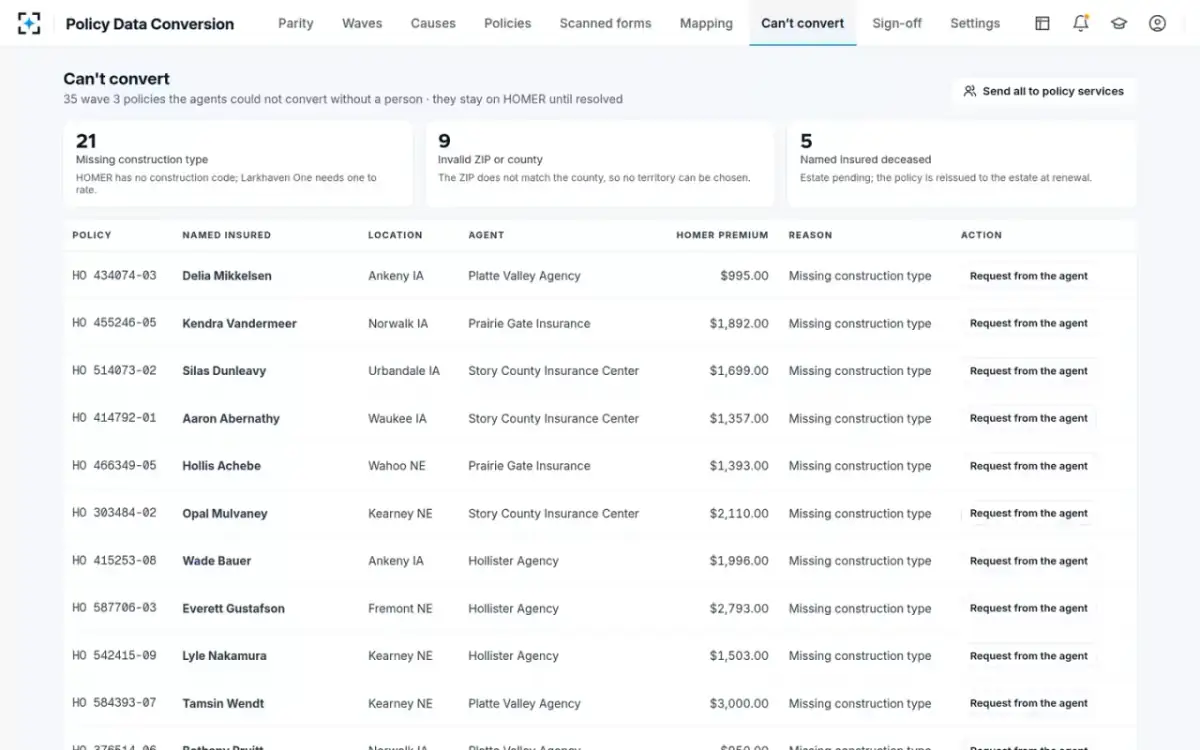
This owner also holds the policies the agents cannot convert. In the sample wave 35 stayed on the legacy system: 21 with no construction type, 9 whose ZIP did not match the county, and 5 where the named insured had died and the estate was pending. Each needs an action with an owner: request the data from the agent, correct the address, or convert by hand at renewal. Whether a converted policy counts in law as a renewal of the old one or a new policy is a separate question with its own notices, taken up in renewal vs rewrite.
The renewal-offer owner's queue: 35 policies that need a person
One fix per cause: what the conversion lead approves
The conversion lead is both responsible and accountable for approving fixes, and the RACI works best when a fix is a rule for one cause of difference, not an edit to one policy. In the sample, a protective device credit was dropped on 128 wave 3 policies, worth +$2,108 a year, because the map had no target for a bare Y. The evidence for all 128 sat on one screen: 128 of 128 remarks named a central station, and 119 alarm certificates and 9 monitoring invoices showed fire and burglary monitoring.
The lead approved one rule, the map moved from version 3.7 to 3.8, and all 128 policies re-rated to the cent; parity moved from 97.25% to 97.94%, and differences fell from 472 to 344 across five remaining causes. The agents may not change a premium, a rate or a coverage to force a match, so every fix is a decision with a name on it. How the agents decide when to ask rather than guess is set out in what an insurance data migration tool should do.
Sign-off order: what each signature attests
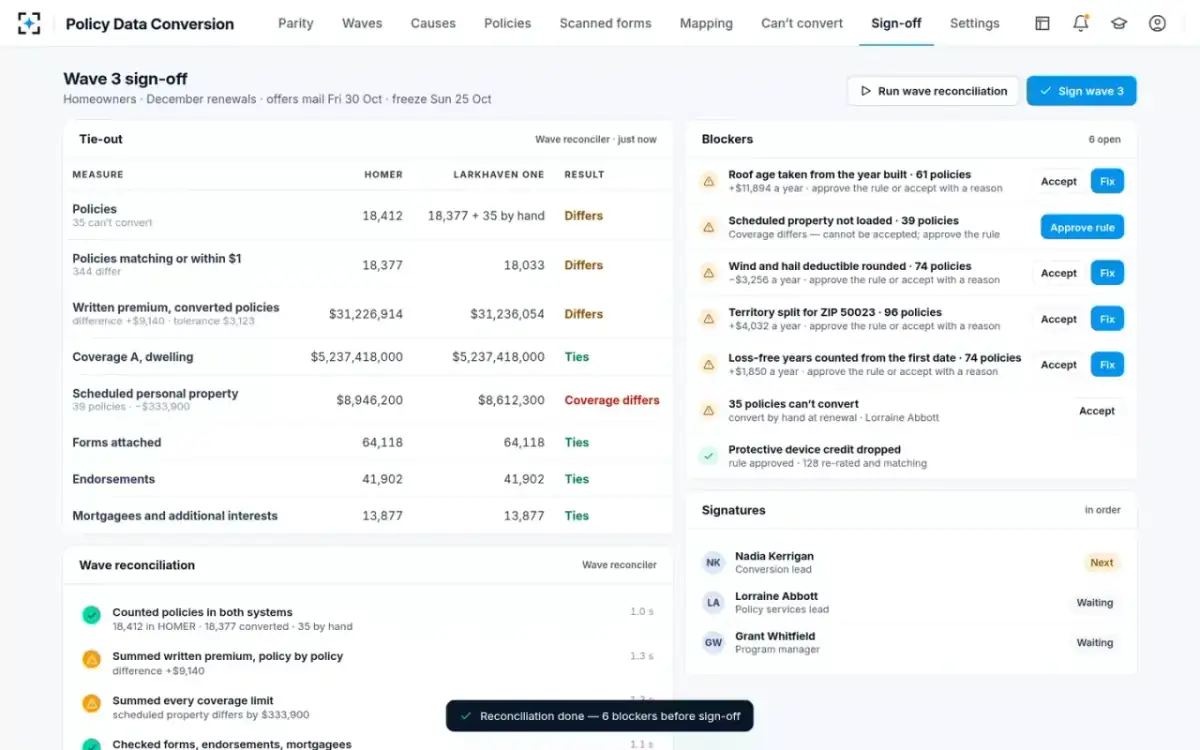
A wave should be signed in order, by three people, from a tie-out rather than a finished batch. In the sample the order is the conversion lead, then the policy services lead, then the programme manager, and each signature attests something different: that every difference has a cause and a rule, that every policy that could not convert has an owner and an action and that renewal offers can go on time, and that count, premium and every coverage tie between the old and new systems within tolerance.
The sample's tie-out shows why totals are not enough. Coverage A ($5,237,418,000), forms, endorsements and mortgagees tied; written premium was +$9,140 against a $3,123 tolerance, and scheduled property was $333,900 short. Six blockers were listed, each with its owner, and nobody could sign until they cleared. The reconciliation report example shows the full report and why batch totals hide the problem.
The wave signs only when it ties out, in order
What a data migration RACI costs to staff
Most of a by-hand cycle goes on finding and explaining differences, not on moving data, and that time falls on the accountable owners. Botminds' estimate for one convert, load and compare cycle on one wave, done by hand, is 22 working days, of which ten are reconciling and tracing. Those are days in which the person who should be deciding a mapping is searching a remark field, and the person who should be preparing renewal offers is waiting for a list of affected policies.
Most of a by-hand conversion cycle is reconciling and tracing
By hand, 22 working days
- Profile and map · 18%
- Load and re-rate · 14%
- Reconcile · 23%
- Trace causes · 23%
- Fix and reload · 13%
- Sign-off report · 9%
With agents reading and comparing, 5 days
- Profile and map · 20%
- Load and re-rate · 20%
- Reconcile · 10%
- Trace causes · 20%
- Fix and reload · 20%
- Sign-off report · 10%
Policy Data Conversion does not merge the roles; it gives each accountable owner a queue and takes the reading away from all of them. Six agents read the legacy extracts and scans, map with a stated confidence, convert and re-rate every policy at the legacy rate version, group differences by cause, draft one rule per cause and tie out each wave. People approve every rule, decide every doubtful mapping and sign in order.
Six tests for a policy conversion RACI
- One A per step
Every row has exactly one accountable person, by name, not a team.
- No vendor in the A column
Wherever a vendor is Responsible, an insurer role is Accountable.
- A row for the scanned forms
Someone is accountable for what remarks and scans say when fields do not.
- The renewal date drives the plan
Every step for a wave finishes before its renewal offers must leave under state law.
- Fixes are rules, not edits
One approved rule per cause, versioned, with the evidence across every policy it touches.
- Signatures from a tie-out
Count, premium and every coverage tied, with open items and owners listed, before anyone signs.
The data migration plan template puts these roles into a plan, wave by wave, with the date each step has to finish. The whole series starts from Policy Data Conversion.
Questions people ask
Who should be accountable for data migration on a policy conversion?
An insurer-side owner for each decision type: the product and forms specialist for mappings and scanned forms, the conversion lead for fixes, the policy services lead for policies that cannot convert and renewal offers, and the programme manager for the wave signature. A vendor can be responsible for the work but should not hold an accountable seat.
What is the difference between responsible and accountable in a RACI?
Responsible is whoever does the work; accountable is the single person who approves it and answers for it. On a conversion the vendor may extract, map and load, but an insurer role approves each mapping below the confidence threshold and signs each wave.
Can an insurer hand data migration accountability to the policy system vendor?
No. Market conduct examiners check that an insurer adequately monitors any entity acting on its behalf, and the NAIC's data security model law calls for due diligence in selecting a third-party service provider that holds policyholder data. Keep the sign-off seats inside the insurer.
Who signs off a data migration wave?
In the sample conversion, three people in order: the conversion lead, the policy services lead and the programme manager. Each signs from a tie-out of policy count, written premium and every coverage, with any blocker listed and owned, not from a finished batch.
What roles does a data migration governance model need for insurance?
Beyond the usual data and technical roles, three that generic models omit: someone accountable for scanned forms and remarks, someone accountable for renewal offers and their state deadlines, and someone inside the insurer who oversees the vendor's reconciliation. In the sample, the scanned forms alone held $333,900 of scheduled property the extract missed.
How many people does a policy conversion wave need?
No published standard sets a number; the matrix sets the roles. The sample wave of 18,412 policies runs with four accountable insurer roles plus the vendor's technical team, and Botminds estimates one by-hand cycle at 22 working days against about 5 with agents doing the reading and comparing.