Medical writing quality control is the check a results document gets before it leaves the writing team: every number in it is traced back to the statistical output it came from, and each one is tested four ways — is the value the same, does it come from the population the sentence names, is it the analysis the sentence claims, and is it the run that is current — before anyone reads it for grammar. That is why the step takes days rather than hours, and why it is the check that catches a late re-run. Botminds' Medical Writing Quality Control does the tracing: five agents find every number in a draft, match each to its exact table cell in the current run, and test population, denominator, analysis and rounding against the house rules, so the QC lead opens a draft with the agreements already settled and decides only the numbers that disagree.
The worked examples come from the sample study that ships with the solution: Northwind Bio's VLT-302, Veltrimab 150 mg every two weeks against placebo in plaque psoriasis, 642 patients randomised. The company, the drug, the study and the people in it are fictional. Every figure taken from the product is tagged demo (seen in the product on that sample study), target (a design goal) or estimated (our own arithmetic). The research figures come from guidelines, regulators and peer-reviewed studies, linked where they appear.
One QC pass in Medical Writing Quality Control, in four numbers
1,150numbers
traced to their table cells across 8 drafts of one study
demo
18
left for a person to decide on that pass
demo
94.5%
of numbers expected to match their cell on the first pass
target
1.2days
median from draft received to QC sign-off, across all document types
target
What is medical writing quality control?
Quality control in medical writing is a defined review of a document against the evidence behind it, run to a procedure rather than done by eye. The European Medical Writers Association's own journal puts the scope plainly: "In medical writing, quality control (QC) means ensuring that a document's content, style, and format are of high quality. This does not just 'happen' but is the result of a systemic QC review" (Haycock, Medical Writing, 2012). Content comes first in that sentence, and in a results document content means numbers.
In a clinical trial the phrase has a second, narrower home. ICH E6(R3), the good clinical practice guideline ICH adopted as final in January 2025, puts quality control inside data handling: "Quality control should be applied using a risk-based approach to each stage of the data handling to ensure that data are reliable and have been processed correctly" (ICH E6(R3) §3.11.3). The same guideline asks for "appropriate and documented quality control of statistical programming and data analysis" at §3.16.2(b). A results document is the last stage of that chain. The tables were programmed and checked; the writer then lifts figures out of them into sentences, and the lift is the step nothing upstream has verified.
So the QC of a clinical study report section is not a second opinion on the statistics. The statistician owns whether 66.4% is the right answer. The QC reviewer owns whether the sentence on page 47 says 66.4%, whether it says it about the population the table divided by, and whether the table it was taken from is still the current one. Those are three different failures with three different fixes, and a reader who sees only the final document cannot tell them apart.
"These reviews are critical because mistakes can cause the reader to question the validity of the content and may lead to errors in interpretation."
Haycock, “Quality control: getting the best out of your review”, Medical Writing, 2012
The five checks behind one QC sign-off
A QC pass on a results document resolves into five questions asked of every number. Four are about data and one is about house style. The order matters: a number that fails the population check is not a rounding problem, and treating it as one produces a corrected digit in a sentence that is still wrong.
The five checks on every number in a results document
- 1 · Value — is the digit in the sentence the digit in the cell?
The plain transcription check. It is the only one a careful reader can do with the table open beside the draft, and the only one a copy-editor ever catches. Skipped, a sentence disagrees with the table a reviewer is looking at in the same submission.
- 2 · Population and denominator — does the percentage divide by the set the sentence names?
ICH E9 §6.3 puts safety on the treated set; efficacy percentages divide by the set the sentence claims. Skipped, the digits are right and the claim is wrong: 52.1% of patients instead of 52.2%, because the sentence divided the 223 patients with an event by 428 randomised rather than 427 treated.
- 3 · Analysis — is it the primary analysis, or a sensitivity analysis quoted as though it were?
An estimate and its confidence interval must come from the same output. Skipped, a sentence reports a primary-analysis point estimate with an interval from the unstratified sensitivity analysis — 55.4 to 67.0 where the primary analysis gives 55.9 to 66.5.
- 4 · Run — is the cell from the current output, or from a run that has been superseded?
Only the final run may be quoted, and a superseded run is where a stale number came from, never a source for it. Skipped, a document quotes a dry run and nobody can say which other documents do too.
- 5 · Format — rounding, decimals, p-value style, the house conventions.
Rounded once from the table value, never from an already-rounded figure. Skipped, the document is internally inconsistent in a way a reader notices and a reviewer has to raise, for no scientific gain.
Why four of the five checks are data checks, not language checks
Take one sentence from the sample study's topline memo: "Any treatment-emergent adverse event was reported in 52.1% of Veltrimab patients." Nothing in it is misspelled, nothing is ambiguous, and 52.1% is a number that appears nowhere wrong on its face. It is wrong. The study randomised 428 patients to Veltrimab and treated 427; 223 of them had at least one treatment-emergent event. Divided by the treated set the figure is 52.2%; divided by the randomised set it is 52.1%. The author divided by the wrong one, and the only way to see it is to know which set the table used — which is check 2, not a reading of the English.
Take a second from the same study's efficacy section: a sentence saying 66.6% of Veltrimab patients reached the week 16 endpoint. That figure was true in the dry run of 12 September. A data query at site 114 re-scored one week 16 reading before database lock, the output was re-run on 2 October, and the responder count fell from 285 to 284 — 66.4%. The sentence is a perfect transcription of a cell that no longer exists. No spell-checker, no document-comparison tool and no second reader without the new tables in front of them will find it; the check that finds it is check 4.
Both failures share a shape. The number is plausible, the sentence is well written, and the error lives in the relationship between the sentence and an output somewhere else. That is why QC of a results document is slow work and why it does not get faster by reading harder. It gets faster when the relationship is made explicit — every number carrying the output, row, column and run it was checked against. The two cases above are worked through in detail in which denominator each number needs and in what a re-run table changes.
Quality control, quality assurance and audit: three different jobs
The three words are used loosely in conversation and precisely in ICH E6(R3), which gives each its own subsection of §3.11. Quality assurance is about the system and its risks; quality control is applied to the data as it is handled; an audit stands outside both and judges whether the processes were fit to produce reliable results. A QC reviewer who is asked to "do the QA" on a synopsis is being asked for the wrong thing, and an inspector who finds no QC records will not accept assurance in their place.
Quality assurance, quality control and audit in ICH E6(R3) §3.11
What the guideline says: Quality assurance "should be applied throughout the clinical trial and includes implementing risk-based strategies to identify potential or actual causes of serious noncompliance with the protocol, GCP and/or applicable regulatory requirements to enable their corrective and preventive actions."
What it means at a medical writing QC desk: The procedure that says a results document gets a QC pass at all: who reviews what, against which outputs, at which version, and what happens when a finding is refused. Written once, not per document.
What the guideline says: "Quality control should be applied using a risk-based approach to each stage of the data handling to ensure that data are reliable and have been processed correctly." The guideline also asks for "documented quality control of statistical programming and data analysis" (§3.16.2(b)).
What it means at a medical writing QC desk: The pass itself, document by document: every number traced to its cell, tested for population, analysis, run and format, each finding decided by a named person and kept with the document version.
What the guideline says: A sponsor’s audit "is independent of and separate from routine monitoring or quality control functions" and exists "to evaluate whether the processes put in place to manage and conduct the trial are appropriate to ensure compliance with the protocol, GCP and the applicable regulatory requirements."
What it means at a medical writing QC desk: Someone else, later, asking to see the QC records rather than redoing the QC. What they can be shown is the limit of what the step was worth.
The audit row is not hypothetical. In the MHRA GCP Inspectorate's metrics report for 2019–2020, of the seven commercial sponsors inspected in that period, "four (57.1%) had at least one critical finding and all (100.0%) had at least one major and/or critical finding" (MHRA GCP Inspections Metrics Report 2019–2020). In one of the critical findings the same report describes at a contract research organisation, a primary endpoint response had been hard coded into the analysis and "there was also insufficient documentation available to verify the level of QC of data which had been hard coded". An undocumented check and an unperformed check look identical from the outside.
Where the days go in QC of one CSR section
For a single clinical study report section the product's dashboard shows a median of 4.5 working days of QC by hand on its sample data, against 1.7 with the agents doing the tracing (demo). The split below is the more useful number, because it shows which part of the work the time is in. Two lines — finding every number and the output it should have come from, and ticking each number against its cell — are half the effort by hand and almost none of it afterwards. The lines that survive are the ones that need a person: deciding which of two numbers is right, chasing a run, writing to the statistician.
Where a CSR section's QC days go, by hand and with the agents
By hand · 4.5 working days for one CSR section
- Finding every number and the output it should come from · 0.75 d · 17%
- Ticking each number against its table cell · 1.5 d · 33%
- Population, denominator, analysis and rounding · 0.75 d · 17%
- Working out which run a number came from, and statistician queries · 0.75 d · 17%
- Cross-checking the synopsis, abstract and other drafts · 0.5 d · 11%
- Comment log, corrections to the writer and the QC record · 0.25 d · 5%
With the agents · 1.7 working days for the same section
- Finding every number and the output it should come from · 0.05 d · 3%
- Ticking each number against its table cell · 0.15 d · 9%
- Population, denominator, analysis and rounding · 0.5 d · 29%
- Working out which run a number came from, and statistician queries · 0.5 d · 29%
- Cross-checking the synopsis, abstract and other drafts · 0.3 d · 18%
- Comment log, corrections to the writer and the QC record · 0.2 d · 12%
Those totals are for one section of one report. A study package is many documents at once, which is the second reason the step is slow: the same figure appears in the section, the synopsis, the topline memo, the abstract and the lay summary, and each is checked by a different person at a different time against whatever run was current when they looked.
The QC desk in Medical Writing Quality Control: every number as a dot
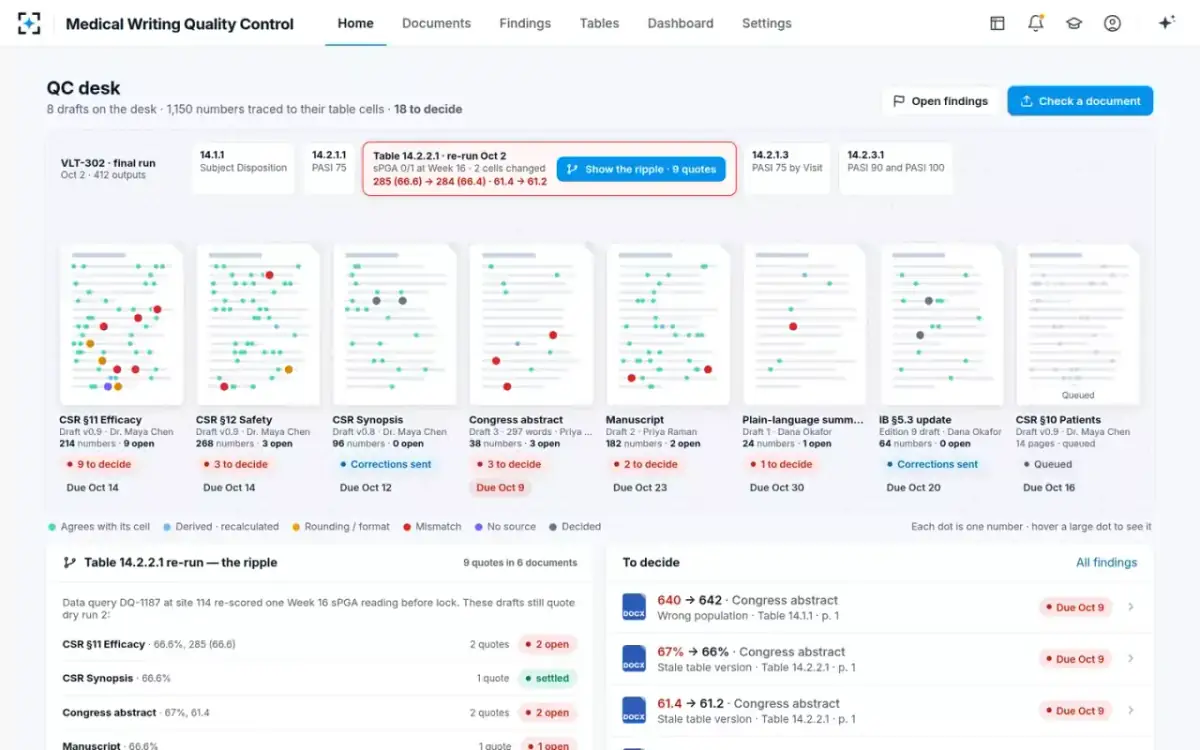
Does QC check the numbers, or only the text?
Both, and the numbers are the larger half. A results document exists to restate what the tables say: ICH E3, the guideline that defines what a clinical study report contains, expects that "important demographic, efficacy and safety data should be presented in summary figures or tables in the text of the report" with the rest cross-referenced to section 14 (ICH E3 §14). Everything presented in the text of the report is a restatement, and every restatement is a place a figure can part company with its source.
The language half is real but smaller, and it is also the half that is well served already. House style, consistent terminology, correct cross-references and readable sentences are what a copy-edit and a style sheet are for. A QC step that spends its hours there and samples the numbers has its effort upside down, because the language errors embarrass and the number errors are the ones that cost a correction after submission.
A useful test for any QC procedure: for each check in it, name what the reviewer must have open to perform it. If the answer is only the document, it is a language check. If the answer is the document and an output, it is a data check, and it needs the output to be identified by name, version and run time before the check can be called done.
What a 100% check means, and what it costs
A "100% QC" is a pass in which every number in the document is checked against its source, as against a sampled pass in which a proportion is checked and the rest accepted. ICH guidelines do not define the term; ICH E6(R3) asks for a risk-based approach rather than a fixed percentage, so the choice is the sponsor's and it belongs in the procedure. What the guideline does require is that whatever was done is documented, which is why a sampled pass has to record what the sample was.
The cost is arithmetic. One efficacy section of the sample study quotes 214 numbers. The by-hand estimate puts 1.5 days — about 11 working hours — on ticking each against its cell, which is a little over three minutes a number: find the output among several hundred, find the row and column, compare, mark it. Three minutes is not slow work. It is the volume that makes a 100% pass expensive, and the volume is why a sampled pass is tempting and why sampling fails in exactly the case that matters: a re-run table affects particular cells, and the sample either includes them or does not.
That trade-off changes when the tracing is mechanical and the person's time goes to the decisions. On the sample study's pass, 1,150 numbers were traced across eight drafts and 18 were left for the QC lead — a hundred per cent check on the number of numbers, with a person's judgement spent on a day's worth of real questions. What the published record says about how often numbers drift is the baseline any such claim has to be held against.
The documents QC covers: CSR sections, synopses, abstracts, manuscripts, lay summaries and IB updates
Medical writing QC is usually described as a clinical study report job, but the report is only the largest of the documents that restate the same tables, and it is not the one that goes out first. The table below is the set a study package produces, with what each restates and the trap that sits on it.
The documents a medical writing QC step covers, and what makes each one risky
| Document | What it restates | Numbers, on the sample study | What makes it risky |
|---|---|---|---|
| CSR section | Efficacy and safety results in the text, with the rest cross-referenced to the tables in section 14. | 214 in one efficacy section, 9 open at the point shown (demo) | Volume. It quotes more numbers than any other document, and derived figures — differences, ratios, "about N times" — have to be recalculated, not matched. |
| Synopsis | The whole study, in a few pages, as a stand-alone document. | Part of the 1,150 traced across 8 drafts (demo) | It cannot cross-reference its way out of a number, so it restates them all; and it is often written and signed before the last section is settled. |
| Topline results memo | The headline results, early and internally. | 31 numbers, 2 findings (demo) | Written fastest, from whatever run exists. One of the two findings on the sample memo was a site count no output reported at all. |
| Congress abstract | The primary outcome and its effect size, to a word limit. | 3 open findings, due 9 October (demo) | It is often drafted from a dry run to meet a congress deadline, and has to be re-checked after the final run. |
| Manuscript | The same results, at length, for a journal. | Part of the 1,150 traced (demo) | Written over months by several authors, often against the abstract rather than against the tables. |
| Plain-language summary | The results in non-technical words, often as whole numbers. | Part of the 1,150 traced (demo) | Rounding. A whole-number percentage rounded from an already-rounded figure drifts, and the audience has no table to check it against. |
| IB section update | Accumulated safety and efficacy across studies. | Part of the 1,150 traced (demo) | It quotes results from several studies at once, so "the current run" is a different output for each figure in the same paragraph. |
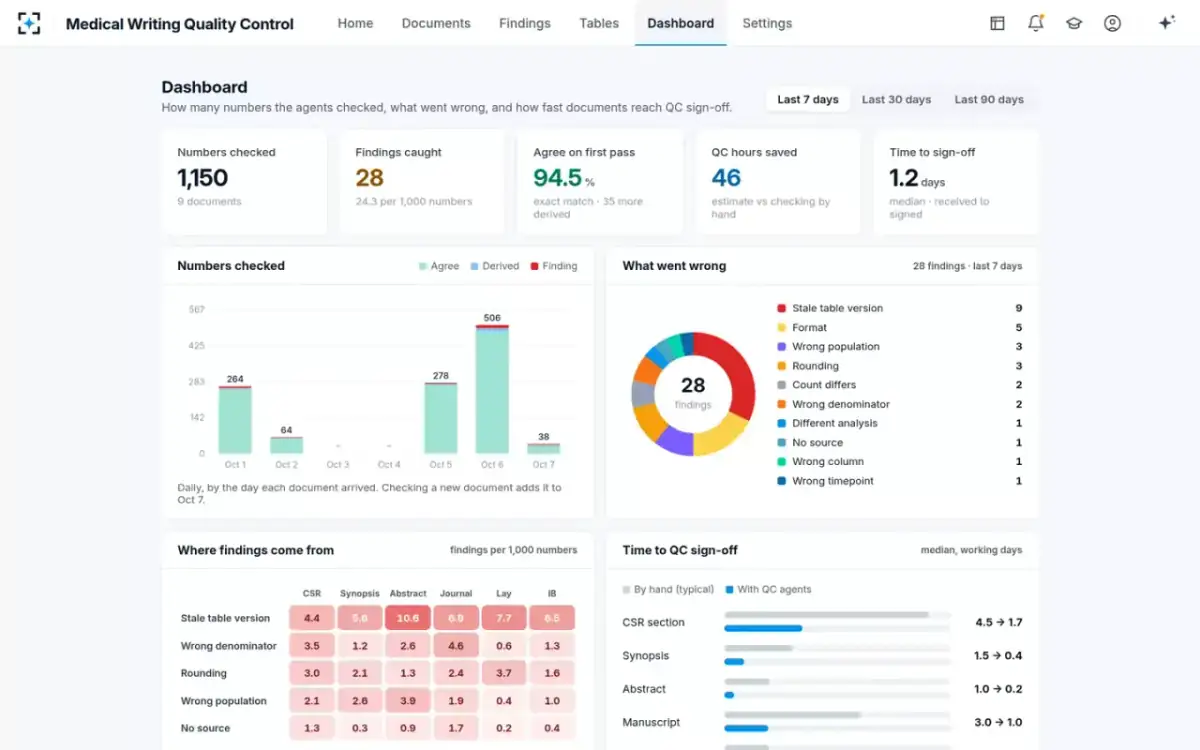
Seen as a set rather than one document at a time, the job changes shape. The question stops being "is this sentence right" and becomes "do these seven documents say the same thing, and does that thing match the current tables" — which is the question the dashboard is built to answer, and the one the numbers behind each CONSORT abstract item pushes hardest.
Findings by type and by document, with first-pass agreement against checking by hand
Who signs, and what the signature means
A QC pass ends in a signature, and the signature is a statement about what was done, not an opinion that the document is good. ICH E6(R3) requires the sponsor to ensure that clinical trial reports "meet the standards of ICH E3 or are otherwise in accordance with applicable regulatory requirements" (§3.17.2), and leaves who signs what to the sponsor's own procedures. In practice the QC reviewer signs that the QC was performed to the procedure, against a named results package; the author and the responsible clinician sign the document itself.
Two properties make that signature worth something later. The first is that the meaning is stated on the record rather than implied — in the solution the stated meaning is that QC review is complete and every number was verified against the final tables, and the signer re-authenticates at the moment of signing. The second is that it cannot be given while a finding is still open: every finding must be decided — the fix accepted, the sentence removed, the statistician's answer taken, or the number kept with a reason — before the record can be signed. A signature that can be given over an open question records nothing.
What a signature cannot do is substitute for the trail underneath it. Each finding in the solution carries both locations: the draft's page and sentence, and the output, row, column and run time it was checked against. That is what an auditor asks for, and it is the difference between a step that was performed and a step that can be shown to have been performed.
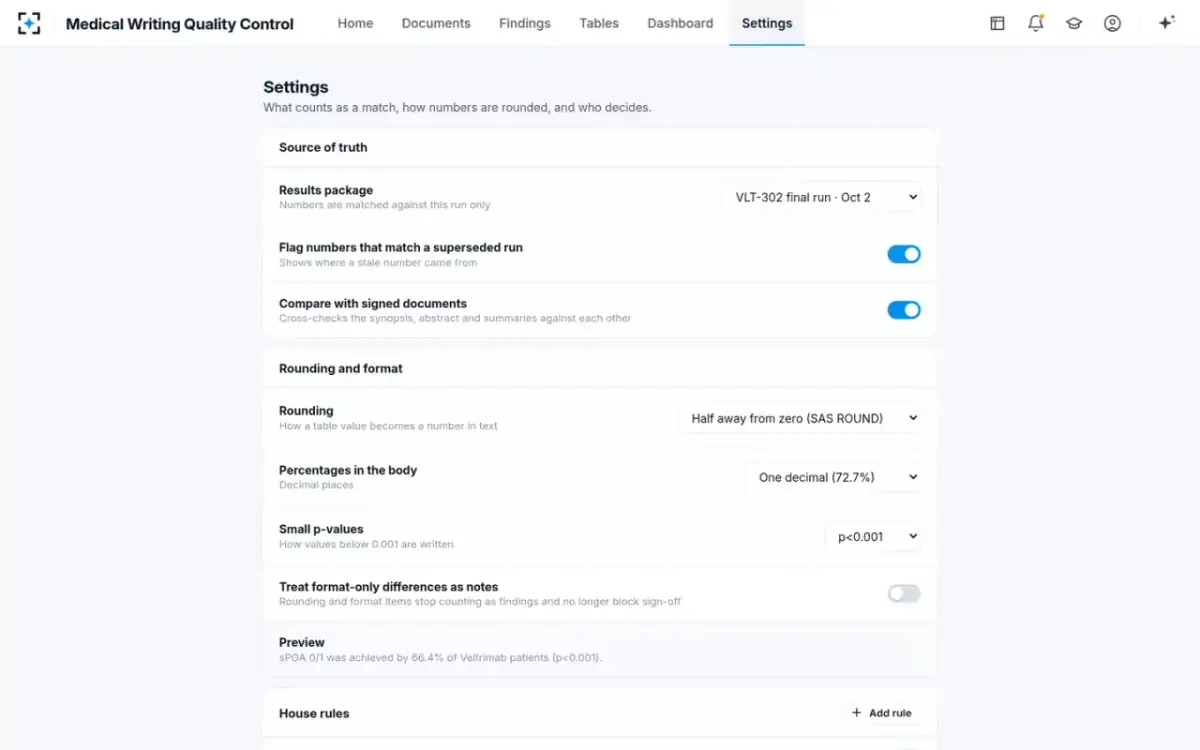
House rules in Medical Writing Quality Control: what counts as a match, and who signs
To see the five checks run on a draft, the ripple of one re-run table and a signed QC record end to end, start from Medical Writing Quality Control.
Questions people ask
Who does QC in medical writing?
A medical writer other than the author, a dedicated QC reviewer, or a QC lead in the medical writing group; on publications, often the publications manager as well. The usual rule is independence from the draft: the author does not QC their own document, because the errors that survive a self-review are the ones the author's eye has already accepted. ICH E6(R3) leaves the roles to the sponsor's procedures, which is why the procedure has to name them.
How long does QC of a CSR section take?
On the product's sample data, the dashboard median for one CSR section is 4.5 working days by hand against 1.7 with the agents tracing the numbers (demo). The time is driven by how many numbers the section quotes — one efficacy section of the sample study quotes 214, a little over three minutes each to tick against its cell — and by how many runs of the tables exist.
Is medical writing QC the same as proofreading?
No. Proofreading tests the document against itself and against a style sheet. Medical writing QC tests the document against evidence outside it — the statistical outputs, the analysis plan and the other documents in the package. A sentence can pass every proofreading test and still quote a cell from a superseded run, which is the failure that costs an erratum.
Do you need a QC checklist for medical writing?
A checklist is how the step becomes repeatable and auditable, and ICH E6(R3) expects the QC that was performed to be documented. The useful form is not a list of things to look at but a list of questions asked of every number — value, population and denominator, analysis, run, format — each recording the output it was checked against. A checklist that cannot fail a document, because its items are matters of impression, documents nothing.
Can a results document be QC'd before the tables are final?
It can be checked against the run that exists, and that is worth doing for a congress abstract whose deadline falls before database lock. What it is not is finished: every number taken from a dry run has to be re-checked against the final run, and the record should say which run each number was verified against. The honest position is that a pass is against a named results package, not against the study.
What happens when QC finds a number that is right but comes from the wrong table?
It is a population or analysis finding, not a value finding, and it has two possible fixes: change the number, or change the sentence to name the population the number actually belongs to. Choosing between them is a scientific decision, so it goes to a person — in the solution the agents raise it with both candidate cells cited and never decide which of the two is correct.