Pharma proofreading software is usually bought to catch typos and house-style breaches, and it does that well. What buyers in this category are often actually trying to solve is a different problem: a sentence in a results document that quotes a number which does not match the statistical output behind it. Five things are sold into that step — copy-checking, document comparison, scripted checks written from the analysis datasets, outsourced 100% manual quality control, and checking each number against its table cell — and they catch different errors. This guide runs all five against a single sentence that is wrong in three ways, using Botminds' Medical Writing Quality Control, which is the last of the five.
Being explicit about where our own category does not help: it does not proofread. It will not improve a sentence, catch a misspelled drug name in a heading, or tell you the discussion contradicts the conclusion. The worked examples are from a fictional sample study inside the solution — Northwind Bio's study VLT-302 of Veltrimab — and figures from it are tagged demo; design goals are tagged target.
One new draft, checked against the final outputs
31numbers
in a topline results memo, each traced to a cell or reported as having none
2
findings raised, both of a kind a copy-check cannot see
412outputs
searched for the one number that turned out to have no source anywhere
1.2days
median from draft received to QC sign-off, as a design goal across document types
What does pharma proofreading software actually check?
Most of it checks the document against itself, or against another copy of itself. That is a real and useful job: a results document is written by several people over several weeks, and internal consistency — the same term, the same spelling, the same number in the synopsis as in the body — is where it most visibly falls apart. Copy-checking tools compare a draft with the source text it was typed from; document comparison tools show what changed between two versions; both read words.
The errors that matter most in a results document are not in the words. They are in whether a number is the number the analysis produced. ICH's guideline on the structure of a clinical study report is explicit that the text is where the important results are restated — overall summary figures and tables for important variables can sit in the text itself to make the key points, with the rest cross-referenced to the output sections. Every one of those restatements is a copy of a cell, made by hand, and a copy is exactly what a tool reading only the document cannot verify.
The same guideline asks for something stricter about numbers the text works out for itself: "In any table, figure or data listing, estimated or derived values, if used, should be identified in a conspicuous fashion. Detailed explanations should be provided as to how such values were estimated or derived and what underlying assumptions were made." Differences, ratios and the phrase "about N times" are derived values. There is no cell to tick for any of them; they have to be recomputed.
One sentence, five tools: the test
Here is the sentence. It would pass a careful read, and it is wrong three times:
“In the Veltrimab group, 285 patients (66.6%) achieved sPGA 0/1 at Week 16 — a difference of 61.4 percentage points against placebo — and 223 patients (52.1%) had at least one treatment-emergent adverse event.”
A test sentence, written against an earlier run of the sample study's outputs
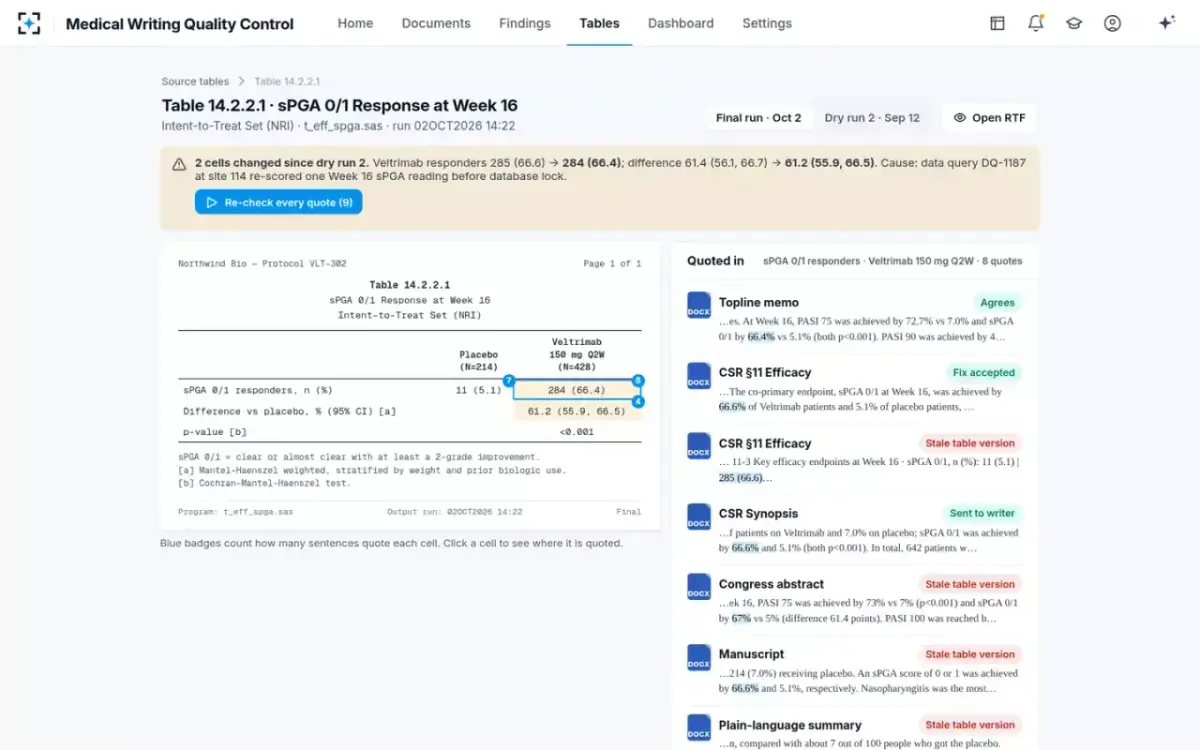
The three errors, in the order a reviewer would find them if they found them at all. First, 285 and 66.6% come from an earlier run of the output. A data query at one site re-scored a single Week 16 reading before database lock, and in the final run the figure is 284 (66.4%); the treatment difference moved with it, from 61.4 to 61.2. Second, 52.1% divides 223 by the 428 patients randomised rather than the 427 who were treated: on the safety set the figure is 52.2%. Third — the one most likely to survive every check — the sentence names no analysis set at all, so nothing in it is falsifiable until someone decides which population it was meant to claim.
Nothing about this sentence looks wrong. Every number in it exists somewhere in the output package. The percentages are internally consistent with the counts beside them. It reads like a sentence that has been checked, which is why the category of tool you point at it decides what you find.
Five categories against one sentence: what each catches, what it needs, what it costs to run
285 → 284Wrong denominator
52.1 → 52.2No population namedRounded the wrong way
Copy-checking
A second reader, or a tool, compares the draft against the text it was written from: spelling, house style, consistent terms, consistent numbers within the document.
Stale runBlind to it
Wrong denominatorBlind to it
No population namedBlind to it
Rounded the wrong wayOnly sometimes
Needs from you: The document. Nothing else. Cost to run: Hours, not days, and no setup at all.
Document comparison
A difference engine between two versions of the same document, or between a document and a reference copy of it.
Stale runOnly sometimes
Wrong denominatorBlind to it
No population namedBlind to it
Rounded the wrong wayOnly sometimes
Needs from you: Both versions, in the right order, with a clean lineage between them. Cost to run: Minutes per pair, once you hold the right pair.
Scripted checks from the analysis datasets
Programs written by statistical programming that regenerate the quoted values from the analysis data and compare them with a machine-readable version of the text.
Stale runCatches it
Wrong denominatorCatches it
No population namedOnly sometimes
Rounded the wrong wayCatches it
Needs from you: Analysis datasets, a structured way to get the numbers out of the document, and programming time per document type. Cost to run: Days to build per document type, then minutes to run — and a rebuild when the document changes shape.
Outsourced 100% manual QC
A second organisation checks every number in the document against the outputs, by hand, and returns a comment log.
Stale runCatches it
Wrong denominatorCatches it
No population namedCatches it
Rounded the wrong wayCatches it
Needs from you: The draft, the output package and a turnaround window. Cost to run: Days per document, every time, and the window is the schedule risk.
Number-to-cell checking
Agents find every number in the draft, locate the output cell each should match in the current run, compare value, population, analysis and format, and raise only what disagrees.
Stale runCatches it
Wrong denominatorCatches it
No population namedCatches it
Rounded the wrong wayCatches it
Needs from you: The outputs of the current and earlier runs, house rules, the analysis plan, and the documents already signed. Cost to run: Minutes to run; the setup is loading the outputs and writing down the house rules.
Read the first column down and the picture is uncomfortable for the two categories most medical writing groups already own. A copy-check catches none of the three errors in the sentence, because nothing about it is a copying mistake in the ordinary sense: the writer copied accurately, from the wrong version. A document comparison catches the stale value only if you happen to hold both the old and the new draft and know to compare them — and the error is not in the draft's history at all, it is in the output's.
Copy-checking: what it catches, and what it is blind to
Copy-checking earns its place. It catches transposed digits, a percentage that does not match the count printed beside it, a term that changes halfway through a document, a p-value written two ways in one section, a cross-reference to a table that was renumbered. In a document written by four people to a congress deadline, that is a long list of real findings.
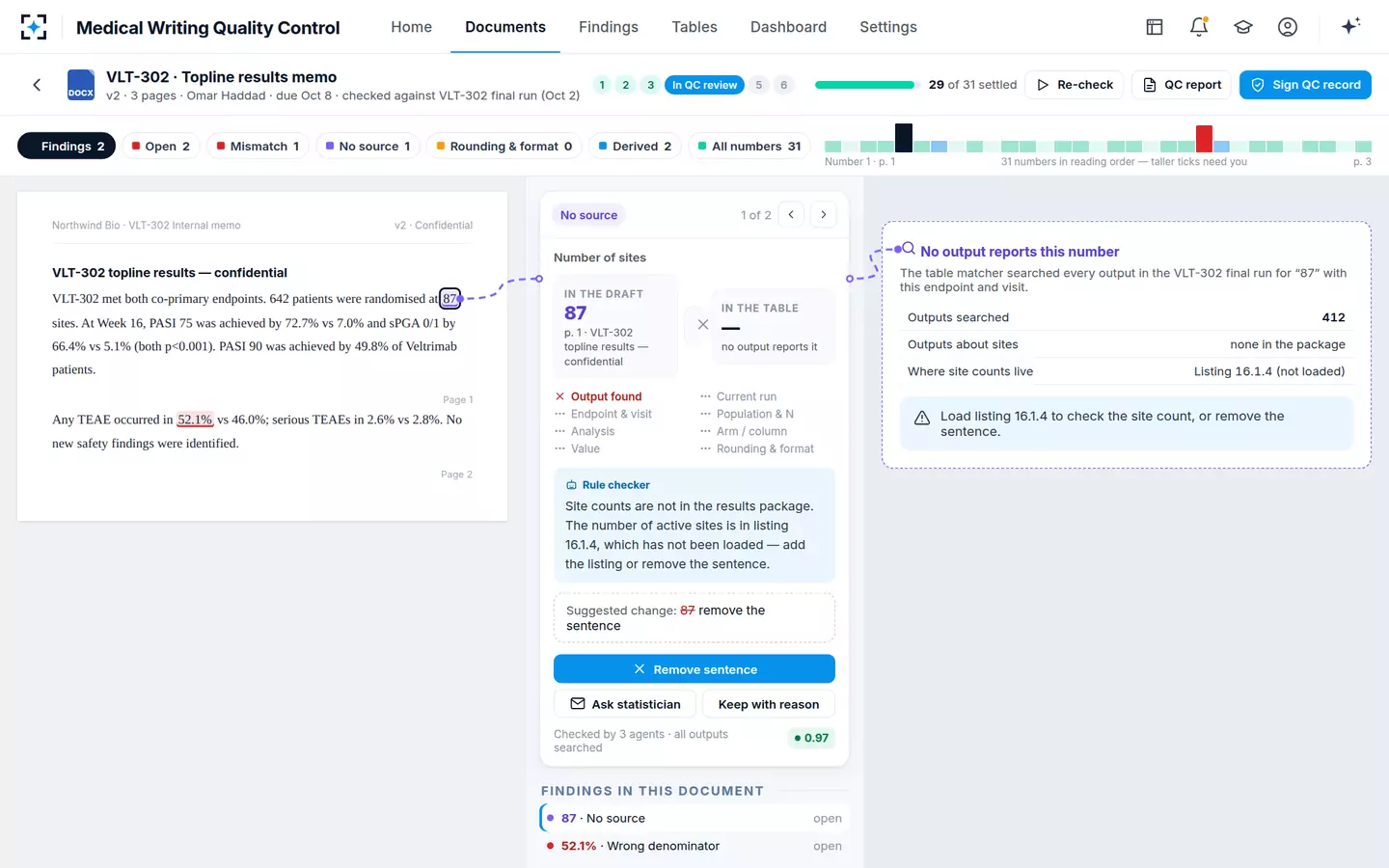
Its blind spot is structural rather than a matter of quality: it never sees the table. A sentence whose number is internally consistent, correctly spelled and wrong is invisible to it, and so is a sentence whose number no output reports at all. On the sample study, one draft claimed a site count — 87 sites — that no output in the package reports, because site counts live in a listing that was never loaded. A copy-check reads that sentence as clean. So would most readers.
The second blind spot is the population. A safety percentage over an efficacy denominator is arithmetically perfect and clinically wrong, and the only way to see it is to know which set the output used. That is a comparison between the document and the output's own column header, which again is outside what the category reads.
Can a document comparison tool catch a wrong number?
Only by accident, and only in one direction. A comparison between draft version 3 and version 4 shows every number that changed between them — useful for confirming that an agreed correction was actually made, and for spotting a change nobody asked for. It cannot tell you that a number which did not change should have, which is the whole of the late-re-run problem.
The asymmetry is worth stating plainly, because it is the reason groups that own a comparison tool still miss stale values. When an output is re-run, the thing that changes is the output. The drafts stay exactly as they were, and all of them keep comparing clean against their own previous versions. Finding the damage requires starting from the changed cell and asking which documents quote it — a question no tool reading documents can answer, because it needs the two runs of the output and a list of every quote of every cell.
The question only the table can ask: which drafts quote this cell, and are they still right?
Can you script the number checks instead of buying a tool?
Yes, and in a group with strong statistical programming it is a serious option — with two costs that are usually underestimated and one advantage that is usually understated.
The advantage is traceability. Scripted checks run from the analysis data, and the CDISC analysis data standard exists precisely so that analysis results can be traced back through the analysis data to the tabulated study data; it is one of the required standards for submission to the US and Japanese regulators. A check written at that level can regenerate the value rather than merely locate it, which is the strongest claim any of these five categories can make about a number.
The first cost is getting the numbers out of the document. A script can compute what the value should be; it still has to know what the draft says, which means either a structured authoring environment or a text-extraction layer that someone has to maintain against every document type — report sections, synopses, abstracts, lay summaries — and against every change in house format. The second cost is coverage: the scripts check the numbers somebody thought to check. The sentence above fails on a population that was never named, and a check that was not written for that case will not raise it.
A common pattern in groups that go this way is partial: scripted checks on the primary endpoints of the main report section, where the payoff is highest, and hand-checking for everything else. That is a reasonable allocation. It just leaves the abstract, the manuscript and the lay summary — the documents that reach people outside the company first — on the manual side.
Do you still need 100% manual QC if you have software?
The answer is that 100% manual checking is expensive and, where the underlying work was done properly, can mostly confirm what you already had. There is published evidence for this from an unusual source: an academic phase III trial, ICON6, which had been run with limited on-site monitoring and single data entry and then had to be made acceptable for a marketing authorisation application. The team performed extensive retrospective source data verification and additional quality control checks, and reported the result: "Data point changes were minimal; those key to the primary results had a 0.47% error rate (36/7686), and supporting data points had a 0.18% error rate (109/59,261)." The conclusion for the primary outcome was unchanged — the log-rank p-value "changed only at the sixth decimal place" — and the authors' judgment on the exercise was blunt: "The burden of such comprehensive retrospective effort required to ensure the results of ICON6 were acceptable to regulators is difficult to justify."
That is about trial data rather than document text, and the analogy should not be stretched: a QC pass over a document is cheaper than retrospective source data verification and catches a different kind of error. But the shape of the finding transfers. When the error rate is low and the checking is uniform, almost all of the effort is spent confirming correct values, and the question worth asking is not whether to check everything but who — or what — does the confirming.
That is the case for automating the confirmation and keeping the judgment. In the sample study, 1,150 numbers across eight drafts were traced to their cells and 18 were left for a person to decide (demo); the design goal is 94.5% first-pass agreement (target), which is another way of saying that about one number in twenty is worth a reviewer's attention. Checking 100% of numbers remains the right standard. Doing it by hand is a choice about who spends the day.
Time to run each category over one document — and only two of the five complete a QC pass
Number-to-cell checking: what it needs from you before it works
This is the category to be most sceptical about, including when it is ours, because its results depend entirely on inputs that live outside the document. It needs the output package of the current run and of earlier runs, so a verdict can be taken against the current one and a stale value traced to where it came from. It needs the house rules — rounding method, decimals in the body, p-value format, whether format differences block sign-off. It needs the statistical analysis plan, so a sentence naming a sensitivity analysis is judged against that analysis and not the primary one. And it needs the documents already signed, so a new draft can be checked against what the company has already said.
Miss any of those and the behaviour degrades in a specific, visible way. Without earlier runs, a stale number is reported as a plain mismatch with no explanation of where it came from. Without house rules, every format difference becomes a finding and the reviewer learns to skim. Without the analysis plan, a correctly quoted sensitivity interval is raised as an error. Those are the failure modes to probe in a pilot, and they are a fair test of whether a supplier will tell you what it cannot do.
The behaviour that matters most is the one at the edge: what happens when nothing fits. The useful answer is a statement of which outputs were searched and what came closest, with the number left unresolved for a person — on the sample study, all 412 outputs searched and the honest conclusion that site counts live in a listing nobody loaded. A tool that instead quietly matches the nearest plausible cell has converted a visible gap into an invisible error.
The same paragraph, read by a copy-check pass and by a number-to-cell pass
A copy-check pass: The draft and the house style guide.
A number-to-cell pass: The draft, the 412 outputs of the final run, the earlier run, the house rules and the analysis plan.
A copy-check pass: No finding. 285 of 428 is 66.6%, the count and the percentage agree, and the figure appears in the package.
A number-to-cell pass: Stale table version. The final run gives 284 (66.4%) after a data query re-scored one Week 16 reading at one site before lock.
A copy-check pass: No finding. Plausible, and consistent with the two figures around it.
A number-to-cell pass: Stale table version, and marked as a derived value: 61.2 in the final run, recalculated from the two arms rather than read from a cell.
A copy-check pass: No finding. 223 of 428 is 52.1%; the arithmetic in the sentence is sound.
A number-to-cell pass: Wrong denominator. Safety percentages use the 427 patients treated, which gives 52.2%.
A copy-check pass: No finding. The term matches the style guide and is used consistently.
A number-to-cell pass: No analysis set named. The population is recorded as implied rather than asserted, and goes to the reviewer to confirm.
A copy-check pass: A marked-up draft, and a clean report on the numbers.
A number-to-cell pass: Findings, each citing the page and sentence and the output, row, column and run — every one of them left open for a person.
What to ask before you buy, and how to pilot a QC tool on your own documents
A pilot in this category is unusually easy to design well, because you already have the answers. Take three or four past documents whose QC findings you kept, including at least one that went through a late re-run, and run the candidate over them with the output package as it stood. Then compare both directions: what it found that your reviewer did not, and — the number suppliers rarely volunteer — what your reviewer found that it did not.
Eleven questions to put to any tool in this step, each with the answer that should worry you
- Does it read the outputs, or only the document?
If the answer is only the document, it is a copy-checker, whatever the category on the website.
- Can it take a verdict against a named run?
"It checks against the latest files it has" means you cannot say what a pass meant last Tuesday.
- What does it do with a number that matches a superseded run?
Passing it is the worst answer; failing it without saying where it came from is the second worst.
- Does it check the denominator, or only the value?
"It compares numbers" will miss every safety percentage written over the randomised total.
- Does it recalculate derived values?
Differences, ratios and "about N times" are in no cell. Ask to see the tolerance, and who sets it.
- What happens when no output fits?
"It finds the closest match" turns a visible gap into an invisible error.
- Can it check one draft against another, and against signed documents?
The abstract and the manuscript quote the same cells as the report section; if they are checked separately, they will diverge.
- Who writes the house rules, and how fast can one change?
"Raise a change request" means the rules will stay in people's heads, where they already are.
- Does any finding close without a person?
A confidence threshold that closes findings is a saving you will spend twice over in a review.
- Can you export the whole QC record, with both locations for each finding?
If the evidence lives only in the supplier's screen, you cannot hand it to an auditor.
- What did it miss on our own documents?
A supplier who has no answer has not run a pilot the way you are about to.
Two measures are worth agreeing before the pilot starts, because they are hard to argue about afterwards: the share of your reviewer's historical findings that the tool reproduced, and the number of items it raised that a reviewer then dismissed. The first is the one that matters; the second decides whether anyone will use it. A tool that finds everything and raises three hundred format notes per document is likely to be switched off within a month.
Validation sits alongside the pilot rather than after it. ICH's good clinical practice guideline asks sponsors to make sure the requirements for a computerised system — validation, audit trails, user management, backup, disaster recovery and IT security — are addressed and implemented, and that these "should be proportionate to the importance of the computerised system and the data or activities they are expected to process". Proportionate is the operative word, and for a tool whose findings are all decided by a person it argues for a focused validation: does it find every number, cite every cell, apply your rounding, and leave every finding open? The wider question of what evidence an automated step owes is set out in which tasks to automate and which to keep.
A new draft, checked in seconds — including one number no output reports
Where each category fits — and where ours does not
Nobody should buy one of these five and switch off the others. Copy-checking is the cheapest quality in medical writing and the only one of the five that improves the prose; keep it, and run it first, because a document full of style breaches wastes a number check. Document comparison belongs at the point where an agreed correction is confirmed, and is the fastest way to see what a co-author changed overnight. Scripted checks belong on the primary endpoints of the main report section in any group that has the programming capacity to maintain them.
Outsourced 100% manual QC belongs where the schedule allows it and the volume does not justify building anything — and its real cost is the turnaround window, not the day rate, because a document waiting two days for an external desk is two days of the submission calendar. Number-to-cell checking belongs where results documents are numerous, where the same cells are quoted in several of them, and where late re-runs happen, which describes many late-stage programmes.
And the honest limits of our own category, in one list: it does not edit a draft, it does not choose between two conflicting numbers, it does not judge whether an interpretation is supported, it does not proofread, and it is only as good as the outputs and house rules it is given. ICH's report guideline asks sponsors to describe the steps taken centrally to ensure accurate and consistent data, naming "data verification, cross-checking" among them — a reminder that this checking is something you will be asked to describe, not just to perform, and a reason to prefer whichever of the five leaves a record you could hand over. What that record has to carry is set out in the clauses behind a signed QC record, and what the reviewer who decides actually checks is in what a QC reviewer checks.
Questions people ask
What is the difference between copy-checking and data QC?
Copy-checking compares a document with the text it was written from and with itself: spelling, style, internal consistency. Data QC compares the document with the statistical outputs it quotes: the right cell, in the right run, from the right analysis set, rounded the house way. A sentence can pass the first perfectly while being wrong in all four respects, which is why groups that own only a copy-checking tool still find stale numbers after a submission.
Can a document comparison tool catch a wrong number?
Only a number that changed between two drafts you are holding. It cannot see a number that should have changed and did not — which is the common failure after an output is re-run, because the output changed and every draft still compares clean against its own earlier version. Finding that damage means starting from the changed cell and listing every document that quotes it.
Do you still need 100% manual QC if you have software?
Checking 100% of the numbers is the right standard; doing it by hand is a choice about who spends the day. Published experience from the ICON6 trial's retrospective verification found error rates of 0.47% on data points key to the primary results and 0.18% on supporting ones, with conclusions unchanged, and the authors judged the burden of that comprehensive effort difficult to justify. The lesson for documents is to automate the confirming and keep the deciding.
Can you script the number checks instead of buying a tool?
Yes, and scripted checks have the strongest claim of the five because they regenerate values from the analysis data rather than locating them. The two costs are getting the numbers out of the document in a structured form, and coverage: scripts check the cases someone wrote them for. Groups that go this way often script the main report section's primary endpoints and hand-check the abstract, manuscript and lay summary.
What should you look for in a document QC tool?
That it reads the outputs and not just the document; that it takes its verdict against a named run and flags anything matching a superseded one; that it checks population and denominator, not only the value; that it recalculates derived values; that it says what it searched when nothing fits; that house rules are settings rather than code; and that no finding closes without a person. Ask what it missed on your own past documents before anything else.
How do you pilot a QC tool on your own documents?
Take three or four past drafts whose findings you kept, including one that went through a late re-run, and run the candidate against the output package as it stood at the time. Measure both directions — what it found that the reviewer did not, and what the reviewer found that it did not — and count the items a reviewer dismissed, because that number decides whether people keep using it.