A clinical study report addendum is a separate, signed document added to a completed report, carrying results or analyses the original did not contain — most often because a table was re-run, an analysis was added, or a dataset was corrected after the report was finished. Neither ICH E3 nor ICH E6(R3) defines the word, which is the first thing to know about it: addendum, amendment and errata are industry practice, and what the guidelines require is something narrower and harder — that the change is documented, justified, traceable to the program and run that produced it, and reported in the trial report itself. Botminds' Medical Writing Quality Control is built around the half of that work nobody has a list for: when one cell changes, which sentences in which documents have just become wrong.
The worked example is the sample study that ships with the solution: Northwind Bio's VLT-302, Veltrimab against placebo in plaque psoriasis. The company, the study, the people and the data query in it are fictional; figures from the product are tagged demo, and the guidelines and inspection findings quoted are linked where they appear.
What one re-run table did to a study package
412outputs
in the final results package of 2 October
demo
1table
re-run since the dry run of 12 September
demo
2cells
changed in that table, of the many it contains
demo
9quotes
of those two cells, across 6 documents — 3 already settled
demo
What is a clinical study report addendum, and when is one needed?
An addendum is used when a finished report has to carry something new without the original being reopened: a long-term follow-up analysis, a re-run of an output after a data correction, an analysis a regulator asked for during review. It is its own document, with its own signatures, read alongside the report rather than replacing any part of it. That is its attraction — nothing in the approved report is disturbed — and also its risk, because a reader now has two documents that both state a result and only one of them is current.
The decision to write one is rarely a documentation decision. It is a decision about how far a changed number has travelled. If a table is re-run before the report is signed, the fix is to correct the draft. If it is re-run after the report is signed but before submission, the question becomes whether the change is confined to the sections nobody has yet approved. If it is re-run after submission, the instrument is an addendum or an errata, and the clean-up reaches the synopsis, the registry entry, the investigator's brochure and any manuscript in press.
What the guidelines do say is where the record of the change belongs. ICH E6(R3) requires that post-unblinding data changes and deviations from the planned analysis be reported in the trial report itself — not merely filed — and ICH E3 asks that "any changes in the analysis made after blind-breaking should be identified" (ICH E3 §11.4.2). An addendum that presents a new number without saying why it is new satisfies neither.
Amendment, addendum or errata: three ways to correct a report, and which fits which change
The three words are used differently by different sponsors, so the useful comparison is not a dictionary but a table of what each actually does to the record. The left column is how each is generally used; the right is what the rules require regardless of which is chosen.
Amendment, addendum and errata: what each does, and what the rules require of all three
How the instrument is generally used: The report itself is reissued at a new version, with the changed text in place. Used when the change is pervasive or when the conclusions move. The original version remains in the record as a superseded version.
What the guidelines require, whichever is chosen: The change is documented and justified; the superseded version stays retrievable and is not overwritten; the reason for the change is reported in the report. Every number in the reissued text is a number that has to be re-checked, including the ones that did not change.
How the instrument is generally used: A separate signed document added alongside the report, carrying the new analysis or the corrected output. Used for a late re-run, a follow-up analysis or a regulator’s request. The original is not reopened.
What the guidelines require, whichever is chosen: Same requirements, plus one more: the addendum has to be readable beside the report without ambiguity about which figure is current. A reader who has only the original must not be misled, which in practice means the addendum names each superseded figure explicitly.
How the instrument is generally used: A short list of corrections — a wrong digit, a mislabelled column, a cross-reference to a table that was renumbered. Used when the text was wrong about a result the tables got right.
What the guidelines require, whichever is chosen: The correction is documented and traceable to the output it should have matched. An errata is the cheapest instrument and the easiest to misuse: if the tables themselves changed, the correction is not an errata, because the underlying result is different rather than mistyped.
One practical consequence: the choice of instrument should follow the reach of the change, and the reach is not knowable until every quote of the changed cells has been found. A sponsor that reaches for an errata because the change is "one number" and then discovers that the number appears in the synopsis, the abstract and a manuscript under review has chosen the instrument before it had the facts.
What a late re-run actually changes: one table, two cells, nine quotes, six documents
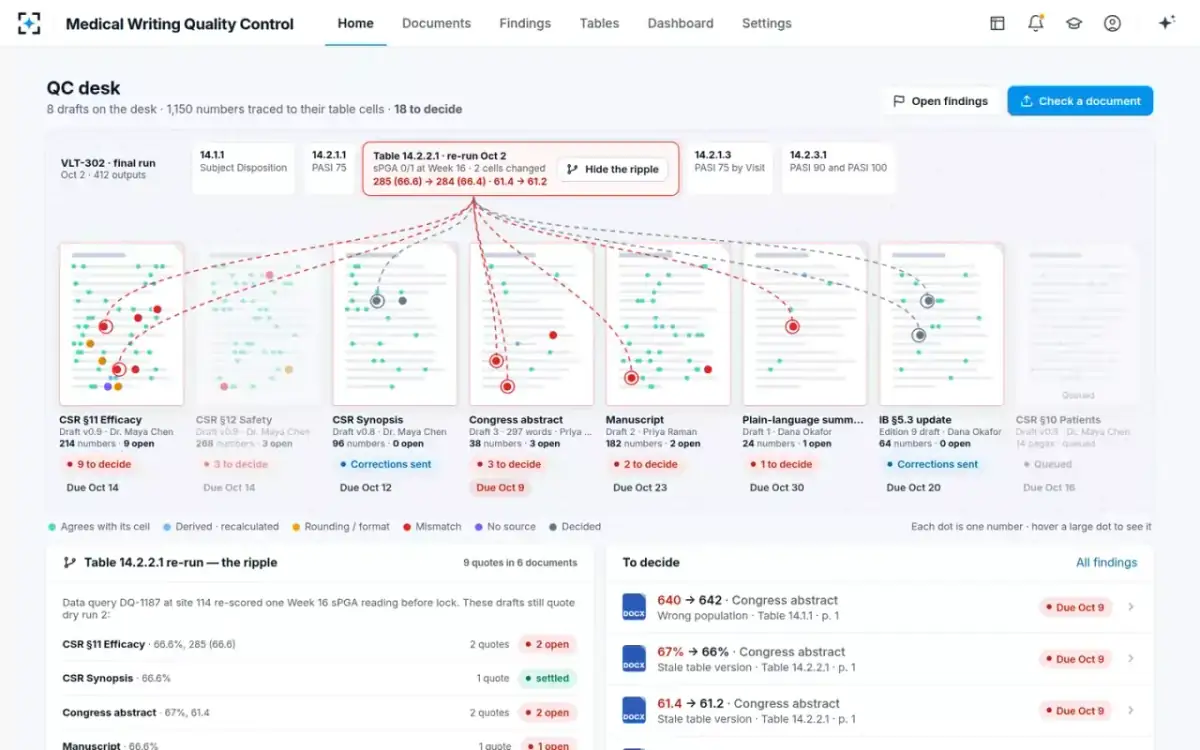
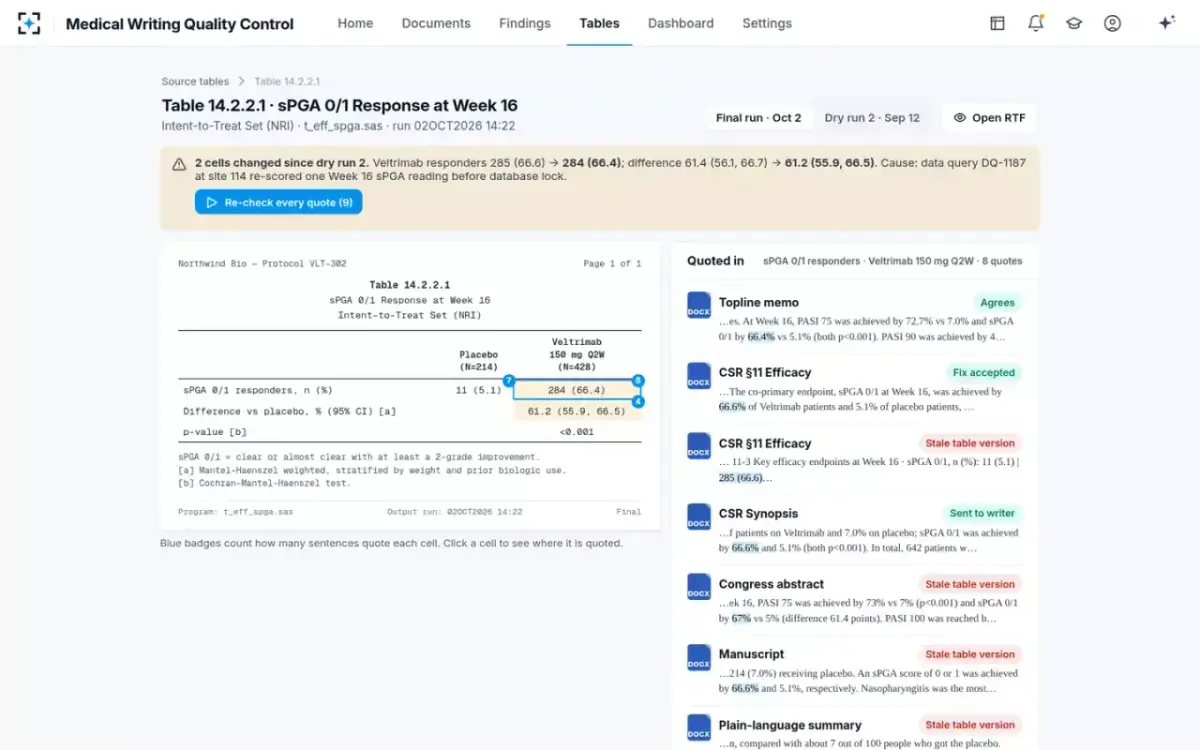
On the sample study, a data query raised against site 114 before database lock re-scored one week 16 assessment. The statistician re-ran the output on 2 October. Two cells moved: the Veltrimab responder count from 285 to 284, which is 66.6% to 66.4% of the 428 analysed, and the difference against placebo from 61.4 to 61.2 percentage points. Nothing about the study's conclusion changed. The clean-up was still nine sentences in six documents, three of which had already been settled and sent to their writers.
Twenty days between two runs, and the documents written inside them
- Dry run 2 is the newest output, and the six documents are drafted or reviewed against it20 days
That window is the structural problem, and it is not avoidable by discipline. Documents with external deadlines — a congress abstract, a manuscript revision, a safety update — have to be written before the final tables exist, and a dry run is what a writer is given. The question is not how to stop people quoting dry runs. It is how to know, on the day the final run lands, exactly which sentences were written against the old one.
The ripple from two changed cells, document by document
| Document | Why it quotes the changed cells | Status when the final run landed | Who corrects it |
|---|---|---|---|
| CSR section 11, Efficacy | The week 16 responder result and the difference against placebo are the section’s headline findings, stated in the text and again in an in-text table. | Open. In active review, against the dry run. | Lead medical writer, on her corrections list |
| CSR Synopsis | A stand-alone summary restates the primary result in full, because it may not cross-reference the section. | Settled. Correction already with the writer. | Lead medical writer |
| Investigator’s brochure, section 5.3 | Accumulated efficacy across studies quotes this study’s primary result. | Settled. Correction already with the writer. | Lead medical writer |
| Congress abstract | The primary outcome and effect size are required abstract content, and it was drafted from the dry run to meet the congress deadline. | Open, and due 9 October — the tightest deadline in the package. | Publications manager |
| Manuscript | The same result at length, drafted over the same window against the same dry run. | Open. | Lead medical writer and the author group |
| Plain-language summary | The result again, as a whole-number percentage for a non-specialist reader. | Open, and rounded from the superseded value. | Medical writer |
Do you have to document a change made after unblinding?
Yes, and the requirement is unusually specific. ICH E6(R3) treats a post-unblinding change as an exception that has to earn its place in the record: a departure from the planned analysis, or a change to the data once the blind is broken, must be documented clearly, justified, and kept to exceptional cases such as a discrepancy that has to be resolved for the results to be reliable (ICH E6(R3) §3.16.2(e)). The same paragraph adds that such data changes should be authorised by the investigator, reflected in an audit trail, and reported in the clinical trial report.
Three duties are stacked there, and they fail separately. A change can be justified and not reported. It can be reported and not traceable to the run that produced the new figure. It can be traceable and still leave four documents quoting the old value, because nothing in the requirement is about the documents. That last gap is where a results package quietly contradicts itself.
It is worth being precise about the sample study's case. The re-score at site 114 happened before database lock, so it is a data correction in the ordinary course rather than a post-unblinding change. The documents written against the dry run are the consequence either way: whether a change is routine or exceptional affects what has to be justified, not how many sentences have to be found.
Traceability: why every output is tied to its program, run and time stamp
The reason a re-run is tractable at all is that outputs are supposed to be identifiable. ICH E6(R3) requires sponsors to retain "the statistical programming records that relate to the output contained or used in reports of the trial results, including quality control/validation activities performed", and goes on: "outputs should be traceable to the statistical software programs, dated and time stamped, protected against any changes, and have access controls implemented to avoid inappropriate viewing of information that may introduce bias" (ICH E6(R3) §3.16.2(f)).
Read as a QC requirement, that sentence is a gift. If every output carries a program, a date and a time stamp, then "which run is this number from?" has an answer, and a document's numbers can each be pinned to one. In the solution that pinning is the unit of work: every finding cites the draft's page and sentence on one side and the output, row, column and run time on the other, so a reviewer is comparing two identified things rather than recalling where a figure came from.
The electronic-records rules make the same demand of the system that holds the trail. Under 21 CFR Part 11, a closed system has to keep secure, machine-generated, time-stamped audit trails that independently log every entry or action creating, changing or deleting an electronic record, and no change may hide the information recorded before it (21 CFR 11.10(e)). The second clause is the one that matters after a re-run: the old value does not disappear, which is precisely what lets a stale quote be explained rather than merely corrected.
What inspectors found when sponsors could not explain a re-run
The cost of losing that trail is on the public record. The MHRA GCP Inspectorate's metrics report for 2019–2020 describes, in one of four critical findings at a contract research organisation, a data integrity failure any statistician will recognise.
"Multiple runs of the statistical analysis had been taking place following and between each database snapshot. The records to demonstrate why these had taken place had not been maintained to allow reconstruction in a timely manner."
MHRA GCP Inspectorate, GCP Inspections Metrics Report, metrics period 1 April 2019 to 31 March 2020
The same finding continues: "the inspectees were unable to explain during interview, why the primary endpoint analysis had been repeated several times, even with the same data extract, the p-value of the primary endpoint analysis changed throughout these runs." Nothing in that passage says the analysis was wrong. It says nobody could reconstruct why it had been run again, and that a key result moved between runs with no account of why.
That is the inspection shape of the problem this page is about. Re-runs are normal. Re-runs with no record of their reason, and documents quoting whichever run was current when each author happened to look, are what an inspector finds. The defence is dull and effective: one named source of truth per study, a reason recorded against every re-run, and a list of which documents quote which cells of which output.
One re-run table, drawn to every quote of its changed cells
The synopsis problem: a stand-alone document restates every number
A synopsis looks like the easiest document in the package and behaves like the hardest, because it is not allowed to point anywhere. The ICH E3 questions and answers are explicit: "since the synopsis will be used as a stand-alone document within a Common Technical Document, it should be written so that it can be understood and interpreted on its own, i.e., without the other sections of a CSR", and "cross-references to other sections of the CSR should be avoided" (ICH E3 Q&A (R1), Question 2).
So the synopsis restates. Every primary and key secondary result it mentions is a second copy of a figure that also lives in a section, and every copy is a place the package can disagree with itself. On the sample study the synopsis was one of the two documents whose corrections had already been issued when the final run landed — which is the good case, and it still means a settled document had to be reopened.
The lesson is not that cross-references would be better; the guidance has its reasons, and a submission reader needs a synopsis that stands alone. The lesson is that a restating document needs its numbers linked to their sources in the working materials even when the published text cannot contain a reference. The link lives in the QC record rather than in the prose.
Finding every quote of a changed cell, document by document
The mechanical question is simple to state and tedious to answer: given two cells, find every sentence in every document that quotes either. A text search for "66.6" finds some of them and misses the ones that round to 67%, state the count 285 rather than the percentage, or quote the difference of 61.4 that was derived from the same cells. It also returns matches that are unrelated figures which happen to share the digits.
The clean-up chain after a re-run, and who owns each step
Agent
Table matcherCompares the final run with the superseded one, lists which cells changed — 2 on this table, out of a package of 412 outputs — and finds every quote of those cells across every draft, by what each number is rather than by its digits.
Never: Never matches against a superseded run without flagging it
Agent
Cross-document checkerChecks that the drafts agree with each other and with documents already signed, so a settled synopsis and an open section cannot disagree unnoticed.
Never: Reports disagreements; never picks a winner
Agent
Rule checkerRe-checks each quote against the final run and gives it a type, a reason a writer can act on, and a suggested fix — recalculating the derived figures rather than matching them.
Never: Never marks a finding resolved
A person decides
QC leadDecides every finding: accept the fix, ask the statistician, remove the sentence, or keep it as written with a reason on the record.
Agent
QC report writerWrites the comment log and a corrections memo per writer, citing both locations for each finding.
Never: Never edits a draft, and never signs
A person decides
The document’s authorMakes the change in her own document; the QC lead then signs the QC record against the named results package.
Two design choices in that chain are worth naming because they are where this kind of tool usually goes wrong. The agents match on what a number is — statistic, endpoint, arm, visit, population — not on its digits, which is what lets them find the rounded and the derived quotes. And they never resolve a finding: the verdict is a comparison, the decision is a person's, and the record carries who decided and when. The checks behind each verdict are set out in what a QC reviewer checks, and the population half of them in which denominator each number needs.
A superseded run is evidence, never a source of truth
When a stale number is found, the useful next question is not "what should it be" but "where did it come from". A figure that matches no output at all is a different problem — possibly a transcription error, possibly a number with no source — from a figure that matches the dry run exactly. The second has an explanation, and the explanation is what a writer needs in order to trust the correction.
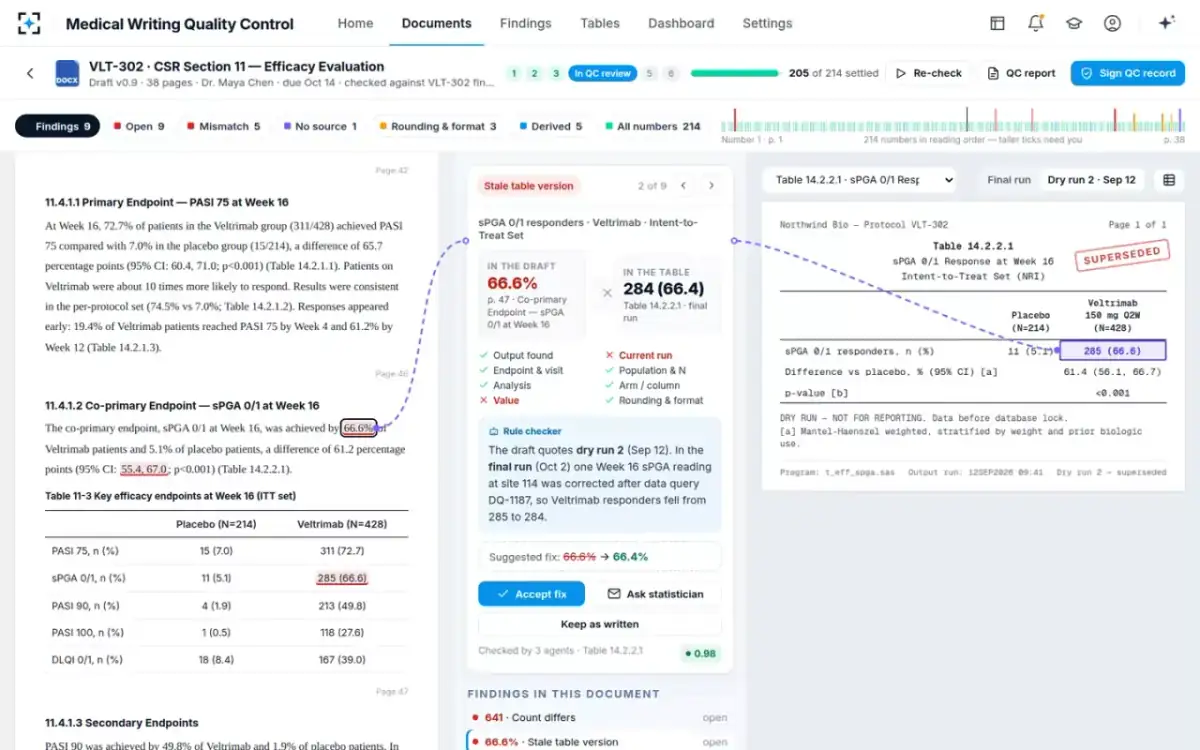
That is why the solution keeps superseded runs available and stamps them. The sample study's dry run of 12 September carries its own footnote — a dry run, not for reporting, data before database lock — and holds 285 with 66.6% in the cell the draft quotes. Switching to it answers the question in one step. The verdict, though, is always taken against the final run: a number that matches only a superseded run is flagged with where it came from, never passed. Whether that flag is on is a setting, and leaving it off is how a package ends up with two internally consistent stories.
The superseded dry run, stamped, holding the cell the draft still quotes
A table and every quote of it, for the statistician who changed the cell
To see a re-run traced from the table to every quote of it, and the QC record signed against a named run, start from Medical Writing Quality Control.
Questions people ask
Amendment or addendum to a clinical study report: which do you use?
An amendment reissues the report at a new version with the change in place; an addendum leaves the report alone and adds a separate signed document beside it. Sponsors generally amend when the change is pervasive or moves the conclusions, and add an addendum when a discrete analysis or output changed after the report was finished. Neither ICH E3 nor ICH E6(R3) defines either term, so the sponsor's own procedure decides — and whichever is chosen, the change has to be documented, justified, traceable to its program and run, and reported in the report.
Which documents have to be re-checked when a table is re-run?
Every document that quotes a changed cell of the output. The new run, dated and time stamped, becomes the only source that may be quoted, and every document that quoted the previous run has to be found and re-checked, including documents already signed or submitted. The re-run itself also needs a recorded reason: the MHRA has cited a contract research organisation whose staff could not explain, during interview, why a primary endpoint analysis had been repeated several times, with the p-value changing between runs.
Does a signed CSR section have to be re-approved when a table changes?
If the changed cell is quoted in it, yes — the signed version now states something the current tables do not, and the correction has to go through whatever approval the original text had. If the cell is not quoted in it, the useful output of the check is the evidence that it is not: a ripple map that shows which documents are affected is also proof of which are not, and that is what keeps a correction from becoming a re-review of the whole package.
What records must be kept for a re-run statistical output?
ICH E6(R3) §3.16.2(f) asks sponsors to retain the statistical programming records relating to any output used in reports of the trial results, including the quality control and validation activities performed, and requires outputs to be traceable to the programs that made them, dated, time stamped and protected against change. In practice that means the program, the run, the time, the reason and the QC evidence — enough for someone else to reconstruct why this version exists.
Can a synopsis cross-reference the section instead of restating the number?
No. The ICH E3 questions and answers say a synopsis is used as a stand-alone document within the Common Technical Document and should be understandable on its own, and that cross-references to other sections of the report should be avoided. So the synopsis restates every key result, and each restatement is a copy that has to be re-checked when its source cell moves.
How do you find every document that quotes a changed table?
Not by searching for the digits: the same cell is quoted as a count, as a percentage, rounded to a whole number and inside a derived difference, and a digit search finds one of those four and plenty of false matches. What works is holding, for every number in every draft, the output, row, column and run it was checked against — then a changed cell is a lookup rather than a search. On the sample study that turned two changed cells into a list of nine quotes in six documents, with the rest of the package demonstrably untouched.