A late-stage drug trial ends in hundreds of statistical tables,1 and a family of documents that repeat their numbers in sentences. Medical writing quality control, or QC, is the check that each of those numbers still says what its table says, about the right patients, before the document leaves the team. The reviewer keeps the draft and the tables open side by side and checks one number at a time.
This guide is for anyone who writes, checks, signs or pays for results documents: medical writers and QC reviewers, biostatisticians and statistical programmers, publications managers, quality teams, and the leaders deciding whether to automate this check. No background needed.
Imagine you are the QC lead for medical writing at a biotech company, Northwind Bio. Your team is reporting VLT-302, a late-stage psoriasis trial of a drug called Veltrimab: 642 patients. Eight drafts sit on your desk, including the section of the clinical study report, or CSR, on whether the drug worked, a congress abstract due October 9, and a summary for patients.
Page 47 of that section says 66.6% of patients on Veltrimab reached clear or almost clear skin. That section alone quotes 214 numbers, and your reviewer has been ticking each one against the statistics team's tables, a line at a time.
On October 2 the final tables arrive. A question to trial site 114, called a data query, had re-scored one patient's skin reading at Week 16, so that patient no longer counts as reaching clear or almost clear skin. Table 14.2.2.1 changed in two cells. Nobody edited the drafts, so every sentence still reads perfectly.
Table 14.2.2.1 · dry run 2, Sep 12
Row
sPGA 0/1: clear or almost clear
Column
Veltrimab (N=428)
Cell
285 (66.6)
The draft says
66.6%
Table 14.2.2.1 · final run, Oct 2
Row
sPGA 0/1: clear or almost clear
Column
Veltrimab (N=428)
Cell
284 (66.4)
The draft says
Still 66.6%
9 quotes6 documentsstill carrying the old values, including an abstract due in a week.
The conclusion stands: the drug still works. But the patient summary says 67 out of 100, a number that no longer exists, and the only way to find it by hand is to re-read finished documents looking for a value nobody flagged.
Careful QC catches the sentence on page 47, and then answers the harder question: where else did we quote that cell?
Medical writing QC: the checks on every number, the rules behind them and where they fail
What a QC reviewer does, what governs it, how numbers go wrong in results documents, what inspectors have found, and what regulators say about AI, explained without selling anything. If you are new to clinical reporting, start here.
01 · In plain words
Every results document repeats numbers from a table, and someone has to check each one
When a clinical trial finishes, statistical programmers run the analysis and produce files called tables, listings and figures, or TLFs. A review posted as a preprint, not yet peer reviewed, puts a late-stage (Phase 3) trial at 200 to 500 of them.1 These files are the official answer to what the trial found. A medical writer turns them into sentences: the clinical study report for regulators, then a short synopsis, a congress abstract, a journal paper, a summary for patients and an update to the brochure investigators use.
Each of those documents copies numbers out of the same tables by hand, at different times and by different people. A copy can go wrong in dull ways, such as a typo, the wrong column or a percentage from the placebo group. Or it can read perfectly and still be wrong: a percentage that divides by everyone assigned to the drug (randomized) when the sentence is about everyone who took it (treated), or a figure from a sensitivity analysis, which re-tests a result under different assumptions, quoted as the main result.
So before a document goes out, a second person checks it. That person opens the draft on one side and the tables on the other, finds the source of each number, and ticks it or writes a comment. A second reader catches what the author's eye slides over, because the author sees the number they meant to type. Writers call this step quality control, or QC. Quality specialists sometimes call the same people data integrity reviewers.2
The hardest case is a table that changes after the words are written. A programmer re-runs it. Nothing in any draft changes by itself, and nothing on the page shows that a sentence is now out of date. Each quote is a small trap, waiting in a finished document, until someone remembers to look.
From statistical tables to a signed QC record, in five steps
Statistics delivers the results tablesVLT-302's final run lands on October 2: 412 outputs under the statistical analysis plan, the document that fixes the analyses in advance.
Writers restate them in documentsReport sections, synopsis, abstract, manuscript, patient summary, brochure update.
QC checks every number against its cellValue, patients, analysis, table version and format, recorded with both locations.
Writers correct, statisticians answerAccepted fixes go to the author; "which number is right?" goes to the biostatistician.
The QC lead signs the recordA named person states what was checked, against which run, with each decision kept.
Step 3 is the subject of this guide. The study, people and figures in this example are fictional.
Ticking 214 numbers, invisible errors and two more QC surprises
Most ticks find nothing
In the fictional study, 94.5% of numbers match on the first pass. A reviewer spends days confirming the agreement to reach the few that matter, and attention follows the odds.
We found no guideline that names this step
ICH E6(R3), the international guideline on good clinical practice, asks for risk-based QC of data handling and documented QC of programming and outputs.3 The check of text against tables, and how much of it to do, is your own procedure.
A tenth of a point can be a real error
52.1% and 52.2% look like rounding. In the example, they are two different groups of patients, and only one of them is what the sentence claims.
We found no published error rate
We found no public figure for wrong numbers per CSR at QC, or for how many a QC pass catches. Published studies measure journals and registries instead.
TLF, final run, stale quote and denominator defined
TLF
A table, listing or figure from statistical programming, also called an output. Every result in a document should trace to one.
Run
One execution of the programs that make the outputs. Each run has a date and time, and the final run is the one a document should quote.
Stale quote
A number copied correctly from a run that has since been replaced. It agrees with an old table and disagrees with the current one.
Denominator
The group a percentage divides by. Different analysis sets have different denominators, so the same count can give different percentages.
What a CSR QC reviewer tests on each number: value, patients, analysis, run and format
In shortQC of a results document asks five questions of every number. Only the last concerns style. A proofreading pass reads the document against itself, and these checks need the tables open beside it, which is why they take days and why spelling software cannot do them.
The European Medical Writers Association's journal defines QC as ensuring "a document's content, style, and format are of high quality", and adds that "a good QC review takes time".4 One experienced specialist describes checking "against source data" and "for consistency", and warns that proofreading software "will not identify issues with analytical statements or incorrect data".2
A published walkthrough from a contract research organization, or CRO, a company hired to run trial work, gives a working order: format, then table numbers against their sources, then numbers in the text, then conclusions and the synopsis against the body, then language and references. Each number error goes back to the author as a comment with the corrected value, and a signed checklist closes the job.5
The check
The question
What fails it, from the fictional study
1. Value
Do the digits match the cell?
The text says 641 patients. Table 14.1.1 says 642.
2. Patients
Is it the group the sentence names, with the right denominator?
A "per-protocol" sentence quotes 27.6%, the intent-to-treat value. The per-protocol value is 28.7%.
3. Analysis
Is it the primary analysis, the trial's main planned one, unless the sentence says otherwise?
The interval 55.4, 67.0 is from an unstratified sensitivity table. The primary analysis gives 55.9, 66.5.
4. Run
Is it from the current output?
66.6% matches dry run 2 of September 12. The final run says 66.4%.
5. Format
Does it follow the house rules, your team's written rules for rounding and notation?
"p=0.000" should read p<0.001. "39%" should read 39.0% in this report.
Per-protocol means the patients who followed the protocol closely enough. Intent-to-treat means everyone randomized, or as close as possible. Section 05 explains both.
Only a reader with the tables open sees all five kinds of error
Blind to itSometimesSees it
Spell and style toolsComparing two versionsA reader with the tablesA programmed number checkWrong valueSometimesSometimesSees itSees itWrong patients or denominatorBlind to itBlind to itSees itSometimesWrong analysisBlind to itBlind to itSees itSometimesStale runBlind to itSometimesSees itSometimesHouse formatSees itSometimesSees itSees it
Our reading of the sources2,5 · Our classification of what each method can see. A programmed check depends on what it was told to compare, so it sees some patient, analysis and run errors only if it is given that context.
Show the numbers
Spell and style tools
Comparing two versions
A reader with the tables
A programmed number check
Wrong value
Sometimes
Sometimes
Sees it
Sees it
Wrong patients or denominator
Blind to it
Blind to it
Sees it
Sometimes
Wrong analysis
Blind to it
Blind to it
Sees it
Sometimes
Stale run
Blind to it
Sometimes
Sees it
Sometimes
House format
Sees it
Sometimes
Sees it
Sees it
Proofreading, QC, quality assurance and audit: four jobs people confuse
ICH E6(R3) gives quality assurance and quality control separate subsections.3
The job
What it does
Proofreading
Tests a document against itself and a style sheet
Quality control
Tests it against evidence outside it: the tables, the analysis plan and the other documents. In E6(R3), QC is "applied using a risk-based approach to each stage of the data handling"3
Quality assurance
Runs throughout the trial and uses risk-based strategies to find causes of serious noncompliance3
Audit
Evaluates whether the processes are appropriate to ensure compliance. E6(R3) keeps it independent of routine QC3
Ask a QC reviewer to "do the QA" and you have asked for the wrong thing. Show an inspector an assurance procedure when they ask for QC records and you have answered a different question.
Derived numbers need their own step. ICH E3 says "estimated or derived values, if used, should be identified in a conspicuous fashion" in tables.6 In text, "about 10 times more likely" or a difference between two groups usually has no cell to tick, so the reviewer rebuilds it from the cells it came from. Section 06 works one through.
03 · The rules as of 2026
No ICH guideline says "check 100% of CSR numbers": what E3, E6(R3), E9 and Part 11 do ask
In shortRegulators hold the sponsor responsible for accurate results and documented QC of the outputs. The exact depth of a text-to-table check is your own procedure, and it must be documented. E6(R3) is the guideline that changed most recently, and it makes outputs traceable to their programs and runs.
First, the names. ICH, the International Council for Harmonisation, writes guidelines that regulators such as the US Food and Drug Administration (FDA) and the European Medicines Agency (EMA) then publish as their own: E3 on the structure of a study report, E6 on good clinical practice and E9 on statistical principles. 21 CFR Part 11 is FDA's rule on electronic records and signatures. The sponsor is the company responsible for the trial.
The rules behind a CSR number span 1995 to 2027, and E6(R3) is the one still moving
Nov 30, 1995ICH E3 final
The structure of a clinical study report. EMA's page lists no revision; we found none adopted.
Feb 5, 1998ICH E9 final
Defines the full analysis set and the set for safety analysis.
Jul 6, 2012E3 Q&A (R1)
E3 "is a Guideline, not a set of rigid requirements or a template".
Apr 14, 2025CONSORT 2025
The reporting checklist for randomized trials, updated, including what a trial abstract should carry.
Jul 23, 2025E6(R3) in effect in the EU
Principles and Annex 1. FDA published its version in September 2025.
Jan 15, 2027E6(R3) Annex 2 in effect in the EU
An added part of the guideline. ICH adopted it June 3, 2026, and EMA's medicines committee, CHMP, June 25, 2026. We found no final FDA notice on Annex 2.
QC "should be applied using a risk-based approach to each stage of the data handling"3
How much of a document's text to check, and who does it
ICH E6(R3) 3.16.2(b)
"Appropriate and documented quality control of statistical programming and data analysis", naming "outputs for clinical trial report"3
The method: double programming (two programmers build one output separately and compare), spot checks, or both
ICH E6(R3) 3.16.2(d)–(e)
Analysis-set criteria pre-defined; changes to data after unblinding, when the team learns who received what, "should be reported in the clinical trial report"3
Where in the report, and how a change reaches the other documents
ICH E6(R3) 3.16.2(f)
Outputs "traceable to the statistical software programs, dated and time stamped, protected against any changes"3
How a writer knows which run a sentence came from
ICH E3 and E3 Q&A
Summary tables may sit in the text with the rest in section 14; the synopsis "should include numerical data"; changes after blind-breaking "should be identified"6,7
Template, section numbers, and which numbers to repeat
ICH E9 5.2 and 6.3
The full analysis set for primary analysis in superiority trials; a safety set "usually defined as those subjects who received at least one dose"10
The exact definitions, in your analysis plan
21 CFR Part 11
Validation for accuracy, reliability and "consistent intended performance", audit trails, signed records that show the signer's name, the date and time and the meaning, linked to the record13
Your validation and procedures. No product can be certified to it
21 CFR 314.125(b)(7)
FDA may refuse to approve an application that "contains an untrue statement of a material fact"14
Accuracy is yours, whoever or whatever made the copy
42 CFR 11.64(b)
Errors in registry results on ClinicalTrials.gov are corrected within 25 calendar days of a notice, or of learning of them15
Knowing the registry record quotes the same cell
Quality that shows up on the record. E6(R3) section 3.16.2(f) also asks the sponsor to retain programming records "including quality control/validation activities performed". A QC step that leaves only a signature cannot show what it covered. The UK inspectorate's report below gives an example: QC that could not be verified from the records.
04 · Documents that restate a table
From CSR section to patient summary: the documents that quote one results table
In shortThe CSR is the largest document that quotes the tables, and rarely the first one out the door. A synopsis, abstract, manuscript, lay summary, brochure and registry entry repeat the same results, under different rules for rounding and patient groups, on different deadlines.
ICH E3 lays out the report at different levels of detail: overall summary tables "may be placed in the text to illustrate important points", other tables go in section 14, and patient-level listings in appendix 16.2.6 Every number in the text is therefore a restatement, and most of the report's pages are outputs. Across 78 industry reports studied by Doshi and Jefferson, a non-random sample, the efficacy text had a median of 13.5 pages while the tables behind the report ran to 337.16
The words are a thin layer over the tables they quote
Median pages per section, 78 clinical study reports
Efficacy listings447 pages
Tables337 pages
Safety evaluation text17 pages
Efficacy evaluation text13.5 pages
Synopsis5 pages
Source16 · A non-random sample, dated 1991 to 2011; the authors cannot say it is representative.
Show the numbers
Part of the report
Median pages
Efficacy listings
447 pages
Tables
337 pages
Safety evaluation text
17 pages
Efficacy evaluation text
13.5 pages
Synopsis
5 pages
Document
What it restates
The trap that sits on it
CSR sections 10–12
Patients, efficacy and safety results, in text and in-text tables
Volume, and in-text tables typed instead of copied
CSR synopsis
The main results, with "numerical data to illustrate results"6
Often written early, so it drifts from the body
Topline memo
First results for leadership
Fast, informal, and then copied by everyone else
Congress abstract
Numbers randomized, numbers analyzed, a result for each group with effect size and precision, and harms11
A deadline that falls before the final tables; whole-number rounding
Journal manuscript
Primary results and tables redrawn for the journal
Months in review while the tables move on
Plain-language summary
Results as "about 66 out of 100 people"
Rounded and reworded, so a text search misses it
Investigator's brochure
Results from earlier and current trials
An edition cycle of its own, on another team's calendar
Registry results
Outcome data on ClinicalTrials.gov, generally due within a year of primary completion for applicable trials17
A public record, with its own 25-day correction clock15
EU results summary
Results and a lay summary, within one year of the trial's end in all Member States concerned18
Written from the tables by another team, often well before the journal paper
One study's documents put more than a thousand numbers in front of QC
Numbers quoted by each draft in the fictional VLT-302 study
CSR Section 12, safety268 numbers
CSR Section 11, efficacy214 numbers
Journal manuscript182 numbers
CSR Section 10, patients142 numbers
CSR synopsis96 numbers
Brochure update64 numbers
Congress abstract38 numbers
Plain-language summary24 numbers
Fictional example from this guide · We found no public figure for numbers per CSR. Count yours from one finished section.
Show the numbers
Draft
Numbers quoted
CSR Section 12, safety
268 numbers
CSR Section 11, efficacy
214 numbers
Journal manuscript
182 numbers
CSR Section 10, patients
142 numbers
CSR synopsis
96 numbers
Brochure update
64 numbers
Congress abstract
38 numbers
Plain-language summary
24 numbers
05 · Denominators and analysis sets
Safety analysis set or randomized patients: how one denominator changes a CSR percentage
In shortA percentage is a claim about a group of patients. A trial usually carries at least three groups: everyone randomized, those who kept to the protocol, and those who took the drug. Divide by the wrong one and the digits still look right, which is why this error survives reading.
Does assigning this treatment work? In superiority trials, this set carries the primary analysis10
N=428
Per-protocol set
Those who followed the protocol closely enough
A supportive look. ICH E9 warns it can overstate the effect10
N=404
Safety set
"Usually defined as those subjects who received at least one dose"10
What happened to people who took it?
N=427
Why 223 patients give 52.1% in one sentence and 52.2% in another
In the fictional study, 428 patients were randomized to Veltrimab and 427 took at least one dose. In the safety table, 223 of them had a treatment-emergent adverse event, one that started or worsened during treatment. A topline memo says 52.1%. The table says 52.2%. Work it through: 223 ÷ 428 = 52.10%, and 223 ÷ 427 = 52.22%. The memo divided by the wrong group.
A one-patient difference in the denominator moves a safety percentage by a tenth
Divided by those randomized (428)Divided by those treated (427), the safety set
Any treatment-emergent event (223 patients)52.1%52.2%
Nasopharyngitis, a common cold (52 patients)12.1%12.2%
Fictional example from this guide · Fictional study.
Show the numbers
Row in the safety table
Divided by those randomized (428)
Divided by those treated (427), the safety set
Any treatment-emergent event (223 patients)
52.1%
52.2%
Nasopharyngitis, a common cold (52 patients)
12.1%
12.2%
A reviewer who sees a tenth of a point assumes rounding, and is usually right. That is how the rare case of the wrong patient group gets through. Published errors follow the same shape: when one research team tried to reproduce numbers taken from trials into meta-analyses, studies that pool many trials, the common problems were an "erroneous number of patients, means, standard deviations, and sign for the effect estimate".19
The right number from the wrong analysis set
Population errors can also leave the digits untouched. A sentence on page 48 of the fictional report says the per-protocol set reached PASI 100, complete skin clearance, at 27.6%. That number exists: Table 14.2.3.1 shows 118 of 428 in the intent-to-treat set, 27.6%. The per-protocol figure, in Table 14.2.3.2, is 116 of 404, or 28.7%. Two fixes are possible, changing the number or changing the words, and the choice depends on what the writer meant to claim. A person with the analysis plan has to choose.
What the sentence names
Set
Per-protocol
Value
27.6%
Comes from
Table 14.2.3.1, intent-to-treat
What the plan says it should be
Set
Per-protocol
Value
28.7%
Comes from
Table 14.2.3.2: 116 of 404
The abstract has the same problem in miniature. It says 640 patients were randomized. That is the safety set across both arms. The randomized count is 642.
06 · Rounding and derived numbers
Rounding a percentage twice, SAS and R ties and "about 10 times": the arithmetic of a CSR check
In shortRound once, from the table's unrounded value, by a rule written down. Rounding twice can change a digit. Software disagrees about ties, so programmers and writers must use the same rule. Differences and ratios often have no cell, so they are rebuilt by hand.
How rounding 4.449 twice turns a correct 4.4% into a wrong 4.5%
A safety table shows 19 of 427 patients with an event, printed as 4.4%. The draft says 4.5%, because someone rounded twice, in two reasonable-looking steps.
Rounding twice moves 19 of 427 from 4.4% to 4.5%
1Exact value
19 ÷ 427 = 4.449…%
Calculator4.449
2First rounding
To two decimals: 4.45
An intermediate copy4.45
3Second rounding
To one decimal: 4.5
The draft, and wrong4.5
4Rounded once
4.449 to one decimal: 4.4
The table, and correct4.4
Fictional example from this guide · Fictional study numbers, ordinary arithmetic.
Show the numbers
Step
What happens
Who
Time
Exact value
19 ÷ 427 = 4.449…%
Calculator
4.449
First rounding
To two decimals: 4.45
An intermediate copy
4.45
Second rounding
To one decimal: 4.5
The draft, and wrong
4.5
Rounded once
4.449 to one decimal: 4.4
The table, and correct
4.4
Why SAS ROUND and R round can disagree on a percentage ending in 5
SAS and R, two programming languages used for trial statistics, treat a tie, a value exactly halfway between two rounded values, differently. SAS's ROUND function uses what its blog calls the traditional method, which "rounds the midpoint between two integers away from zero", so 2.5 becomes 3; SAS also offers ROUNDE, which rounds to even.20 R's round is documented to follow IEC 60559, "go to the even digit", so 2.5 becomes 2 and 0.5 becomes 0, and the same page warns that stored values matter: round(0.15, 1) "could be either 0.1 or 0.2".21
A CRO program in one language and a sponsor check in another can therefore print different digits from the same data. Clinical programmers also report comparison differences "on numbers that appear identical", because of how computers store decimals.22 A QC reviewer needs one answer: which rule did the table use? Write it in the house rules.
Same answer, so a spot check on this row proves nothing
66.5
67
66
An abstract in whole numbers can honestly differ by one
Rebuilding differences, ratios and "67 out of 100" from their cells
Three kinds of number need extra care, because the figure in the sentence is more than a straight copy of one cell.
Rebuild and compare
A difference between groups
It may be adjusted. In the example, the table's 61.2 comes from a stratified method named in its footnote, one that analyzes patient subgroups and combines them, so 66.4 minus 5.1 gives 61.3 and that subtraction is the wrong check. A reviewer compares it with the printed cell.
Rebuild and judge
A ratio in words
"About 10 times" is rebuilt and judged against a house rule: 72.7 ÷ 7.0 = 10.4, which is fair to call about 10.
Round once
A plain-language figure
It rounds once from the table: 66.4% is about 66 out of 100, and the draft's 67 came from the old 66.6%.
The worked formula a reviewer applies to any percentage is short. Find the count and the denominator in the cell. Divide. Round once, by the house rule. Compare with the sentence, and compare the denominator with the group the sentence names.
percentage = count ÷ denominator of the set the sentence names × 100, rounded once from the unrounded value
07 · When a table is re-run
Re-run TLF impact on a CSR: one changed cell, nine quotes and why a sample misses them
In shortA late re-run is the dangerous case. The old value lives on in documents nobody plans to reopen, and no reading of those documents can reveal it. Sampling numbers fails here, because a stale quote sits in particular cells. Only a list of every quote of that cell answers the question.
Runs happen for good reasons. A data query corrects a reading, QC finds a programming error, a reviewer asks for a change. ICH E6(R3) wants outputs "dated and time stamped", so the run is knowable.3 The hard part is the other direction: from a changed cell to every sentence that quotes it.
The UK inspectorate described the opposite of good practice in a critical finding at a contract research organization: multiple runs of a statistical analysis, no maintained records of why they had taken place, and a p-value for the primary endpoint, the trial's main measure, that "changed throughout these runs".23
A dry run is a rehearsal before database lock, the point when trial data are frozen for analysis. In blinded trials, where the team does not know who received what, it commonly uses dummy treatment codes: one published analysis plan marks its drafts "DRAFT/DUMMY TREATMENT ASSIGNMENTS APPLIED",24 and programmers preparing data monitoring packages work on dummy treatment too.25 Numbers from such a run should never reach a sentence as results.
Drafting from unfinished tables still happens. One medical writing paper calls reporting from draft tables a "commonly used strategy" and advises against it, since changes in the final tables force changes in the report.26 The fictional study labels its older run "dry run 2", and it shows real values by treatment arm. Treat that as a label for any superseded run.
What one data query did to VLT-302's documents
One corrected reading at one site reached six documents
Sep 12Dry run 2
Table 14.2.2.1 shows 285 (66.6) responders and a difference of 61.4. Writers draft from it.
Before lockData query DQ-1187
Site 114 re-scores one Week 16 skin reading, so one patient stops counting as a responder.
Oct 2Final run
412 outputs. Two cells change in this table: 284 (66.4) and 61.2 (55.9, 66.5).
Oct 2 onwardNine old quotes remain
In the report, synopsis, abstract, manuscript, patient summary and brochure update.
Oct 9Abstract deadline
The first document out carries two of the nine.
Fictional example from this guide
Show the numbers
When
What
Sep 12
Dry run 2
Before lock
Data query DQ-1187
Oct 2
Final run
Oct 2 onward
Nine old quotes remain
Oct 9
Abstract deadline
The same two cells were quoted nine times across six documents
Quotes still carrying an old value, by document
CSR Section 1166.6%, 285 (66.6)2
Congress abstract67%, 61.42
Brochure update66.6%, 61.42
CSR synopsis66.6%1
Journal manuscript66.6%1
Plain-language summary67 out of 1001
Fictional example from this guide · Notice the rounding: a search for 66.6 finds only some of them.
Show the numbers
Document
Old-value quotes
CSR Section 11
2
Congress abstract
2
Brochure update
2
CSR synopsis
1
Journal manuscript
1
Plain-language summary
1
Why a 20% QC sample almost never finds all nine stale quotes
Many procedures check a sample of numbers and accept the rest. For random typing errors, that gives an estimate of quality. For a re-run it fails, because the nine stale quotes are specific. If each number has the same chance of being sampled, the expected share found is the sample rate, and the chance of finding all nine is that rate multiplied by itself nine times. That is arithmetic, and we have not measured it on real QC.
Only a full check finds all nine stale quotes with any confidence
Chance, by share of numbers checked at random
Expected share of the nine foundChance all nine are found
0%25%50%75%100%100%100%
10%25%50%75%90%100%
Illustrative · replace with your own numbers · Rate to the ninth power. Replace nine with your own count.
Show the numbers
Expected share of the nine found
Chance all nine are found
10%
10%
0%
25%
25%
0%
50%
50%
0.2%
75%
75%
7.5%
90%
90%
38.7%
100%
100%
100%
That does not make every procedure a bad one. ICH asks for risk-based QC, and a sampled pass with a written reason can fit that.3 It means a re-run deserves its own step: after every run, list what changed and find every quote of those cells. Whether you do that by searching files, by keeping a table of quotes, or with software, the record should show it was done.
08 · How often numbers disagree
How often a restated number is wrong: what journals and registries show when someone checks
In shortWe found no published error rate for clinical study reports, or for how many errors a QC pass catches. Studies of similar acts, restating a result from a source, find disagreement in a fifth to about seven in ten documents, depending on what was measured. Treat these as what happens elsewhere, and measure your own.
When researchers re-check restated results, a large share of documents disagree
Share of documents or trials with a disagreement, by what was checked
Pilot surgical trials: abstract against main text, any inconsistency, 202569.4%
Meta-analyses of standardized mean differences: data against the trial, any error, 200763%
Psychology papers: p-value against its own test statistic, 201650%
Cardiology trials: meeting abstract against full paper, primary effect, 200641%
Nature papers: p-value against test statistic, 200138%
BMJ papers: same test, 200125%
Phase 3–4 trials: registry against paper, primary outcome value, 201420%
Source27,28,19,29,30,31 · Different fields, objects and methods, so never average them. None is a CSR. The 50 is the authors' "half". The 69.4 also counts stronger conclusions, omitted results and different outcomes.
Show the numbers
Study and what was compared
Share
Pilot surgical trials: abstract against main text, any inconsistency, 2025
69.4%
Meta-analyses of standardized mean differences: data against the trial, any error, 2007
63%
Psychology papers: p-value against its own test statistic, 2016
50%
Cardiology trials: meeting abstract against full paper, primary effect, 2006
41%
Nature papers: p-value against test statistic, 2001
38%
BMJ papers: same test, 2001
25%
Phase 3–4 trials: registry against paper, primary outcome value, 2014
20%
Study
What it found
What it says to a QC lead
García-Berthou and Alcaraz, 2004
11.6% of 181 results in Nature and 11.1% of 63 in BMJ were incongruent; at least one in 38% and 25% of papers27
A rate per number looks small; the rate per document is what ships
Toma et al., 2006
60 of 148 cardiology-meeting trials (41%) differed between meeting abstract and full paper on the primary outcome; in 20 (14%), the estimate was significant in only one of the pair29
Abstracts come early, and early numbers move
Gøtzsche et al., 2007
17 of 27 meta-analyses of standardized mean differences (63%) had an error in at least one of two trials checked; 10 of 27 could not be reproduced within 0.119
The causes are mechanical: patient counts, means, signs
Pitkin et al., 1999
Abstracts with data that conflicted with, or never appeared in, the article: 18% to 68% across six major journals32
Top journals and their editors did not stop it
Hartung et al., 2014
Of 110 trials, 22 (20%) reported the primary outcome value inconsistently between registry and paper30
Two public versions of one result can differ
Why reading harder does not fix a number check
Human checking by eye is weak in a way people do not expect. In one experiment, 195 undergraduates entered data by one of three methods. Those who checked their work by eye made 2,958% more errors than those using double entry, about 31 times as many, and did no significantly better than people who did not check at all.33 The participants were students entering data sheets, so read it as a warning about the method and nothing more.
It fits what QC specialists say. "It is extremely easy to add incorrect data to tables when working with source tables that are over a hundred pages long".2
Two in three people who checked data by eye still got a statistic wrong
66 in 100
of participants using visual checking produced an incorrect coefficient alpha, a common reliability statistic. Undergraduates entering data, 2011.
of participants using visual checking produced an incorrect coefficient alpha, a common reliability statistic. Undergraduates entering data, 2011.
66 of 100
09 · What inspectors found
"Deficient quality control of the CSR": what EMA, MHRA and FDA have written about reports and QC
In shortRegulators rarely report a wrong percentage as such. They report weak QC, thin records and reports that say what was planned in place of what happened. The risk runs from a finding at inspection to a refusal to approve, while one reviewer survey suggests data errors are already less common than wordiness.
The European Medicines Agency's inspectors publish a yearly list. For 2024, across 67 good clinical practice (GCP) inspections requested by its medicines committee, they recorded 335 critical and major findings, 11 of them critical. The clinical study report category holds 5, with 1 critical. Examples include "Deficient quality control of the CSR" and "Incomplete or inaccurate reporting of protocol deviations and key data in the CSR".34
Few findings name the report itself, while source records and data management draw far more
Critical and major findings, EMA-requested GCP inspections, 2024, selected categories
Source documentation38 findings
Data management27 findings
Statistical analysis7 findings
Clinical study report5 findings
Source34 · Selected from 335 findings. A CSR finding can start in any of the others.
Show the numbers
Category
Findings
Source documentation
38 findings
Data management
27 findings
Statistical analysis
7 findings
Clinical study report
5 findings
When an inspector cannot tell how much QC was done
The UK's Medicines and Healthcare products Regulatory Agency, the MHRA, reported on 36 GCP inspections for April 2019 to March 2020. One critical finding, at a contract research organization, concerned a response hard coded, written directly into the program in place of coming from the data, into part of a primary endpoint, with "insufficient documentation available to verify the level of QC of data which had been hard coded".23 QC that left no record could not be told apart from QC that did not happen.
When a CSR states what was planned in place of what happened
An FDA warning letter of November 27, 2024 faulted a sponsor whose report "reported dose levels for subjects as stated in the protocol", when mislabeled drug meant 80% of the protocol-required dose was given between March and June 2021.35 A table-to-text check would not catch that by itself, since the text matched the plan. It shows why the check needs data, and why a regulator treats it seriously: FDA may refuse to approve an application containing "an untrue statement of a material fact".14
What regulatory reviewers told a survey about document quality
Most reviewers surveyed say poor documents slow them down
Share of those answering: 23 on the first two statements, 19 on the last. 32 responses overall, reported as descriptive only
Poor quality impedes the assessment87%
Poor quality will delay approval77%
Send back over 10% of applications with questions from poor quality53%
Send back over 10% of applications with questions from poor quality
53%
Keep that in proportion. The same survey found length, repetition and lack of clarity reported most often, and data errors "ranked relatively low", which the authors read as a sign that "many applicants have implemented processes to catch these avoidable issues".36 QC is one such process: the checks may be working, and they still take reviewer days.
10 · How long QC takes
How long CSR QC takes, how much of it the industry does and what a late day is worth
In shortThe only public stage benchmark we found gives QA on a final CSR a mean of 6.6 working days, ranging from 1 to 30. No public figure exists for QC of an abstract or synopsis, or for what QC costs. Registry counts of completed late-stage trials show no rise since 2022, and AI drafting may add more text to check.
Hamilton's survey of participants at eight European medical writing conferences, 2008 to 2013, asked for typical durations on a moderately complex Phase 3 study of 200 to 400 subjects. Quality assurance on the final integrated report had a mean of 6.6 working days, with a range of 1 to 30, from 77 responses. The paper does not define that stage, so read it as the nearest public stand-in for a QC pass. It concludes there are "no industry standard durations".26
One QC specialist adds a warning: "It is not realistic for a consistency and data check to be performed in one day on a 100 page clinical study report!"2
From lock to final report, QA is the shortest of five stages in the only public survey
Mean working days by stage, moderately complex Phase 3 report
First draft to final25.7 days
Final tables to first draft16.9 days
Lock to draft tables13.9 days
Draft to final tables10.6 days
QA on the final report6.6 days
Source26 · Data from 2008 to 2013; 75 to 78 responses per stage. Stages may overlap, so a sum is only a rough total. The step before lock, last data to lock, has the same printed mean.
Show the numbers
Stage
Mean working days
First draft to final
25.7 days
Final tables to first draft
16.9 days
Lock to draft tables
13.9 days
Draft to final tables
10.6 days
QA on the final report
6.6 days
1.6–2×
the primary programming effort, spent again on double programming of outputs, according to a preprint review.1
medRxiv, 2026 · not peer reviewed
$500K
about one day of lost sales on average, if a late document holds up a filing. The same group's white paper says about $800,000.37,38
Tufts CSDD, 2024
How many CSRs and restated documents the industry produces
There is no public count of CSRs. A rough stand-in is the number of late-stage industry trials recorded as completed each year, read from ClinicalTrials.gov.39 FDA's drug center approved 55, 50 and 46 novel drugs in 2023, 2024 and 2025.40,41,42 The market for all medical writing is estimated at $3.94 billion to $5.43 billion for 2025, by two research firms whose public listings disagree and show no dataset;43,44 we found no figure for QC alone.
About 640 industry-led late-stage trials are recorded as completed each year
5702021
6982022
6692023
6562024
6152025
Source39 · Registry records, Phase 3 including Phase 2/3, status Completed, read November 3, 2026. Counting every status, terminated and unknown included, gives 796 to 988. Recent years can change as sponsors update records. A stand-in: this counts trials and leaves out reports.
Show the numbers
Completion year
Trials
2021
570
2022
698
2023
669
2024
656
2025
615
The trend pushing more text toward the QC desk
Generative drafting could put more text in front of reviewers. A 2026 paper from one drug company found AI-drafted sections on pharmacokinetics, how the body handles a drug, scored about 90% on reporting quality relative to manually written reports, in two blinded review sessions; every author is a current or former employee of that company.45 Whether that holds elsewhere is unknown, and we found no public figure for what it does to QC workload.
On the data side, the Analysis Results Standard from CDISC, the clinical data standards body (v1.0, April 2024), aims to deliver results as data that a computer can read,46 which would make matching a number to its result far simpler once tables stop being PDF and RTF files.
11 · AI and the 2026 rules
AI in medical writing QC: what FDA, EMA and the EU say in 2026, and what must stay with a person
In shortWe found no rule that forbids AI in checking a document, and none that excuses the sponsor from what it submits. FDA's guidance is still a draft and leaves out some writing uses. EMA expects close human supervision of generated text. Finding and comparing can be automated; deciding which number is right and signing should stay with a person.
Source and status, November 2026
What it says
What it means for QC
FDA, AI for regulatory decision-making, draft, January 2025
Does not address AI for "drafting/writing a regulatory submission" where the use does "not impact patient safety, drug quality, or the reliability of results"47
The condition matters. A check that decides what a result is comes closer to affecting "the reliability of results" than one that only finds numbers
EMA reflection paper, adopted September 9, 2024
Tools for "reviewing" product information need "close human supervision", since models can give "plausible but erroneous or incomplete output"48
Written about product information. By analogy, a QC tool's flags need a person, and so does its silence
EMA and FDA, ten principles, January 2026
Risk-based use, a clear context of use, the stated job the AI does, and data and analytical decisions documented in a traceable, verifiable way49
Principles with no new duties. Write down what the tool does and record what it compared
EMA, computerised systems in clinical trials, March 9, 2023
ALCOA++ (data that are attributable, legible, contemporaneous, original, accurate and more), audit trails, validation50
A QC record should show who did what, and when
ISPE GAMP Guide: AI, July 2025
Industry guidance on developing and using AI-enabled computerized systems in GxP areas51
A starting point for your quality team
EU AI Act, as amended by the AI Omnibus, Regulation (EU) 2026/1744
Published July 24, 2026, in force July 27, 2026; Annex III high-risk rules from December 2, 2027; product rules from August 2, 202852
Document QC is not a listed Annex III use on our reading. Ask counsel
EU good manufacturing practice (GMP) Annex 11 and draft Annex 22
EudraLex, the EU's medicines rulebook, lists Annex 11 at January 2011 and no Annex 22.53 The draft says large language models (LLMs) "should not be used in critical GMP applications";54 a June 30, 2026 EMA workshop report says "there may be viable pathways"55
The revised Annex 11 and Annex 22 are drafts, and both annexes concern manufacturing. They do not govern writing QC, though your quality team may borrow from them
FDA's Computer Software Assurance guidance, final February 2026, covers software in medical device production and quality systems,56 so it does not apply to this work either.
Which QC tasks suit automation, and which need a named person
Automate what can be checked afterward from cited evidence, and keep judgment with people
What a wrong call would cost →
Person decides
Person reviews
Spot-check
Automate
Which number is rightSign the recordSentence with no sourceEvery quote of a cellMatch to a cellDerived numbersHouse rounding
How well a rule can do it →
Our reading of the sources47,48,49 · Our judgment, and yours may differ. Place your own tasks.
Show the numbers
Item
How well a rule can do it (0–1)
What a wrong call would cost (0–1)
Which number is right
0.10
0.76
Sign the record
0.10
0.58
Sentence with no source
0.10
0.20
Every quote of a cell
0.78
0.68
Match to a cell
0.78
0.54
Derived numbers
0.78
0.30
House rounding
0.78
0.12
The limits of automated CSR number checking
A checker's confidence is a score, and a sponsor still needs evidence. Published evidence on automating this kind of work is thin: a preprint review of statistical programming found quantitative effectiveness data in only 12 of 527 validation papers, or 2.3%.1 Three limits apply to any tool, rule-based or AI.
Reading
Table layouts vary
Tables in RTF and PDF vary by programmer and CRO, so the first failures are often in reading.
Inference
Patient groups go unnamed
A sentence may imply a patient group without naming it, so a tool has to mark what it inferred.
Measurement
Agreement measures workload
High agreement can mean clean writing, a stable run or a weak checker. Only errors you plant yourself can tell them apart.
12 · How teams run QC today
How medical writing QC runs today: reviewer, writer, statistician and the hand-offs between them
In shortA writer finishes a draft and sends it to a reviewer who did not write it, usually near the end. The reviewer works through outputs and text, comments go back, and a statistician answers questions about numbers. Teams staff this in house, through a CRO, with scripted checks or with software, and by our estimate about half the time goes to finding and ticking.
QC lead to publications manager: who handles a results document
QC
QC lead, medical writing
Sets the procedure, assigns reviews, decides disputed findings, signs that the QC was done.
Cares about: what was checked, against which run, and whether the record will stand up.
MW
Medical writer
Writes the draft and makes the corrections. Should not QC their own document.
Cares about: which of my sentences still use an old run?
BS
Biostatistician
Owns the analysis and answers "which number is right?"
Cares about: I changed one cell, so who quoted it?
SP
Statistical programmer
Delivers the outputs and their runs, and validates them, often by double programming.1
Cares about: corrections reaching the text.
PM
Publications manager
Runs abstracts and manuscripts, often on congress dates set far ahead.
Cares about: writing to a deadline that falls before the tables are final.
Six hand-offs from a draft to a signed QC record
A number crosses six hand-offs between a draft and a signed QC record
1Draft sent to QC
Near-final document, with the outputs it quotes and a brief.
Writer to reviewerNear the end
2Format and tables
Heading numbers, in-text tables against outputs.
ReviewerNo public figure
3Numbers in the text
Each number found in its output and compared.
ReviewerThe largest part, our estimate
4Questions on numbers
Which analysis, which run, which is right?
Reviewer to statisticianWaiting time
5Comments returned
Number errors with the corrected value; inconsistencies named.
Near-final document, with the outputs it quotes and a brief.
Writer to reviewer
Near the end
Format and tables
Heading numbers, in-text tables against outputs.
Reviewer
No public figure
Numbers in the text
Each number found in its output and compared.
Reviewer
The largest part, our estimate
Questions on numbers
Which analysis, which run, which is right?
Reviewer to statistician
Waiting time
Comments returned
Number errors with the corrected value; inconsistencies named.
Reviewer to writer
No public figure
Check and sign
Corrections confirmed, checklist signed.
QC lead
No public figure
Where the days go when one CSR section is checked by hand
By our estimate, finding and ticking numbers takes about half of a by-hand CSR section check
Our split of the sample's 4.5 working days for one section
Ticking each number against its cell1.5 days
Finding each number and the output it should come from0.75 days
Patients, denominator, analysis and rounding0.75 days
Working out which run, and statistician questions0.75 days
Cross-checking the synopsis, abstract and other drafts0.5 days
Comment log, corrections and the QC record0.25 days
Illustrative · replace with your own numbers · Our estimate, for a section of about 214 numbers. The 4.5 days is the sample's own figure, and we found no public figure that splits QC time this way. Time one section of your own.
Show the numbers
Task
Days
Ticking each number against its cell
1.5 days
Finding each number and the output it should come from
0.75 days
Patients, denominator, analysis and rounding
0.75 days
Working out which run, and statistician questions
0.75 days
Cross-checking the synopsis, abstract and other drafts
0.5 days
Comment log, corrections and the QC record
0.25 days
One sum shows why teams feel this. At an illustrative three minutes a number, 214 numbers take about 10.7 hours of ticking. That is close to the 1.5 days above, and it holds only if nobody is interrupted.
In-house reviewers, outsourced QC, scripted checks or QC software
In house
A QC group or a second writer
Close to the study and the house rules. It competes with writing for the same people, and a reviewer's depth is hard to show afterward.
Outsourced
A CRO or specialist reviewers
Capacity on demand, per document. The turnaround window becomes schedule risk, and the sponsor stays responsible.3
Scripted
Programs that regenerate numbers
Strong on repeated formats. Each document type takes programmer time, and it needs the text in a form a script can read.
Software
Style checkers and number tracers
Style tools read words. Tracers link numbers to cells. Vendors publish percentages for QC time saved, and we found none with an independent test. Ask what was timed, from where to where.
Part B · See it working
Botminds Medical Writing Quality Control on a re-run table, six documents and one signed record
Part A described the work without naming a product. This part shows how Botminds does it, on VLT-302, the fictional study from the top of the page. Every person, company, number and document in the screens is sample data.
13 · One re-run, start to finish
The VLT-302 re-run: one changed results table, nine old quotes found, and a fix on the writer's list
In shortThis is the example from the top of the page, inside the product. AI agents, each a program with one job, trace every number to its table cell. Lena Ortiz, the QC lead, opens a draft with the agreements already settled. When a table changes, one click draws a line to every quote of the changed cells, and she decides each finding. The agents never edit a draft.
1
The QC desk: every draft a page, every number a dot
Lena's home screen shows the work waiting. Eight drafts sit on the desk as page thumbnails. Each dot is one number, colored by verdict: agrees with its cell, derived and recalculated, rounding or format, mismatch, no source, or decided.
The results package runs across the top: VLT-302's final run of October 2, with 412 outputs. Table 14.2.2.1 stands out in red. Beside each draft sit its due date and the count to decide: 9 on the efficacy section, 3 on the abstract due October 9.
The QC desk. "18 to decide" out of the numbers traced, with the re-run table in red above the drafts.
2
Show the ripple: from two changed cells to nine quotes
Data query DQ-1187 at site 114 re-scored one Week 16 reading before lock. Responders went from 285 (66.6) to 284 (66.4), and the difference from 61.4 to 61.2.
Lena clicks "Show the ripple". Lines fan out from the table to the exact dots in six pages. Red lines reach quotes still open, gray lines reach those already settled, and drafts it does not touch fade back. This is the question nobody could answer quickly by hand.
The re-run ripple. Each line lands on one quote of a changed cell: 9 quotes in 6 documents.
3
Re-check the nine quotes: six open, three settled
She clicks "Re-check the 9 quotes" and each step shows as it runs. The two runs are compared: 2 of the table's 9 cells changed. Every quote of those cells is found, including the abstract's rounded 67% and the patient summary's "67". Each is re-checked against the final run.
Six still disagree. Three, in the synopsis and brochure update, are already settled, with corrections sent. The writers are notified.
Re-checking the quotes. Quotes by document, old value shown, then the steps with what each one found.
4
Page 47: the sentence, the reasoning and the cell, side by side
Lena opens 66.6% in Section 11. The draft sits on the left and the table on the right, with a line joining the sentence to the cell: Table 14.2.2.1, Veltrimab column, 284 (66.4).
Between them the rule checker explains itself. Eight small checks pass or fail: output found, endpoint and visit, analysis, current run, patients and N, arm and column, value, rounding and format. Two fail here: current run and value. It suggests 66.4% and shows how sure the agents are: 0.98.
Draft, reasoning and table. "The draft quotes dry run 2 (Sep 12)." Both locations are on the screen, so nobody has to search.
5
Where the old number came from, and where it goes
One toggle shows the superseded run, stamped as such, with 285 (66.6) in the cell the draft quotes. The verdict is always taken against the final run; the old one only explains the mistake.
Lena accepts the fix. The finding records her name and the time, the dot turns to decided, and the correction goes on the list of the lead medical writer, Dr. Maya Chen. She changes the sentence in her own document.
The old run, flagged. The sample's older run is labeled a dry run. In blinded trials real dry runs commonly use dummy codes, as Part A explains.
A decision on the record. "Fix accepted by Lena Ortiz." The correction goes to the author, and the draft stays hers.
What the sample's nine documents add up to
Of 1,150 numbers, 28 need a person, and 18 are still open
Numbers checked1,150
Not an exact match on the first pass63
Findings for a person28
Open findings on the current desk18
Fictional example from this guide · From the sample's dashboard and findings list. 1,150 and 28 cover nine documents checked this week, including two signed documents from other studies; the desk's 18 covers the live drafts. The other 35 of the 63 are derived numbers, recalculated and verified. 94.5% agreed exactly.
Show the numbers
Stage
Numbers
Numbers checked
1,150
Not an exact match on the first pass
63
Findings for a person
28
Open findings on the current desk
18
14 · Errors the re-run did not cause
Wrong analysis set, safety denominator, rounding twice: the sample's other CSR QC findings
In shortMost findings have nothing to do with the re-run. Here each error type from Part A appears on the screen with its reasoning. Every finding cites the draft's page and the table cell, and a person chooses what to do with it. The agents never choose between two conflicting numbers.
The right number, the wrong analysis set. The sentence says per-protocol, and 27.6% is the intent-to-treat value. The fix may be the number, or the words.
A sensitivity result quoted as primary. 55.4, 67.0 sits in Table 14.2.2.3. The primary analysis gives 55.9, 66.5.
Rounded twice. 19 ÷ 427 = 4.449. Rounded once, it is 4.4%, as the table shows.
The wrong denominator. The safety table divides by the 427 treated, and the sentence divided by the 428 randomized.
The wrong column. 605 is the total, and 94.4 belongs to the Veltrimab column. This one is already with the writer.
A number with no source. The maintenance period is still blinded, and all 412 outputs were searched. Remove the sentence, or keep it with a reason until the addendum.
The abstract, days from its deadline. "Randomized" says 640, which is the safety set. Table 14.1.1 shows 642 randomized.
A rounded quote in plain words. "About 67 out of 100" was rounded from the old 66.6. Rounded once from the final table, it is about 66.
Which kinds of error the sample's week of QC turned up
Stale table versions lead the sample's 28 findings, a single re-run's doing
Stale table version9 findings
Format5 findings
Wrong population3 findings
Rounding3 findings
Wrong denominator2 findings
Count, analysis, source, column or visit6 findings
Fictional example from this guide · Sample data, last seven days on the dashboard. Your own mix will differ; counting it is the point.
Show the numbers
Type
Findings
Stale table version
9 findings
Format
5 findings
Wrong population
3 findings
Rounding
3 findings
Wrong denominator
2 findings
Count, analysis, source, column or visit
6 findings
15 · Every other screen
Documents, the results package, a table's quotes, the QC dashboard and your rounding settings
In shortThe story used the desk and the check screen. These are the rest: all documents with their verdict bars, all findings with a comment log, every output and how often it is quoted, a dashboard of what went wrong, and the settings that hold your house rules.
Documents. Each draft with its numbers, verdict bar, open count, stage and due date.
All findings. Draft value against table value, by type and source. Export the comment log or send corrections.
The results package. Every output with its run time and how often it is quoted. The superseded run stays listed, marked as such.
A table and every quote of it. Blue badges count the sentences quoting each cell, so a statistician sees who quoted it.
The dashboard. 1,150 numbers and 28 findings across nine documents, including two signed ones from other studies. Figures are sample data.
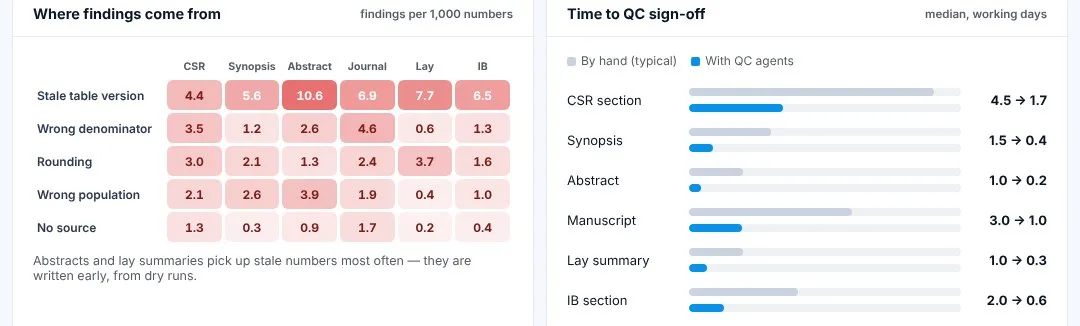
Where findings come from, and how long sign-off takes. Sample figures. A CSR section's 4.5 days by hand and 1.7 with the agents are the sample's medians, and neither is a published benchmark.
Settings. The source of truth, the rounding method, decimals, p-value format and whether format differences block sign-off.
House rules. Six sample rules, each on or off, in plain words. They are the sample's, so write your own.
Check a document. Choose the draft, the run and the house rules.
Ask the statistician. "Which value should the document quote?" with both locations attached, on the record.
16 · Agents, sign-off and what goes in and out
Five QC agents trace every number, and a named QC lead decides each finding and signs the record
In shortEach agent has one job and limits it does not cross. They find, match, check and report. A person decides each finding: accept the fix, ask the statistician, remove the sentence or keep it with a reason. The QC lead cannot sign with a finding open. The solution reads the drafts and tables you already produce and leaves a QC report, a comment log, corrections per writer and a signed record.
Number finder to QC report writer: the five medical writing QC agents
Number finder
Reads the draft, in-text tables included, and records each number with its statistic, endpoint, arm, visit, the patients the sentence names or implies, and its page. Marks derived numbers and the cells they come from.
Never edits the draft.
Table matcher
Finds the output whose title, population, endpoint and visit fit the sentence, then the row and column in the current run. When a table is re-run, it compares the runs and finds every quote of the changed cells.
Never matches against a superseded run without flagging it.
Rule checker
Compares each number with its cell: patients and denominator, analysis, arm and visit, then your rounding and format rules. Recalculates derived numbers, and gives a reason a writer understands and a suggested fix.
Never marks a finding resolved or decides which number is right.
Cross-document checker
Checks that the synopsis, abstract, manuscript and summaries agree with each other and with documents already signed.
Never picks a winner or edits a signed document.
QC report writer
Writes the number-by-number QC report, the comment log and a corrections memo for each writer, citing both locations for every finding.
Never signs.
A QC lead, a writer, a statistician and a publications manager in the VLT-302 screens
Fictional, from the sample data
LO
Lena Ortiz · QC lead, medical writing
Decides each finding and signs the QC record.
"I tick 214 numbers to find the nine that matter."
MC
Dr. Maya Chen · lead medical writer
Writes CSR Sections 10 to 12 and the synopsis, and receives each accepted fix.
"Which of my sentences still use dry run 2?"
OH
Omar Haddad · lead biostatistician
Re-runs outputs and answers "which number is right?"
"I changed one cell. Who quoted it?"
PR
Priya Ranvelle · publications manager
Runs the congress abstract, due October 9, and the manuscript.
Inherits whatever changed after she wrote to the deadline.
Signing the QC record: a topline memo with a site count no table holds
A topline memo from Omar Haddad, the lead biostatistician, arrives, and Lena checks it against the final run. Of 31 numbers, two are findings. "87 sites" has no output: the table matcher searched all 412, and site counts live in listing 16.1.4, which has not been loaded. The other, any treatment-emergent event at 52.1%, divides by those randomized.
She marks the site sentence for removal and accepts the fix. With every finding decided, she signs. The stated meaning is "QC review complete — every number verified against the final tables", and she enters her password again.
No output reports it. The searched outputs, and where the number would live.
Signing, with its meaning. Numbers checked, findings decided, the run, the stated meaning and re-authentication.
The QC report. Every finding and decision, then number by number, with both locations.
The record, signed. Name, date, time and what was checked, kept with the document version.
Controls that support your Part 11 and GCP obligations
Control in the design
What it supports
Every finding cites page and sentence, and output, row, column and run
These are controls that support your compliance. Validation and the decision to rely on them stay with you.13 Botminds' security credentials are SOC 2 Type II audited and information security managed to ISO 27001.
From draft documents and TLFs to a QC report, comment log and signed record
From writers and publications
CSR sections, synopses, abstracts and manuscripts
Lay summaries and brochure sections
Word or PDF
From statistics and your team
TLF outputs in RTF or PDF, current and earlier runs
The statistical analysis plan
House rules: rounding, decimals, p-values, patient groups
Documents already signed
Agents trace, check and reportEvery number matched to its cell, under your rules, at any volume of studies and CROs
A person decides every finding
Drafts are never edited by agents
Outputs
Number-by-number QC report, as PDF
Comment log, as a spreadsheet
Corrections memo for each writer
Every quote of a changed cell
Signed QC record
What changes for the team
Reviewers see only what disagrees
A re-run becomes a short list
Statisticians see who quoted a cell
Systems a medical writing QC rollout connects to
Statistical computing environmentOutputs and their runs
Document managementDrafts, signed documents, QC records
Authoring toolsWord, and corrections to writers
Clinical data and registriesListings; the numbers behind registry results
Identity and accessRoles, separation of duties, single sign-on
The two design targets for medical writing QC, and how to read them
1.2 days
median from draft received to QC sign-off, the design target, measured in the live solution.
Design target
94.5%
of numbers matching their table on the first pass, so reviewers decide only the rest. Read it as a forecast of work, since it says nothing about what is missed.
Design target
The design covers roles and separation of duties, maker-checker sign-off, an audit trail you can export, connections to the systems above, and scale across studies and CROs.
Part C · Are you ready to automate?
Automating CSR QC: what number errors cost you, what it could return and how to test it first
You run medical writing QC, or lead the people who do, or answer for the documents they clear. This part is written for you: what errors and QC days cost, what tracing numbers could return, whether your team is ready, and what to ask any QC software vendor, including us.
17 · What errors and QC days cost
What ticking numbers and late corrections cost your medical writing team
In shortStart from your own records. We found no published figure for what a QC pass costs, how many errors it catches or what a correction costs, so your QC logs and timesheets hold the numbers that matter. A correction's labor is usually small. The re-checking, the records and any lost day are what add up.
6.6 days
mean working days of QA on a final integrated CSR, as survey participants reported it, with answers up to 30.26
EMWA, 2008 to 2013
41%
of 148 cardiology-meeting trials had a primary-outcome estimate that differed between meeting abstract and full paper. We found no published CSR rate.29
JAMA, 2006
$500K
about one day of lost sales on average, if the document holds up a filing. The same group's white paper says about $800,000, and your product's figure will differ.37,38
Tufts CSDD, 2024
The sample's QC time falls most where a document holds the most numbers
Median working days from draft to QC sign-off, by document type
Sample figure, by handSample figure, with the numbers traced
CSR section4.5 days1.7 days
Manuscript3 days1 day
Brochure section2 days0.6 days
Synopsis1.5 days0.4 days
Abstract1 day0.2 days
Lay summary1 day0.3 days
Fictional example from this guide · Fictional sample data, shown so you can see the shape of a baseline. Neither column measures your team. Replace both.
Show the numbers
Document
Sample figure, by hand
Sample figure, with the numbers traced
CSR section
4.5 days
1.7 days
Manuscript
3 days
1 day
Brochure section
2 days
0.6 days
Synopsis
1.5 days
0.4 days
Abstract
1 day
0.2 days
Lay summary
1 day
0.3 days
What we could not find. No public figure for the hours in a QC pass by document type, wrong numbers per CSR at QC, how many errors a QC pass catches, re-runs per report, or what share of regulator questions trace to a number error. A vendor percentage means little until you know what was timed, from where to where. Measure your own.
Pulling a QC baseline from your last ten results documents
Cost
Where it hides
How to find your number in a week
Reviewer hours per document
QC specialists' timesheets, or per-document CRO invoices
Pull ten documents across types; note numbers quoted and hours
Days from draft to sign-off
Waiting in queue and for statisticians
Dates from your document system: received, comments back, signed
Findings by type
Comment logs nobody counts
Tag one log: value, patients, analysis, run, format, no source
Re-checks after a re-run
Emails to writers; finished documents reopened
Count re-runs after first delivery; ask for hours on the last three
Errors found after QC
Final review, errata, journal corrections, registry fixes
List every number corrected after sign-off for one study
Statistician interruptions
Chat and email on "which number is right?"
Ask two statisticians to count for two weeks
The QC costs that no timesheet shows
The abstract with an old numberA correction at a congress is public, and a journal erratum is permanent.
Records an inspector cannot read"Insufficient documentation" to verify the level of QC was part of a critical finding.23
Senior reviewers tickingThe people best at spotting a wrong conclusion spend their days confirming agreement.
Sampling you cannot defendA sample with no written reason is hard to call risk-based.3
Trust inside the teamOne number that does not reconcile sends reviewers back to doubt the rest.
18 · Your return
What automating number checks returns once you count tracing, findings and re-runs
In shortPut in your own numbers. The calculator values two things you can measure: minutes per number, and hours per re-run. Labor alone pays only above a certain volume. A day off a filing can be worth far more, so it sits on its own line and stays out of the total.
Ticking, re-run checks and statistician time: where QC hours come back
Tracing
Agreements settled before a person looks
A reviewer spends time on what disagrees and spot-checks what the tool passed.
documents × numbers × minutes per number ÷ 60 × hourly cost
Findings
Each finding arrives with both locations
Less hunting for the output, and a shorter comment to write.
Those that remain carry both locations and sit on the record.
queries × minutes saved ÷ 60 × hourly cost
Late fixes
Errors caught before they leave
Count corrections after sign-off, and what each one cost.
late corrections avoided × cost per correction
Calendar
Days off a filing or a congress date
Counts only when QC is what holds the document, priced by whoever owns the forecast.
days earlier × value of a day
Work out your CSR QC return from documents a year, minutes per number and re-runs
Only two inputs come from elsewhere: 5.5% follows from the solution's 94.5% design target, and the value of a day is a published average across 645 drugs, the lower of two the same group published.37,38 Every input marked illustrative is an assumption to replace.
Your volumeChecking numbersRe-runsYour costDocuments a filing is waiting on
Illustrative yearly value
QC time today, valued$0
Time released, valued$0
After your yearly cost$0
Hours released a year0
Sales value of earlier days, kept out of the total$0
Formulas, per year: Time today = documents × numbers × minutes per number ÷ 60 + re-runs × documents × hours by hand, then × hourly cost Time after = documents × numbers × share decided × minutes per decision ÷ 60 + re-runs × documents × hours with list Released = time today − time after, valued at hourly cost After your cost = released − yearly cost Earlier days = documents holding up a filing × days earlier × value of a day
Released hours are money only if you take on work you would otherwise outsource or delay. Keep spot checks of passed numbers in your yearly cost: EMA asks for close human supervision of AI tools on product information,48 the nearest published expectation, and that time never reaches zero. The $500,000 is sales, on average, so ask whoever owns your forecast, and count it only when QC holds up the filing.
Below about 170 documents a year, QC hours alone will not cover a $150,000 cost
Time released in a year, valued at $95 an hour, at the calculator's other defaults
400 documents$269.3K
250 documents, the default$191.8K
200 documents$166K
100 documents$114.4K
Illustrative · replace with your own numbers · Re-runs are held at 40 re-runs × 6 documents × 2.75 hours saved. At a $150,000 yearly cost, the break-even point falls near 170 documents.
Show the numbers
Documents a year
Time released, valued
400 documents
$269.3K
250 documents, the default
$191.8K
200 documents
$166K
100 documents
$114.4K
Change the inputs and the answer changes with them. A team running twenty documents a year on a small portfolio should expect hours alone to fall well short of any software cost. Such a team might do better with a written re-run step and a rule on rounding, which cost only staff time. A larger group, or a CRO running QC as a service, reaches the numbers faster.
Start here19 · Readiness check
How ready your medical writing group is for automated QC: run control, house rules and the sign-off rule
In shortPick the answer closest to your team today. Eight questions score 0 to 2, and the last is for reflection. The meter adds up your score as you go, and each question says why it matters and what a strong answer sounds like.
1
Documents through QC
How many results documents go through QC in a year, across reports, abstracts, manuscripts and summaries?
Why it mattersVolume decides whether hours pay for a tool. A small group may need a process more than software.
A strong answer"About 300, across twelve studies, with counts by document type."
2
Your QC baseline
Do you know the hours and days per document, and how many numbers each quotes?
Why it mattersReported QA times run from 1 to 30 working days,26 so only your own history can prove an improvement.
A strong answer"Ten documents timed: 4 days for a CSR section at 200 numbers, 1 day for an abstract."
3
Findings by type
Do your comment logs record the type of each finding, and a decision on it?
Why it mattersTypes turn a log into data. Without them, you cannot tell whether a change helped.
A strong answer"Value, patients, analysis, run and format are counted per document, and reported monthly."
4
Runs after first delivery
When a table is re-run, does anyone get a logged notice naming the cells that changed?
Why it mattersE6(R3) wants outputs dated and traceable.3 A re-run step is where tracing pays most, and it starts with a notice.
A strong answer"A delivery log with run time and reason, and a list of writers on each output."
5
House rules on paper
Are rounding, decimals, p-values and which patient group a percentage uses written down?
Why it mattersA check can only apply a written rule, and SAS and R differ on ties.20,21
A strong answer"One page per document type, with the rounding rule matching our table programs."
6
Tables a tool can read
Are your outputs consistent across studies and CROs, with a run date and program in each footer?
Why it mattersReading the tables is where a tool fails first. Analysis results as data go further.46
A strong answer"Standard table templates, RTF from one macro library, the run date and program on every output."
7
Who decides, who signs
Is there a named QC signer, a statistician for queries, and a rule for keeping a number as written?
Why it mattersSoftware can route only to people you have named, and an inspector can ask why a result changed.23
A strong answer"The QC lead signs, the study statistician answers, and any kept number needs a reason."
8
Validation route
Does your quality team have a route to validate a tool for this use, with AI governance and electronic signatures?
Why it mattersPart 11 asks for validated systems,13 and regulators want a clear context of use.49
A strong answer"QA has a risk-based procedure, and has approved a written context of use for number checking."
9
Looking ahead · for reflection
If a statistician told you at 9 a.m. that one cell changed, what would have to be true for you to name every sentence that quotes it, in every draft, by 10?
Why it mattersYour answer lists the gaps. Each is a candidate job for a process or for software.
A strong answerA short list, for example: "every number tied to a cell, every run kept, a named person to decide each finding, and a rule for the documents already signed."
A low score usually means writing down your QC rules first
0–6
Explore
Tag one month's findings by type. Write your rounding and patient-group rules. Add a re-run step: every run names its changed cells, and a person lists the quotes. Those three cost only staff time and will show what to buy, if anything.
7–11
Ready to pilot
Replay one finished study with errors you plant in a copy, then run a few live documents in parallel while your people still sign everything. Count catches, false alarms and hours.
12–16
Ready to implement
Plan your house rules as settings, validation for intended use, roles and separation of duties, connections to your document and statistical systems, and rollout study by study and CRO by CRO.
20 · Questions for any vendor
What to ask a CSR QC software or medical writing QC vendor about cells, runs and sign-off
In shortAsk every vendor the same questions, us included. The answers show whether the tool reads tables or only words, what it does with a re-run, who decides a disagreement, and how you would measure it on your own study.
Ask
A good answer
A warning sign
Tracing a number
Does it find numbers in words, such as "one patient", as well as digits?
Yes, and it shows what it counted as a number
Digits only
Does a verdict cite output, row, column and run?
Yes, on every number, passed ones included
A score with no location
How does it know which patient group a sentence means?
Reads the sentence and the table title, and marks what it inferred
Matches values and ignores the group
Rules and arithmetic
Whose rounding rule does it apply?
Yours, as a setting, from the unrounded value where available
Built in and undocumented
How are differences, ratios and "about N times" checked?
Rebuilt from the cited cells, with the sum shown
Flagged as "no match", or skipped
Re-runs and other documents
When a table is re-run, what happens?
A cell comparison, and a list of every quote in every draft, rounded forms included
Upload everything and run it again
Can it compare drafts with documents already signed?
Yes, and it reports disagreements without editing either
One document at a time
Who decides
Who chooses between two conflicting numbers?
A named person, with the statistician's answer on record
"The model picks the likely one"
Does it ever change the draft?
Never. Corrections go to the author
Auto-fix on by default
Can the QC record be signed with a finding open?
No, and keeping a number needs a reason
Bulk close
Records and validation
How do signatures and audit trails support our Part 11 obligations?
Named controls, with evidence for your validation
"We are Part 11 certified": no such certificate exists
What will you give our QA team to validate for intended use?
Requirements, test evidence, change control and release notes
A slide deck
Which models do you use, where do they run, and does our data train them?
Named models, a region you choose, no training on your data, in writing
"Proprietary AI", no more detail
Who can see unblinded outputs in the tool?
Access follows your blinding plan, for people and software alike
"We trust the user"
Proof
Can we replay our own finished study with errors we plant, on outputs from our CROs?
Yes, blind, reported by error type
Demo study only
"Less QC time": how much, from what to what?
Named start and stop points, and the data behind them
A percentage with no start or stop point
How many errors does it miss, by type?
A detection rate from planted errors, and how many were planted
Quotes first-pass agreement instead
21 · How to start
Plant errors in a finished CSR section: a six-step test for any QC process or tool
In shortPull your baseline, plant errors in a copy of a finished document, then replay a past re-run and run live documents in parallel. Decide with three numbers. None of these steps commits you to a vendor, and the same test measures your current process.
Time and type ten past documents: hours, days, numbers quoted, and findings by type.
Choose a finished study that had at least one re-run, and freeze each delivery as it left statistics.
Plant known errors in a copy: a wrong denominator, a swapped column, a stale value, a sensitivity result quoted as primary, a number rounded twice, a sentence with no source. Keep clean copies too.
Replay the re-run. Can the process list every quote, including rounded and worded ones like "67 out of 100"?
Run live documents in parallel, with your people deciding and signing everything.
Decide with three numbers: catch rate by error type, false alarms on clean copies, and hours to a signed record.
A ten-week pilot ends with a decision on three numbers
Your teamVendor
Baseline from ten documents; choose the study
Validation plan and context of use, with QA
Load house rules and outputs
Replay with planted errors and a past re-run
Score the replay
Parallel run on live documents
Decide
Week 0246810
Illustrative · replace with your own numbers
Show the numbers
Activity
From
To
Baseline from ten documents; choose the study
0
2
Validation plan and context of use, with QA
1
3
Load house rules and outputs
2
3
Replay with planted errors and a past re-run
3
5
Score the replay
5
6
Parallel run on live documents
5
9
Decide
9
10
Which medical writing QC documents to automate first
Start with the documents that quote the most numbers and cost the most if late or wrong
Illustrative · replace with your own numbers · Place your own document types, from your baseline and filing plans.
Show the numbers
Item
Numbers quoted (0–1)
Cost of a late or wrong document (0–1)
Abstract
0.12
0.74
Synopsis
0.12
0.58
CSR sections
0.76
0.72
Manuscript
0.76
0.26
Lay summary
0.12
0.28
Brochure update
0.12
0.13
Catch rate, false alarms and reviewer hours for each planted error
Measure
How
Why
Catch rate by type
Planted errors found ÷ planted, per type
An average hides a blind spot
Re-run recall
Quotes listed ÷ quotes you know exist, rounded forms included
A miss is a stale number in a finished document
False alarms
Findings on clean copies
A tool that flags everything catches every plant
Right-cell rate
Sample passed numbers and check the cited cell by hand
A pass can cite the wrong cell
Numbers with no source
Count them alongside any agreement figure
Agreement leaves them out
Hours to a signed record
Reviewer and QC lead time, spot checks included
The cost you will compare
Findings per 1,000 numbers
By type, by document type, month by month
Tells you which upstream step to fix
How big the test must be. Catching every plant of one error type in a test of twelve still allows a miss rate of up to 22%, at 95% confidence; 59 plants with none missed brings that bound to 5%. Those figures are binomial arithmetic: 1 − 0.05^(1/n). Plant enough of each type to mean something, and test your people the same way.
The full working-session questions: 15 questions in five groups
Bring medical writing, biostatistics, programming, publications and quality into one room. Each question says why it matters, what a strong answer looks like, and the warning sign.
A
QC volume and document mix
A1
How many documents next year, by type and by in-house or CRO?
Why it mattersSets capacity and tells you whose tables you must read.
Strong answer · warning sign
A list by study, with due dates.
"It depends on the pipeline."
A2
Do you check every number, or a sample?
Why it mattersE6(R3) asks for a risk-based approach,3 so the choice needs a reason.
Strong answer · warning sign
A written rule per document type.
"Whatever time allows."
A3
Who QCs what the CRO writes?
Why it mattersOutsourced work leaves responsibility with you.3
Strong answer · warning sign
A sponsor check with a sampling rule.
"Their QC covers it."
B
Outputs and runs from statistics
B1
Is every run kept, labeled and dated?
Why it mattersE6(R3) expects it,3 and any comparison needs the old run.
Named, by program, and matched in the house rules.
Nobody has asked.
C
House rules for medical writing numbers
C1
When may a whole number replace one decimal?
Why it mattersAbstracts and lay summaries round differently.
Strong answer · warning sign
A rule per document type.
Each writer's habit.
C2
What does "about N times" need to be within?
Why it mattersA check needs a tolerance, in writing.
Strong answer · warning sign
A stated percentage.
"Judgment."
C3
Which documents must agree with which?
Why it mattersSets what a cross-document check compares.
Strong answer · warning sign
A map by study.
Found out at submission.
D
Decisions, sign-off and the QC record
D1
What does your QC signature mean, in words?
Why it mattersPart 11 asks for the meaning on an electronic signature.13
Strong answer · warning sign
One sentence, stating which run.
"That QC was done."
D2
Could an inspector tell which numbers you checked?
Why it mattersInsufficient records of QC appeared in a critical finding.23
Strong answer · warning sign
Yes, number by number or by a written sample.
"We have a signed checklist."
D3
What happens to a signed QC record when a table is re-run?
Why it mattersA signature vouches for a named run.
Strong answer · warning sign
A rule: re-check the quotes, and sign the change.
No rule.
E
Validation and AI for number checking
E1
What is your written context of use?
Why it mattersFDA's draft and the joint principles both start there.47,49
Strong answer · warning sign
Finding and comparing, with named people deciding.
"General productivity."
E2
How will you spot-check what the tool passed?
Why it mattersA pass is a claim as well, and EMA asks for close supervision of AI tools on product information.48
Strong answer · warning sign
A sample each month, tied to its cell.
"It's 99% accurate."
E3
Do participant-level listings leave your control?
Why it mattersPrivacy duties stay with you.
Strong answer · warning sign
Region, retention and no training, in the contract.
Not yet asked.
22 · Frequently asked questions
Medical writing QC questions answered: CSR checks, denominators, re-runs, rounding and AI
In shortCommon questions from writers, reviewers and buyers, each answered on its own.
What is medical writing quality control?
Medical writing quality control, or QC, is the check a results document gets before it leaves the writing team. A reviewer who did not write it compares it with the evidence behind it, mainly by tracing every number to the statistical table it came from, and checks consistency and format. The result is a list of findings for the author and a record of what was checked.
What does a CSR QC reviewer check?
A reviewer asks five questions of each number in a clinical study report: is the value the same as the cell, is it about the patient group the sentence names, is it the analysis the sentence claims, is it from the current table run, and does it follow the house format, your team's written rules. Only that last question can be answered without the tables open. Reviewers also check the conclusions and the synopsis against the body.
What are TLFs in medical writing QC?
TLFs are tables, listings and figures, the output files statistical programmers produce from the trial data under the statistical analysis plan. Every result in a report or paper should trace to one. A preprint review says a late-stage (Phase 3) trial typically needs 200 to 500 of them, and QC compares each number in the text with the matching cell.
How long does QC of a clinical study report take?
The only public benchmark we found, a survey of medical writers from 2008 to 2013, gives quality assurance on a final report a mean of 6.6 working days, with a range of 1 to 30. One QC specialist writes that a consistency and data check cannot realistically be done in one day on a 100-page report. Time your own: hours depend on how many numbers a section quotes and how many table runs exist.
What is the difference between QC and proofreading in medical writing?
Proofreading tests a document against itself and a style sheet: spelling, grammar, consistent terms. QC also tests it against evidence outside it, such as the statistical tables, the analysis plan and other documents. A sentence can pass every proofreading test and still quote a number from a replaced table.
What is the safety analysis set, and why does it change percentages?
The safety set is usually everyone who received at least one dose of study treatment, as ICH E9, the guideline on trial statistics, describes it. It can differ from the number randomized, so the same count gives a slightly different percentage: 223 of 427 is 52.2%, while 223 of 428 is 52.1%. A sentence about treated patients has to divide by the treated group, even when the difference looks like rounding.
How should percentages be rounded in a clinical study report?
Round once, from the unrounded value, under a rule your team has written down and matched to your table programs. Rounding twice can change a digit: 4.449 becomes 4.45, then 4.5, when the correct one-decimal value is 4.4. SAS's ROUND sends a tie away from zero and R's round sends it to the even digit, so check which rule your tables used.
What happens when a TLF is re-run after the CSR is drafted?
Nothing in the drafts changes by itself, so every sentence quoting a changed cell becomes wrong without showing it. Someone has to compare the two runs, find every quote of the changed cells in every document, and correct them, including rounded forms such as an abstract's whole number. ICH E6(R3), the good clinical practice guideline, expects outputs to be dated and traceable, and changes after unblinding to be reported in the trial report.
Is 100% QC of CSR numbers required?
We found no ICH guideline that sets a percentage. ICH E6(R3), the good clinical practice guideline, asks for a risk-based approach to quality control and for documented QC of statistical programming and outputs, so the depth is a sponsor's decision, written in its procedure. A sampled check can be defensible for random errors, but it is weak against a re-run, where the wrong numbers sit in particular cells.
Can AI do medical writing QC?
AI and rules can find numbers, match them to table cells and compare them, and we found no rule that forbids it. People still need to decide which number is right and to sign, and the sponsor remains responsible for what it submits. EMA's reflection paper calls for close human supervision of generated text in product information documents, and a tool's real detection rate is best measured with errors you plant yourself.
Does FDA guidance cover AI used to check regulatory documents?
FDA's January 2025 draft guidance on AI for regulatory decision-making, still a draft in November 2026, does not address AI used for operational efficiencies such as drafting a regulatory submission, provided the use does not affect patient safety, drug quality or the reliability of study results. It encourages sponsors to talk to FDA early if unsure. FDA's electronic records rule, Part 11, and the sponsor's duty of accuracy still apply.
Can QC software be Part 11 compliant or certified?
No software can be certified to 21 CFR Part 11, FDA's rule on electronic records and signatures, and compliance belongs to how you validate and use the system. A vendor can supply controls that support your compliance, such as audit trails and electronic signatures that show the signer's printed name, the date and time, and the meaning. Ask for evidence for your validation, and be wary of a claim of certification.
Who should sign a medical writing QC record?
Your procedure decides, since we found no ICH guideline that assigns QC roles. A signed checklist at the end of QC is common practice, and a QC lead or the reviewer can sign that QC was done against a named set of tables. ICH E3 separately calls for the coordinating investigator's or the sponsor's responsible medical officer's signature on the report itself, depending on the regulator. The record is stronger if it states the meaning of the signature and cannot be signed with a finding still open.
23 · One-page summary
Medical writing QC checklist on one page: five checks, the November 2026 rules and the terms
Print this page
In shortThe whole guide on one screen: the method, the rules as of November 2026, the readiness scale and the terms.
The method
Write down your rounding, decimal, p-value and patient-group rules.
Name the run a document is checked against, and keep every run.
Ask five questions of every number: value, patients, analysis, run, format.
Rebuild derived numbers from their cells, rounding once.
After any re-run, compare cells and find every quote, rounded forms included.
Record each finding's type and decision. A named person decides and signs.
Readiness: score 0–2 on eight questions: 0–6 explore · 7–11 pilot · 12–16 implement.
As of November 2026: ICH E3 from 1995, Q&A 2012, no adopted revision found · E6(R3) in effect in the EU since July 23, 2025; Annex 2 from January 15, 2027 · ICH E9 from 1998 · CONSORT 2025 · FDA's AI guidance still a draft · EMA and FDA AI principles, January 2026 · EU AI Act Annex III rules from December 2, 2027 · draft Annex 22 and revised Annex 11 still drafts.
14 terms
QC
Quality control: checking a document against the evidence behind it.
CSR
Clinical study report: the full account of one trial for regulators.
TLF
A table, listing or figure from statistical programming.
Run
One execution of the programs that make the outputs.
Stale quote
A number copied correctly from a replaced run.
Dry run
A rehearsal before lock, commonly with dummy treatment codes.
Database lock
The point when trial data are frozen for analysis.
Intent-to-treat set
Everyone randomized, or as close as possible.
Per-protocol set
Participants who followed the protocol closely enough.
Safety set
Usually everyone who took at least one dose.
Denominator
The group a percentage divides by.
Derived number
A difference or ratio with no cell of its own.
sPGA, PASI
Psoriasis severity scores: a doctor's overall rating and an area-and-severity index.
ALCOA++
Data that are attributable, legible, contemporaneous, original, accurate and more.
24 · Sources
Sources
Accessed November 2026. Regulatory status statements are as of November 2026.
Yan J, Zhang J, Tian T. Evidence Behind the Automation of Clinical Trial Statistical Programming: A Scoping Review. medRxiv preprint, not peer reviewed, posted May 15, 2026. medrxiv.org
Jones C. Getting the most out of quality control specialists: Practical guidance for medical writers. Medical Writing, September 2018;27(3):67–69. emwa.org
ICH, E6(R3) Guideline for Good Clinical Practice, final January 6, 2025. database.ich.org
Haycock N. Quality control: getting the best out of your review. Medical Writing 2012;21(3):221–224. emwa.org
Grody M (Bioforum). The QC process for CSRs, February 25, 2021. bioforumgroup.com
ICH, E3 Structure and Content of Clinical Study Reports, Step 4, November 30, 1995. database.ich.org
ICH, E3 Structure and Content of Clinical Study Reports: Questions and Answers (R1), July 6, 2012. database.ich.org
European Medicines Agency, ICH E6 Good clinical practice: scientific guideline page, read November 3, 2026. ema.europa.eu
US Food and Drug Administration, E6(R3) Good Clinical Practice, final guidance, September 2025. fda.gov
ICH, E9 Statistical Principles for Clinical Trials, Step 4, February 5, 1998. database.ich.org
Hopewell S, Chan AW, Collins GS, et al. CONSORT 2025 explanation and elaboration: updated guideline for reporting randomised trials. BMJ 2025;389:e081124, Table 2. discovery.ucl.ac.uk
European Medicines Agency, ICH E3 Structure and content of clinical study reports: scientific guideline page, read November 3, 2026. ema.europa.eu
21 CFR Part 11, Electronic Records; Electronic Signatures. govinfo.gov
21 CFR 314.125, Refusal to approve an NDA. govinfo.gov
Doshi P, Jefferson T. Clinical study reports of randomised controlled trials: an exploratory review of previously confidential industry reports. BMJ Open 2013;3(2). PubMed 23447465
Gøtzsche PC, Hróbjartsson A, Maric K, Tendal B. Data extraction errors in meta-analyses that use standardized mean differences. JAMA 2007;298(4):430–437. pubmed.ncbi.nlm.nih.gov
Wicklin R. Round to even. The DO Loop (SAS blog), November 11, 2019. blogs.sas.com
The R Project, Rounding of Numbers (round) documentation. stat.ethz.ch
McGrogan J, Widel M. The Problems Surrounding Rounding. PharmaSUG 2026, Paper AP-108. pharmasug.org
Medicines and Healthcare products Regulatory Agency (MHRA), GCP Inspections Metrics Report, April 1, 2019 to March 31, 2020. assets.publishing.service.gov.uk
A published statistical analysis plan, section 4.1 Dry Runs/Blinded Data Reviews, ClinicalTrials.gov record NCT03763877. clinicaltrials.gov
Mehta B, Patel M. The Role of the Blinded Programmer in Preparation of Data Monitoring Committee Packages. PharmaSUG 2024, Paper SI-185. pharmasug.org
Hamilton S. Effective authoring of clinical study reports: A companion guide. Medical Writing 2014;23(2):86–92. emwa.org
García-Berthou E, Alcaraz C. Incongruence between test statistics and P values in medical papers. BMC Medical Research Methodology 2004;4:13. pubmed.ncbi.nlm.nih.gov
Nuijten MB, Hartgerink CHJ, van Assen MALM, Epskamp S, Wicherts JM. The prevalence of statistical reporting errors in psychology (1985–2013). Behavior Research Methods 2016;48(4):1205–1226. pubmed.ncbi.nlm.nih.gov
Toma M, McAlister FA, Bialy L, et al. Transition from meeting abstract to full-length journal article for randomized controlled trials. JAMA 2006;295(11):1281–1287. pubmed.ncbi.nlm.nih.gov
Hartung DM, Zarin DA, Guise JM, et al. Reporting discrepancies between the ClinicalTrials.gov results database and peer-reviewed publications. Annals of Internal Medicine 2014;160(7):477–483. pubmed.ncbi.nlm.nih.gov
McKechnie T, Kazi T, Shi V, et al. Inconsistency between abstract and main text reporting is common in pilot randomized controlled trials of surgical interventions. American Journal of Surgery 2025;243:116250. pubmed.ncbi.nlm.nih.gov
Pitkin RM, Branagan MA, Burmeister LF. Accuracy of data in abstracts of published research articles. JAMA 1999;281(12):1110–1111. pubmed.ncbi.nlm.nih.gov
Barchard KA, Pace LA. Preventing human error: The impact of data entry methods on data accuracy and statistical results. Computers in Human Behavior 2011;27(5):1834–1839. doi.org
European Medicines Agency, Annual Report of the Good Clinical Practice Inspectors' Working Group 2024, EMA/INS/GCP/37608/2025, December 15, 2025. ema.europa.eu
US Food and Drug Administration, Warning Letter, reference 24-HFD-45-11-01, November 27, 2024. fda.gov
Cooper J, Chamberlain James L, Affleck J, Bass B, Forjanic Klapproth J, Harris D, et al. Value of medical writing: The regulator's perspective. Medical Writing, June 2022;31(2). A survey with 32 responses, fewer on some questions, reported as descriptive only. emwa.org
Smith ZP, DiMasi JA, Getz KA. New Estimates on the Cost of a Delay Day in Drug Development. Therapeutic Innovation & Regulatory Science 2024;58(5):855–862. PubMed 38773058
Smith Z, DiMasi J, Getz K. Quantifying the Value of a Day of Delay in Drug Development. Tufts CSDD white paper, August 2024. csdd.tufts.edu
ClinicalTrials.gov API v2: interventional studies, lead sponsor class Industry, phase filter Phase 3 (includes Phase 2/3), overall status Completed, counted by completion date year, read November 3, 2026. clinicaltrials.gov
US Food and Drug Administration, Novel Drug Approvals at FDA, 2023. fda.gov
US Food and Drug Administration, Novel Drug Approvals at FDA, 2024. fda.gov
US Food and Drug Administration, Novel Drug Approvals at FDA, 2025. fda.gov
Mordor Intelligence, Medical Writing Market, listing dated August 4, 2026. giiresearch.com
Reports and Data, Medical Writing Market, published December 2025. reportsanddata.com
Samuelsson J, Blakeman S, Alexander E, et al. A Generative AI Framework for Pharmacokinetic Clinical Study Report Authoring. Clinical and Translational Science, June 2026;19(6):e70644. Abstract read through PubMed; all authors are current or former employees of one drug company. PubMed 42298335
CDISC, Analysis Results Standard v1.0, April 19, 2024. cdisc.org
US Food and Drug Administration, Considerations for the Use of Artificial Intelligence to Support Regulatory Decision-Making for Drug and Biological Products, draft guidance, January 2025, docket FDA-2024-D-4689. fda.gov
European Medicines Agency, Reflection paper on the use of artificial intelligence in the medicinal product lifecycle, adopted September 9, 2024. ema.europa.eu
European Medicines Agency and US Food and Drug Administration, Guiding principles of good AI practice in drug development, January 2026. ema.europa.eu
European Medicines Agency, Guideline on computerised systems and electronic data in clinical trials, EMA/INS/GCP/112288/2023, March 9, 2023. ema.europa.eu
ISPE, GAMP Guide: Artificial Intelligence, July 2025. ispe.org
National Law Review, on Regulation (EU) 2026/1744, the AI Omnibus, published July 24, 2026 and in force July 27, 2026. natlawreview.com
European Commission, EudraLex Volume 4, read November 3, 2026. health.ec.europa.eu
European Commission and PIC/S, draft EU GMP Annex 22: Artificial Intelligence, consultation text, July 2025, section 1. picscheme.org
European Medicines Agency, Report of the multistakeholder workshop on expert contributions to artificial intelligence guidance development (Annex 22), workshop of June 30, 2026, EMA/156789/2026. ema.europa.eu
US Food and Drug Administration, Computer Software Assurance for Production and Quality Management System Software, final guidance, February 2026. fda.gov
Next step
See it on your own CSR section and tables.
Explore the solution, or bring one finished CSR section with the TLFs behind it and your house rounding rules, and we will trace every number to its cell with you. Plant a few errors first and count what comes back.
We use essential cookies to make this site work, and cookieless, anonymised analytics to understand how it's used. "Accept all" also turns on Google Analytics, which sets cookies. Privacy policy