The 21 CFR Part 11 electronic signature requirements come down to four things on the signature itself — the printed name of the signer, the date and time, the meaning of the signature, and at least two distinct identification components — and one thing on the system around it: a secure, time-stamped audit trail whose changes never obscure what was recorded before. Everything else in the regulation describes how to administer those. This guide takes one record that is signed in medical writing every week — the QC sign-off on a results document, confirming that every number in it was checked against the statistical outputs — and walks it against each clause, using Botminds' Medical Writing Quality Control, where five agents trace each number to its table cell and the QC lead decides and signs.
Two things to settle before the clauses. First, nothing here is a claim that any product is validated or certified under Part 11: no software is, because the regulation binds the organisation using it, not the tool. What a tool can do is carry the information each clause asks for, and make it visible; whether your deployment of it is compliant is your validation to perform and your certification to file. Second, the worked record below comes from a fictional sample study inside the solution — Northwind Bio's study VLT-302 of Veltrimab — and the figures taken from it are tagged demo. The clause text is quoted from the Code of Federal Regulations as it reads today.
“The items identified in paragraphs (a)(1), (a)(2), and (a)(3) of this section shall be subject to the same controls as for electronic records and shall be included as part of any human readable form of the electronic record (such as electronic display or printout).”
21 CFR 11.50(b), Signature manifestations
What are the 21 CFR Part 11 electronic signature requirements?
Part 11 splits the subject in two, and the signature requirements sit on both sides of the split: subpart B says how a signature appears on a record and how it is tied to it, subpart C says who may hold one and what executing it takes. In the order a reviewer meets them on a screen: the signature must belong to one identified person and to nobody else (11.100(a)); the person's identity must have been verified before the signature was issued (11.100(b)); the organisation must have certified to the agency that its electronic signatures are intended as the legally binding equivalent of handwritten ones (11.100(c)); executing the signature must use at least two distinct identification components (11.200(a)(1)); and the signed record must show the name, the time and the meaning (11.50), linked to the record in a way that cannot be detached (11.70). Around all of it, 11.10 sets the controls for the closed system in which it happens, including the audit trail.
What makes this readable rather than bureaucratic is that each clause corresponds to a question an inspector will actually ask, and each question has a place on the screen where the answer either is or is not. The table below is the whole regulation as it bears on one QC record.
Part 11, clause by clause, against one document QC sign-off
11.50(a)(1)
What it requiresThe printed name of the signer.
What the QC record showsThe signer’s name in full, printed beside the signature, not only a user identifier.
Where a reviewer sees itOn the signed QC record, and on every printout of it.
11.50(a)(2)
What it requiresThe date and time when the signature was executed.
What the QC record showsThe moment of signing, to the minute, in a stated time zone.
Where a reviewer sees itBeside the name, and again on the audit trail.
11.50(a)(3)
What it requiresThe meaning (such as review, approval, responsibility, or authorship) associated with the signature.
What the QC record showsThe sentence the signer is asserting — here, that QC review is complete and every number was verified against the final tables.
Where a reviewer sees itAbove the signing control, before the signer commits, and inside the record afterwards.
11.50(b)
What it requiresThose three items are subject to the same controls as the record and appear in any human readable form of it.
What the QC record showsName, time and meaning survive the export: they are on the PDF, not only on the screen.
Where a reviewer sees itThe QC report as issued to the file.
11.70
What it requiresSignatures are linked to their records so they cannot be excised, copied or transferred to falsify a record by ordinary means.
What the QC record showsThe signature belongs to one document version and one results package, and is not a detachable page.
Where a reviewer sees itThe QC record, kept with the document version it signs.
11.200(a)(1)
What it requiresAt least two distinct identification components, such as an identification code and password.
What the QC record showsSigning is a deliberate act with its own credentials, not a click inherited from the morning’s login.
Where a reviewer sees itThe re-authentication step in the signing dialogue.
11.10(e)
What it requiresSecure, computer-generated, time-stamped audit trails; record changes shall not obscure previously recorded information.
What the QC record showsEvery decision, every change of mind and every house-rule change is kept, with who and when — nothing overwritten.
Where a reviewer sees itThe audit trail behind the record.
11.100(a)–(c)
What it requiresEach signature unique to one individual and never reassigned; identity verified first; the organisation certifies to the agency that its electronic signatures are legally binding equivalents.
What the QC record showsWho may sign is administered by the sponsor, not by the software vendor, and the certification is the sponsor’s to file.
Where a reviewer sees itYour own account administration and your certification letter.
The three things a signed electronic record must show on its face
11.50 is an easy clause to half-implement. A system can capture the name and the time, because both are a byproduct of being logged in, and then record the meaning as a status flag — "approved" — set by the workflow rather than stated to the signer. The regulation is explicit that all three must be indicated by information associated with the signing, and 11.50(b), quoted at the top of this page, closes the obvious escape route: the name, time and meaning fall under the same controls as the record and must appear on any human readable form of it, on screen or on paper.
That last phrase decides what a QC record has to look like when it is exported. A screen that shows the signer's name but produces a PDF with only an initials stamp fails the clause, and the failure is invisible until someone asks for the file. The test to run on any system is dull and conclusive: sign something, export it, print it, and see whether a reader holding only the paper can state who signed, when, and what they meant.
On the sample study, the record carries the counts it is signing over as well: 31 numbers checked and 2 findings decided, against the final run of 2 October (demo). That is not a Part 11 requirement — but it is what makes the three required items mean anything, because a signature whose scope is unstated is a signature over whatever the reader assumes.
A signature with its scope on the same screen: numbers checked, findings decided, run, meaning
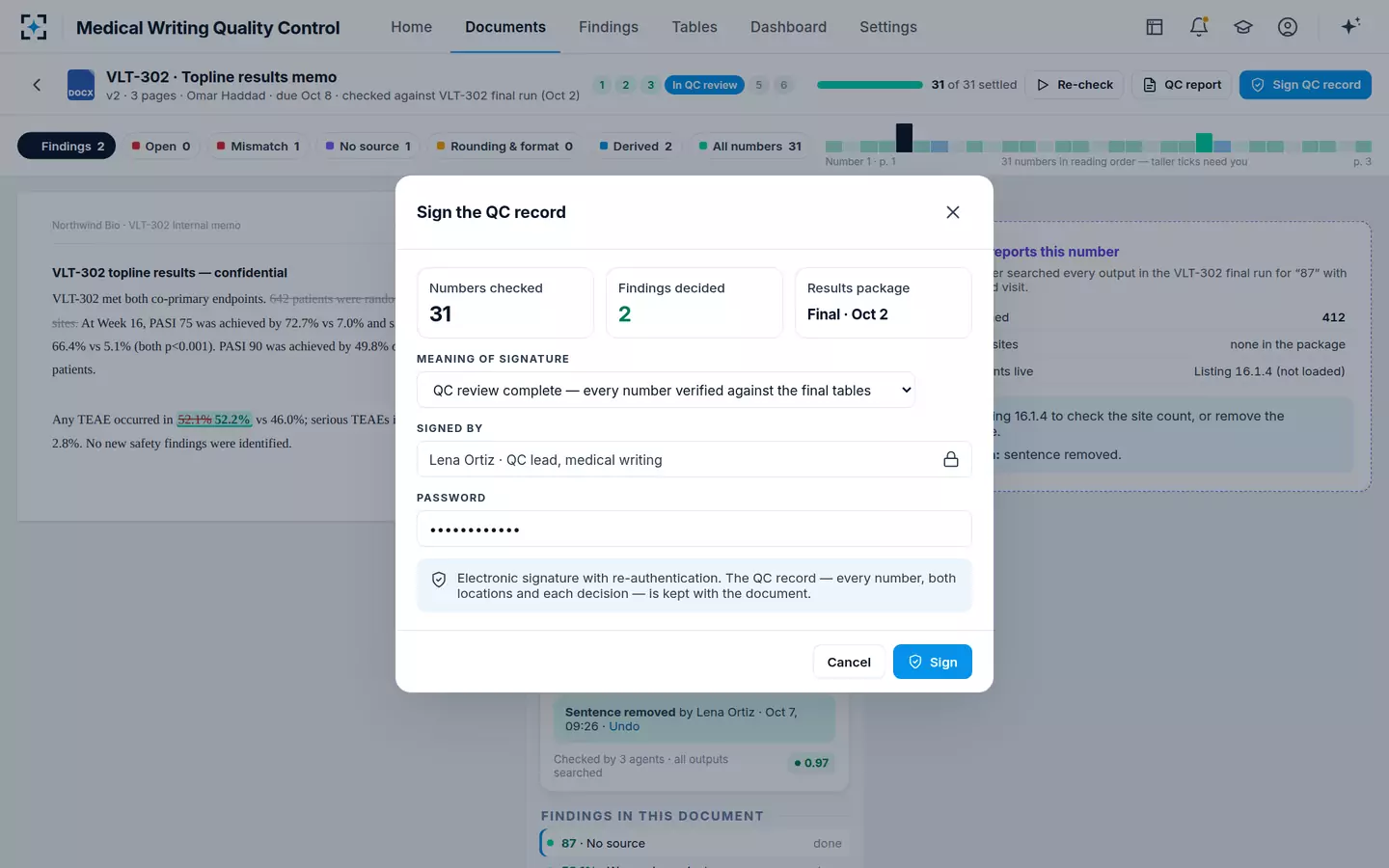
What “the meaning of the signature” means, and why it is written out
The meaning is the assertion the signer is making. The regulation gives four examples — review, approval, responsibility, authorship — and they are examples, not a list to pick from. A QC sign-off is a review signature, and the useful practice is to write the review out in a sentence specific enough to be falsifiable. On the sample study the meaning reads: "QC review complete — every number verified against the final tables." That sentence can be tested against the record, and that is the point of it.
Compare it with the meanings most systems offer. "Approved" says nothing about what was examined. "Reviewed" says nothing about against what. Both are compliant on their face and useless as evidence, because neither tells a later reader what the signer was asserting. If the results package changes the week after, a signature meaning "approved" cannot be assessed at all; a signature meaning "every number verified against the final tables" can be assessed in one step, by asking which run was final when it was signed.
This is also the one requirement in Part 11 that no software can satisfy on its own. A system can present the sentence, capture it and keep it with the record. It cannot mean it. The meaning belongs to a person, which is why, in the solution, a sign-off is blocked while any finding is still open — a signature asserting that every number was verified cannot be true over a disagreement nobody decided.
Do you have to re-enter your password to sign?
Usually yes, and the regulation says exactly when. 11.200(a)(1) requires a signature that is not biometric to use two or more distinct identification components — the regulation's own example is an identification code plus a password — and then divides the cases. Within one continuous period of controlled system access, the first signing uses all components and "subsequent signings shall be executed using at least one electronic signature component that is only executable by, and designed to be used only by, the individual". Outside a single continuous session, every signing uses all the components again.
In plain terms: logging in is not signing. The first signature of a session asks for both components, later signatures in the same unbroken session may ask for one, and a session that has ended resets the clock. A system that treats the morning's login as consent for the afternoon's signature has collapsed the distinction the clause exists to preserve, and an inspector will find it by asking the signer to describe what they typed.
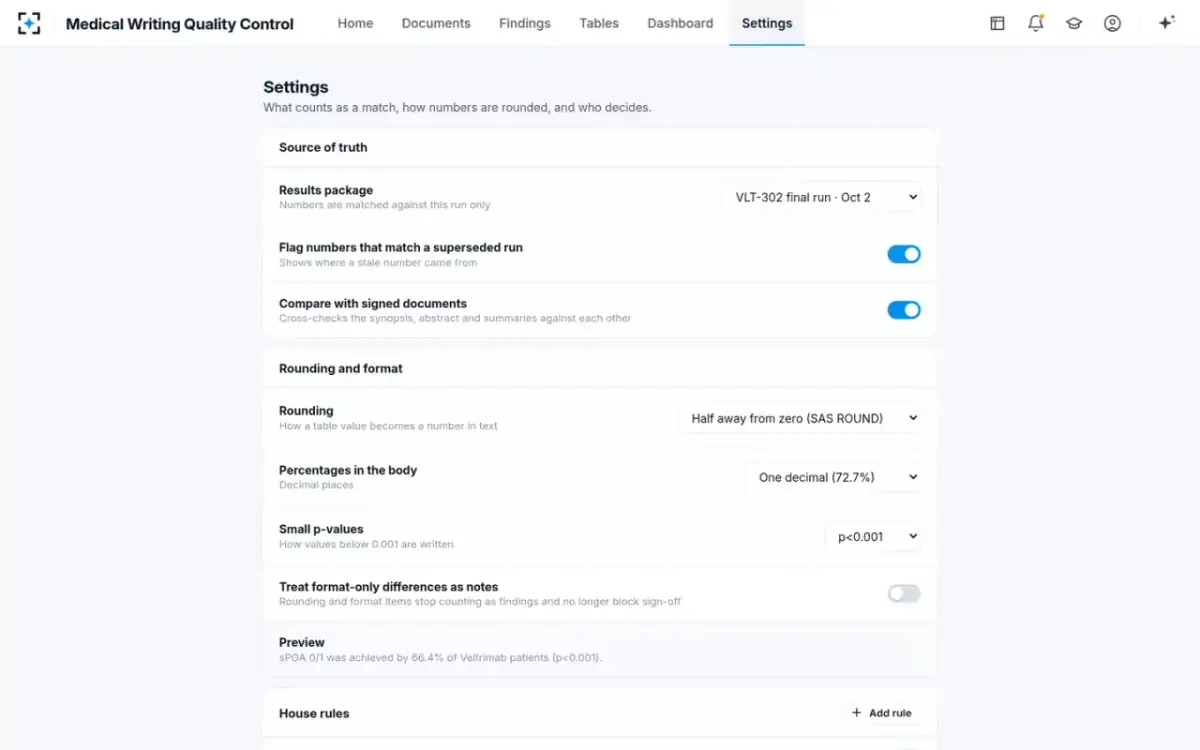
Two practical consequences for a QC desk. First, the signer must be a named individual, administered under 11.100(a), which requires each signature to belong to one person only and never be reused or reassigned — so a shared QC account is not a cheaper way to run holidays, it is a disqualifying arrangement. Name an alternate instead: in the sample study the signer is a setting, with a second named reviewer available, so cover is a configuration change on record rather than a shared credential.
Who may sign is a setting, on record — not a shared login
The audit trail clause: record changes shall not obscure previously recorded information
11.10(e) is the clause that catches systems which are otherwise careful. It requires audit trails that are secure, generated by the computer and time-stamped, recording independently when an operator created, changed or deleted a record, and then adds the sentence that does the work: a change to a record must never hide what was recorded before it. It also requires the audit trail to be kept at least as long as the records it covers, and to be available for agency review and copying.
Obscure is a stronger word than delete. A system that keeps an old value but shows only the new one, or that lets a reviewer edit a decision in place so the earlier decision cannot be reconstructed, has obscured it without deleting anything. For a QC record this bites in a specific place: a reviewer who accepts a fix, then changes their mind after the statistician answers, must leave two decisions on the trail, not one. The second decision is the one that stands; the first is the one that explains why the correction list changed.
ICH's good clinical practice guideline asks for the same thing in the vocabulary of a trial: its audit trail records each activity, the first entry and every later change to a data field or record — who made it, when, and where applicable the reason — and in a computerised system it must be secure, machine-generated and time stamped. The addition worth noticing is why. Part 11 does not require a reason; good clinical practice does, where applicable, and a QC decision is exactly the case where it applies — which is why keeping a number as written, in the solution, requires a reason before the finding can be closed.
An unreliable trail is not a theoretical finding. In the UK regulator's published inspection metrics, one critical data-integrity finding at a contract research organisation records simply that "it was found that the audit trial was unreliable as it had not documented accurately the data changes made for primary endpoint data" — the inspectorate's own spelling. What failed there was the record of what had changed.
Signature-to-record linking, and why a QC record travels with the document version
11.70 requires each signature to be bound to the record it signs, so that ordinary means cannot cut it out, copy it or move it onto another record to falsify that record. The clause is usually read as an anti-tampering rule, and it is, but for document QC it also settles an everyday question: what exactly was signed?
A QC record signs one version of one draft against one results package. If the draft is revised afterwards, the signature does not travel with it; the new version is unsigned until it is checked again. If the results package is re-run afterwards, the signature stays true about what it asserted — the document matched the tables as they stood — and false about the present, which is the distinction a late re-run forces and the reason a re-run table can require an addendum to text already signed. Linking is what lets a reader tell those two states apart instead of arguing about them.
The practical test for a system is whether you can ask it, of any signed record, which document version and which output run it covers, and get both answers from the record itself rather than from someone's memory of the folder structure.
Can an agent sign? Where the authority boundary sits
No. An electronic signature under Part 11 is defined as a compilation of symbols "executed, adopted, or authorized by an individual to be the legally binding equivalent of the individual's handwritten signature", and it must be unique to one individual whose identity the organisation verified. An agent is not an individual, has no identity to verify and cannot be the subject of 11.100(c)'s certification. The question is therefore not whether it is allowed but where the boundary falls on the screen — which parts of getting to a signature software may do, and which it may not.
The sign-off chain: what the agents assemble, and where the person takes over
Agent
Number finderReads the draft and records every number with its statistic, endpoint, arm, visit, implied population, page and sentence.
Never: Never edits the draft
Agent
Table matcherFinds the output, row and column in the current run, and compares runs when an output has been re-run.
Never: Never matches against a superseded run without flagging it
Agent
Rule checkerCompares value, population, denominator, analysis, arm, visit, rounding and format, and recalculates derived values.
Never: Never decides which of two conflicting numbers is right
Agent
Cross-document checkerChecks the synopsis, abstract, manuscript and summaries against each other and against documents already signed.
Never: Never edits a signed document
A person decides
QC lead decides each findingAccepts the fix, queries the statistician, removes the sentence, or keeps it with a reason. Every decision records who, when and why.
Never: No finding is ever closed by an agent
Agent
QC report writerAssembles the number-by-number record, the comment log and a corrections memo for each writer, citing both locations for every finding.
Never: Never signs
A person decides
QC lead signs the recordReads the stated meaning, re-authenticates, and signs. Sign-off is blocked while any finding is still open.
Never: Not available to an agent, under any setting
The boundary is not drawn where it is for safety's sake alone. It is drawn there because each step on the agents' side is checkable after the fact — the matching cites an output, a row, a column and a run — and the two steps on the person's side are not. A decision between two conflicting numbers and an assertion that the review is complete are judgments, and a judgment is only as good as the person accountable for it.
What an inspector asks for after a re-run, and what the record has to answer
The sequence an inspector follows is predictable, because it is the sequence that finds problems. Which run was current when this was signed? What changed between that run and the one before? Which documents quoted the changed cells, and what happened to each? Who decided, and when? Why was this number kept as written? Show me the trail, and show me that nothing on it was overwritten.
A QC record built to Part 11 answers the first five from the record and the sixth from the audit trail. A document QC process run on a spreadsheet and an email thread answers the first and struggles with the rest — not because anyone did anything wrong, but because the evidence was never assembled while it was cheap to assemble.
Two sign-offs on the same document: what an inspector can and cannot reconstruct
A sign-off that will not hold up: Initials in a cell, or a shared QC account used by whoever is on shift.
A sign-off that answers the questions: One named individual, identity verified, signature never reassigned (11.100(a), (b)).
A sign-off that will not hold up: A status changed by someone already logged in that morning.
A sign-off that answers the questions: Two identification components at the first signing of the session (11.200(a)(1)).
A sign-off that will not hold up: "Approved" — of what, against what, unstated.
A sign-off that answers the questions: A sentence: QC review complete, every number verified against the final tables (11.50(a)(3)).
A sign-off that will not hold up: Implied by the folder the file sits in.
A sign-off that answers the questions: The document version and the results package, named in the record and linked to it (11.70).
A sign-off that will not hold up: The cell is overwritten; the earlier view is gone.
A sign-off that answers the questions: Both decisions on the trail, with who, when and why — nothing obscured (11.10(e)).
A sign-off that will not hold up: A PDF showing a tick and a date.
A sign-off that answers the questions: Name, time and meaning on the human readable form (11.50(b)).
A sign-off that will not hold up: No record that anyone considered it.
A sign-off that answers the questions: A decision with a reason, by name, attached to the finding.
One QC record, walked clause by clause
Take the last record signed on the sample study and read it as an inspector would. The document is a topline results memo, version 2. The results package is the VLT-302 final run of 2 October, 412 outputs. The agents found 31 numbers and traced each to a cell; two disagreed. One sentence quoted a site count that no output reports — the site counts live in a listing that was never loaded — and the reviewer marked the sentence for removal rather than invent a source. The other divided an adverse-event count by the randomised total instead of the treated set: 223 of 427 treated patients is 52.2%, and the draft said 52.1%. The reviewer accepted the correction.
With both findings decided, the record could be signed. It shows the printed name of the QC lead, the date and time, and the meaning written as a sentence; it names the run it was checked against and the document version it covers; it was signed with re-authentication; and behind it the trail holds each agent step, the two decisions with who made them and when, and any house-rule change made along the way. Each of those is a clause above. None of them is extra work at signing time, because all of it was recorded as it happened.
Five things to look for in any QC sign-off screen, and the clause behind each
- Is the meaning a sentence the signer reads, or a status the system sets?
11.50(a)(3) requires the meaning to be indicated with the signing. A workflow state set after the fact is not the signer's assertion.
- Does signing ask for credentials, separately from logging in?
11.200(a)(1): two distinct components at the first signing of a session. If nothing is typed, nothing was executed.
- Does the exported PDF carry the name, the time and the meaning?
11.50(b) extends the three items to any human readable form. Sign something and print it before you believe the demonstration.
- Can you see a superseded decision, not just the current one?
11.10(e): record changes shall not obscure previously recorded information. Change a decision deliberately and look for both.
- Does the record name the document version and the output run it covers?
11.70 links the signature to its record. Without the scope, a signature cannot be assessed after anything changes.
What Part 11 does not ask for, and what people add anyway
Three things are commonly believed to be Part 11 requirements and are not. There is no requirement for a graphical image of a handwritten signature; the regulation is indifferent to how the signature looks and specific about what it indicates. There is no requirement for a second signature on every record; four-eyes review is good practice in medical writing and is required by many sponsors' own procedures, but 11.50 governs one signature at a time. And there is no requirement that the signer type a reason — though, as above, good clinical practice asks for one where applicable, and a QC decision is one of those places.
What Part 11 does ask for, and what buyers most often forget to arrange, is the certification under 11.100(c): the organisation using electronic signatures must certify to the agency that they are intended to be the legally binding equivalent of handwritten signatures. That letter is yours, not your supplier's, and it is not covered by any statement a vendor makes about its product. It is worth confirming that it exists before the first QC record is signed rather than during an inspection.
Who owns what, when a QC record is signed in software
| Obligation | Whose it is | What the software can do about it |
|---|---|---|
| Verifying the signer's identity before issuing a signature (11.100(b)) | The sponsor or service provider employing the signer | Hold the named account and refuse to let anyone else use it. |
| Certifying signatures as legally binding equivalents (11.100(c)) | The organisation, in a letter to the agency | Nothing. No product can file it for you. |
| Validating the system for its intended use | The organisation, proportionate to what the system affects | Provide the specification, the audit trail and the evidence to test against. |
| Showing name, time and meaning on the record (11.50) | The system, under the organisation's configuration | Carry all three into the record and into every export of it. |
| Keeping the audit trail unobscured and retained (11.10(e)) | The system, and the organisation's retention policy | Make every change additive, and make the trail exportable. |
| Deciding each finding, and meaning the signature | The named reviewer | Block sign-off while a finding is open, and record who decided what, and why. |
Reading the table from the bottom up is the honest way round. The parts that matter most — the decisions and the meaning — are the parts no supplier can supply, and the parts a supplier can supply are the ones that make the decisions reviewable afterwards. For how the rest of the work divides along the same line, see which tasks to automate and which to keep; for what the seat holding the signature actually does, see what a QC reviewer checks.
Questions people ask
What does 21 CFR 11.50 require a signed record to show?
Three things, by 11.50(a): the printed name of the signer, the date and time the signature was executed, and the meaning associated with it — review, approval, responsibility, authorship or another stated meaning. By 11.50(b) all three are subject to the same controls as the record and must appear in any human readable form of it, so they have to survive printing and export, not just display on screen.
Do you have to re-enter your password every time you sign?
Not every time, but more often than most people expect. Under 11.200(a)(1), the first signing in a single continuous period of controlled system access uses all the signature components; subsequent signings in that same unbroken session may use at least one component that only that individual can execute. Once the session ends, the next signature uses all components again. Being logged in is never, by itself, signing.
What audit trail does Part 11 require?
Secure, computer-generated, time-stamped trails that independently record the date and time of operator entries and actions creating, modifying or deleting electronic records — and, in the clause's own words, record changes shall not obscure previously recorded information. The trail must be retained at least as long as the records it covers and be available for agency review and copying. ICH E6(R3) adds that the trail should also show why, where applicable.
Can an AI agent sign a QC record?
No. An electronic signature must be unique to an identified individual whose identity the organisation verified, and must be the legally binding equivalent of that person's handwritten signature; an agent meets none of those conditions. In Medical Writing Quality Control the agents assemble the record and the evidence, no finding is ever closed by an agent, and the sign-off is reserved to a named person with a stated meaning and re-authentication.
How is a signature linked to the record it signs?
By 11.70, signatures must be linked to their records so they cannot be excised, copied or otherwise transferred to falsify a record by ordinary means. For document QC the useful consequence is that a signature covers one document version checked against one results package: revise the draft and it is unsigned again; re-run an output and the signature remains true about what it asserted at the time, which the record has to make visible.
Is any software Part 11 compliant on its own?
No, and a claim to the contrary should be treated as a reason to ask harder questions. Part 11 binds the organisation that creates the records: identity verification, the certification to the agency, validation for the intended use and retention are all yours. What to ask of a product is narrower and answerable — does the record carry the name, the time and the meaning into every export, is the audit trail additive, and does the record name the document version and the run it covers?