Medical writing automation works when it is bought by the task rather than by the document. Take one quality control pass over a results document — a clinical study report section, a synopsis, an abstract, a manuscript, a lay summary — and the work splits cleanly in two. Finding every number, finding the output cell each should match, comparing them, recalculating derived values, applying house rounding and checking the other drafts are mechanical, and should be automated end to end. Deciding which of two conflicting numbers is right, whether a sentence may stand with no source, and whether the review is complete are judgments that must not be. Botminds' Medical Writing Quality Control is built on that split: five agents do the first list, and a named person does the second and signs.
The split is not a matter of taste. It decides how much evidence you owe a regulator for the automated part, because the evidence you owe depends on what the output is used for and how much the decision rests on it. The examples below come from a fictional sample study inside the solution — Northwind Bio's study VLT-302 of Veltrimab — and the figures taken from it are tagged demo or, where they are design goals, target.
What one automated QC pass produced on the sample study
1,150numbers
across 8 drafts traced to their table cells
18
left for a person to decide — nothing was closed automatically
94.5%
of numbers agreeing with their table on the first pass, as a design goal
2of 31
numbers in a new topline memo raised as findings, in seconds
What can be automated in medical writing, and what cannot?
Treat the question as a list of tasks, not a list of documents, and the answer stops being contentious. Below is every task in one QC pass, with who should do it and why. The test applied to each row is simple: can the task be checked afterwards by someone looking at the evidence it cites? Finding a cell can be — the agent names the output, the row, the column and the run, and anyone can open it. Choosing between two numbers that disagree cannot be, because the evidence that settles it is not in the documents at all.
Every task in one QC pass, and who should do it
Find every number in the draft, with its statistic, endpoint, arm, visit and page
WhoAgents, end to end
WhyExhaustive reading of a long document is a task people are reliably worse at than software, and errors here are errors of omission nobody notices.
Work out which analysis population the sentence names or implies
WhoAgent prepares, person decides
WhyThe named set is mechanical; an implied set is a reading of what the writer meant, and the agent marks it as implied rather than asserting it.
Find the output, row and column the number should come from
WhoAgents, end to end
WhySearching four hundred outputs for the one whose title, population, endpoint and visit fit the sentence is a matching problem, not a judgment.
Compare the draft value with the cell
WhoAgents, end to end
WhyArithmetic. It is also where human attention fails at scale, because most comparisons pass and attention follows the odds.
Recalculate derived values — differences, ratios, “about N times”
WhoAgents, end to end
WhyA derived number exists in no cell, so there is nothing to tick; it has to be recomputed from the cells it was built from.
Apply house rounding, decimals and p-value format
WhoAgents, end to end
WhyRules, once written down. The writing down is the part that is often missing.
Check the other drafts quote the same cells
WhoAgents, end to end
WhyCross-document comparison is bookkeeping across files, and the sixth document is where a manual pass tends to stop.
Find every quote of a cell that has just been re-run
WhoAgents, end to end
WhyA changed cell and a set of drafts is a lookup. Doing it by hand means re-reading finished documents for a value.
Decide which of two conflicting numbers is right
WhoA person, always
WhyA statistician’s answer about the data, not a confidence score about two strings. Nothing in the documents settles it.
Decide whether a sentence may stand with no source
WhoA person, always
WhySometimes the sentence is wrong; sometimes the output has not been loaded; sometimes the claim belongs in a later document. Three different actions.
Decide whether a format difference matters this time
WhoA person, always
WhyA rounding difference in an abstract with a whole-number convention is not the same finding as the same difference in a report section.
Edit the draft
WhoA person, always
WhyThe writer owns the words, and a document whose sentences were changed by software has no author who can defend them.
Resolve a finding, and sign the QC record
WhoA person, always
WhyAn assertion that the review is complete can only be made by someone who can be asked about it afterwards.
Seven rows to the agents, five to a person, one shared. The ratio is not an argument for how good software is; it is an observation about what the work contains. The seven are high-volume and low-stakes individually — one number, one cell — and the five are low-volume and high-stakes. Automating the seven does not shrink the five. It gives them the whole day.
The tasks in one QC pass, re-divided between agents and people
What changes when the division is drawn this way is the shape of the document that comes out of QC. A manual pass produces a marked-up draft and a comment log. An automated pass produces a list of findings, each one of which already carries both locations — the page and sentence on one side, the output, row, column and run on the other — and a reason written in words the author can act on, plus a suggested fix the reviewer may accept or not.
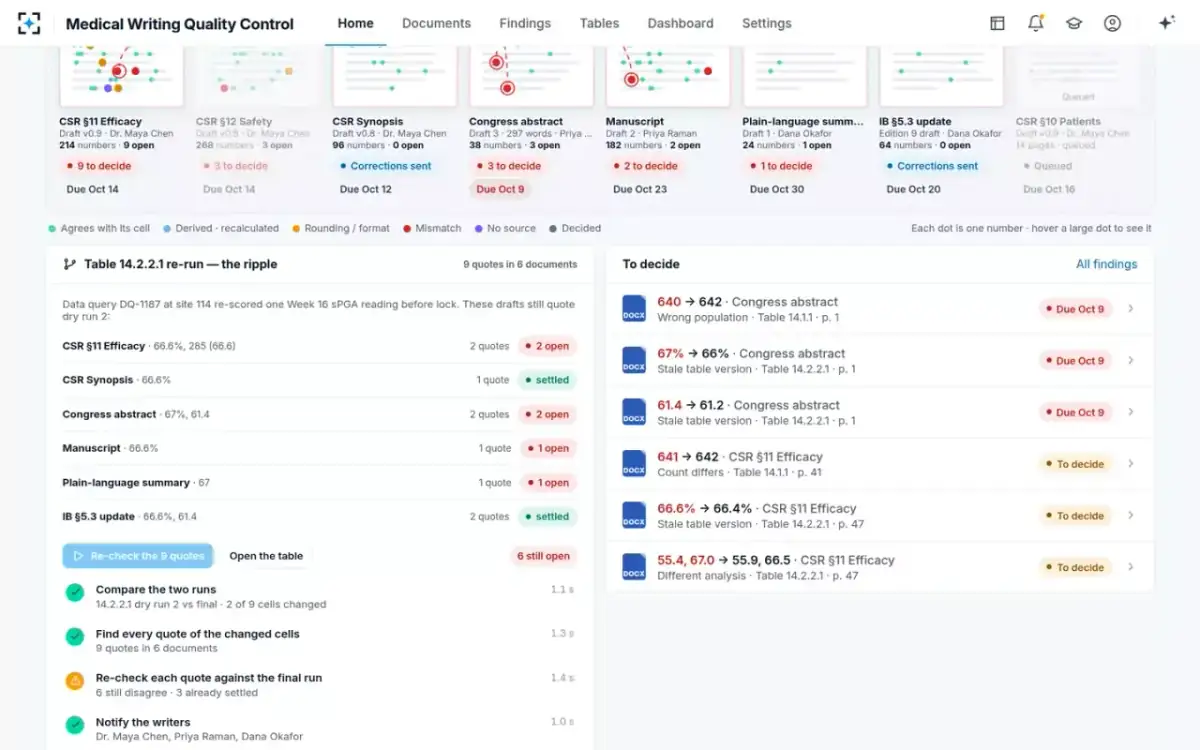
That difference matters most in the case manual QC handles worst: the late re-run. On the sample study, one table was re-run after a data query at a site changed a single reading before database lock, and two cells moved — a responder count from 285 to 284, and the treatment difference from 61.4 to 61.2. Finding which drafts still quote those two cells is, by hand, a re-read of every finished document. Automated, it is a lookup: nine quotes in six documents (demo), three already settled and six needing a decision. The six still need a person, which is the point.
The agents' half, shown as it runs: two runs compared, every quote found and re-checked
Why matching a number to its cell is mechanical, and choosing between two numbers is not
Matching is a search with a verifiable answer. The sentence names a statistic, an endpoint, an arm, a visit and — explicitly or by implication — a population; some output in the package has a title, a population, an endpoint and a visit that fit, and within it one row and one column. When the agent returns an answer it returns the coordinates, so the reviewer's check is a glance rather than a repetition. When no output fits, the honest result is not a guess but a statement of what was searched and what came closest. On the sample study, one sentence cited a site count that no output reports: the search covered all 412 outputs, and site counts live in a listing that was never loaded. That is a usable finding. A tool that instead matched it to the nearest plausible number would have produced a silent error.
Choosing between two numbers is a different kind of problem. When a draft says one thing and a table says another, the question of which is right is not answered by either of them. It is answered by the analysis plan, by what the statistician did in the run, and sometimes by the data. Confidence scores are no help: a model that is 98% sure the table is right is still 98% sure about a string comparison, not about the study. So the rule in the solution is flat — the agents never decide which number is right, and never mark a finding resolved. Both are a person's, and the second belongs to the person who will sign.
Does the FDA allow AI to produce information in a submission?
Yes, with a condition, and the condition is the whole subject. FDA's draft guidance for industry on artificial intelligence in regulatory decision-making opens by stating its scope: recommendations to sponsors and others who use AI to generate information or data meant to support regulatory decisions about a drug's safety, effectiveness or quality. The condition is credibility: the guidance sets out a risk-based framework for establishing and evaluating how far an AI model can be trusted for one particular context of use. It is a draft, open for comment under docket FDA-2024-D-4689 and issued in January 2025, so the detail may change; the structure of the question will not.
Then comes the sentence most people quoting this guidance leave out, and it is the one that decides whether a document QC step is inside it at all. Section II of the guidance excludes two uses of AI: drug discovery, and operational efficiencies — internal workflows, resource allocation, and drafting or writing a regulatory submission are its examples — but only where they do not affect patient safety, drug quality or the reliability of results from a nonclinical or clinical study.
Read the qualifier, not just the parenthesis. Drafting a submission is named as an operational efficiency — but only where it does not impact the reliability of results from a clinical study. A tool that drafts prose is comfortably outside. A tool whose output decides which number appears in a results sentence is not obviously outside at all, because a wrong number in a results section is precisely an impact on the reliability of reported results. The honest position for a buyer is therefore not "QC tooling is out of scope" but "that depends on what the output is allowed to change, and we should be able to say why."
The guidance's own advice on the uncertain case is to ask: it encourages sponsors to engage with FDA early where they are unsure whether a use is within scope. That is a cheaper conversation than a finding.
Context of use: the question that decides how much evidence you owe
The framework turns on two definitions. The context of use sets out exactly what role the AI model plays and how far its job extends in answering a question of interest, and the description of it should say in detail what is modelled and how the output will be used. Model risk then combines two factors: model influence, meaning how much the model's evidence counts beside the other evidence used to answer the question, and decision consequence, meaning how serious the harm would be if a decision on that question were wrong. The effort you owe — the stringency of the assessment, the acceptance criteria, the documentation — is to be scaled to that model risk and fitted to the particular context of use.
Apply that to a document QC step and the result is unusually clear. Decision consequence is high: an incorrect decision means a wrong number in a regulatory document. Model influence, though, is a design choice. If a tool decides which numbers are right and the reviewer rubber-stamps a list, influence is high and the two factors multiply into the top corner of the matrix. If every finding cites the output, row, column and run, the reviewer opens the cell, and no finding is closed without a person, then the evidence informing the decision is the table — the model contributed the pointer. Influence falls, and with it the evidence you owe.
This is the practical reason to care about the boundary, and the reason a buyer should distrust a tool that resolves findings automatically to save time. It is not more automated; it is more expensive to justify.
A credibility case for one automated QC step, in the framework's seven steps
- Step 1 — the question of interest
Does every number in this draft agree with the statistical output it quotes, under our house rules?
- Step 2 — the context of use
The model locates candidate output cells for each number and flags disagreements for review. It does not select between conflicting values, does not edit the document, and its output is one input to a reviewer who opens the cited cell.
- Step 3 — model risk
Decision consequence: high — a wrong number in a results document. Model influence: low by design, because the cited cell is the evidence and a person decides every finding. State both, and state what would raise influence.
- Step 4 — the credibility plan
How you will show it works: a truth set of past documents with known findings, measures for both missed findings and false ones, and an acceptance level for each, agreed before the pilot runs.
- Step 5 — execute it
Run the plan on your own documents and your own outputs, not on a demonstration study. Record the version of the model and the rules in force for each run.
- Step 6 — document it, and the deviations
Write down what you did, what you found and where you departed from the plan — including documents you excluded, and why.
- Step 7 — is it adequate for this use?
A yes here is narrow: adequate for flagging candidate mismatches for human decision on this document type. It is not a general finding about the tool.
What an automated QC step must show: both locations, the run, and its reasoning
Three things make an automated finding reviewable in a second rather than reproducible in an hour, and a buyer should refuse to accept any one of them as optional.
The first is both locations. Every finding should carry the draft's page and sentence and the output's row, column and run, so neither the reviewer nor an auditor has to go looking. The second is the run. A verdict is only meaningful against a named version of the results package, and a number that matches a superseded run should be reported as matching a superseded run — not passed, and not simply failed. The third is the reasoning in words: not a score, but a sentence a writer can act on. "The draft quotes the earlier run; in the final run one reading at a site was corrected after a data query, so responders fell from 285 to 284" tells the author what happened. A confidence of 0.98 tells them nothing they can use.
There is a fourth, quieter requirement that only shows up on bad days: the tool has to be able to say it does not know. The useful behaviour when nothing fits is to report which outputs were searched and what came closest, and leave the sentence to a person.
What a proofreading or document-comparison tool covers, and what a number-to-cell check covers
Copy-checking and document comparison: The document, and usually a second version of the same document.
Checking each number against its table cell: The document and the statistical outputs it quotes, in the current run and earlier ones.
Copy-checking and document comparison: Caught, and caught well. This is what the category is for.
Checking each number against its table cell: Partly: rounding and format are checked against house rules, but prose style is not its job.
Copy-checking and document comparison: Not caught. It matches itself in both versions.
Checking each number against its table cell: Caught, with the cell it should have matched.
Copy-checking and document comparison: Not caught. The value is real, and appears in the package.
Checking each number against its table cell: Caught: the sentence names a set, and the cell belongs to a different one.
Copy-checking and document comparison: Caught only if you happen to compare the right two versions, and only in the document in front of you.
Checking each number against its table cell: Caught across every draft that quotes the changed cell, from the table’s side.
Copy-checking and document comparison: Not caught — there is nothing to compare it with.
Checking each number against its table cell: Reported as having no source, with the outputs searched and the nearest candidates.
Copy-checking and document comparison: The two documents.
Checking each number against its table cell: The outputs of the current and earlier runs, the house rules and the analysis plan.
The row to read twice is the last one. A number-to-cell check is the more useful category and the more demanding one, because it only works if the outputs are available to it in a form it can read, run by run. Most of the implementation effort of this kind of automation is in that plumbing, not in the checking — which is why a pilot that starts from a folder of PDFs will under-perform one that starts from the outputs the statistician actually produced. The practical comparison of all five tool categories sold into this step is in five ways to check one results line.
House rules as settings, not code
Every medical writing group's conventions differ, and most of what an automated QC step does is apply them. Which run is the source of truth, whether a number matching a superseded run is flagged, how values are rounded, how many decimals a percentage takes in the body, how small p-values are written, whether format-only differences block sign-off, who signs and who answers statistician queries — all of those are configuration in the solution, and each change is recorded.
The harder case is the rule nobody wrote down until it was broken. On the sample study, a reviewer added one in plain words during the pass: "about N times" must be within 5% of the ratio of the table values. It applied immediately and re-checked the derived ratios already on the desk — the report section said "about 10 times", and 72.7 divided by 7.0 is 10.39, so "10" is 3.7% from the ratio and the sentence stood as a verified derived value. Had the house rule been 2%, the same sentence would have been a finding. The rule, the threshold and who set it all go on the audit trail, because a QC decision made under a rule is only interpretable afterwards if the rule's version is known.
A tool that requires a change request to add that rule has automated the wrong half of the job: the rules are the part that changes, and the matching is the part that does not.
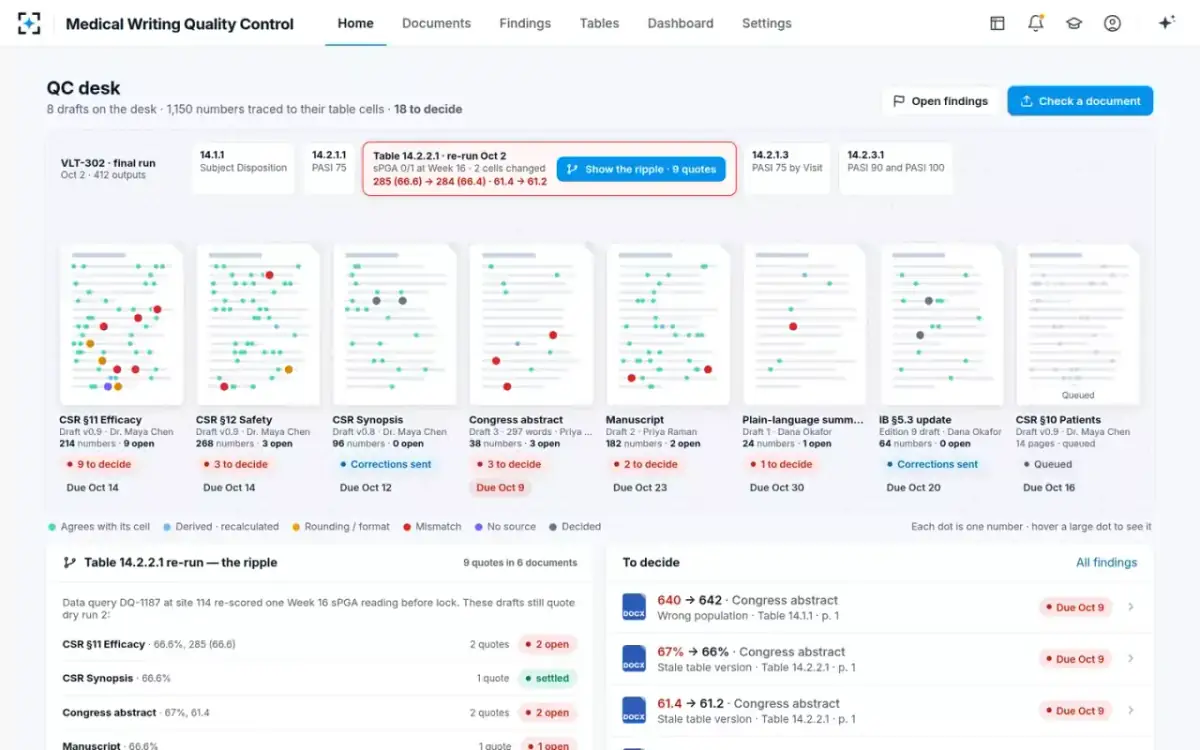
Eight drafts, every number a dot by verdict — and the findings that need a person
Validating it: traceability, audit trail and the records you keep
Validation of a computerised system in a trial is not a certificate; it is a proportionate argument. ICH's good clinical practice guideline defines it as "a process of establishing and documenting that the specified requirements of a computerised system can be consistently fulfilled from design until decommissioning of the system or transition to a new system", and adds that the approach "should be based on a risk assessment that takes into consideration the intended use of the system and the potential of the system to affect trial participant protection and the reliability of trial results". That is the same shape as FDA's framework, in different words: define the use, assess what it could affect, and size the evidence to match.
For a QC step, the specified requirements are refreshingly testable. Does it find every number in a document you have already checked by hand? Does it cite an output, row, column and run for each? Does it apply your rounding rule? Does it refuse to pass a value that matches only a superseded run? Does it leave every finding open until a person decides it? Each of those is a test you can write and run on your own documents, which is what makes this kind of tool easier to validate than a model whose output is a prediction.
Two other records matter. The first is traceability on the statistics side, which the tool inherits rather than creates: the analysis data standard exists, in its own words, to support "traceability among analysis results, analysis data, and data represented in the Study Data Tabulation Model (SDTM)", and it is one of the required standards for data submission to FDA and PMDA. A document QC step is the last link in that chain — from the cell to the sentence — and it is worth nothing if the chain behind it is broken. The second is the audit trail behind each decision, which is the subject of what a signed QC record has to carry.
Where a wider governance frame is wanted, NIST's voluntary artificial intelligence risk management framework is the common reference: it was written to help organisations manage the risks AI poses to individuals, organisations and society, and to build trustworthiness into how AI products and systems are designed, developed, used and evaluated. It is not a trial regulation and does not substitute for one; it is useful for the organisational questions — who owns the model, who reviews it, what happens when it changes — that the trial guidance does not cover. It is currently being revised, so cite the version you used.
What stays with people, permanently
Four things, and they are not a transitional arrangement pending better models.
Which of two conflicting numbers is right stays with the statistician, because the evidence that settles it is the analysis, not the documents. Whether a finding is resolved stays with the reviewer, because closing a finding is an assertion about the document's correctness and someone has to be answerable for it. Editing the draft stays with the author, because a sentence changed by software has no author who can defend what it claims. And the signature stays with a named person, because its meaning is an assertion, and only a person can mean something.
One more belongs on the list for practical rather than principled reasons: deciding what to do about a number with no source. The three available actions — remove the sentence, load the missing output, or keep it with a stated reason until a later document — look alike to a tool and are completely different decisions about the study. For what the seat that makes those decisions actually checks, see what a QC reviewer checks.
Nine questions to put to an automated QC tool before a pilot, and the answer that should worry you
| Ask | The answer that should worry you | What to ask for instead |
|---|---|---|
| Does every finding cite the output, row, column and run? | "It shows the table name." | A finding you can click through to the exact cell, in the run it was checked against. |
| What happens when no output fits a number? | "It picks the closest match." | A statement of what was searched and the nearest candidates, with the number left unresolved. |
| Can it close a finding on its own? | "Yes, above a confidence threshold." | No finding closed without a person, whatever the score. |
| Does it ever edit the draft? | "It can apply fixes automatically." | Corrections sent to the author, who makes the change. |
| How does it treat a superseded run? | "It matches against whatever it has." | A verdict against the current run only, and a flag for numbers that match a superseded one. |
| Who can add a house rule, and how fast? | "It goes into the next release." | A rule added in plain words, applied to the documents already on the desk, with the change on the audit trail. |
| What does it do with derived numbers? | "It checks numbers that appear in tables." | Differences, ratios and "about N times" recalculated from the cells, against a stated tolerance. |
| How will we measure it on our own documents? | "Customers typically see a large time saving." | A pilot on your past drafts with known findings, measuring missed findings as well as false ones. |
| What is in scope under the AI guidance, and who decided? | "It is only a productivity tool." | A written context of use and a model-risk position your quality assurance function has read. |
The last row is the one most often skipped, and it is the cheapest to fix: write down what the tool's output is allowed to change and who decides, before the pilot rather than after it. Everything else in the credibility argument follows from that paragraph. The cost side of the same decision — what a wrong number costs once a document has gone out — is set out in what one wrong number costs to fix.
Questions people ask
What should not be automated in medical writing?
Four things, at least: deciding which of two conflicting numbers is right, which is the statistician's answer; resolving a finding, which is an assertion that the document is now correct; editing the draft, which belongs to its author; and signing, whose meaning only a person can hold. A fifth is practical — deciding what to do about a number no output reports, because remove, load the missing output and keep with a reason look identical to a tool and are different decisions about the study.
Can AI check the numbers in a clinical document?
Yes, and it is the part of the work most worth automating, because it is exhaustive, repetitive and fails quietly when done by hand. What makes it trustworthy is not the model but the evidence trail: each number traced to an output, row, column and run; derived values recalculated; a reason in words; and no finding closed without a person. On the sample study, 1,150 numbers across eight drafts were traced and 18 were left for a reviewer to decide (demo).
How do you validate an AI tool used on a submission document?
Proportionately to what it can affect. ICH E6(R3) describes validation as establishing and documenting that the system's specified requirements can be consistently fulfilled, with an approach based on a risk assessment of its intended use and its potential to affect the reliability of trial results. For a QC step, the requirements are testable on your own documents: does it find every number, cite every cell, apply your rounding, refuse a superseded run, and leave every finding to a person?
Who is accountable when an automated check misses an error?
The sponsor, through the people who own the document and the QC step — which is why the division of labour has to be written down before the tool is bought. In practice the question splits: a missed finding is a failure of the credibility case, to be measured in a pilot and monitored afterwards; a finding that was raised and decided wrongly is a reviewer's decision, on record with their name, the time and the reason.
How much of document QC can be automated?
By task, seven of thirteen in one QC pass, with an eighth shared — the finding, matching, comparing, recalculating, rounding and cross-document work. By time, more than that, because the automated tasks are the slow ones: in the sample study the two mechanical steps account for about half of a section's QC days by hand and almost none of them afterwards (estimated). By decision, none: every finding is still decided by a person.
Does the FDA have rules about using AI in a submission?
There is a draft guidance for industry, issued in January 2025 under docket FDA-2024-D-4689, covering AI used to produce information or data supporting regulatory decisions about safety, effectiveness or quality. It sets out a risk-based credibility assessment framework built around a model's context of use. It expressly does not address AI used for operational efficiencies, including drafting a submission, where those do not affect patient safety, drug quality or the reliability of study results — a qualifier worth reading carefully before assuming a checking tool is outside it.