Clinical study report errata are cheap to write and expensive to cause. The erratum itself is a short document; the cost sits in everything around it — finding every other place the same cell is quoted, re-checking six documents nobody planned to reopen, pulling in a statistician and three writers, re-signing what was signed, and leaving a records trail that will be read by someone with no stake in your deadline. This guide prices those four lines, separates them from the one figure everybody quotes wrongly, and ends with a model you can fill in with your own numbers. Botminds' Medical Writing Quality Control exists to move the whole cost to the cheapest point: the QC desk, before the document goes out.
Two warnings about numbers, since this page is about numbers. The sample figures come from a fictional study inside the solution — Northwind Bio's VLT-302 of Veltrimab — and are tagged demo; design goals are tagged target; our own arithmetic is tagged estimated and names its inputs. And the widely quoted cost of a day of delay is a figure about drug development as a whole, not about one wrong number. It is used here only to price a day, and only where a day is genuinely lost.
What one re-run cell did on the sample study
2cells
changed in one table after a data query before database lock
9quotes
of those two cells, in 6 documents, still carrying the earlier values
4roles
pulled in by the correction: reviewer, statistician, writers, publications manager
1.2days
median from draft received to QC sign-off, as a design goal across document types
What does it cost to correct one number in a clinical study report?
Less than people fear in money and more than they expect in time, and the two answers point in opposite directions, which is why the business case for better document QC is so often argued badly. Price the labour and you get a small number: on our model, correcting one number after the documents have gone out takes about seven hours across four roles, which at the US median wage for the occupation that includes medical writers is roughly $300. Nobody changes a process for $300.
The costs that matter are the other three. The first is the re-check: one wrong cell is quoted in however many live documents quote that cell, and finding them means re-reading finished drafts unless something is tracking the quotes. The second is the records: every correction has to leave who decided, when, why and against which version of the outputs, and the cost of a thin trail is paid years later, during an inspection, at a rate nobody budgets. The third is the calendar, and it is the only one that can become large — but only if the correction actually delays something.
The business-case model, line by line, with every input named and tagged
Hours to correct one number after the documents have gone out
7 hours across four roles — the reviewer who finds and decides, the statistician who confirms, three writers who make the changes, the manager who re-checks the abstract
Our estimate
Where it comes fromOur model, built from the steps the sample study’s re-run required. Count your own by timing one correction end to end.
A rate to price those hours
$43.46 an hour, the 2025 median for the US occupation Technical Writers, which lists Medical Writer among its reported job titles
Published
Where it comes fromUnderstates the statistician and the manager, so treat the labour line as a floor. 7 hours at that rate is about $300.
Documents to re-check for the same cell
6 documents quoted the two changed cells, 9 times between them
Sample data
Where it comes fromFrom the sample study. Your own number is the count of live documents quoting one output, which many groups cannot produce on demand.
Records the correction has to leave
Who decided, when, why, against which run — for each of the 9 quotes
Required, unpriced
Where it comes fromNot priced here, because the cost appears later, as the time an inspection takes when the trail is thin.
Days of delay, if the correction lands on the critical path
About $500,000 a day in lost prescription drug or biologic sales, plus about $40,000 a day in direct costs to run a phase II or III trial
Published
Where it comes fromSmith, DiMasi and Getz’s 2024 estimate for a day of delay in drug development as a whole — never the cost of one error. Use it only to price a day, and only if a day is actually lost.
How often it happens
Documents a year × numbers each quotes × your own first-pass disagreement rate
Your own data
Where it comes fromThe only line that turns one correction into a business case. Take it from your last four re-runs, not from a vendor.
The reason to write it out this way is that the model is usually argued the other way round — day-of-delay figure first, everything else as decoration. That argument collapses the moment anyone asks whether the correction was on the critical path, and many corrections are not. A model built from hours, documents and frequency survives the question, and the delay line is then the upside rather than the premise.
The four cost lines: hours, documents, records and days
Hours are the easiest to measure and the least interesting. Time one correction end to end in your own group — from the moment someone notices to the moment the last document is re-signed — and you will have a better number than any published one, because the variation between groups can be large and depends heavily on how documents are tracked.
Documents are the line many groups cannot produce on demand. Ask how many live documents quote a given table cell and the answer in many medical writing departments is that somebody would have to look. That is the cost: not the re-checking, but the searching that precedes it. On the sample study the answer was nine quotes across six documents, available the moment the table changed (demo), which converts a day of re-reading into a list.
Records are a cost you cannot avoid and should not want to. Every correction after a re-run needs to show what changed, why the analysis was repeated, who decided and against which run. Where that is missing, inspectors say so. The UK regulator's published inspection metrics include a critical data-integrity finding in exactly this area: "There was insufficient documentation available to demonstrate when database pages were frozen, unfrozen and re-frozen between database locks in order to verify what data had been changed and by whom or when." Nothing in that sentence is about effort. It is about a trail that was never written.
Days are the line that can dwarf the other three and usually does not apply. A correction found and fixed inside the QC window costs no days at all. A correction found after a document has gone into a submission, or after results have been posted, can cost some — and that is where the published figure belongs.
Who one wrong number pulls in, and for how long
Four roles, in a fixed order, each waiting on the one before. The reviewer finds the discrepancy and decides what it is. The statistician confirms which value is right — the one question no document can answer and no software should. The writers change their own documents, one each. The publications manager re-checks whatever is closest to an external deadline, because that is the document most likely to leave the building before the correction lands.
Where the hours of one correction go, by role
About 7 hours, after the documents have gone out
- QC reviewer: find every quote, decide each one · 43%
- Writers: change three documents · 29%
- Statistician: confirm which value is right · 14%
- Publications manager: re-check the abstract · 7%
- Re-signing and the records · 7%
About 0.3 hours, caught at the QC desk before the draft goes out
- QC reviewer: decide one finding · 67%
- Writer: change one sentence · 33%
The second row is the argument of this page in one line. It is not cheaper because the work is done faster; it is cheaper because three of the five activities do not happen at all. Nothing has been signed, so nothing is re-signed. Nothing has been sent, so nobody is chasing an abstract. And the correction is one sentence in one document, because the other five documents have not been written against the wrong value yet.
Where is the cheapest point to catch a wrong number?
At the QC desk, by a wide margin, and the margin grows with every document that quotes the cell afterwards. The chart below is in hours rather than money, because hours are the part we can estimate honestly; the later points carry costs this chart cannot price.
Hours of work to deal with one wrong number, by the point at which it is found
Three points about the shape of it. The first step up, from the QC desk to the next document, is the cheapest to eliminate and an easy one to miss: it is the cost of writing an abstract from a draft rather than from the outputs. The second step, to seven hours, is the cost of signing. And the fourth bar is not really about hours at all, which is why it is drawn almost level with the third: what changes after a document leaves is the obligation, not the effort.
How much is one day of drug development delay worth, and why is the old figure wrong?
The day-of-delay figures that circulate in these conversations are decades old, and the researchers who re-measured them say so in the first line of their paper:
“Two frequently cited figures by clinical research insiders and observers — the cost of missing a day to generate prescription drug sales and the cost of a day to conduct a clinical trial — are outdated and based on anecdotal evidence.”
Smith, DiMasi and Getz, New Estimates on the Cost of a Delay Day in Drug Development, Therapeutic Innovation & Regulatory Science, 2024
Their replacement figures come from 645 drugs launched since 2000 and 409 clinical trial budgets. On lost revenue, one day is worth roughly $500,000 in prescription drug or biologic sales forgone, with infectious, haematologic, cardiovascular and gastrointestinal products at the high end. On the cost of running the trial while it waits, a phase II or III trial costs about $40,000 a day in direct costs, highest in respiratory, rheumatology and dermatology. The paper also reports that average sales per day have been falling by roughly "$80,000-$100,000" a year, so this is not a constant to be quoted forever: cite the year you took it from.
Now the discipline. None of this is the cost of one wrong number. It is the price of a day, and it enters a document QC business case only when a correction actually costs a day on the critical path — a submission that slips, a filing window that moves, a congress deadline missed. Multiplying a day of delay by every correction a group makes in a year produces a number that is both enormous and indefensible, and the first reviewer who notices will discount everything else in the case. Use it once, on the delays you can actually name.
An erratum that was not an error: what one sentence in a report cost
The sharpest published example of this cost is not a wrong result at all. In the ARISTOTLE trial of apixaban, a statement in the clinical study report drew a regulatory question, and the authors of the subsequent analysis describe what followed plainly: "approval of apixaban was delayed to investigate a statement in the clinical study report that '7.3% of subjects in the apixaban group and 1.2% of subjects in the warfarin group received, at some point during the study, a container of the wrong type.'"
The investigation reviewed medication container labels for 6,520 participants from randomly selected sites. The actual rate of dispensing error resulting in treatment error was 0.04%, and the paper's conclusion is the part worth sitting with: "The initially reported dispensing error rate was the result of data recording and data management errors and not true medication dispensing errors." Most of the originally reported errors were cases where the right container was dispensed and the wrong container number was entered.
So: a figure in a clinical study report, correct as a summary of what the database said, wrong as a statement about what happened, and expensive out of all proportion to the effort of getting it right. The cost was not the erratum. It was the sentence, in a document a regulator read, that could not be reconciled with anything quickly.
Do you have to re-post results when a number changes?
If the results are on a public registry, yes, and on a clock. Under the US registry rules, results information for an applicable clinical trial is in general due within one year of the trial's primary completion date. The correction duty is separate and shorter: a responsible party who becomes aware of errors "shall have not more than 15 calendar days for clinical trial registration information, or 25 calendar days for clinical trial results information, to correct or address such errors". Errors the registry itself flags in its quality control review run to the same deadlines from the date of the notification.
That turns a document correction into a dated obligation the moment the number has been posted, and it is the clearest reason to care where in the chain the error is caught. A wrong cell found at the QC desk is a finding. The same cell found after posting is a finding, a re-check of every document quoting it, a registry correction inside 25 calendar days, and a decision about any publication that quotes it too.
Publications have no equivalent regulation and a longer tail. A journal correction is at the editor's discretion and on the journal's timetable, and the version that was wrong stays in circulation. That asymmetry is why the congress abstract — written earliest, from the least final outputs, to the least movable deadline — is an especially expensive document to get wrong, and why the numbers behind each abstract checklist item repay checking before submission rather than after.
The records cost: what an inspector asks for after a re-run
A re-run invites a specific line of questioning, because repeated analyses are where data integrity problems hide. Which runs happened, and why? What changed between them? Who authorised the change, and when? Which documents were written against which run, and what happened to each when the run changed?
Those questions are cheap to answer if the answers were recorded as the work happened and expensive if they were not — and "expensive" here means inspection time, follow-up questions and, in the worst case, a finding that is not about the number at all but about the inability to reconstruct the sequence. The published metrics quoted above show what that reads like in an inspection report: not an accusation of a wrong result, but the absence of documentation sufficient to verify what was changed and by whom.
The practical implication for a document QC process is that the record is part of the correction, not paperwork after it. Each finding should carry both locations — the page and sentence, and the output, row, column and run — the decision, the person who made it, the time, and the reason where one is needed. Assembled as the work happens, that costs nothing extra. Reconstructed a year later, it costs whatever it costs. What the signed record has to carry, clause by clause, is set out in the Part 11 requirements for a QC sign-off.
The correction, closed: every finding decided and the record signed against a named run
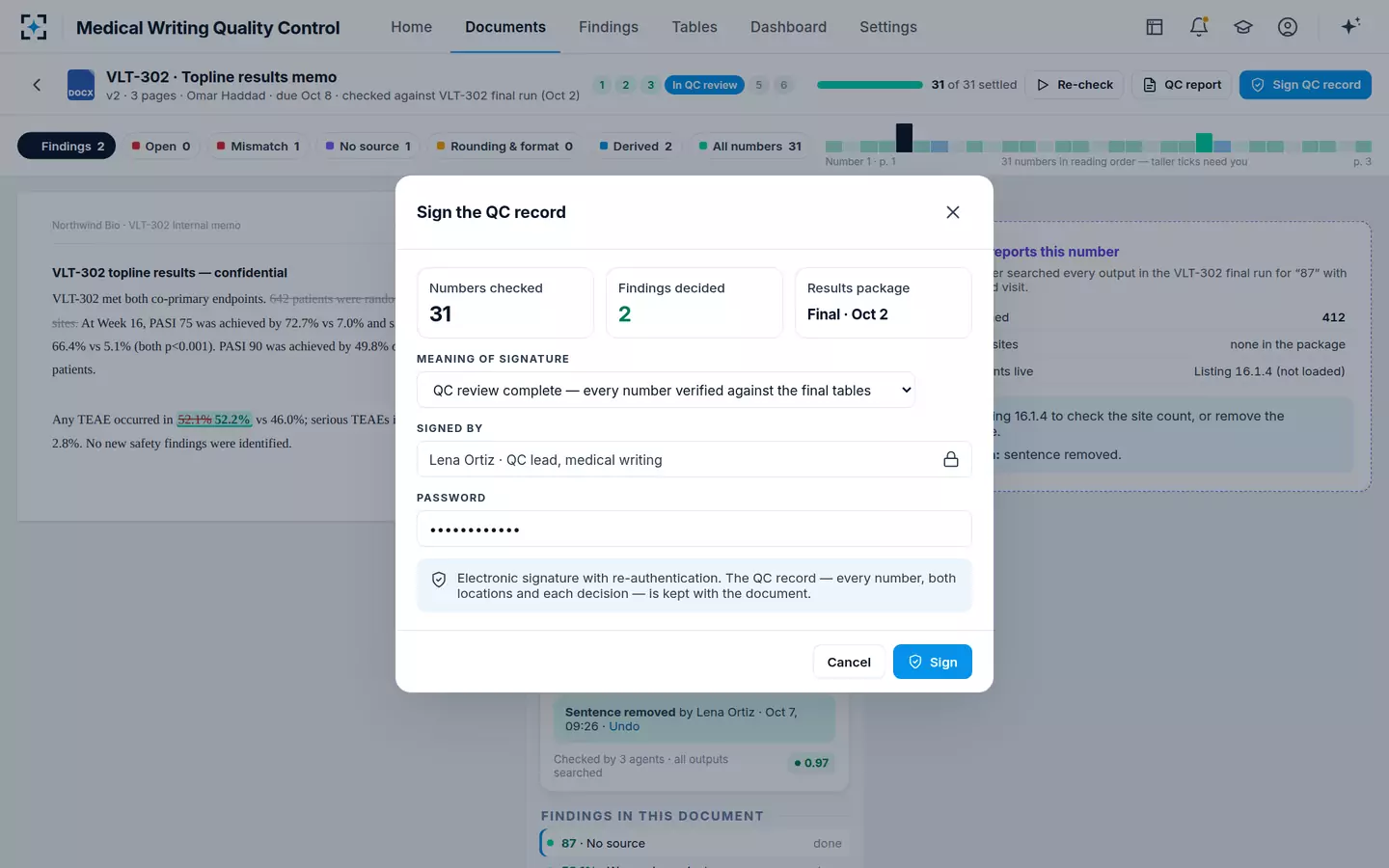
Catching it early: the same correction, drawn to scale
The two paths below are the same wrong cell, found at two different moments. The difference is not speed. It is how many of the steps exist.
One wrong cell, found at the QC desk and found after six documents had gone out
- One findingsame day
- Before anyone notices3 d
- Finding every quote of the cell1 d
- Re-checking 6 documents2 d
- Corrections made by three writers1.5 d
- Re-signing
- Writing up the records1 d
The first lane has one phase because that is all there is: the reviewer sees the sentence and the cell side by side, decides, and the correction goes to the writer. The second lane has six, and the longest of them is the first — the days before anyone notices, which is the only phase no process improvement shortens except one that watches the outputs rather than the documents.
Building the business case, line by line
Write it in this order and it survives review. Start with frequency, because it is the line that does the arithmetic: how many results documents your group produced last year, how many numbers each quotes, and what share of them disagreed with their table on the first pass. Many groups have never counted the third, and the act of counting it on four past documents is itself the most persuasive page of the case.
Then hours, from your own timing of one correction, priced at a rate your finance function will accept. Then documents: the count of live documents quoting one output, which doubles as evidence of the problem, since the inability to produce the number on demand is the thing being bought. Then the records, stated as a risk rather than a figure. And last, the days — named, specific, and only where they happened.
What the solution offers against each line is deliberately narrow. Against frequency: 1,150 numbers traced across eight drafts with 18 left to decide (demo), and a design goal of 94.5% first-pass agreement (target). Against hours: the mechanical half of a QC pass, which on our estimated split of the sample study's figures is about half of a report section's QC days (estimated). Against documents: the list of every quote of a changed cell, built from the output's side. Against records: both locations, every decision and every house-rule change, kept with the document version. It does not shorten an inspection, decide which number is right, or stop anyone writing an abstract from an early run.
The measures a business case needs, in the form it needs them
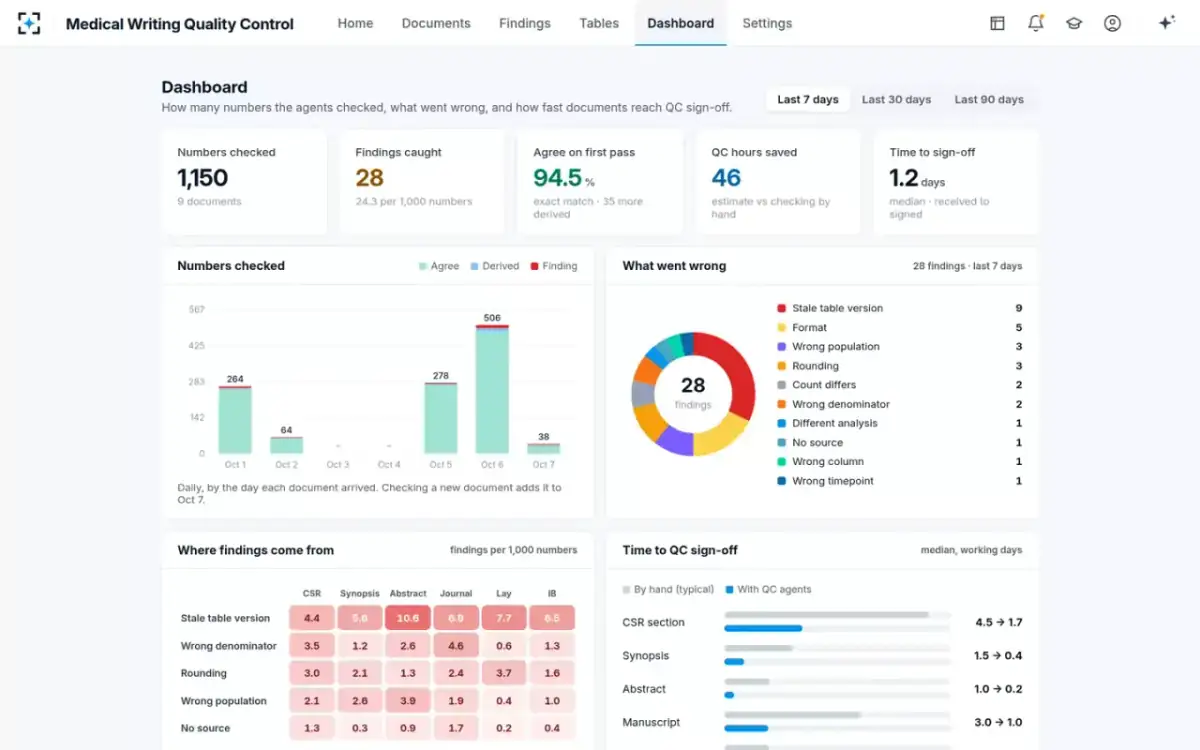
The findings-by-type view is worth more than the time saving in the long run. A group whose commonest finding is a stale table version has a results-package distribution problem; one whose commonest finding is a wrong denominator has a writing-convention problem that training fixes; one whose commonest finding is format has house rules that nobody wrote down. The division of the QC pass between agents and people sets out which of those a tool can take and which it cannot, and what a QC reviewer checks describes the seat that does the deciding.
Questions people ask
How long does an erratum to a clinical study report take?
The erratum itself is quick; the work around it is not. On our estimate for a correction of the size the sample study produced — two changed cells quoted nine times in six documents — the elapsed time is about nine days, of which roughly three are the days before anyone notices and most of the rest is waiting rather than working. The same correction caught at the QC desk is one finding, one decision and one sentence.
How many people does one wrong number pull in?
Four, in a fixed order, each waiting on the one before: the QC reviewer who finds it and decides what it is, the statistician who confirms which value is right, the writers who change their own documents, and the publications manager who re-checks whatever is closest to an external deadline. On our model that is about seven hours in total, and the largest share belongs to the reviewer doing the searching.
Do you have to re-post results when a number changes?
On the US registry, yes, and quickly. A responsible party who becomes aware of errors has not more than 15 calendar days for registration information or 25 calendar days for results information to correct or address them, and the same deadlines apply to errors the registry's own quality control review flags. Journal articles have no equivalent rule and a longer tail, which makes an abstract or manuscript the more awkward place for a stale number to land.
How much is one day of drug development delay worth?
About $500,000 in lost prescription drug or biologic sales, plus about $40,000 a day in direct costs to run a phase II or III trial, on a 2024 peer-reviewed analysis of 645 drugs and 409 trial budgets by Smith, DiMasi and Getz — whose first finding is that the figures usually quoted are outdated and based on anecdotal evidence. It prices a day of delay in development as a whole, so it belongs in a document QC case only for delays you can actually name.
Where is the cheapest point to catch a wrong number?
Before the draft leaves the QC desk, because three of the five activities a late correction requires simply do not happen: nothing has been signed, nothing has been sent, and no other document has been written against the wrong value. The step that is cheapest to eliminate, and most often missed, is the next one — an abstract written from a draft instead of from the outputs inherits the draft's errors.
How do you build a business case for better document QC?
Frequency first: documents a year, numbers each quotes, and the share that disagreed with their table on the first pass, counted on four of your own past documents. Then hours, from timing one real correction. Then the count of live documents quoting one output — if nobody can produce it, that is the finding. Then records, as a risk. Then days, named and specific. A case built in that order survives the question that destroys the usual one: was this correction actually on the critical path?