Medical policy updates are the new editions a health plan issues of its coverage criteria, and they follow a calendar mostly set by others: Medicare's national and local coverage decisions, which take effect on any day of the year; quarterly code files every January, April, July and October; the utilization management (UM) committee's review, which Medicare Advantage rules require at least once a year; and a criteria filing to CMS due each 28 February. The hard part is not issuing the edition. It is that an appeal, an audit or a provider dispute months later will ask which edition applied on a past date. Botminds' Medical Policy Search keeps every edition of every policy dated and searchable, so the answer for any service, plan type and date comes back quoted with section and edition.
How much warning a Medicare coverage change gives a medical policy team
- Request to proposed decision≤ 6 months
- Public comment30 d
- Final decision≤ 60 d
- Comment≥ 45 d
- Notice≥ 45 d
- Committee to effective dateplan’s choice
How often are medical policies updated?
Every Medicare Advantage UM policy must be reviewed at least once a year, and most change more often because the rules they sit beside change more often. The UM committee rule is explicit: the committee must “At least annually, review the policies and procedures for all utilization management, including prior authorization, used by the MA plan”, and that review must consider Medicare's coverage decisions and current clinical guidelines. Medicaid managed care plans must review their practice guidelines “periodically as appropriate”, and network Medicare Advantage plans must keep theirs “reviewed and updated periodically”.
The yearly review is a floor. Medicare's own coverage documents move constantly, and a plan policy that sits beside one moves with it. On 27 October 2026, CMS's Coverage API listed 853 local coverage determinations (LCDs) in effect; for 348 of them, 41%, the version in force had taken effect during 2026. Of 1,960 billing and coding articles in effect, 655 had a 2026 version. Across the 345 national coverage determinations (NCDs), 68 showed a last-updated date in 2026. These counts understate the churn, because an LCD revised twice this year shows only its latest version.
The versions pile up. The median LCD in effect is on its 22nd version; the most revised, a contractor's Biomarkers for Oncology LCD, is on version 220. A plan policy that cross-walks to an LCD inherits that history: each Medicare version is a question about whether the plan edition still says what Medicare says.
Why do medical policies change in April and October?
Because the code sets do. CMS publishes the HCPCS Level II file every quarter, effective January, April, July and October, and the ICD-10 diagnosis and procedure codes now update twice a year, on 1 October and 1 April. A new code for a device or a drug changes what a policy's coding section covers even when no clinical criterion moves, and Medicare contractors are told to make that kind of change without the full comment process: they “shall update LCDs to reflect changes in Statutes, Federal regulations, CMS Rulings, NCDs, HCPCS code changes for DME, coverage provisions in interpretive manuals, and payment policies.”
LCDs in effect on 27 Oct 2026 whose current version took effect in each month of 2026
The pattern is the work plan. January, April and October are when a medical policy analyst should expect code-driven edits across many policies at once, and when the risk of a reviewer quoting last quarter's coding section is highest. The other months bring fewer, larger changes: a new NCD, a reconsidered LCD, a society guideline that moves the evidence.
What triggers a medical policy review?
Six things trigger a review, and only one of them is the calendar. A Medicare NCD or LCD changes; a code is added, deleted or revised; the evidence moves (a new guideline, a large trial, a systematic review); appeals overturn denials that cite the same section; a federal rule changes what criteria may say; and the annual review comes due. The fifth is easy to miss. Since 1 January 2024 a Medicare Advantage plan may apply its own criteria only where Medicare's are not fully established, and must publish the evidence and rationale for each (42 CFR 422.101(b)(6)). Every edition written before then needed a second look against that test, which internal coverage criteria in plain words walks through.
The appeals trigger deserves a standing process. When the same section keeps losing on appeal, the policy is usually the problem, not the reviewers. The rule also expects pruning: the committee must revise policies as necessary, including the step that plans rarely schedule.
“…removing requirements for UM for services and items that no longer warrant UM.”
42 CFR 422.137(d)(3), the Medicare Advantage UM committee's duties
The medical policy year, month by month
Laid out by month, the year has three crowded seasons: the turn of the year, when editions approved in the autumn take effect and the CMS filing follows; April, when code updates and contractor revisions pile up; and October, when the fiscal-year code sets change while the committee prepares next year's editions. The table is a template; the rules in the right-hand column are fixed, the plan's own dates are not.
A medical policy calendar: what arrives each month, and the rule behind it
| When | What arrives | What the medical policy team does | Rule or source |
|---|---|---|---|
| 1 January | Plan year begins; editions the committee approved in the autumn take effect; January HCPCS file | Confirm each new edition is published and the old one closed with an end date, not overwritten | HCPCS quarterly update (CMS) |
| By 28 February | Part C UM annual data submission to CMS (2026 only: 30 April) | File every internal criterion used for prior authorization that year, the plan’s and its vendors’ | CMS-10913 |
| By 31 March | Public prior authorization metrics for the prior year | Read the approved-after-appeal share by service as a policy signal | 42 CFR 422.122(c) |
| 1 April | April HCPCS file; ICD-10-CM April update; contractor LCD revisions peak | Re-map codes in every policy that cites a changed code | CMS ICD-10 and HCPCS pages |
| Early April | Deadline to tell CMS of a uniform local coverage policy for a multi-area plan | Decide which contractor’s LCDs to apply plan-wide, if any | 42 CFR 422.101(b)(3)(i) |
| First Monday in June | Medicare Advantage bids due for next year | Have next year’s policy changes with cost effects known before the bid | 42 CFR 422.254(a)(1) |
| 1 July | July HCPCS file | Coding updates; mid-year evidence reviews | HCPCS quarterly update (CMS) |
| 1 October | New fiscal-year ICD-10-CM and ICD-10-PCS codes; October HCPCS file; article revisions peak | Code-driven edits across many policies at once | CMS ICD-10 page |
| October to December | UM committee’s review of the year’s policies; next year’s editions approved | Prepare redlines, evidence summaries and the Medicare cross-walk for each vote | 42 CFR 422.137(d) |
| Any day | New or revised NCDs and LCDs, effective on their own dates | Check which plan policies sit beside them and whether their answers change | SSA §1862(l); PIM ch. 13 |
Two dates in that table are new. The prior authorization metrics come from the 2024 interoperability rule, under which “the initial set of metrics must be reported by March 31, 2026.” The criteria filing is CMS's Part C UM annual data submission, first due on 30 April 2026 and then every 28 February (CMS); what the submission asks for is set out field by field elsewhere. Both turn the policy library into something CMS reads every year.
When do medical policy changes take effect?
A plan's edition takes effect on the date printed on it, and for Medicare Advantage no federal rule sets a minimum notice period for a new internal criterion; commenters on the 2023 rule asked for 30 days, and the final text has none (CMS-4201-F). Medicare's own documents are different. A final LCD's notice period is at least 45 calendar days, and if the contractor does not extend it, “the effective date of the LCD is the 46th calendar day after the notice period began.” An NCD's final decision follows a 30-day comment period by no more than 60 days, and the claims-processing instructions arrive separately, in change requests.
For the person applying the policy, the effective date matters less than the date rule: which date decides the edition. Plans typically use the date of service for claims, the date of the request for prior authorization and the admission date for inpatient stays. That is plan practice and contract language, not federal text, so it should be written into the policy itself. One federal rule does settle a common case: once a Medicare Advantage plan approves a service through prior authorization, it may not later deny that service for lack of medical necessity (42 CFR 422.138(c)), so a later edition cannot reach back to an approved request.
Who updates a health plan's medical policies?
The director of medical policy and a team of analysts draft the editions; the UM committee approves them; for Medicare Advantage, no UM policy may be used unless the committee has reviewed and approved it. The committee is led by the plan's medical director and must include a majority of practicing physicians, at least one practicing physician independent of the plan and one expert in the care of elderly or disabled people (42 CFR 422.137). Network plans must also consult their contracting physicians on the organization's medical policy (42 CFR 422.202(b)). How the wider UM team divides that work is covered in the guide to the utilization management team.
Who is busy when a medical policy update lands
Today
Owns the library and its review calendar; learns that a criterion went beyond Medicare when the appeals arrive, months after the edition took effect.
With agents
Sees every effective date, plan edition and Medicare change on one calendar, with the policies whose answers would change listed against each.
Still theirs: What goes to the committee, and what is published
Today
Reads the new code files, the coverage database and the literature, then re-drafts sections by hand and tracks which editions cite what.
With agents
Starts from a list of policies a Medicare or code change touches, with the passage that changed; drafts the edition and the evidence summary.
Still theirs: The evidence review and the draft
Today
Signs off a year of editions in a few long meetings, often without the tracked changes beside the vote.
With agents
Votes each edition with the redline, the Medicare source and the committee’s earlier decision on the same section in view.
Still theirs: The vote and the written reason
Today
Apply whichever edition the portal shows today, and rebuild the old one from a shared drive when an appeal looks back.
With agents
Ask for a service, plan type and date and get the edition that was in force then, quoted by section.
Still theirs: The review of each case
The calendar's crowded seasons fall on different people. April and October load the analysts with code-driven edits. The fourth quarter loads the committee. January loads the reviewers, who must stop quoting December's editions the morning the new ones take effect, while appeals for services from last year still need last year's text.
How are providers told about medical policy updates?
The rules require publication, not a particular notice. Network Medicare Advantage plans must make sure “The guidelines are communicated to providers and, as appropriate, to enrollees.” Medicaid managed care plans must disseminate their guidelines “to all affected providers and, upon request, to enrollees and potential enrollees.” Internal coverage criteria in Medicare Advantage must be publicly accessible with their evidence and rationale, and CMS has said that means on a website, not behind a paywall. Most plans add a monthly or quarterly update bulletin listing new and revised policies with their effective dates; that is practice, and providers rely on it.
A bulletin that lists changes without dates helps no one in an appeal. The useful bulletin says, for each policy, what changed, from which date, for which plan types, and which edition it replaces.
Keeping every edition, because appeals look backward
Every update creates a past edition that someone will need again. A Medicare Advantage payment reconsideration can arrive months after the service; a provider dispute can arrive a year later; an auditor can ask for the criteria applied to a sample of last year's decisions. Medicare Advantage organizations must keep books and records for 10 years, and Medicare's own contractors keep each LCD's record for 6 years and 3 months after it is retired (PIM ch. 13). A policy portal that shows only today's PDF meets neither need.
Every effective date on one calendar in Medical Policy Search, with the committee's agenda beside it
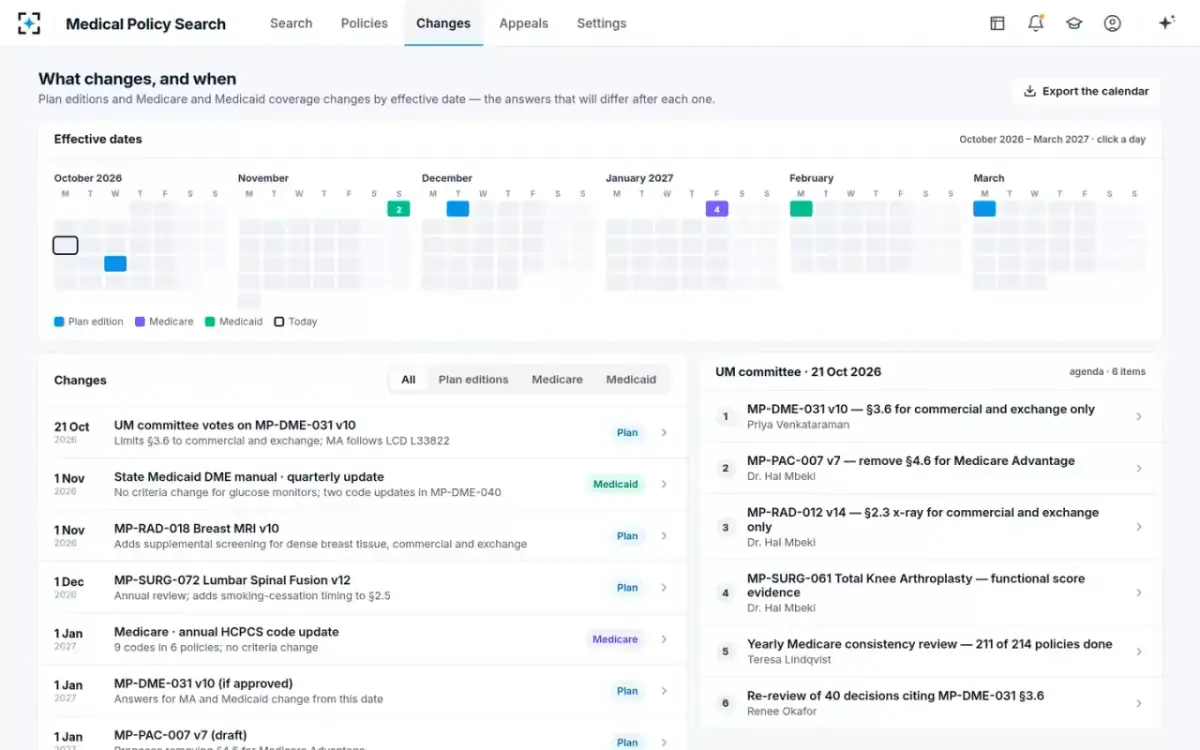
In the solution, the change tracker reads Medicare and state Medicaid coverage changes each week and lists the plan policies whose answers would change, so the analyst starts from the affected passage instead of from the coverage database. New editions still go through the committee and are published by the director of medical policy; the agents draft and flag, and never edit a policy.
The library view: current edition, next review and the Medicare rule each policy sits beside
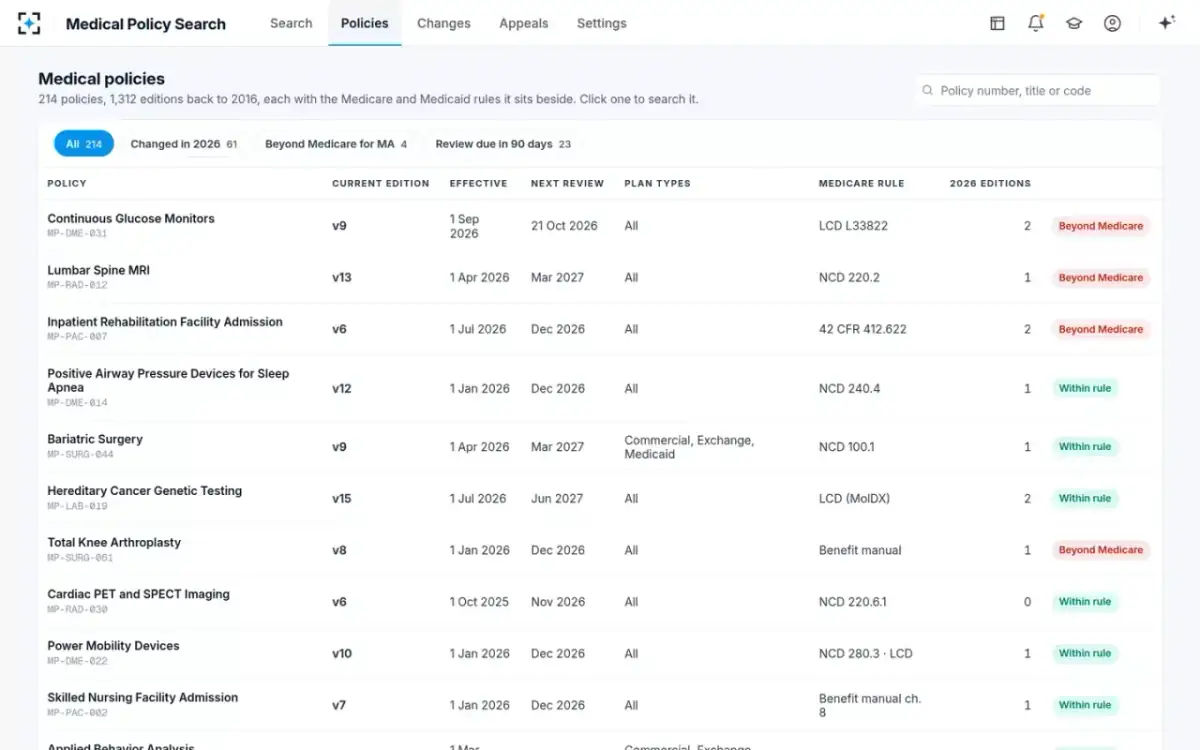
Search is where the calendar pays off. A nurse who asks which criteria applied to a service on 18 August gets the edition in force that day, not the one published on 1 September; how the edition in force is found is set out step by step. To see the calendar, the library and the dated answer together, start from Medical Policy Search.
Questions people ask
How often must the UM committee review medical policies?
For Medicare Advantage, at least once a year, covering every UM policy including prior authorization, and considering Medicare's NCDs, LCDs and current clinical guidelines (42 CFR 422.137(d)(1)). The committee must also document the reason for its decisions and make that documentation available to CMS on request.
What is the medical policy review cycle?
A typical cycle runs from trigger to evidence review, draft, committee vote, publication with an effective date, and application by reviewers, then back to monitoring. In Medicare Advantage two steps are fixed by rule: committee approval before use, and at least an annual review. The rest of the cycle, including how far ahead editions are published, is the plan's own design.
Can a health plan change a medical policy in the middle of the year?
Yes. Plans issue editions whenever evidence, codes or Medicare's rules move, and Medicare's own LCDs change in every month of the year. What a plan cannot do in Medicare Advantage is apply a new edition to a service it already approved through prior authorization and later deny it for lack of medical necessity (42 CFR 422.138(c)).
Where do Medicare's coverage changes appear first?
In the Medicare Coverage Database, where contractors must publish proposed and final LCDs and their articles, and where CMS posts proposed and final NCD decisions. The database's data is refreshed weekly, and CMS also offers it through a public Coverage API, which is how the 2026 counts on this page were made.
Do code updates change a medical policy's coverage?
Not by themselves, but they change what the policy points at. A new HCPCS code for a device, or a deleted ICD-10 code, can leave a policy's coding section covering the wrong items. Medicare contractors treat these as non-discretionary updates; plans should give them the same quarterly rhythm, in January, April, July and October.
How long should a plan keep old editions of its medical policies?
At least as long as anyone can ask about a decision made under them. Medicare Advantage organizations must keep records for 10 years under their CMS contract (42 CFR 422.504(d)), and the edition behind a decision is part of the story an auditor or a court will ask for.