An LCD lookup tool finds Medicare's local coverage determination (LCD) for a service, and the standard one is CMS's own: the search page of the Medicare Coverage Database, where every Medicare contractor must publish its proposed and final LCDs and their billing and coding articles. It answers ‘what does this contractor's LCD say today?’ well. A health plan reviewer usually needs more: which rule governs this request, for this member's plan type, on this date, in what order. For a Medicare Advantage member that order is fixed by regulation: national coverage determinations (NCDs), general coverage conditions in Medicare law, the LCD and article of the contractor with jurisdiction, and only then the plan's own criteria. Botminds' Medical Policy Search runs that order on every question and returns the governing rule with the plan's criteria laid beside it.
Which rule wins for a Medicare Advantage request: the decision tree a lookup tool should run
Agent
Is there an NCD for the service?If yes, its criteria bind; national coverage determinations are binding at every level of Medicare appeal. Note any coverage-with-evidence-development condition.
Never: A plan criterion may not add conditions to a fully established NCD.
Agent
Do Medicare’s general coverage conditions apply?Inpatient admission criteria in 42 CFR 412.3; skilled nursing, home health and inpatient rehabilitation conditions; benefit-category rules. These apply to Medicare Advantage as written.
Agent
Is there an LCD from the contractor with jurisdiction?Use the LCD, and its billing and coding article, of the contractor for the area where the service is covered, in the version in force on the governing date.
Never: An LCD from another contractor’s area is not Medicare’s rule for this plan; used here, it is internal criteria.
Agent
Are Medicare’s criteria fully established?If not, under one of the three tests (gap to fill, flexibility beyond listed indications, or no rule at all), the plan’s internal criteria may apply, with public evidence and rationale.
Agent
Apply to this patientMedical necessity rests on the member’s history, physician recommendations and clinical notes, criterion by criterion.
A person decides
Physician or other appropriate professionalReviews any expected adverse medical-necessity decision before it is issued, with knowledge of Medicare coverage criteria.
How do I look up an LCD?
Use the Medicare Coverage Database search: enter a keyword, a CPT or HCPCS code, an ICD-10-CM code, a document ID (L for LCDs, A for articles) or a contractor's name, then narrow by the state where the service was furnished. CMS's own instructions for a code are specific: “Enter the CPT/HCPCS code in the MCD Search and select your state from the drop down. (You may have to accept the AMA License Agreement.) Look for a Billing and Coding Article in the results and open it.” Durable medical equipment is the exception: for the DME contractors, procedure codes still sit in the LCD itself.
Three details catch experienced users. California and New York have partial-state selections, so a search can return documents for the wrong half of the state. Retired LCDs are not in the main search but in a separate archive of documents no longer in effect. And a document's newest version may not be in effect yet: on 27 October 2026, CMS's Coverage API listed four LCD versions scheduled to take effect in November or December. The same data is available as a public API, which is how plans and vendors keep a copy current.
What is the difference between an NCD and an LCD?
An NCD is CMS's decision on whether an item or service is covered nationally; an LCD is a Medicare contractor's decision on whether it is reasonable and necessary within that contractor's jurisdiction. The Social Security Act defines the LCD as a determination “respecting whether or not a particular item or service is covered on an intermediary–or carrier–wide basis”. CMS's coverage pages put the balance plainly: “The vast majority of coverage is provided on a local level and developed by clinicians at the contractors that pay Medicare claims.”
NCD, LCD, article and internal criteria: what each is and how much it binds
| NCD | LCD | Billing and coding article | Plan internal criteria (Medicare Advantage) | |
|---|---|---|---|---|
| Issued by | CMS | A Medicare contractor, for its jurisdiction | The same contractor | The plan, or a vendor it licenses |
| Process | Proposed decision within 6 months of a request (9 with an outside assessment), 30-day comment, final within 60 days | Proposed LCD, at least 45 days of comment, open meeting, then at least 45 days’ notice | Published with the LCD; codes updated without the full process | Committee approval; public evidence summary, sources and rationale |
| Codes | None; codes come through change requests | None for most contractors; still in LCDs for DME | CPT/HCPCS, ICD-10, bill types | As the plan writes them |
| In appeals | Binding at every level, including the ALJ and Council | Not binding on ALJs and the Council, but given substantial deference | Not binding; follows the LCD | Must meet 42 CFR 422.101(b)(6) to support a denial |
| For a Medicare Advantage plan | Must comply | Must comply with the LCD of the contractor with jurisdiction | Read with the LCD | Only where Medicare’s criteria are not fully established |
The appeal weight is the practical difference. The regulation is unequivocal about NCDs.
“An NCD is binding on fiscal intermediaries, carriers, QIOs, QICs, ALJs and attorney adjudicators, and the Council.”
42 CFR 405.1060(a)(4), applicability of national coverage determinations
LCDs carry less: administrative law judges and the Medicare Appeals Council are not bound by them but “will give substantial deference to these policies if they are applicable to a particular case”, and must explain any decision not to follow one. A reviewer who denies on an LCD is on firm ground; one who denies on a plan criterion beyond the LCD is not.
What is a local coverage article?
It is the companion document an LCD's contractor publishes with the coding and billing detail: the CPT and HCPCS codes the LCD covers, the ICD-10 codes that support medical necessity, bill types and documentation instructions. Medicare moved codes out of LCDs into articles, so for most services the article is what a code search finds. Articles follow the code sets: 655 of the 1,960 articles in effect on 27 October 2026 had a version from that year, with peaks in January, April and October.
An article is not a coverage rule by itself. Read it with its LCD: the LCD says when the service is reasonable and necessary, the article says how to bill it. A reviewer who checks only the article's diagnosis list can approve or deny a request on codes the LCD's criteria would not support.
Do LCDs apply to Medicare Advantage?
Yes. A Medicare Advantage plan must comply with CMS's NCDs and with the “Written coverage decisions of local Medicare contractors with jurisdiction for claims in the geographic area in which services are covered under the MA plan.” Where a plan's service area spans more than one contractor's area, it may apply the local policy most beneficial to members uniformly, after notifying CMS before the bid deadline; a regional plan may apply one area's LCDs throughout its region. Either way, the plan must make the selected policy readily available to members and providers.
Which LCD applies to a Medicare Advantage plan?
The LCD of the contractor with jurisdiction where the plan's services are covered, unless the plan has made one of the uniform elections. That matters because the same topic can carry different text in different jurisdictions: on 27 October 2026, four titles, including facet joint interventions and epidural steroid injections, were each covered by seven separate LCDs in effect. A plan operating in several states may be applying several of them at once.
CMS has closed the shortcut of borrowing a neighbour's LCD. In its February 2024 guidance, an LCD from outside the plan's service area counts as internal coverage criteria, so it needs one of the three tests and public evidence; a plan's criteria may look like an out-of-area LCD, but they must still be justified as the plan's own. The three tests for internal coverage criteria are explained in plain words elsewhere.
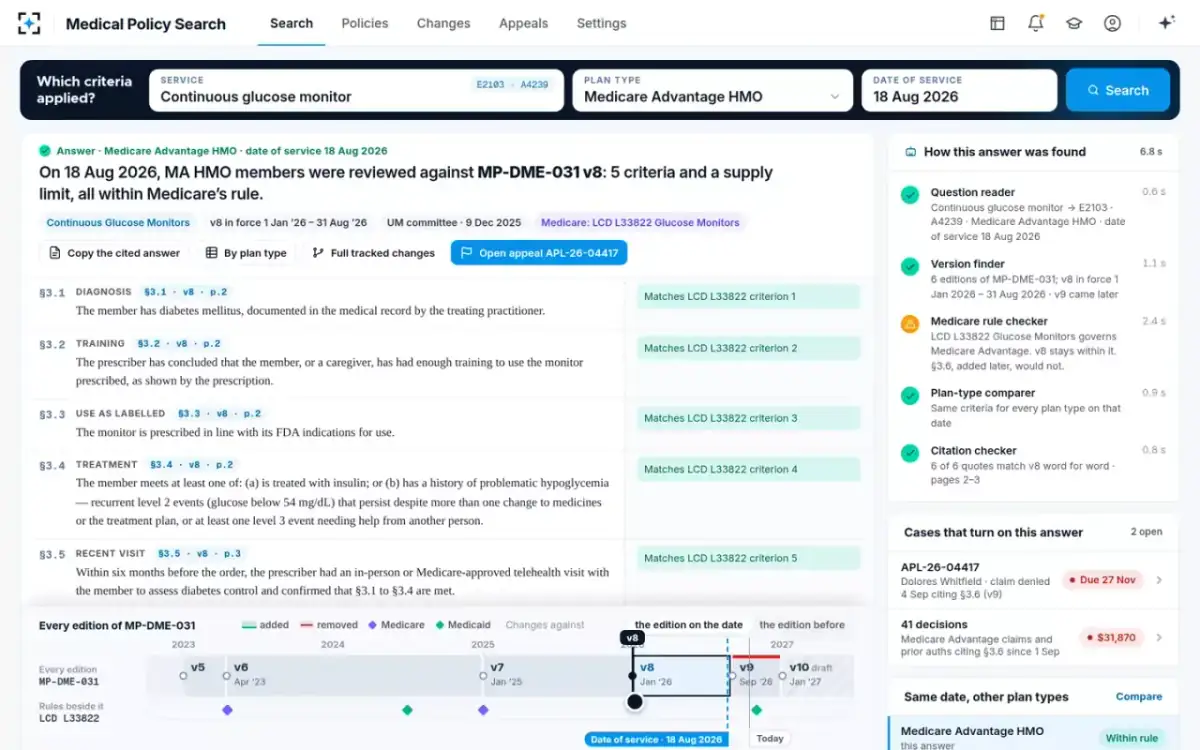
One question, the governing Medicare rule found for the plan's jurisdiction, the plan's criteria beside it
What if there is no NCD or LCD?
Then Medicare's criteria are not established for the service, and each program fills the gap differently. In Traditional Medicare, the contractor decides claims individually under the reasonable-and-necessary standard, and on appeal a qualified independent contractor decides “based on applicable information, including clinical experience and medical, technical, and scientific evidence.” In Medicare Advantage, the plan may apply internal coverage criteria under the third test of 42 CFR 422.101(b)(6), with qualifying evidence and a public rationale, or decide case by case on the same individual-medical-necessity rules.
‘No LCD’ must mean no LCD from the contractor with jurisdiction, in force on the date. A search that finds no LCD because it looked in the wrong state, or because the governing LCD was retired last month and its successor is a different document number, will send the reviewer to internal criteria when Medicare's apply.
Why the date matters as much as the document
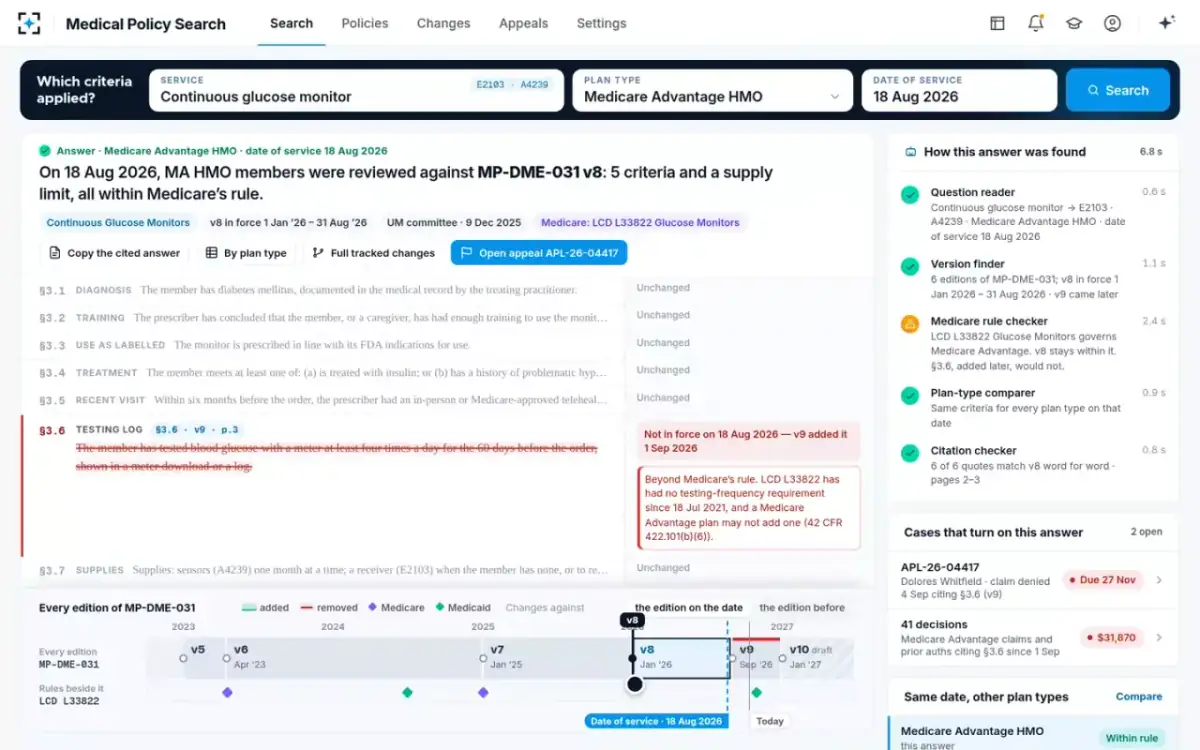
Every LCD and article has versions, and each version has its own effective date. Contractors publish a final LCD at least 45 days before it takes effect, so for six weeks the newest text is not the governing text; and an appeal months later must be decided on the version in force on the date of service. On 27 October 2026, two contractors' facet joint LCDs each had one version in force since August 2024 and another due on 6 December 2026. A lookup tool that shows ‘the LCD’ without dates forces the reviewer to reconstruct the timeline from the version history by hand.
Back to the date of service: a later criterion struck out, as the reviewer should read it
What to look for in an LCD lookup tool for a health plan
A plan does not need a better copy of the coverage database; CMS publishes it, refreshes it weekly and offers it through an API. It needs the database joined to its own policies, plan types, contractor jurisdictions and dates. The questions below separate a lookup tool from a decision aid.
Nine questions to ask of an LCD lookup tool before a plan relies on it
- Does it run the order of precedence?
NCD, general coverage conditions, the LCD with jurisdiction, then internal criteria only where allowed.
- Does it know your contractor jurisdictions?
By state and, for California and New York, by part of the state; plus any uniform election the plan has made.
- Does it return the version in force on a date?
Not the newest version, and not a future one during its notice period.
- Does it read the LCD and its article together?
Coverage criteria from one, codes from the other.
- Does it keep retired LCDs searchable by date?
Appeals look back; the archive is where last year’s rule lives.
- Does it put your plan’s criteria beside Medicare’s?
Criterion by criterion, with anything beyond Medicare flagged to the director of medical policy.
- Does it keep plan types apart?
The LCD governs Medicare Advantage; Medicaid and commercial members follow other rules.
- Does it quote, with document ID and version?
A reviewer’s rationale should cite L-number, version and section, not a paraphrase.
- How fresh is its copy?
CMS refreshes the database weekly; ask how soon a new version reaches your reviewers.
Medical Policy Search answers these by design: its Medicare rule checker finds the NCD, LCD or manual section that governs the service on the date for the contractors the plan follows, and its version finder returns the plan edition in force that day. Where it does not fit: it does not replace the coverage database or the contractors' own education, it does not decide whether a criterion is lawful, and it covers the Medicare documents and plan policies loaded into it. For the plan-side search that sits on top, see how the edition in force is found; to try the tree on your own policies, start from Medical Policy Search.
Questions people ask
Can I look up an LCD by CPT code?
Yes. Enter the code in the Medicare Coverage Database search, choose the state and open the billing and coding article in the results; the article names its LCD. For durable medical equipment the codes are in the LCD itself. You may need to accept the AMA license to see CPT descriptions.
Who writes LCDs?
Medicare Administrative Contractors, the companies that pay Medicare claims in each region, write and maintain LCDs for their jurisdictions; CMS describes local coverage as developed by clinicians at those contractors. Each new LCD goes through a proposal, a comment period of at least 45 days, an open meeting and a notice period before it takes effect.
Can an LCD be challenged?
Yes, in two ways. A beneficiary or stakeholder in the jurisdiction, including a physician or a medical society, can ask the contractor to reconsider an LCD, and a beneficiary who needs a service an LCD would deny, documented by the treating physician, can challenge it before an administrative law judge under 42 CFR part 426. That route is open to Medicare Advantage enrollees too.
Do NCDs include billing codes?
No. CMS says NCDs do not contain claims-processing information such as diagnosis or procedure codes; those come through change request transmittals and the claims processing manual, updated as codes change.
How often is the Medicare Coverage Database updated?
Its search data is refreshed weekly, and contractors publish new and revised documents throughout the year. On 27 October 2026, 348 of the 853 LCDs in effect had a version that took effect in 2026, so a copy that is a month old can already be wrong.