InterQual and MCG are licensed, commercial criteria sets that health plans, hospitals and review vendors use to guide medical-necessity and level-of-care decisions, especially for inpatient, post-acute and home care. For a commercial plan the choice between them is a procurement question. For a Medicare Advantage plan the more important question is what either one may decide at all: CMS's 2023 rule (CMS-4201-F) bars a plan from using such products to change coverage criteria Medicare has already set, and lets it use them as internal coverage criteria only where Medicare's are not fully established, with the evidence behind each criterion made public. This guide compares them by what the rule allows rather than by vendor claims, and shows where Botminds' Medical Policy Search fits: it lays the plan's criteria, licensed or written in-house, beside the Medicare rule in force on the date of each decision.
The use matrix: what a licensed criteria set may decide, by situation
Inpatient admission
Rule that governs42 CFR 412.3: the two-midnight benchmark, the inpatient-only list and the case-by-case exception
What the product may doScreen and document; may not add conditions to Medicare’s admission criteria
Skilled nursing, home health, inpatient rehabilitation
Rule that governs42 CFR part 409; 42 CFR 412.622(a)(3)
What the product may doScreen and document; may not change Medicare’s coverage conditions
Service with complete NCD or LCD criteria
Rule that governsThe NCD, or the LCD of the contractor with jurisdiction
What the product may doApply Medicare’s criteria; a product criterion beyond them may not decide
NCD or LCD leaves a gap, or allows coverage beyond its list
Rule that governsTests A and B of 42 CFR 422.101(b)(6)(i)
What the product may doMay decide as internal criteria, with qualifying evidence and a public rationale
No Medicare rule for the service
Rule that governsTest C of 42 CFR 422.101(b)(6)(i)
What the product may doMay decide as internal criteria, with qualifying evidence and a public rationale
Medicaid managed care
Rule that governsState contract; no more restrictive than the state’s medical necessity definition (42 CFR 438.210)
What the product may doAs the state contract allows
Commercial and exchange
Rule that governsThe plan document and state law
What the product may doThe plan’s choice, subject to state utilization review law
What is the difference between InterQual and MCG?
They are competing products built for the same job: packaged, evidence-referenced criteria that a reviewer applies to a case to judge whether an admission, a continued stay, a level of care or a procedure is appropriate. Both are licensed, proprietary and updated on the vendors' own schedules; each plan that licenses one adopts it through its own UM committee and may modify it. Because their content is proprietary, an independent comparison of their clinical criteria is hard to make from public sources, and vendor descriptions are not evidence. What public sources do support is how each may be used, which is the same for both.
CMS described the category in neutral terms in its 2023 rule: “We understand that utilization management tools such as InterQual or MCG, among others, are coverage criteria products created to assist the plans, providers and others, in clinical review processes and to help guide medical necessity determinations.” It added that, as commenters told it, “these tools are often used in conducting inpatient, post-acute and home care medical necessity reviews, in particular.” Those are the settings where Medicare's own criteria are most fully established, which is why the rule bites there first.
Does Medicare use InterQual criteria?
Traditional Medicare decides coverage from its statute, regulations, national coverage determinations and its contractors' local coverage determinations, not from a licensed criteria set. Medicare Advantage plans must follow the same rules: for an inpatient admission, that means the admission criteria in 42 CFR 412.3, including the two-midnight benchmark, as CMS confirmed in its February 2024 guidance. CMS said in the 2023 preamble that Medicare Advantage plans may not use InterQual, MCG or similar products to change coverage or payment criteria already set in Traditional Medicare law. How the two-midnight benchmark works in Medicare Advantage is covered in the guide to the two midnight rule in Medicare Advantage.
Licensed criteria do appear in federal health care elsewhere. A 2023 study of utilization management in the Veterans Health Administration reported 87,755 surgical admission reviews in fiscal year 2019, of which 81.22% met InterQual criteria, alongside 276,208 continued-stay reviews, 71.87% of which met them (Neugaard et al., Professional Case Management). That is the VA's own utilization management program, not Medicare coverage policy.
Can Medicare Advantage plans use MCG criteria?
Yes, in two ways, and only one of them can decide a denial. As decision support, a plan can use MCG or InterQual to organize a review and spot cases for a physician, while applying Medicare's criteria to the decision. As internal coverage criteria, a plan may use the product's criteria to decide only where Medicare's are not fully established. CMS put the condition plainly: a plan “is permitted to choose to use a product, such as InterQual or MCG or something similar, to assist in creating internal coverage criteria only so long as the requirements in § 422.101(b), (c), and § 422.566(d) are met.”
Two uses of a licensed criteria set in Medicare Advantage
Decision support: Any review, including where Medicare’s criteria are fully established.
Internal coverage criteria: Only where Medicare’s criteria are not fully established: tests A, B or C.
Decision support: Medicare’s criteria and the patient’s record; the product organizes the review.
Internal coverage criteria: The product’s criteria, adopted by the plan as its own.
Decision support: None beyond the general rules on medical necessity.
Internal coverage criteria: Qualifying evidence, cited from primary sources, with a public summary, source list and rationale.
Decision support: Not required for the product’s content.
Internal coverage criteria: Criteria and evidence on a public website without a paywall; a vendor’s site linked from the plan’s is allowed.
Decision support: Not reported as internal criteria.
Internal coverage criteria: Reported each year if used for prior authorization, with the vendor named.
Decision support: Reviewed by a physician or other appropriate professional before issue.
Internal coverage criteria: The same.
The publication duty is where licensed products strain. CMS's 2024 guidance said that “Referencing information, such as a book, website, or third-party criteria, without directly describing and referencing the requisite source citations from primary literature that are widely used treatment guidelines or clinical literature, would not comply with § 422.101(b)(6)(ii).” A plan cannot meet the rule by pointing at a product; it has to show the studies and guidelines behind each criterion it applies. The preamble anticipated the objection that the content is proprietary: “use of such tools and their proprietary nature does not absolve MA plans from their responsibilities under this final rule.”
Are InterQual and MCG evidence based?
Both cite evidence, but independent tests of how well such criteria match clinical outcomes or expert judgment are few, old or narrow, and not flattering. In a cohort of 2,361 adults aged 60 and over with syncope, InterQual criteria for inpatient status predicted a stay longer than two midnights with a sensitivity of 60.8% and a specificity of 47.8% (Chang et al., Journal of Emergency Medicine, 2020). A 1997 VA study found that for each of four continued-stay days, either the sensitivity or the specificity of the 1993 InterQual psychiatry criteria fell below 0.30 against a panel of psychiatrists (Goldman et al., American Journal of Psychiatry).
How well InterQual inpatient criteria predicted a two-midnight stay in older adults with syncope
None of this says either product is worse than the alternative; there is no comparable public study of MCG, and both vendors revise their criteria regularly. It says that a criterion's evidence has to be checked criterion by criterion, which is exactly what the Medicare Advantage rule now requires before a plan applies one as its own.
Licensed criteria in the 2026 CMS filing
Since 2026 CMS asks every Medicare Advantage organization to list the internal coverage criteria it and its delegated entities use for prior authorization, and it named the products. Its November 2025 instructions tell plans to report criteria they or their delegated entities developed and criteria from third-party vendors, and give InterQual, MCG and EviCore as the examples (CMS memo, 26 November 2025). The filing's record layout has a column for the organization or vendor responsible for each criteria document, and CMS's own examples show an MCG imaging criterion and an InterQual criterion for long-term acute care admissions (CMS-10913).
That turns a licensing decision into a reported one. CMS also said it would watch how plans publish vendor criteria: it is concerned that linking to several vendors' sites from the plan's site could make the plan's criteria, taken together, too burdensome to find. A plan that licenses both products for different service lines carries both of those concerns. What the annual submission asks for is set out column by column elsewhere.
Do Medicaid plans use InterQual or MCG?
Federal rules neither require nor bar them; the federal rule for Medicaid is about limits, not products. A Medicaid managed care plan's definition of medically necessary services may be “no more restrictive than that used in the State Medicaid program”, and its review criteria must be applied consistently. Whether a licensed set may be used, and how its criteria must be disclosed, is for the state contract; a plan serving both Medicaid and Medicare Advantage members may be applying the same product under two different sets of limits.
One policy, five plan types: where a licensed criterion would differ by program
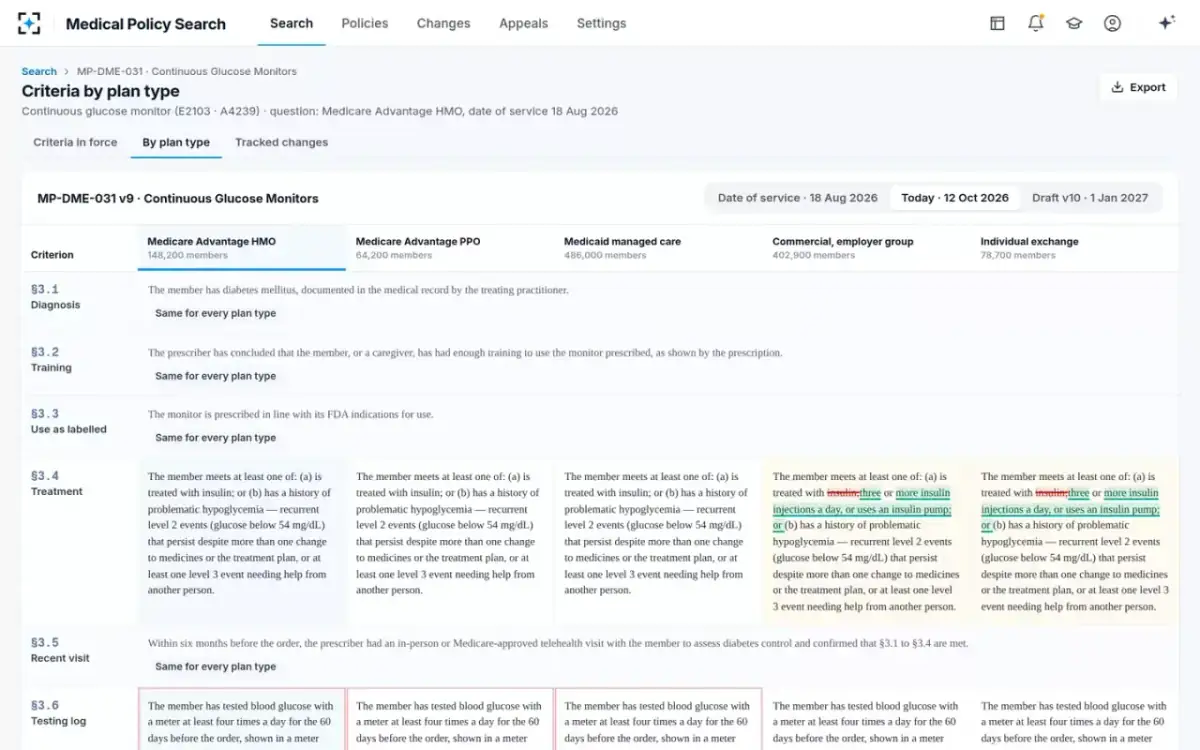
What to check before a licensed criterion decides a Medicare Advantage case
Treat every licensed criterion as the plan's own the moment it can cause a denial. The checks below come straight from the rule and CMS's guidance, and they apply only to the criteria that can decide a Medicare Advantage case, which is where the documentation effort belongs.
Seven checks before InterQual, MCG or any licensed criterion decides a Medicare Advantage case
- Is Medicare’s criterion fully established for this service?
If yes, apply Medicare’s; the product can only support the review.
- If not, which test applies: A, B or C?
Write it down, with the NCD, LCD or provision it relates to.
- Is each criterion supported by named primary evidence?
Specialty-society guidelines or qualifying studies, cited directly, not ‘see product’.
- For test A, is there a benefit-harm rationale for this criterion?
Specific, narrowed to the patients who benefit, including harms from delay.
- Is the criterion, its evidence and rationale public?
On a website without a paywall; a vendor’s site linked from the plan’s is allowed.
- Did the UM committee approve this version?
Product updates are new versions; the committee approves before use.
- Is it in the annual CMS filing, with the vendor named?
Every internal criterion used for prior authorization, by MAC jurisdiction and delegated entity.
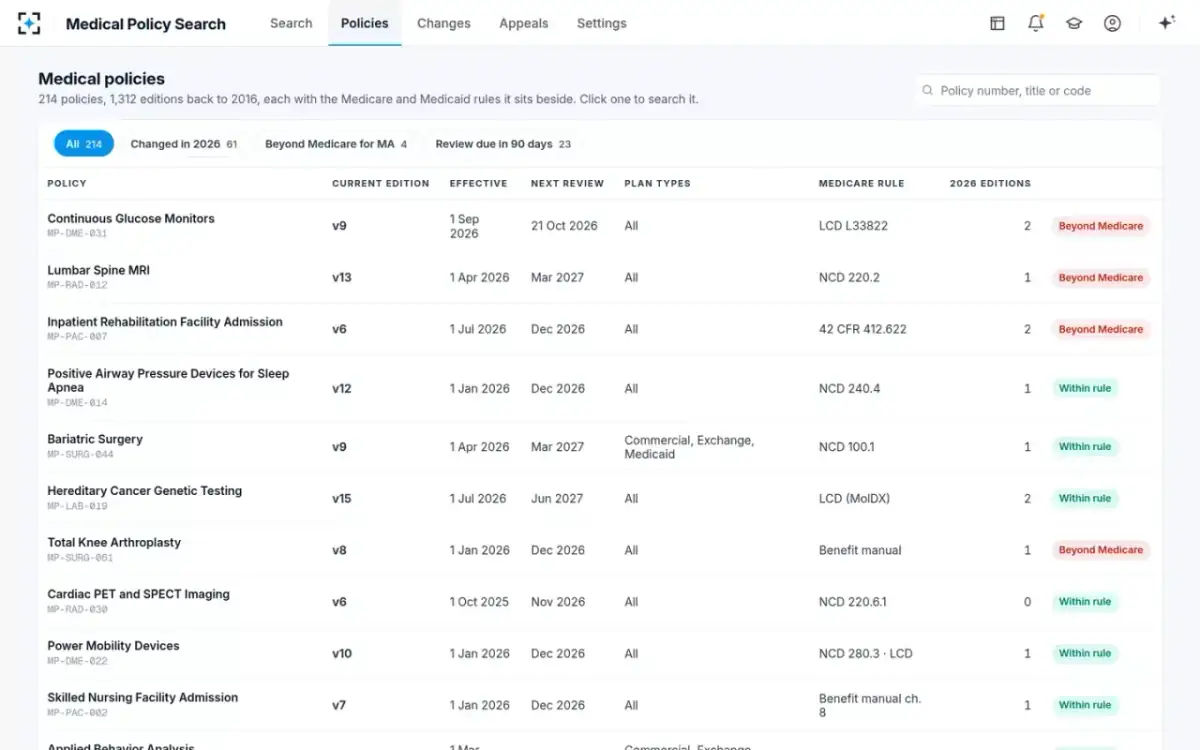
Medical Policy Search does not replace a licensed criteria set and does not read its proprietary content unless the plan loads it as one of its policies. What it does is keep the plan's criteria, however sourced, beside the Medicare rule in force on the date, flag any that go beyond it to the director of medical policy, and quote each one by edition. The three tests for internal coverage criteria are worked through in plain words elsewhere; to see the side-by-side on your own policies, start from Medical Policy Search.
The library with the Medicare rule beside each policy, including the post-acute ones
Questions people ask
What is InterQual used for?
For utilization review: judging whether an admission, continued stay, level of care or procedure meets evidence-referenced criteria. CMS described products like it as tools to assist clinical review and guide medical-necessity determinations, used especially in inpatient, post-acute and home care reviews. In Medicare Advantage it may support those reviews but may not change criteria Medicare has set.
What is MCG used for?
The same family of tasks: admission, continued-stay, level-of-care and procedure review against packaged criteria. CMS's 2026 filing examples show an MCG imaging criterion reported as a Medicare Advantage plan's internal criterion, with MCG named as the vendor.
Is InterQual or MCG better?
No public, independent study compares them head to head on clinical accuracy, and vendor claims are not evidence. For a Medicare Advantage plan the deciding questions are the same for both: where Medicare's criteria are fully established, neither may decide; where they are not, each criterion used must carry public evidence and a rationale.
Do Medicare Advantage plans have to publish InterQual or MCG criteria?
When a plan uses them as internal coverage criteria, yes: the criteria in use, a summary of evidence, a list of sources and a rationale must be publicly accessible, and CMS's February 2024 guidance says that means a website without a paywall or subscription. A vendor's site linked from the plan's site is acceptable.
Can a hospital and a health plan reach different answers with the same criteria set?
Yes. Each organization licenses its own version, adopts it through its own committee and may modify it, and reviewers apply judgment. For a Medicare Advantage member, Medicare's criteria take precedence over both readings wherever they are fully established.