Medical policy search is the lookup a UM nurse, appeals nurse, physician reviewer or service representative runs to find which coverage criteria apply to a service. The policy is usually easy to find. The answer that decides an appeal is harder: the edition of that policy in force on the date of service (or of the request), for this member's plan type, and, for a Medicare Advantage member, whether Medicare's own national or local coverage rule overrides it. Most policy portals show only today's edition, and Medicare's own coverage database warns that one of its links can open a version not yet in effect. Botminds' Medical Policy Search answers the dated question directly: it finds the edition in force on the governing date, checks Medicare's rule, and quotes each criterion with section, edition and page.
How Medical Policy Search answers one dated question, agent by agent
Agent
Question readerTurns the words into service codes, a plan type and the governing date: date of service for a claim, date of request for prior authorization, admission date for a stay.
Never: Never guesses a plan type or a date; asks.
Agent
Version finderLists every edition of the policy with its effective and end dates and committee approval, and picks the one whose interval contains the governing date.
Never: Never answers from the current edition when a date is given; drafts are shown, never quoted.
Agent
Medicare rule checkerFor Medicare Advantage, finds the NCD, LCD or manual section that governs the service on that date for the plan’s contractor jurisdiction, and flags any plan criterion Medicare does not have.
Never: Never decides that a criterion is lawful, and never shows a flag to a member.
Agent
Plan-type comparerLays the criteria for Medicare Advantage, Medicaid, commercial and exchange plans side by side on the same date.
Never: Never merges criteria across plan types.
Agent
Citation checkerMatches every quoted criterion to the source edition word for word, with section and page.
Never: A quote that does not match blocks the answer.
A person decides
Nurse or physician reviewerReads the dated answer against the member’s records and decides; adverse and overturned medical-necessity decisions are signed by a physician reviewer.
How do you search a health plan's medical policies?
A reviewer searching by hand works three sources, each with its own idea of time. The plan's policy portal is usually a library of PDFs searchable by policy number, title or code, and it shows the current edition; retired editions sit on a shared drive, if anywhere. Medicare's coverage rules sit in the Medicare Coverage Database, which searches by keyword, code, document ID or contractor and narrows by state. The state Medicaid manual sits on the state's site, with its own revision dates.
Each source answers a slightly different question. The portal answers ‘what does the policy say now?’, and the coverage database's own help is candid about its links: in a list of followed documents, “Clicking View will take you to the latest document version available, which may not yet be in effect.” Retired LCDs and articles move to a separate archive that, in CMS's words, “contains outdated (No Longer In Effect) Local Coverage Determinations and Articles.” Codes add a fourth step: for most contractors the CPT, HCPCS and ICD-10 codes now sit in billing and coding articles rather than in the LCD itself, so a search by code returns the article and the reviewer must follow it to the policy.
So the search people type, ‘medical policy search’, hides the work the case needs: a dated, plan-specific, Medicare-checked answer. Which Medicare rule applies to a request is a lookup of its own, set out as a decision tree elsewhere.
How do you find the medical policy in effect on a date of service?
Fix the governing date, list every edition with its effective and end dates, and take the one whose interval contains the date; then check whether a Medicare change in the same window alters the answer. The governing date is not always the date of service. Plans commonly use the date of service for claims and payment appeals, the date of the request for prior authorization and the admission date for an inpatient stay. No federal text says so; it is plan practice and contract language, which is why it belongs in the policy and in the search settings, not in a reviewer's memory.
Medicare's own documents show why the interval matters. On 27 October 2026, two contractors' LCDs for facet joint interventions each had one version in force since 11 August 2024 and a new version scheduled to take effect on 6 December 2026, according to CMS's Coverage API. A reviewer who opens “the LCD” in late November and reads the newest text is reading rules that do not yet apply. The same trap sits in every plan policy with an approved edition waiting for its effective date.
Medical policy search by portal, and by date
Portal search: Policy number, title or a code.
Dated search in Medical Policy Search: Service, plan type and a date; the date rule is a setting.
Portal search: The current one. Older editions on a shared drive, if kept.
Dated search in Medical Policy Search: The edition in force on the governing date, with every other edition on a strip below it.
Portal search: In another tab; the reviewer finds the NCD or LCD and compares by hand.
Dated search in Medical Policy Search: The governing NCD, LCD or manual section for the plan’s contractor jurisdiction, criterion by criterion.
Portal search: One PDF, with plan-type exceptions in the text.
Dated search in Medical Policy Search: Each plan type laid out separately on the same date.
Portal search: Whatever the reviewer copies.
Dated search in Medical Policy Search: The policy’s own words, matched to the edition word for word, with section and page.
Portal search: Found only if someone searches decision letters by hand.
Dated search in Medical Policy Search: Every decision that cited the same section, listed with why it may not hold.
Inside the version finder: how an edition is dated
The version finder is a small agent with one job: given a policy and a governing date, return the edition that was in force and nothing else. It reads every published edition of the policy as the plan published it, each with its effective date, its end date (the day before the next edition took effect) and the UM committee approval behind it. Draft editions are read too, so they can be shown on the strip as what is coming, but they are marked as drafts and never quoted as in force.
Three cases make the agent earn its keep. An edition issued off-cycle, for example when Medicare widens coverage mid-year, shortens the interval of the edition before it. An edition approved in December but effective on 1 January must not be returned for a December date. And an edition that changes only one plan type's criteria must not be returned for the others as if they had changed too. In each case the agent returns the edition and the reason it was chosen, so the reviewer can see the arithmetic.
The dated answer: the edition in force on the date, each criterion quoted, every edition on the strip
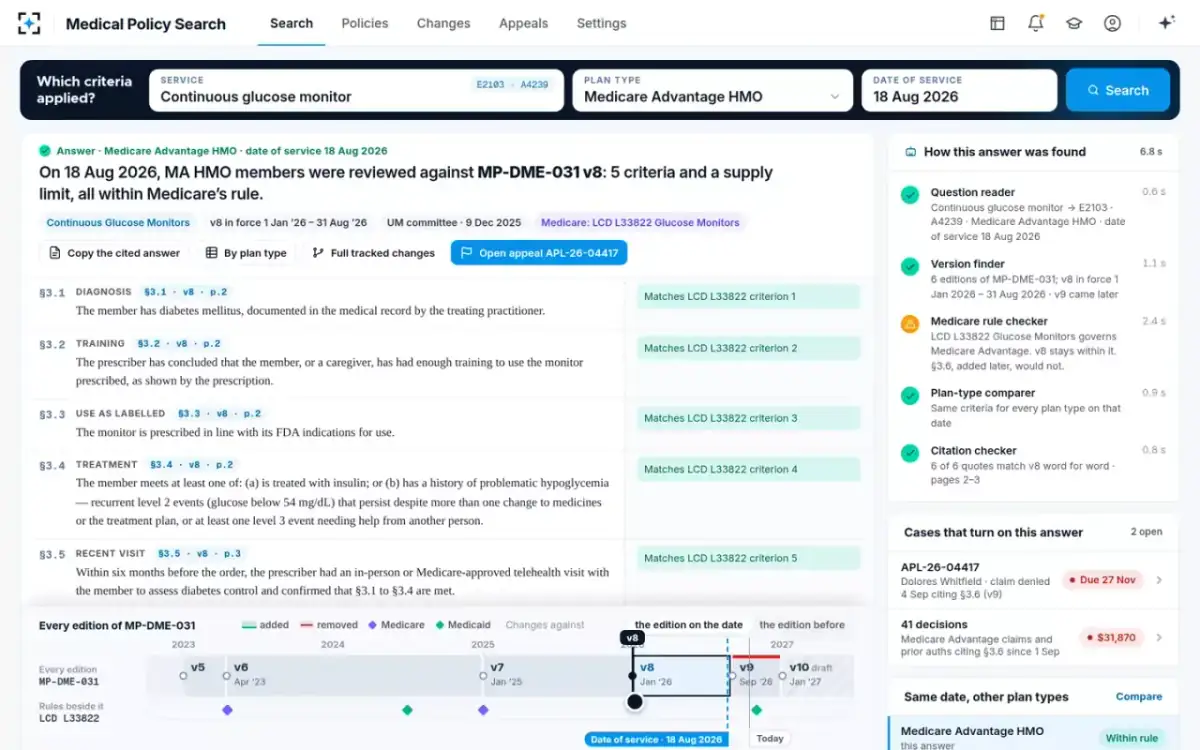
When the version finder refuses to answer
A search agent that always answers is a liability in medical policy, because a confident answer from the wrong edition reads exactly like a right one. The version finder and its neighbours are built to stop in five situations. With no date, it asks for one rather than defaulting to today. With no plan type, it asks rather than guessing. When a service maps to more than one policy, the question reader asks which. When the only edition covering the date is a draft, it says so and quotes nothing. And when the citation checker cannot match a quoted criterion to the source edition word for word, the answer is blocked.
Those refusals are the product's design limits, not tuning choices. They mirror the questions a careful appeals nurse asks before reading a policy, and they are where the solution's speed comes from: a reviewer who trusts that a wrong-date answer cannot come back stops re-checking every one by hand. Whether two reviewers reading the same criteria agree is the next question once the right edition is on the screen.
Does Medicare's rule override the plan's medical policy?
For a Medicare Advantage member, yes wherever Medicare's coverage criteria are fully established. The plan must comply with CMS's NCDs, with general coverage and benefit conditions in Traditional Medicare law, and with the written coverage decisions of the local contractors with jurisdiction in its service area, and it may not deny basic benefits on any criteria beyond those (42 CFR 422.101(b); the guide to internal coverage criteria quotes the rule and explains when a plan may write its own). The plan's own criteria fill gaps; they do not add conditions where Medicare has already set them.
Jurisdiction matters as much as content. CMS has said that if a plan borrows an LCD from outside its service area, “use of the LCD is use of internal coverage criteria and all associated requirements would still apply”, including published evidence and rationale. That is why the solution's settings name the Medicare contractors a plan follows. For Medicaid managed care, the state's definition of medical necessity is the floor: a plan's definition may not be narrower than the state program's (42 CFR 438.210(a)(5)). Commercial and exchange plans follow their own policy and the member's benefit document.
A plan criterion Medicare does not have, flagged on the date asked
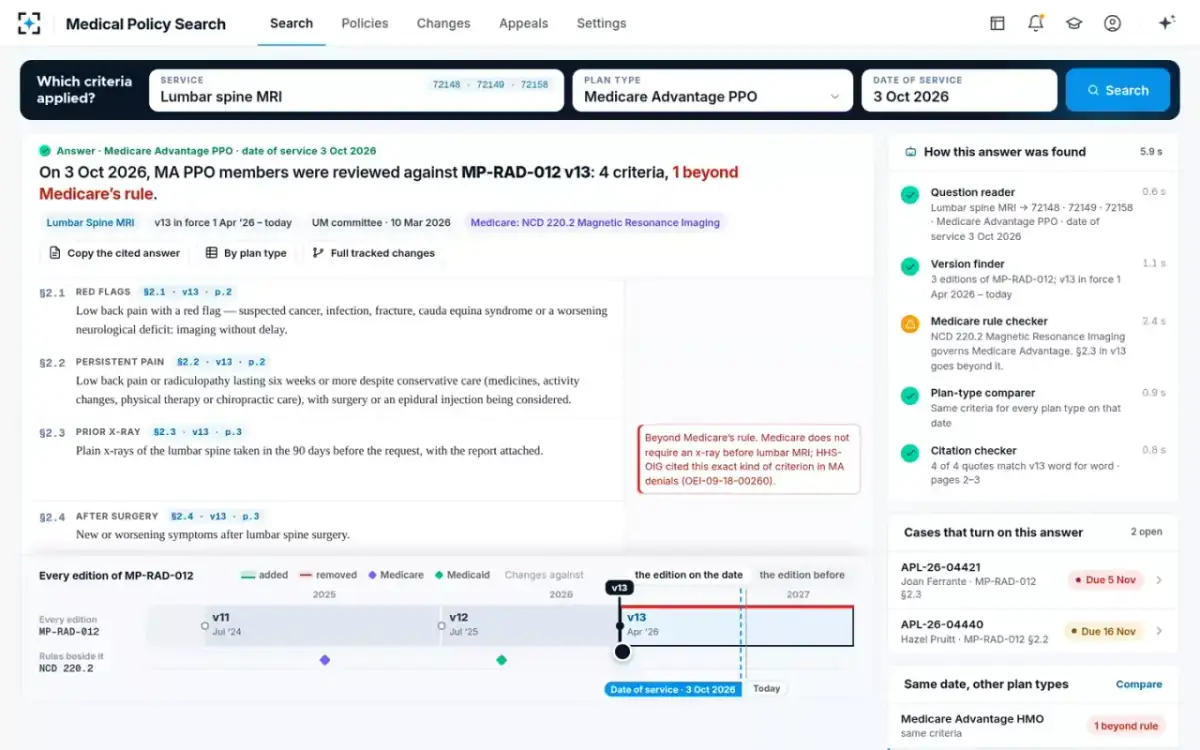
The flag in that screen is not hypothetical. In HHS-OIG's review of Medicare Advantage prior authorization denials from June 2019, requiring an x-ray before more advanced imaging was one of its examples of plan criteria not found in Medicare's coverage rules, a cause it identified behind denials of requests that met those rules (OEI-09-18-00260). The sample predates the 2024 rule that now governs such criteria, which is why a dated search must apply the rule in force on the date too.
How do you compare two versions of a medical policy?
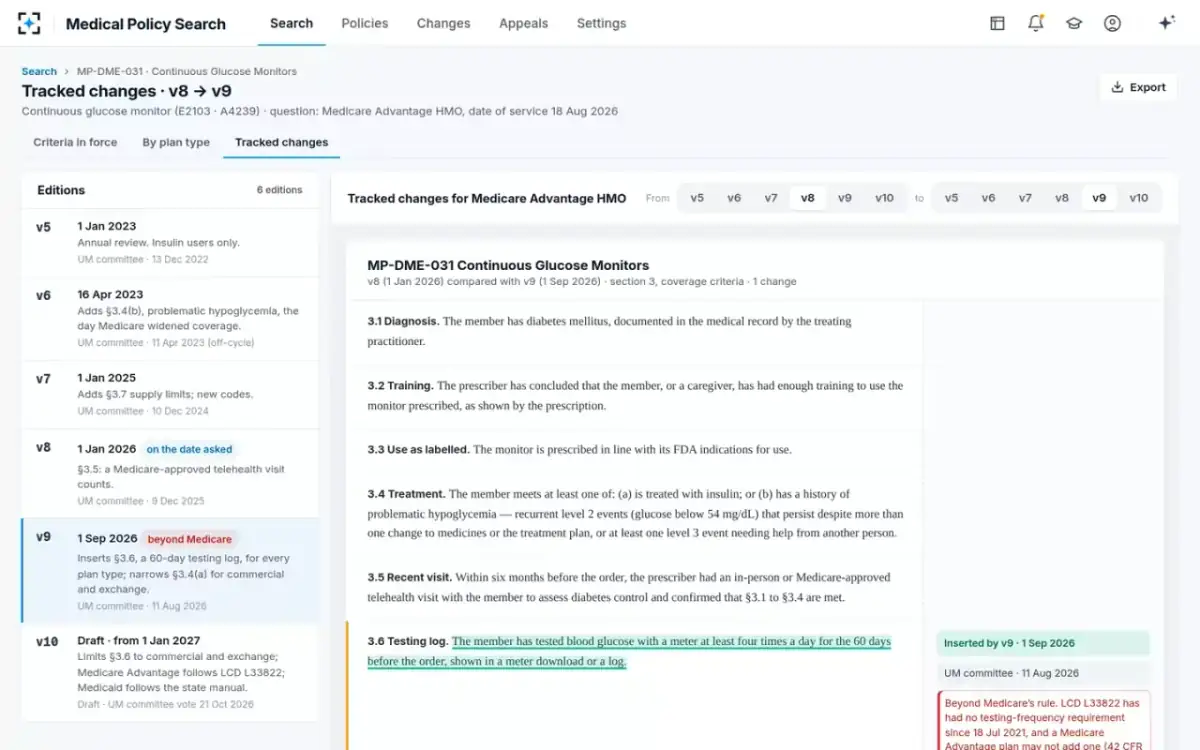
Put the two editions side by side as tracked changes, criterion by criterion, with each edition's effective date and committee approval in the margin. Reading two PDFs in adjacent windows misses changes in definitions and footnotes, and it cannot answer the question an appeal turns on: was this sentence in force on that date? A useful comparison shows inserted words underlined, removed words struck out, and the date each change took effect.
Any two editions compared word by word, with the committee approval beside each change
What to look for in medical policy search software
Buy for the dated answer, not the search box. Most products called medical policy software are authoring and publishing systems, licensed criteria sets or utilization management workflows, and each has search; few answer ‘which criteria applied on that date, for this plan type, and was it within Medicare's rule?’ The checks below separate the two.
Ten questions to ask of any medical policy search software
- Does it keep every edition, with effective and end dates?
A system that overwrites the current PDF cannot answer an appeal about last year.
- Can the date rule differ by decision type?
Date of service for claims, date of request for prior authorization, admission date for stays.
- Does it refuse to answer without a date and a plan type?
Defaulting to today is how wrong-edition denials are made.
- Are drafts kept out of answers?
An approved edition waiting for its effective date is not in force.
- Is every quoted criterion checked against the source edition?
Paraphrase drifts; a quote that does not match should block the answer.
- Does it follow your Medicare contractors?
LCDs are local; an out-of-area LCD is internal criteria for Medicare Advantage.
- Does it flag plan criteria beyond Medicare’s rule, to the right person?
The director of medical policy, not the member and not the claim system.
- Does it keep plan types apart on the same date?
Commercial criteria applied to a Medicare Advantage member is a classic overturn.
- Can it find every decision that cited the same section?
One wrong-edition denial is rarely the only one.
- Who decides?
The software should find, quote and draft; a physician reviewer decides adverse and overturned medical-necessity decisions.
Where the solution does not fit is as useful to know. It does not author policies or run the committee's vote; editions are drafted by analysts and published by the director of medical policy. It is not a licensed criteria set and does not replace one. It does not run the prior authorization workflow, which is the job of Prior Authorization Automation and its prior authorization AI agents. And it needs your editions: a plan that kept only current PDFs must rebuild its history first, from shared drives, committee minutes and decision letters, before any dated search can be trusted.
Can AI search medical policies?
Yes, if every answer is a citation rather than a summary. Language models are good at turning ‘CGM for a type 2 on basal insulin, MA HMO, mid-August’ into codes, a plan type and a date, and at finding the passages that matter. They are poor at being right about which edition was in force unless that is computed from dates rather than inferred from text. That is why the solution splits the work: language for the question and the passages, arithmetic for the edition, and a word-for-word match before anything is shown.
The evidence base for AI in this field is thin. A 2026 systematic review of AI in prior authorization found 16 eligible studies, most reporting technical metrics, with few showing operational gains such as faster decisions (J Manag Care Spec Pharm, 2026). Medicare Advantage rules also keep the decision human: CMS allows software to assist coverage decisions but holds the plan responsible for every rule on how they are made. A pilot should therefore measure what matters on the plan's own cases: how often the dated answer matches what a careful reviewer finds, and how often it refuses.
What medical policy search is worth, in time and in decisions
The minutes are real but the days are larger. By Botminds' estimate, finding the policy, the edition in force on the date and Medicare's rule, and comparing them, takes 15 to 25 minutes by hand; the design target for the solution is 10 seconds. The bigger cost sits after one wrong-edition citation is found: every other decision that cited the same section has to be found too.
Where the days go after one wrong-edition citation is found, by hand and with Medical Policy Search
By hand · about 6 days (estimate)
- Rebuild the edition · 8%
- Medicare rule, plan types · 8%
- Find other decisions · 50%
- Draft rationale · 17%
- Physician review · 17%
With the solution · about 1.8 days (estimate)
- Edition, Medicare rule and other decisions · 17%
- Draft rationale · 28%
- Physician review · 55%
On the solution's fictional sample plan, one overturned appeal led the solution to 41 other Medicare Advantage decisions that had cited the same added section: 29 claims with $31,870 denied and 12 prior authorizations, nine of them for services before the section existed. Those are sample figures, but the shape is general: a wrong edition is a pattern, and the economics of a medical policy program are mostly the economics of patterns. To try the dated answer on your own policies, start from Medical Policy Search.
Questions people ask
What is medical policy search software?
Software that answers which coverage criteria applied to a service, for a plan type, on a date, from the plan's medical policies and Medicare's and the state's coverage rules. It differs from a policy portal by keeping every edition with its effective dates and returning the one in force on the date asked, quoted by section.
How do nurses find the right policy for a request?
Usually by code: the requested HCPCS or CPT code is looked up in the plan's policy library and, for Medicare Advantage, in the Medicare Coverage Database, where most codes now sit in billing and coding articles. The governing date then decides the edition. For prior authorization that is usually the date of the request.
Where do Medicare Advantage plans publish their coverage criteria?
On a website anyone can reach. CMS's February 2024 guidance says internal coverage criteria must be accessible via a website, not behind a paywall or a subscription, and may sit on the plan's site or a delegated vendor's site linked from it. Criteria that simply repeat Medicare's NCDs and LCDs are Medicare's and are published in the Medicare Coverage Database.
Does an approved prior authorization follow the old edition or the new one?
In Medicare Advantage, once a plan approves a service through prior authorization it may not later deny coverage for lack of medical necessity, so a new edition cannot reach back to it (42 CFR 422.138(c)). For a new request, the plan's date rule decides; most plans use the date the request was received.
How fast should a medical policy search be?
Fast enough that nobody shortcuts it. By Botminds' estimate a careful search by hand takes 15 to 25 minutes; the solution's design target is 10 seconds, and on its sample plan a dated answer took 6.8 seconds. What matters more than speed is that a wrong-date answer cannot come back, so the reviewer stops re-checking by hand.