Experimental and investigational is the label a health plan gives a service whose evidence it judges not yet sufficient to show it is safe and effective for the use requested, and plan contracts use the label to exclude a service from coverage. In Medicare the idea sits inside the reasonable-and-necessary test; in commercial coverage each plan defines it in its contract and medical policies. It is especially sensitive to dates, because evidence moves and plans re-write their policies as it does: a gene panel or a device listed as investigational in one edition may be covered with criteria in the next. A denial that quotes the wrong edition is wrong even if the policy is sound. Botminds' Medical Policy Search finds the edition in force on the date that decides the case and quotes it, so the exclusion is applied as it stood then, not as it reads today.
California independent medical reviews, 2021–2025: experimental denials overturned less often than medical-necessity denials
Experimental or investigational · 2,028 reviews
- Plan’s denial overturned · 49.5%
- Denial upheld · 50.5%
Not medically necessary · 9,533 reviews
- Plan’s denial overturned · 68.5%
- Denial upheld · 31.5%
What does experimental and investigational mean in insurance?
There is no single federal definition for commercial plans; each plan's contract defines the term, and its medical policies list the services it treats as experimental or investigational for given uses. Definitions usually turn on regulatory approval for the use, the weight of published evidence and whether the service is still being studied in trials. That is plan language, which is why the same service can be covered by one plan and excluded by another in the same month.
Medicare builds the idea into its coverage standard. When a contractor writes an LCD, it must decide whether the service is reasonable and necessary, and the first conditions are that it is safe and effective and, in the manual's words:
“Not experimental or investigational (exception: routine costs of qualifying clinical trial services with dates of service on or after September 19, 2000 which meet the requirements of the Clinical Trials NCD are considered reasonable and necessary)…”
Medicare Program Integrity Manual, ch. 13, §13.5.4
For devices, Medicare uses the Food and Drug Administration's categories. A Category A device is one for which “initial questions of safety and effectiveness have not been resolved”; Category B covers devices whose incremental risk is the open question. Medicare excludes experimental or investigational devices, with an exception for Category B devices furnished under its coverage requirements (42 CFR 411.15(o)).
Why are services denied as experimental?
Because the plan's policy, in the edition the reviewer applies, says the evidence for that use is not yet enough. The categories that reach independent review show where those judgments cluster. In California's independent medical reviews from 2021 to 2025, diagnostic imaging and screening (574 cases), pharmacy (302) and pain management (244) were the largest treatment categories among experimental denials, and genetic and genomic tests alone accounted for 254.
The label also changes the patient's path. In a study of 805 head and neck cancer patients for whom an Emory radiation oncology clinic sought proton therapy authorization in 2020–2022, plans whose policy called proton therapy ‘experimental’ or not medically necessary for the diagnosis were associated with a significantly longer median time to determination and a later start of any radiation, 46 against 35 days, a difference short of statistical significance (McDonald et al., International Journal of Radiation Oncology, Biology, Physics, 2023). An experimental exclusion is not only a coverage answer; it is a delay.
Share of experimental denials overturned on independent review, by service type, California 2021–2025
How do plans decide a treatment is investigational?
Through a medical policy review of the evidence for the specific use: regulatory status, published trials and systematic reviews, specialty-society guidelines, and whether the service is still mainly offered inside studies. The conclusion is written into the policy as a list of covered indications and a list of uses considered experimental or investigational, approved by the plan's committee with an effective date.
For Medicare Advantage members the plan does not start from a blank page. Where an NCD sets the conditions, including national coverage only within approved studies, the plan must follow it; CMS's coverage with evidence development page listed 27 NCDs that cover a service only in the context of a clinical study (CMS). Where Medicare's criteria are not fully established, a plan's own experimental exclusion is an internal coverage criterion and must meet the evidence and disclosure rules of 42 CFR 422.101(b)(6), which internal coverage criteria in plain words walks through.
How often do experimental policies change?
Often, and in genetic testing and oncology, very often. Medicare's own local documents show the pace: on 27 October 2026, the most revised LCD in effect, a contractor's Biomarkers for Oncology LCD, was on version 220, and another contractor's Molecular Pathology Procedures LCD was on version 156, according to CMS's Coverage API. Genetic testing, oncology biomarkers and new devices are where evidence arrives monthly and policies follow.
Coverage with evidence development shows the mechanism in Medicare. CMS describes a cycle as complete when it reconsiders the decision and removes study participation as a condition of coverage. A plan policy that tracks such an NCD must change when it does, and every decision after that date must use the new text while every appeal about a service before it must use the old.
When the edition changes the answer
A date of service on the wrong side of an effective date turns a correct exclusion into a wrong denial, or a wrong approval. Take an illustrative policy on hereditary cancer gene panels: edition 14, effective 1 January 2026, lists RNA analysis added to DNA panel testing as investigational; edition 15, effective 1 July 2026, covers it when DNA testing is negative and the family history meets stated criteria. The same request, decided on two dates, has two right answers.
One request, two editions: an illustrative gene-panel policy before and after the evidence moved
Edition 14 · in force 1 Jan – 30 Jun 2026: Experimental and investigational for all indications.
Edition 15 · in force from 1 Jul 2026: Covered when the DNA panel is negative and family-history criteria in §2.3 are met.
Edition 14 · in force 1 Jan – 30 Jun 2026: Denied as investigational: correct.
Edition 15 · in force from 1 Jul 2026: Not applicable: edition 15 was not in force on 12 June.
Edition 14 · in force 1 Jan – 30 Jun 2026: Not applicable: edition 14 no longer in force.
Edition 15 · in force from 1 Jul 2026: Reviewed against §2.3; an investigational denial quoting edition 14 would be wrong.
Edition 14 · in force 1 Jan – 30 Jun 2026: Decided on edition 14, the text in force on the date of service.
Edition 15 · in force from 1 Jul 2026: Edition 15 informs whether the plan may choose to pay, not what applied.
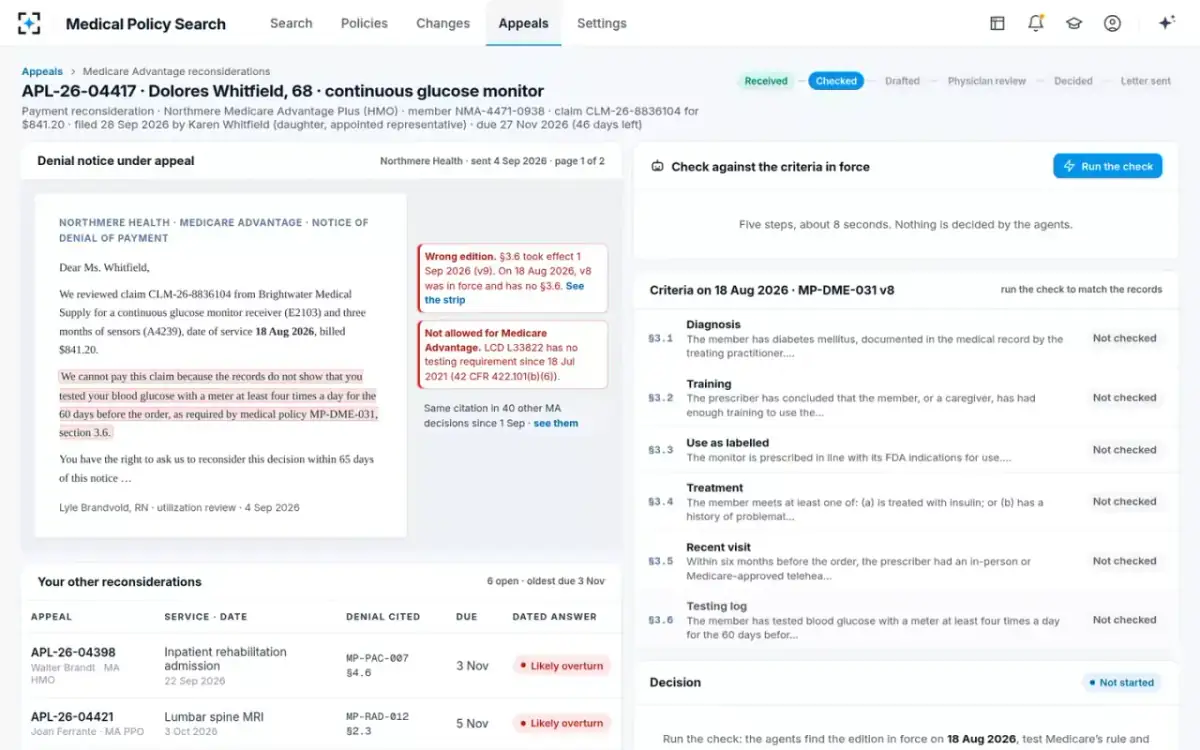
The August appeal is the case that goes wrong most easily. The appeals nurse opens the policy portal, sees edition 15, and either overturns on criteria that did not exist in June or upholds on an exclusion that no longer exists. Both are errors of date, not of judgment, and both are avoided if the search returns the edition in force on the date of service with its effective dates attached.
A denial under appeal, with the edition it quoted checked against the date of service
Can you appeal an experimental treatment denial?
Yes, and the rules treat experimental denials as medical judgments that need clinical reviewers. Employer plans must, in deciding an appeal based on a medical judgment, consult a health care professional with relevant training, “including determinations with regard to whether a particular treatment, drug, or other item is experimental, investigational, or not medically necessary or appropriate”. Non-grandfathered group and individual coverage must offer external review, and the federal standards list among reviewable decisions “its determination that a treatment is experimental or investigational”, with state processes required to follow procedures for experimental treatment reviews modelled on the NAIC uniform act.
California's data shows what independent reviewers do with these cases. In 1,704 of the 2,028 experimental decisions from 2021 to 2025, the reviewers' findings turn on the question California's reviewers apply, whether the service was “likely to be more beneficial for the evaluation of the patient's medical condition than any available standard therapy” or for its treatment, and about half of those plan denials were overturned. The figure is for state-regulated plans in one state; Medicare Advantage appeals follow Medicare's own process.
Does Medicare cover investigational treatments?
In defined circumstances. Medicare may cover Category B investigational devices used in approved studies that meet its requirements; it covers the routine costs of qualifying clinical trials under its clinical trials NCD; and under coverage with evidence development it covers some services only for patients enrolled in approved studies. What it does not cover is the experimental item itself outside those paths. Medicare Advantage plans must follow the same NCDs.
Commercial plans have a parallel duty for trials. Since the Affordable Care Act, a group health plan or individual issuer may not deny a qualified individual participation in an approved clinical trial and “may not deny (or limit or impose additional conditions on) the coverage of routine patient costs for items and services furnished in connection with participation in the trial”. The investigational item itself, and services provided only for data collection, are outside that duty.
What evidence moves a service out of experimental?
Evidence of the kind the policy itself names, judged by the committee. Regulatory approval is usually necessary but not sufficient; plans look for randomized trials or large prospective studies with clear results, systematic reviews and specialty-society guidelines that recommend the service for the use. For Medicare Advantage internal criteria the regulation names that hierarchy outright. For Medicare itself, an NCD reconsideration, or the end of a coverage-with-evidence-development requirement, does the moving.
The practical point for a policy team is to record why each listed use is experimental and what would change it. A policy that says ‘investigational: insufficient evidence’ without naming the evidence awaited cannot be re-reviewed efficiently when the next trial publishes, and cannot be defended well on external review.
Eight checks before a reviewer applies an experimental and investigational exclusion
- The edition in force on the governing date
Date of service for a claim, date of request for prior authorization; never today’s edition by default.
- The use, not just the service
Policies list covered and experimental uses separately; match the indication on the request.
- The plan type
For Medicare Advantage, check the NCD and the LCD of the contractor with jurisdiction first.
- Any coverage-with-evidence-development or trial path
A Medicare service covered in approved studies, or routine trial costs, is not excluded.
- The plan’s contract definition
The exclusion must match the member’s plan document, not only the medical policy.
- The evidence the policy cites
An exclusion with no stated evidence is hard to defend on external review.
- Clinical review before the decision
Medical judgment calls go to a physician with expertise in the service.
- The member’s appeal and external review rights
State them in the notice; experimental denials are reviewable.
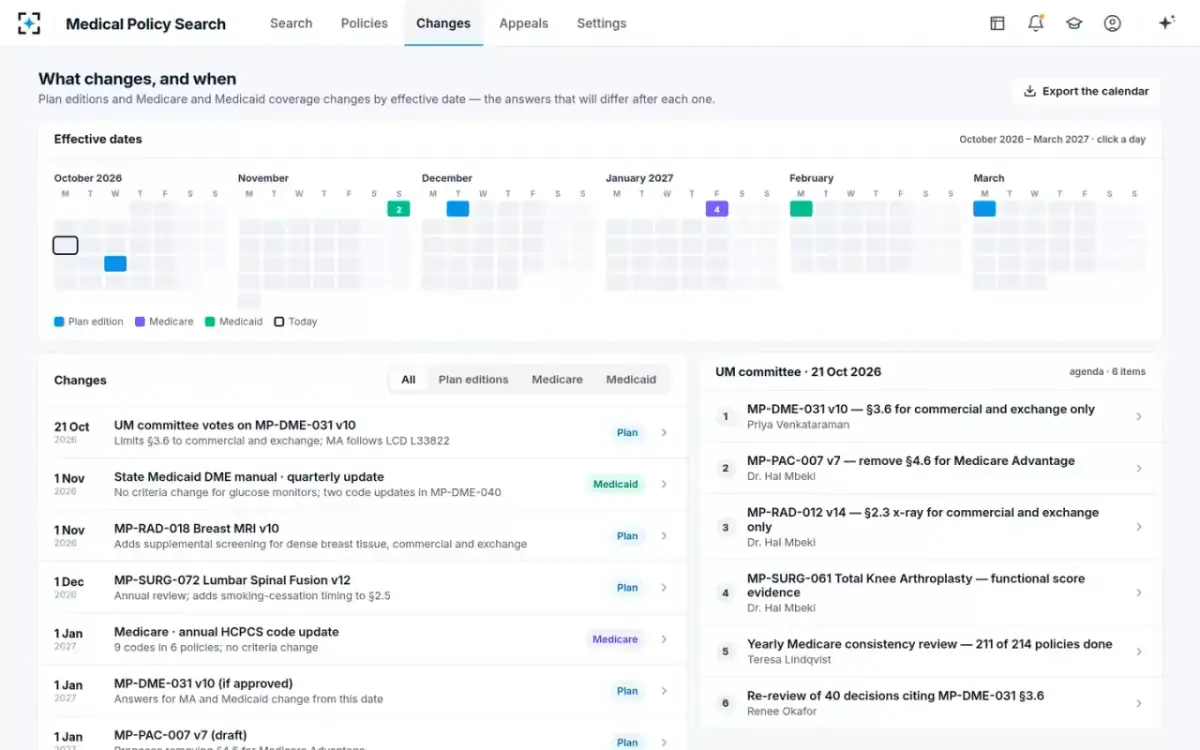
Experimental exclusions are where a dated search earns its keep: they change often and are argued hard. The solution's change tracker lists the policies a new Medicare decision or code would change, and its version finder never answers from today's edition when a date is given. Where the policy calendar sits in the year is set out in medical policy updates; to see the edition in force for your own experimental policies, start from Medical Policy Search.
The coming changes, by effective date, so experimental policies are re-read before they take effect
Questions people ask
Does FDA approval mean a service is no longer experimental?
Not by itself. Approval or clearance is usually necessary, but coverage turns on the evidence for the specific use, judged in the plan's policy or, for Medicare, in the reasonable-and-necessary standard. Medicare contractors are told to describe the FDA indication in an LCD where relevant, and a plan's policy may still list some approved uses as investigational until the evidence it names arrives.
Is off-label use of a drug experimental?
Not automatically. Plans decide off-label uses in their policies, often by reference to compendia and guidelines, and Medicare has its own rules for anti-cancer drugs used off-label. Whether a specific off-label use is excluded depends on the plan's policy edition in force on the date and, in Medicare, on the applicable NCD or LCD.
Who decides an independent review of an experimental denial?
Independent physicians with expertise in the condition, not the plan. California's published findings name each reviewer's board certification and practice status, and in more than half of the 2,028 experimental decisions from 2021 to 2025 the findings describe a third reviewer. The plan must follow the result if the denial is overturned.
Are clinical trial costs covered if the treatment is experimental?
The routine costs usually are. Commercial group and individual coverage may not deny routine patient costs for a qualified individual in an approved trial, and Medicare covers routine costs of qualifying trials under its clinical trials NCD. The investigational item itself, and services only for data collection, are generally not covered.
Can a plan cover a service for one plan type and exclude it as experimental for another?
Yes, within each program's rules. A commercial policy may exclude a use that a Medicare NCD covers; for Medicare Advantage members the NCD governs. Laying the criteria for each plan type side by side on the same date is how a reviewer avoids applying the wrong one.