A medical policy analyst is the person at a health plan who researches the clinical evidence for a service, drafts and maintains the plan's coverage criteria, cross-walks them to Medicare's national and local coverage determinations and the state's Medicaid rules, and prepares each edition for the utilization management (UM) committee. A large share of the week goes to a different task: answering nurses, appeals staff and service representatives who need to know which criteria applied to a service on a date. That second task is the one AI can take, but only if the analyst can trust each answer. Botminds' Medical Policy Search is built for that: every answer shows the policy, the edition in force and the sentence it rests on, so trust can be earned by checking, then sampling, then relying on it for defined policy families.
Four roles around one question, before and after the agents answer it
Today
Answers ‘which criteria applied?’ for nurses and appeals staff by opening PDFs and the coverage database, and drafts editions between the interruptions.
With agents
Checks the agents’ dated answers on a sample, fixes the ones that miss, and spends the reclaimed hours on evidence reviews and drafts.
Still theirs: Evidence appraisal, drafting, the rationale
Today
Has no measure of how often the team’s answers were right, only the appeals that came back.
With agents
Tracks agreement between agent answers and analyst checks by policy family, and decides when a family moves up the trust ladder.
Still theirs: The decision to trust, family by family
Today
Wait for the analyst, or guess from today’s edition.
With agents
Ask directly and get the edition in force on the date, quoted; escalate to the analyst only when the answer flags a conflict.
Still theirs: The case review
Today
Trusts that someone looked up the right edition.
With agents
Sees the sentence, the section and the edition, with Medicare’s rule beside it, before signing.
Still theirs: Every adverse and overturned medical-necessity decision
What does a medical policy analyst do?
The analyst turns evidence and rules into criteria a reviewer can apply, and keeps them current. A typical week mixes five kinds of work: reading Medicare, Medicaid and code changes and listing the policies they touch; appraising new evidence for contested services; drafting editions and their evidence summaries; preparing the committee's agenda with redlines; and answering questions about what a criterion means or which edition applied.
For Medicare Advantage, the rules now set the analyst's standard of evidence. A plan's own criteria must rest on “large, randomized controlled trials or prospective cohort studies with clear results, published in a peer-reviewed journal, and specifically designed to answer the relevant clinical question, or large systematic reviews or meta-analyses”, or on treatment guidelines from organizations representing clinical specialties. CMS spelled out what does not count: “Evidence that is unpublished, is a case series or report, or derived solely from internal analyses within the MA organization” is not a proper justification. The analyst is the person who has to hold that line when a committee member brings utilization data instead of studies.
Is a medical policy analyst a nurse?
It can be, but no rule requires it. The title has no federal occupation code, so no government source counts who holds it; the searches people type, such as ‘medical policy analyst rn’, show how often nursing is part of the question. Clinical training helps with appraising evidence and reading charts, and a team may also need pharmacists for drug policies and coders for the code sections. What federal rules do specify is who decides cases, not who writes policy: in Medicare Advantage, an expected adverse medical-necessity decision must be reviewed by a physician or other appropriate professional “including knowledge of Medicare coverage criteria” before it is issued.
What qualifications does a medical policy analyst need?
Five skills, each traceable to a rule or a deadline. Evidence appraisal, because Medicare Advantage criteria must meet a stated evidence standard and show it publicly. Medicare coverage law, because a plan's criteria may only supplement Medicare's where they are not fully established. Coding, because HCPCS files change every quarter and ICD-10 twice a year, and a stale code section mis-scopes a policy. Plain, exact writing, because criteria must be testable by two reviewers and rationales must be published. And data handling, because since 2026 the plan files its internal criteria with CMS every year.
The writing skill is underrated. CMS has said that a public rationale that assumes criteria generally do more good than harm is not enough; the plan must “systematically explain the harms and benefits and use appropriate clinical evidence”. That is an analyst's paragraph, and it now has a regulator as a reader.
What is a medical policy analyst salary?
No government series reports it, so any figure needs a proxy and a label. The closest federal benchmark for analysts who are nurses is the registered nurse occupation: “The median annual wage for registered nurses was $97,550 in May 2025.” For the compliance side of the role, CMS itself priced the annual criteria filing using the Bureau of Labor Statistics median for compliance officers, $37.70 an hour in May 2024, doubled to $75.40 for benefits and overhead (CMS-10913 supporting statement). Neither is a medical policy analyst figure; both are better than an unsourced number.
Will AI replace medical policy analysts?
No, and the rules are why. CMS allows software to help with coverage decisions but keeps the plan responsible for every rule on how they are made, and it has drawn one line especially sharply for criteria themselves.
“Because publicly posted coverage criteria are static and unchanging, artificial intelligence cannot be used to shift the coverage criteria over time.”
CMS, frequently asked questions on coverage criteria and utilization management (CMS-4201-F), 6 February 2024
Criteria are written, evidenced, approved and published by people; software can help find, compare and apply them. CMS proposed AI-specific guardrails for Medicare Advantage in its proposed rule for 2026 and chose not to finalize them in its April 2025 rule (90 FR 15792), so the binding rules remain the general ones: individual medical-necessity determinations, physician review before adverse decisions, and published criteria. What AI changes is the analyst's week. The lookup questions move to the agents; the analyst's work moves to verifying answers, appraising evidence and drafting, which is where the job's judgment always was.
The trust ladder: checked, then sampled, then trusted
Trust in an AI answer should be earned per policy family, on evidence, and lost the same way. The ladder below has three rungs. Every family starts on the first; the lead analyst moves a family up when the numbers say so, and down after any wrong-edition answer. Families whose criteria sit beside a stable Medicare document climb fastest; families where evidence moves monthly may never leave the second rung, and that is a reasonable outcome.
The trust ladder for AI answers in medical policy, rung by rung
| Rung | What happens to each answer | Evidence to move up | Good first candidates |
|---|---|---|---|
| 1 · Checked | An analyst checks every answer before a nurse relies on it: edition, dates, quote, Medicare source, plan type | A run of consecutive answers with no wrong edition and no unmatched quote, across the family’s common services | Durable medical equipment and imaging policies that sit beside one LCD or NCD |
| 2 · Sampled | Nurses use answers directly; analysts check a random sample each week and every answer that flags a conflict | Sample agreement stays at the plan’s target for a quarter; refusals are reasonable, not frequent | Surgical and post-acute policies with stable Medicare criteria |
| 3 · Trusted | Answers are relied on; analysts review flags, changes and a smaller audit sample | Kept only while the audit sample stays clean; any wrong-edition answer drops the family a rung | Families with few editions and no plan criteria beyond Medicare |
| Stays at 1 or 2 | Checked or sampled indefinitely | Not applicable | Experimental and investigational policies, genetic testing, new drugs: where evidence and editions move fastest |
The ladder works because the answers are checkable. An answer that says ‘the criteria are A, B and C’ cannot be sampled efficiently; an answer that says ‘edition 8, in force 1 January to 31 August 2026, section 3.4, page 2, these words’ can be checked in a minute. That is the design choice behind the solution's citation checker, which blocks any answer whose quote does not match the source edition word for word.
What an analyst checks: the edition on the strip, the passage, and Medicare's rule in the margin
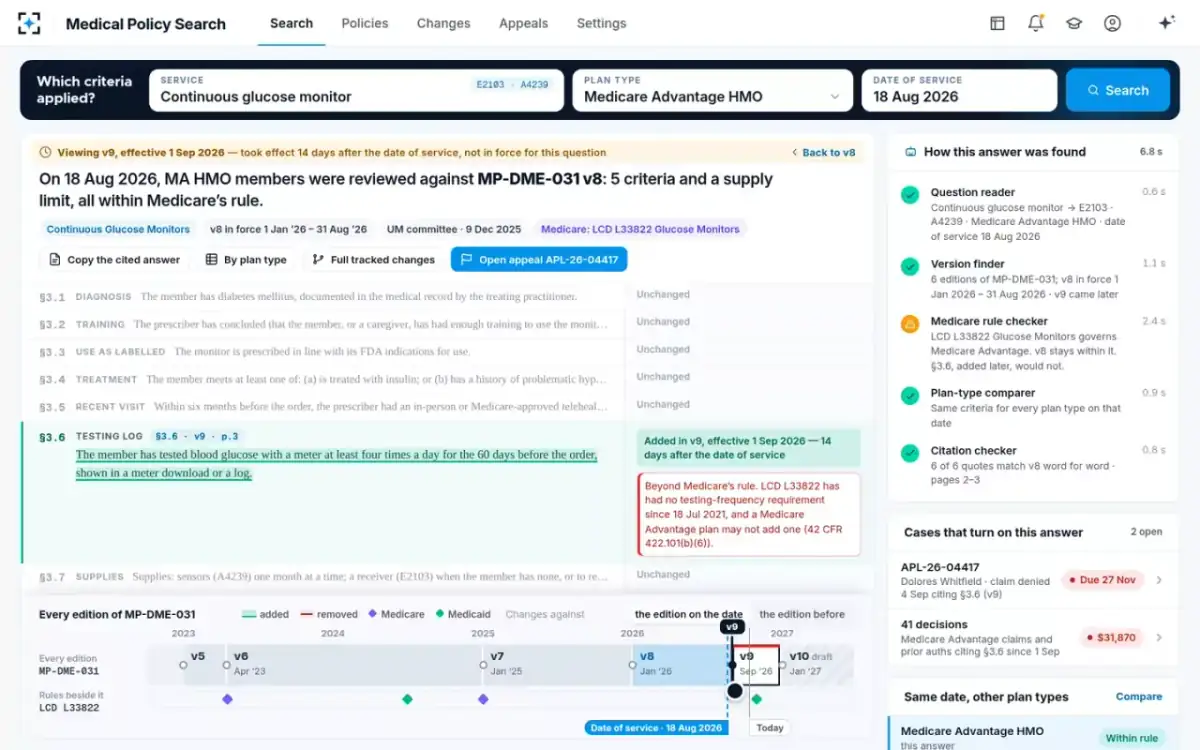
How do analysts verify AI answers?
By checking the answer's claims against the source, in a fixed order, and logging what they find. The order matters because the most damaging errors are the ones a fluent answer hides: the wrong edition, the wrong plan type, a Medicare document from the wrong jurisdiction. A quote that reads well but is not in the source is the easiest to catch and the most important to block.
Eight checks an analyst runs on an AI answer about coverage criteria
- The governing date is the right one
Date of service, date of request or admission date, per the plan’s rule for this decision type.
- The edition’s interval contains that date
Effective date on or before it; the next edition’s effective date after it; no draft quoted.
- The plan type is the member’s
Medicare Advantage, Medicaid, commercial or exchange criteria are not interchangeable.
- Every quoted criterion is in the source, word for word
Section and page given; a paraphrase is not a citation.
- The Medicare document is from the plan’s contractor jurisdiction
An out-of-area LCD is internal criteria for Medicare Advantage.
- The Medicare document was in force on the date too
LCDs and articles have their own versions and effective dates.
- Any criterion beyond Medicare is flagged, not applied silently
The flag goes to the director of medical policy.
- The answer refused when it should have
Missing date, missing plan type, two possible policies: a refusal is a correct answer.
How do you roll out AI to a medical policy team?
Start with the analysts, not the nurses. For the first weeks the agents answer the lookup questions the analysts already field, and the analysts check every one; the team learns where the answers are strong and where they refuse. Then open the search to nurses for the families that have climbed to the second rung, keeping the others behind the analyst. Write the measures down first: agreement between agent and analyst, wrong-edition answers (the target is zero), refusals, and time to answer.
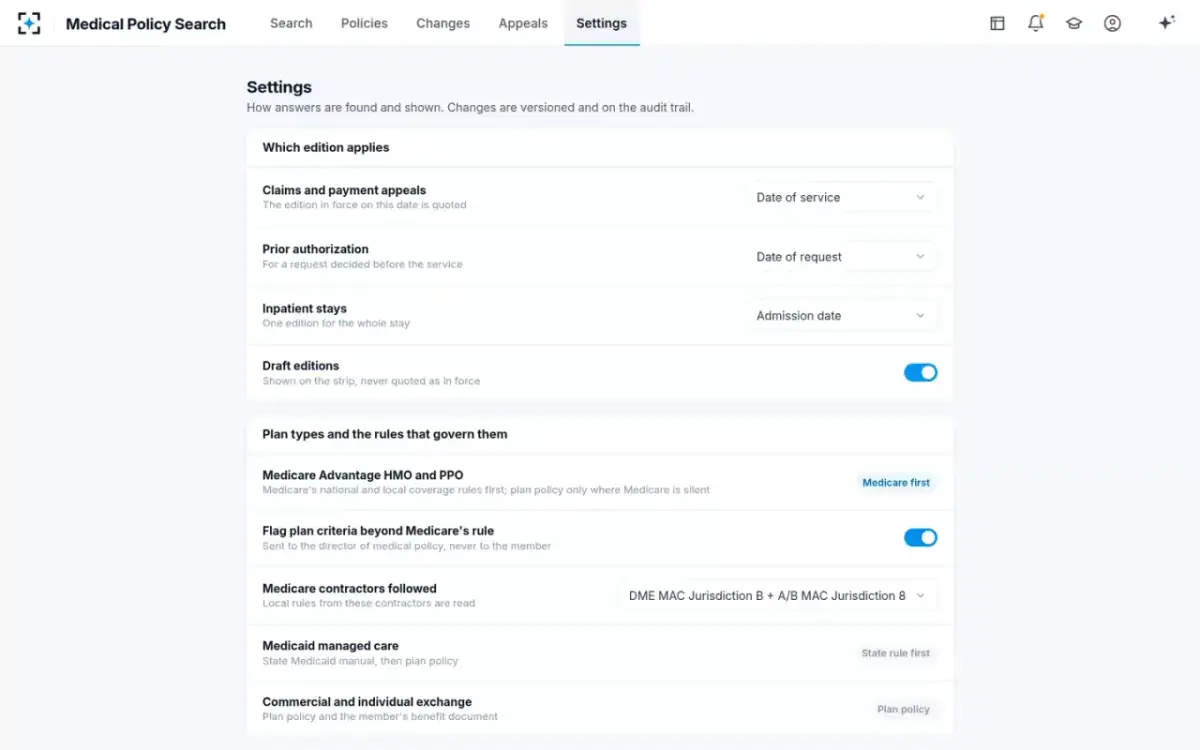
Three practices keep the rollout honest. Load every edition, not only current ones, before anyone asks a dated question; a gap in the history produces confident wrong answers. Name the Medicare contractors the plan follows in the settings, so local rules come from the right jurisdiction. And keep the governance outside the tool: the committee approves editions, the director publishes them, and a physician decides cases. NIST's AI Risk Management Framework gives a common vocabulary for that governance (NIST), but the ladder above is the part an analyst works with day to day.
The plan's own rules: which date decides the edition, which Medicare contractors are followed, who publishes
What stays with the analyst, and with the physician
Judgment stays where the rules put it. The analyst decides what the evidence supports and drafts the words; the committee votes; the director publishes; a physician reviewer decides adverse and overturned medical-necessity decisions and signs them. In the solution the agents find, quote, compare and draft, and no agent may deny, approve, edit a policy or send a letter. That division is what makes the trust ladder safe to climb: the worst an unchecked answer can do is send a case to a person with the wrong page open, and the checks above are built to catch exactly that.
The analyst's week changes shape rather than size. Fewer interruptions, more evidence reviews, and a new duty: owning the ladder for each policy family. The medical policy calendar shows when that work peaks, and reviewer agreement testing gives the analyst a second measure to watch. To see the answers an analyst would check, start from Medical Policy Search.
Questions people ask
What is the difference between a medical policy analyst and a utilization review nurse?
The analyst writes and maintains the criteria; the UM nurse applies them to individual requests. In Medicare Advantage neither makes the final call on an expected adverse medical-necessity decision, which must be reviewed by a physician or other appropriate professional with expertise in the service.
Can AI write a health plan's medical policy?
It can draft, but a draft is not a policy. In Medicare Advantage an internal criterion must rest on qualifying evidence, carry a public summary of evidence, sources and rationale, and be approved by the UM committee before use. In Medical Policy Search the change tracker drafts and flags; it never edits a policy.
Does CMS regulate AI in Medicare Advantage coverage decisions?
Not with AI-specific rules. CMS proposed guardrails in its CY 2026 rulemaking and did not finalize them in April 2025. Its February 2024 guidance applies the general rules: software may assist, decisions must rest on the individual patient's circumstances, and criteria must be the published ones.
How many answers should an analyst check before trusting an AI search?
No rule sets a number; the plan should. A common approach is to check every answer for a family until a run of consecutive answers has no wrong edition and no unmatched quote, then sample, and to write the thresholds down before the pilot so the decision to trust has evidence behind it.
What tools does a medical policy analyst use?
The plan's policy authoring system and library, the Medicare Coverage Database and its coverage API, the state Medicaid manual, the CMS code files, literature databases such as PubMed, and the UM committee's minutes. A dated search across all of them, with editions and quotes, is the gap Medical Policy Search fills.