A product impact assessment is the document a pharmaceutical manufacturer writes when something it used turns out to be defective: it states what was exposed, where the exposed product went, what state each unit is in now, what the existing data says about the risk, what else in the plant shares the failed input, and what is proposed. It is not an essay, and it is not an investigation report. It is six findings in a fixed order, written against a clock, and almost always written before anyone knows the root cause. The hard part is never the prose — it is that findings one to three are a traceability question across four systems, and the clock does not pause while someone joins them. Botminds' Manufacturing Batch Analytics walks the lot links and the shipments in one query and drafts the assessment from what it read, with the source of every sentence attached and the decisions left to named people.
The example used throughout is sample data in the product, on a fictional autologous CAR-T therapy called Corventa made at Plant 3 in Leiden: a fictional supplier, Northgate Bioreagents, withdraws a cryomedium lot, and a fictional quality team has to assess it. The regulations cited are real, and linked where they appear.
What one withdrawn cryomedium lot exposed in the sample assessment
7batches
finished batches frozen in the recalled lot, CRV-26-0420 to CRV-26-0426
3markets
Germany, the Netherlands and the United Kingdom
5
doses already infused, between 4 and 19 September
2
doses still in storage at a treatment centre — the ones a decision can still reach
What is a product impact assessment?
It is the firm's written answer to the question "does this defect reach our product, and if so, how far?" In EU GMP the work sits inside the quality defect investigation, whose procedures must address, among other things, "The determination of the extent of the quality defect" — and the same clause says how: by testing reference or retention samples where relevant and, in certain cases, by reviewing "the batch production record, the batch certification record and the batch distribution records". Those three records are the three findings a reviewer reads first, named in the rule itself.
An impact assessment is therefore a derived document. Nothing in it is new information; all of it already exists somewhere in the plant. What the assessment adds is scope, order and a proposal. That is also why it is so often late: the facts are distributed across the manufacturing execution system, the laboratory system, the enterprise system's material movements and the shipment records, and assembling them is a joining exercise that gets done once, by hand, under pressure.
Two things it is not. It is not a root cause investigation — the cause may take weeks, and the assessment cannot wait for it. And it is not a decision. The author of an impact assessment states facts and proposes actions; a named person with the authority to do so decides whether product is held, quarantined, recalled or reported.
The six findings, in the order a reviewer reads them
Reviewers read an impact assessment in a predictable order, because each finding narrows the next. Exposure without destination is unactionable; destination without state tells you nothing about what can still be stopped; and a proposal that arrives before the first five findings is a guess with a signature block.
The six findings of an impact assessment, and where each one actually comes from
1
The findingWhat was exposed
The question it answersWhich of our materials, batches and units contain or touched the recalled input?
Built fromThe genealogy walk: material movements, batch records, supplier certificates.
Who owns itManufacturing science and technology
2
The findingWhere it went
The question it answersWhich markets, consignees and treatment centres received each exposed batch?
Built fromShipments and chain of custody, batch by batch.
Who owns itSupply chain, with quality assurance
3
The findingWhat state each unit is in
The question it answersShipped, stored, administered, destroyed, or still in our own quarantine?
Built fromDistribution records plus the receiving site's own confirmation.
Who owns itSupply chain and the treatment centres
4
The findingWhat the data already says about risk
The question it answersWhat do release and in-process results for the exposed batches show about the specific defect?
Built fromLaboratory results by test method, and any open deviation on each batch.
Who owns itQuality control and the process scientist
5
The findingWhat else shares the failed input
The question it answersWhich lots in our own stock came from the same upstream material?
Built fromThe backward walk to the supplier's inputs, then forward again.
Who owns itManufacturing science and technology
6
The findingWhat is proposed
The question it answersQuarantine, hold, notification, further testing — and who decides each one?
Built fromFindings 1 to 5, against the firm's own recall procedure.
Who owns itDrafted for quality assurance; the Qualified Person decides
Finding five is the one easiest to leave out, and it is the one that can turn a single-lot problem into a two-lot problem. The supplier's notice names what the supplier knows failed. If what failed is upstream of the named lot — a container, a solvent, a filling campaign — then other things the supplier shipped may carry it too, and the only way to find them is to walk back to the shared input and forward again. The two walks of a lot genealogy sets out that mechanic in full.
What clock are you actually on?
There is no single deadline for an impact assessment, and writing as though there is one is a common error. There are several clocks, they start on different events, and only some of them are regulatory.
The firm's own procedure is often the tightest. In the sample plant, SOP-QA-0112 section 5.2 allows twenty-four hours from a supplier recall notice to a product impact assessment. That is the fictional company's own commitment, written into its quality system — no GMP rule sets twenty-four hours, and a team that believes one does will cite something that does not exist when an inspector asks. The internal clock is nonetheless the binding one in practice, because it is the one the firm has promised to keep and will be audited against.
The regulatory clocks run in parallel and are mostly about telling someone, not about finishing an assessment. EU GMP requires that recall operations "be capable of being initiated promptly and at any time" and that competent authorities be informed in advance where products are intended to be recalled, with rapid action permitted ahead of that notification for very serious issues. In the United States, a licensed biologics manufacturer must file a biological product deviation report "at a date not to exceed 45-calendar days" from acquiring information that reasonably suggests a reportable event occurred — a long clock, but one that starts on the day the notice lands, not on the day the investigation closes.
The first twenty-four hours of a supplier recall, against what each hour can prove
- Read the notice, identify the lot2 h
- Pull movements and batch records9 h
- Reconcile shipments and current state8 h
- Look for the shared inputoften skipped
- Write and route for signature6 h
- Trace, read and draft the six findings
- People check, correct and decidethe rest of the twenty-four hours
Why the assessment starts before the root cause is known
The instinct to wait is strong and wrong. A quality unit that holds the assessment until the supplier explains the failure is optimising for a document that will not need revising, at the cost of the only hours in which some of the product can still be reached. EU GMP addresses this directly.
"Recall operations should be capable of being initiated promptly and at any time. In certain cases recall operations may need to be initiated to protect public or animal health prior to establishing the root cause(s) and full extent of the quality defect"
EU GMP Part I, Chapter 8, §8.22 (in operation 1 March 2015)
Read the second sentence as permission rather than as an obligation. It says that acting on an incomplete picture is a legitimate quality decision, which removes the main argument for delay. What it does not do is tell you how to write an honest assessment on incomplete facts. That is a drafting discipline: state what is known, state what is not known, and never let the two change places. "All seven batches passed sterility at release" is a fact. "The product is therefore safe" is not an assessment finding; it is a conclusion the data does not support, because a container-closure failure found in retained samples is precisely the kind of defect that a release sterility test on a different sample may not catch.
In the sample assessment the distinction is made in the wording: the proposed risk is "low, because release sterility passed", which attributes the judgement to a specific result rather than asserting safety. Reviewers can disagree with it, which is what makes it useful.
What an assessment can state at hour one, and what the same finding looks like at hour six
Hour one · from the trace and the records: Seven finished batches used the recalled lot; three supplier inputs sit behind it.
Hour six · after people have checked and asked: Unchanged. Exposure is the one finding that rarely moves, because it is read from movements rather than inferred.
Hour one · from the trace and the records: Three markets, named consignees, dates and quantities from the shipment records.
Hour six · after people have checked and asked: Confirmed with each site. A record says what was sent; a site says what it still has.
Hour one · from the trace and the records: Five infused, two in storage at a treatment centre, per the last chain-of-custody update.
Hour six · after people have checked and asked: Re-confirmed by both centres before any hold is requested. Status decays faster than any other finding.
Hour one · from the trace and the records: Release sterility passed on all seven; endotoxin 0.12–0.31 EU/mL against a limit of 1.0.
Hour six · after people have checked and asked: Weighed against what the defect actually was. A passed release test on one sample is not a closure guarantee.
Hour one · from the trace and the records: One further lot in the plant's own store came from the same failed bottle lot.
Hour six · after people have checked and asked: Certificate checked by hand; the second lot confirmed as received, unused and quarantinable.
Hour one · from the trace and the records: Four, drafted: quarantine both lots, ask the centres to hold, inform the treating physicians, assess notification in each market.
Hour six · after people have checked and asked: Decided, one at a time, by the person with the authority for each. Some are accepted, some widened, some refused.
The exposure list: from one supplier lot to doses, markets and patients
Finding one and finding two are a single query if the lot links exist, and days of work if they do not. In the sample recall the notice named cryomedium lot CRYO-5512, withdrawn because retained bottles failed a container-closure check and sterility could not be assured. The trace returned seven finished batches, CRV-26-0420 to CRV-26-0426, and their markets: three to Germany, two to the Netherlands, two to the United Kingdom.
What makes an autologous therapy different is that the exposure list is a list of people. There is no inventory to sweep, no wholesaler to notify, no lot to pull from shelves. Each batch is one patient's cells, returned to that patient, so the forward walk ends at a treatment centre and a scheduled infusion date rather than at a distribution centre. The assessment's destination finding therefore has to carry the centre, the dose and the date, and the record that proves each one.
The exposure list behind the assessment, batch by batch
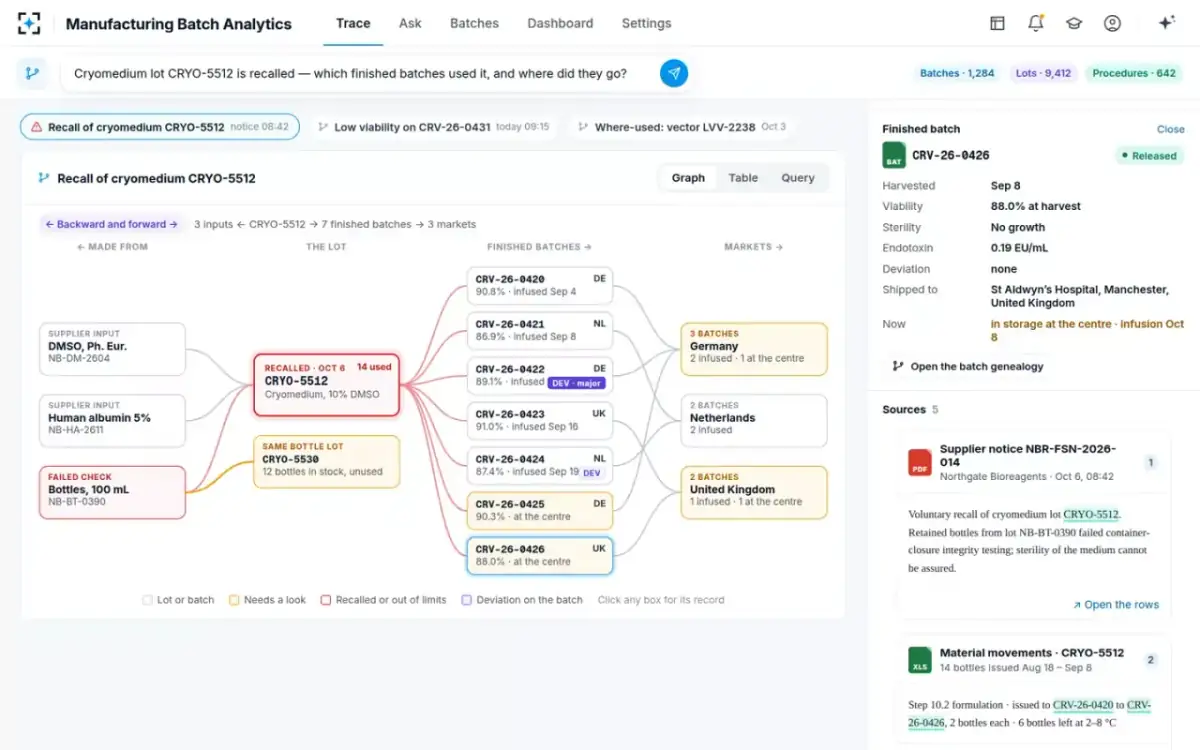
Product status: shipped, stored, administered — and why the three are answered differently
Status is the finding with the shortest shelf life and the weakest evidence, and assessments often treat it as though it were as solid as exposure. It is not. Exposure comes from movements the firm itself recorded. Status comes from what someone else is doing with the product right now.
Shipped is a firm record: the distribution record says what left, to whom, when and in what quantity. Stored is a counterparty's record: the centre's pharmacy says what is in its freezer, and the firm's copy of that is as old as the last update it received. Administered is a clinical event: it happened at a hospital, was recorded in a patient's chart, and may not have reached the manufacturer at all. In the sample recall five doses were infused between 4 and 19 September and two were still in storage — one at a hospital in Manchester with an infusion due on 8 October, one in Cologne due on 14 October.
The practical rule that follows is to write status with its source and its age, every time. "Two doses in storage, per the centres' confirmations of 3 and 5 October" is a finding a reviewer can act on. "Two doses in storage" is a finding that may already be false, and the difference between the two sentences is the difference between a hold that arrives in time and a phone call after an infusion.
The nine facts a firm-initiated recall notification asks for
If the assessment leads to a recall, the information the US regulator asks the firm to provide is enumerated, and it maps almost line for line onto the six findings. A team that has drafted the assessment properly has already written most of the notification; a team that has written an essay has to start again.
The nine items 21 CFR 7.46(a) asks a recalling firm to provide, and where each answer lives
- Identity of the product involved
The exposed batches from the forward walk, with strengths, dosage form and batch numbers as they appear on the labelling.
- Reason for the removal, and the date and circumstances of discovery
The supplier notice itself: its reference, its date, and what it says failed. Quote it rather than paraphrase it.
- Evaluation of the risk associated with the deficiency
Finding four: the release and in-process results for the exposed batches, read against the specific defect, not against general product quality.
- Total amount produced, or the timespan of the production
The batch records for the exposed batches, plus the campaign dates that bound them.
- Total amount estimated to be in distribution channels
Finding three: units shipped, less units confirmed administered or destroyed. For a patient-specific therapy this is a small, exact number rather than an estimate.
- Distribution information, including the number of direct accounts
The shipment records: consignees, dates, quantities — the fields 21 CFR 211.196 already requires a distribution record to carry.
- A copy of the firm's recall communication, or a proposed one
Drafted from the findings; in a patient-specific therapy it is usually a communication to the treating centre and physician rather than a trade notice.
- Proposed strategy for conducting the recall
Depth, public warning and effectiveness checks, under 21 CFR 7.42 — the part the assessment feeds but does not decide.
- Name and telephone number of the firm official to contact
A person, not a function mailbox. In the sample plant this is the Qualified Person who decides the actions.
Item three deserves its own note, because it is also the first element of a recall strategy: 21 CFR 7.42 begins its list of factors with "Results of health hazard evaluation." The impact assessment does not perform the health hazard evaluation, but it supplies almost everything the evaluation needs — exposure, destination, status, and the results already in hand.
Recall, market withdrawal or stock recovery: the classification that changes everything after
Three words are used interchangeably in meetings and are not interchangeable in the rules, and the difference decides what has to happen next. The US definitions are explicit. A recall is a firm's removal or correction of a marketed product that FDA "considers to be in violation of the laws it administers and against which the agency would initiate legal action", and the same definition adds that a recall "does not include a market withdrawal or a stock recovery". A market withdrawal covers a distributed product with a minor violation not subject to legal action, or no violation at all — the rule's own examples are "normal stock rotation practices, routine equipment adjustments and repairs". A stock recovery covers product that "has not been marketed or that has not left the direct control of the firm".
The sample recall contains two of the three at once, which is exactly why the words matter. The seven finished batches left the firm: whatever is decided about them is a recall or a market withdrawal question. The second cryomedium lot — twelve unused bottles in the plant's own store — never left the firm's control, so quarantining it is a stock recovery and not a recall at all. An assessment that puts both under one heading invites the wrong classification and, with it, the wrong notifications.
Classification also drives the depth and the checks. Where a recall is classified, FDA assigns class I, II or III by the degree of health hazard — class I being the case where use of, or exposure to, the violative product is reasonably likely to cause serious adverse health consequences or death (21 CFR 7.3(m)). The recall strategy then sets how far down the distribution chain the action extends and what proportion of consignees must be verified as notified. Testing that machinery before you need it is the subject of the mock recall drill.
What the author signs, and what the Qualified Person decides
An impact assessment has two signatures in it and they mean different things. The author attests to facts. The decision-maker accepts or rejects proposals. Collapsing the two — one signature that means "this is true and I have therefore done it" — is how a document meant to inform a decision becomes a decision nobody made deliberately.
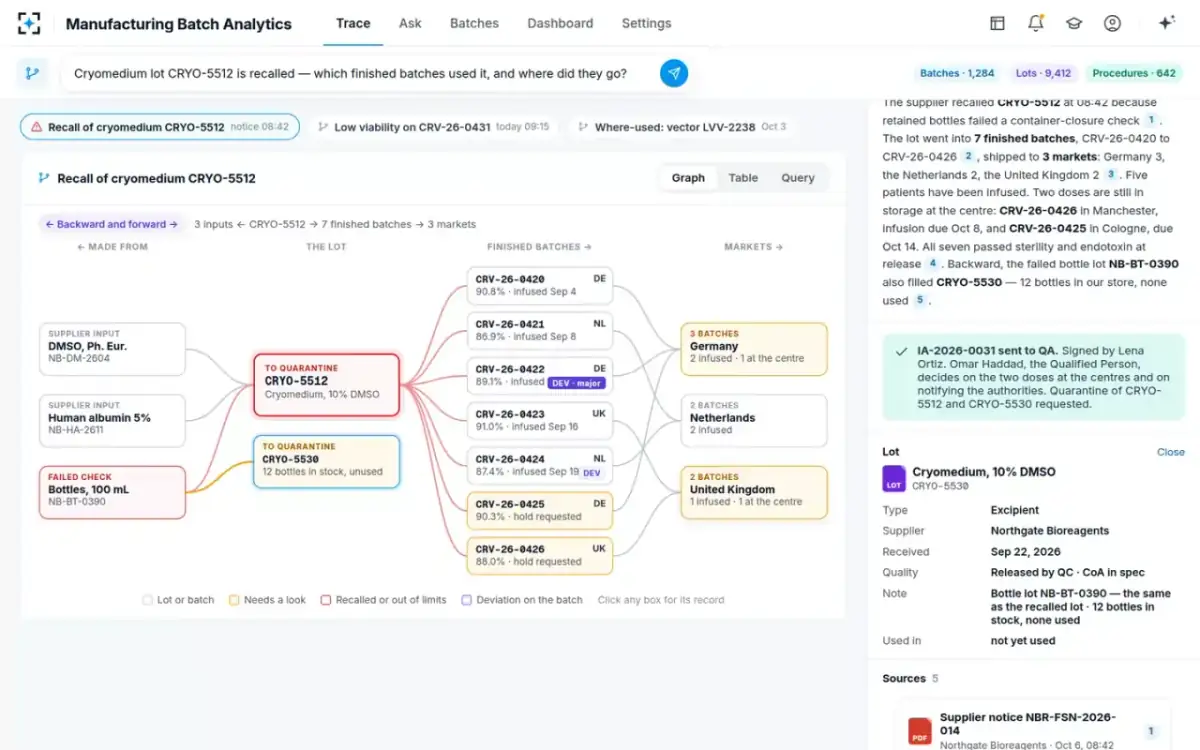
In the product the separation is built in. The drafter reads the trace and the seven batch records and fills the assessment, IA-2026-0031: exposure, product status, proposed risk, and four proposed actions — quarantine the recalled cryomedium lot (six bottles) and the second lot (twelve), ask both treatment centres to hold the stored doses, tell the treating physicians of the five infused patients through medical affairs, and assess notification in each of the three markets. Every sentence carries the source it came from. Nothing is sent. The scientist signs with the meaning "I confirm the facts in this impact assessment are correct", and the assessment goes to the quality assurance lead and Qualified Person, who decides on the two stored doses and on notifying the authorities.
The assessment drafted from the trace, with every finding carrying its source
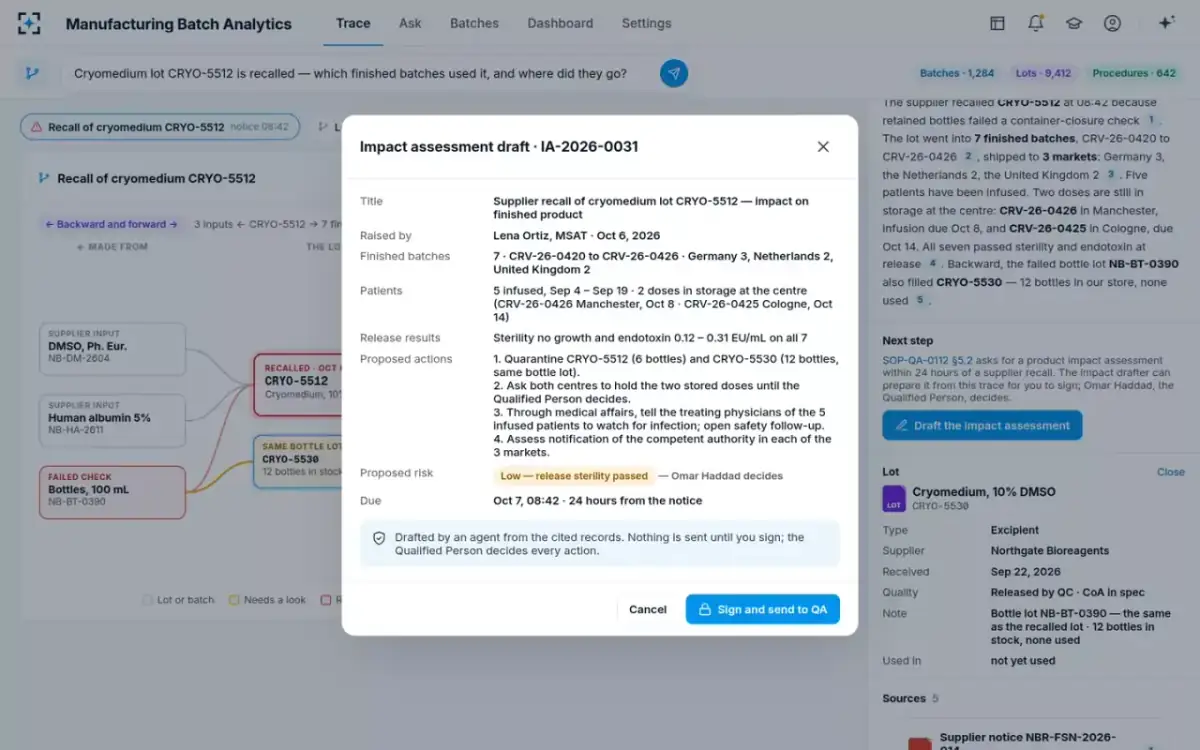
That split is also what makes the twenty-four hours survivable. The hours are not short because writing is slow; they are short because finding the facts is slow. Once findings one to five arrive in minutes, the remaining time goes where it belongs — on whether to hold two doses, whom to tell, and in which markets. Verification on every batch rather than once a year is the other half of the same argument, applied to trends rather than recalls. To see the trace, the draft and the signature in sequence, start from Manufacturing Batch Analytics.
Signed by the author, decided by the Qualified Person
Questions people ask
How long do you have to assess a supplier recall?
As long as your own procedure allows, which is often the shortest clock you are on. GMP does not set a deadline for an impact assessment; it requires that recall operations can be started promptly and at any time, and that authorities are told in advance of an intended recall. Separate reporting deadlines run alongside — for example, a licensed biologics manufacturer in the United States must file a biological product deviation report no later than 45 calendar days after acquiring information that suggests a reportable event occurred.
Do you have to wait for the root cause before recalling?
No. EU GMP says explicitly that in certain cases recall operations "may need to be initiated to protect public or animal health prior to establishing the root cause(s) and full extent of the quality defect". The assessment written at that point should say what is known, what is not, and which findings may change — not assert a conclusion the data has not yet reached.
Who decides whether to recall a batch?
A named person with that authority in the firm's quality system — in the European Union, often the Qualified Person working with the quality unit, with the competent authorities informed in advance where a recall is intended. The author of an impact assessment proposes; they do not decide. Any software in this area should mirror that split rather than blur it.
What is the difference between a recall, a market withdrawal and a stock recovery?
Under 21 CFR 7.3, a recall concerns marketed product FDA considers violative and would act against; a market withdrawal concerns distributed product with a minor violation not subject to legal action, or none at all; and a stock recovery concerns product that never left the firm's direct control. One event can contain more than one of these at once — shipped batches and an unused lot still in your own store are not the same question.
When must a biological product deviation be reported?
Under 21 CFR 600.14, a licensed manufacturer must report an event affecting a distributed licensed biological product's safety, purity or potency as soon as possible, and no later than 45 calendar days from the date it acquired information reasonably suggesting that a reportable event occurred. The clock starts on acquiring the information, not on completing the investigation, so the date the supplier's notice arrived is the date to record.
What goes in a product impact assessment?
Six findings: what was exposed, where it went, what state each unit is in, what the existing data says about risk, what else shares the failed input, and what is proposed, with the record behind each statement. Keep the proposals separate from the facts, name who decides each proposed action, and record the source and the age of every status finding — status is the finding most likely to be out of date by the time the document is read.