A mock recall in pharma is a rehearsal: you pick a lot that really exists, pretend it has been withdrawn, and see how fast and how completely your own systems can say where it went and what state every unit is in. The reason to run one is not that a rule names it — no rule does — but that it is the only test that puts the real data, the real people and the real hour of the day into the same room. It is also, for anyone buying traceability software, the one evaluation that does not have to be invented: run the drill on your own lot by hand, run the same lot through the tool, and compare two scores rather than two sales decks. Botminds' Manufacturing Batch Analytics is built to be measured that way, and this guide says where it helps, where it does not, and what to score.
The worked example is sample data in the product, on a fictional autologous CAR-T therapy made at a fictional plant in Leiden, with a fictional supplier. The regulations are real and linked where they appear.
One drill, four scores — and often only the first gets written down
Time
to a complete consignee list for the chosen lot, from the pretend notice
Gap
between quantity delivered and quantity accounted for, and whether it is explained
Depth
the level in the chain the drill actually reached, against the level it aimed at
Shared
lots that came from the same upstream input and were never named
What is a mock recall, and what does GMP actually ask for?
A mock recall is a documented rehearsal of a recall on a real lot, run end to end without anything actually being withdrawn. The firm picks a batch, starts a clock, works out who received it, contacts whoever the drill's depth requires, reconciles what it finds against what it shipped, and writes the whole thing up. The rules do not mandate it by name. What EU GMP mandates is the evaluation that a mock recall is the obvious way to satisfy.
"The effectiveness of the arrangements in place for recalls should be periodically evaluated to confirm that they remain robust and fit for use. Such evaluations should extend to both within office-hour situations as well as out-of-office hour situations and, when performing such evaluations, consideration should be given as to whether mock-recall actions should be performed. This evaluation should be documented and justified."
EU GMP Part I, Chapter 8, §8.30 (in operation 1 March 2015)
Four obligations hide in that paragraph, and they are worth separating. The evaluation must be periodic, so a single drill at validation does not discharge it. It must cover out-of-hours situations, which is a statement about staffing and access, not about data. Mock recalls must at least be considered, with the consideration recorded — a firm that decides a tabletop review is enough has to justify that choice in writing. And the evaluation itself must be documented and justified, which means the drill's design needs a rationale, not just a result.
The same chapter tells you what the drill is really testing. Distribution records must be "readily available to the persons responsible for recalls" and must carry enough about wholesalers and directly supplied customers — "with addresses, phone and/or fax numbers inside and outside working hours, batches and amounts delivered" — including exports and medical samples. A drill that takes six hours because the distribution extract had to be requested from another team has already found its finding.
The four scores worth keeping, and why time is only one of them
Many drill reports record one number: how long it took to produce a consignee list. It is the easiest to measure and the least interesting, because it is dominated by who happened to be available. The other three say more about whether the arrangements are fit for use.
Time to a complete consignee list. Measure from the moment the pretend notice reaches the person who would really receive it, not from the moment the drill was announced. Record the time to the first list and the time to the final list separately; the gap between them is how much of the answer came from chasing rather than from records.
Reconciliation gap. Chapter 8 requires that the recall process be recorded until closure with "a reconciliation between the delivered and recovered quantities of the concerned products/batches". In a drill nothing is recovered, so the analogue is quantity delivered against quantity accounted for by state: in stock, in transit, dispensed, administered, destroyed, unknown. The unknown column is the score.
Depth reached. A strategy specifies a level in the distribution chain — wholesale, retail, or consumer and user level. The drill should state the level it aimed at and the level it could actually evidence. These can differ, often at the last hop, where the record belongs to someone else.
Shared-input lots found. Of the four this is the one easiest to leave out, and the one that can change the scope of a real event. It is set out in full further down this page.
Designing the drill: choosing the input lot that will hurt
The quickest way to make a drill meaningless is to pick a convenient lot: a recent batch, one market, a single consignee, a product whose records someone has just been working in. The drill then measures how well the firm can look up something it already knows.
Choose instead for difficulty, and say in the protocol why you chose it. A lot that entered several finished batches is better than one that entered a single batch. A lot that crossed more than one market is better than one that stayed home, because notification obligations differ and the drill should hit them. A lot whose supplier certificate names upstream inputs is better than one whose certificate is a scan with no lot numbers, because it is the only kind that tests the backward walk. A closed, fully consumed lot is better than an open one, since the whole history is available to be reconciled against.
Those four criteria are deliberately uncomfortable, and that is the point. A drill designed to be survivable tells you nothing you can act on; a drill designed to find the boundary of your records tells you where to spend next year's budget.
A mock recall, step by step — and which steps a person must do
A person decides
Choose the lot and write the protocolState the lot, the pretend defect, the intended depth, the four scores, the start trigger and who is told it is a drill. Record why this lot and not an easier one.
Never: is chosen by the team that will be scored
A person decides
Start the clock on a realistic triggerDeliver the pretend notice the way a real one would arrive — to the shared mailbox, at the hour you want to test, to whoever is actually on duty.
Never: announces the drill to the people being timed
Agent
Walk the lot forward to batches, shipments and consigneesAcross material movements, batch records and distribution records, in one pass, with the query shown beside the result.
Never: writes to a plant system; every connection is read-only
Agent
Walk the lot backward to its upstream inputsThrough the supplier certificate, then forward again from each input, to find other lots the notice would not have named.
Never: treats a certificate value as a test the plant performed
A person decides
Verify a sample of the list against the sourcePick several consignees and check the shipment record by hand. A drill that trusts its own output measures nothing.
Never: is skipped because the tool was fast
A person decides
Reconcile and scoreDelivered against accounted-for by state, depth aimed at against depth evidenced, time to first and final list, shared-input lots found.
Never: records only the elapsed time
A person decides
Write the report and the actionsWhat was found, what could not be found, what will change, who owns each change and by when. Close the actions before the next drill.
Never: ends in a score with no owner
Out of hours is the real test
The out-of-hours requirement is easy to satisfy on paper and fail in practice, because a drill run at 10:00 on a Tuesday exercises a different system from the one that would answer at 02:00 on a Sunday. What changes at night is not the data; it is who can reach it.
Three things tend to break. First, access: the distribution extract lives in a system whose out-of-hours licence covers two people, and one of them is on leave. Second, authority: the person who can reach the records cannot decide anything, and the person who can decide cannot reach the records. Third, the contact list itself — Chapter 8 asks for consignee telephone numbers "inside and outside working hours" precisely because the daytime number is a switchboard.
A useful discipline is to run one drill a year entirely out of hours and to score it separately. If the out-of-hours time to a consignee list is three times the in-hours time, the finding is not about traceability at all; it is about rota and access, and no software will fix it.
Effectiveness checks: the levels, and what percentage of consignees each means
In a real recall, producing the consignee list is the beginning. The firm then has to verify that those consignees were told and acted. 21 CFR 7.42 states the purpose plainly — "to verify that all consignees at the recall depth specified by the strategy have received notification about the recall and have taken appropriate action" — and then defines five levels by the share of consignees contacted. A drill that stops at the list has tested half the machinery.
Effectiveness-check levels under 21 CFR 7.42(b)(3), and what each one asks of a drill
| Level | What the rule specifies | What a drill should prove at this level |
|---|---|---|
| Level A | 100 percent of the total number of consignees to be contacted. | That a complete, current contact list exists for every consignee of the lot — including export consignees and anyone who received samples. |
| Level B | Some percentage between 10 and 100 percent, determined case by case. | That the firm can justify and document how it chose the sample, not merely that it reached the number. |
| Level C | 10 percent of the total number of consignees to be contacted. | That the 10 percent is drawn across markets and consignee types rather than from whoever answers fastest. |
| Level D | 2 percent of the total number of consignees to be contacted. | That the small sample is still traceable to named consignees, with the contact attempt recorded. |
| Level E | No effectiveness checks. | That the strategy justifies why none are needed — which, for a product administered to patients, it rarely will. |
For a patient-specific therapy the levels compress: there may be only a handful of consignees, each a treatment centre, and anything below level A is hard to justify. That makes the consignee contact detail — the out-of-hours pharmacy number, the named pharmacist — part of the traceability data rather than an administrative afterthought.
Reconciliation: delivered against recovered, and the gap that needs explaining
Reconciliation is where a drill turns from an exercise in retrieval into an exercise in honesty. The requirement in a real recall is a reconciliation between delivered and recovered quantities, recorded in the final report. In a drill the useful version is a table with one row per consignee and one column per state: delivered, confirmed in stock, confirmed dispensed or administered, confirmed destroyed, and unaccounted for.
Two rules make the table worth the effort. The first: unaccounted-for is its own column, never folded into dispensed. A unit nobody can place is a finding; a unit assumed consumed is a guess that has been promoted to a fact. The second: every non-zero cell names the record that supports it. "Centre says five infused" is not evidence until the drill records who said so, when, and against what.
A drill that produces a reconciliation table with a 4% unaccounted-for column and a written explanation of why is more valuable than one that produces a clean table in half the time. Firms that score only elapsed time create a quiet incentive to produce the second.
The score most drills never record: lots that share the failed input
Here is the score we would add to every drill, and the one that can turn a one-lot event into a two-lot event. After the forward walk is finished, ask a second question: which other lots in our own stock came from the same upstream input as the lot we just traced? Record the answer, and record how long it took and how it was obtained.
In the sample recall, the supplier's notice named one cryomedium lot, withdrawn because retained bottles had failed a container-closure check. The forward walk found seven finished batches across three markets. The backward walk then reached the three inputs on the supplier's certificate, including bottle lot NB-BT-0390 — the component that had actually failed — and walking forward again from that node found a second cryomedium lot, CRYO-5530, received on 22 September, twelve bottles in the plant's store, none used. A where-used report on the recalled lot alone would have missed it, and so would a drill that only ever scored the forward direction. How the two walks differ sets out why one is not the other.
The second lot the notice never named, found by walking back and then forward
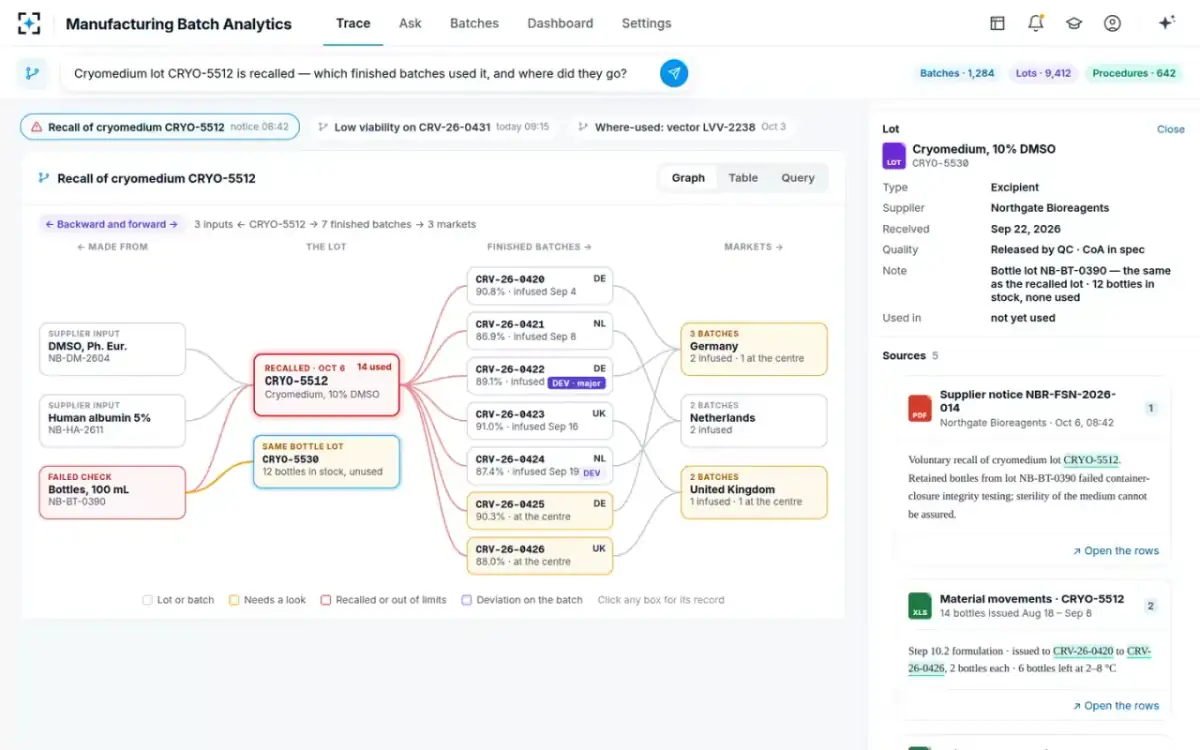
There is a regulatory argument for this score as well as a practical one. 21 CFR 211.192 requires an investigation to reach every other batch, and every other product, that may have been associated with the failure (21 CFR 211.192), and FDA raises it when firms stop short. A 2023 FDA warning letter to a drug manufacturer, in its additional concerns about an out-of-specification investigation, put it in one sentence: "However, you did not extend the investigation to other potentially impacted drug product batches manufactured around the timeframe when objectionable microorganisms were recovered." A drill that never scores the sideways question is rehearsing the half of the work that does not get cited.
How do you use a mock recall to evaluate software?
Because the drill is already a measurement, it converts directly into a procurement test, and it is a far harder test than a demonstration. The method is simple: run the drill by hand on one of your own lots and record the four scores. Then give the same lot to each tool under evaluation, on your own data, and record the same four scores. Compare the pairs.
Three conditions keep it honest. Use your data, not the vendor's sample plant — a tool's performance on its own tidy data tells you about the tool, not about your records. Use a lot the vendor did not choose. And require the tool to show its working: the query it ran, the systems it read, the number of links it walked, so a reviewer can check the answer rather than accept it.
A drill scorecard that also works as a software evaluation
- Time from the pretend notice to the first consignee list, and to the final one
Record both. The gap between them is the part of the answer that came from chasing people rather than from records, and no tool removes it.
- Quantity delivered against quantity accounted for, by state
With unaccounted-for in its own column. Ask the tool to produce the table, not just the list.
- Depth aimed at against depth evidenced
The level in the chain the strategy specified, against the level you could actually show a record for.
- Lots sharing the upstream input, and how they were found
The score that reveals whether you have a genealogy or a one-hop report. Ask to see the certificate the second lot was found through.
- Out-of-hours time against in-hours time for the same drill
If they differ by more than about double, the finding is about access and rota, not about data.
- Whether every number can be opened to its source
The query, the tables read, the record behind each consignee row. A score you cannot audit is not a score.
- What the tool refused to answer
A tool that says "no lot code recorded at this step" is more useful than one that silently returns a shorter list. Ask explicitly how gaps are shown.
- Whether anything was written to a plant system
A traceability tool should be read-only. Check the connection configuration yourself rather than taking the claim.
- Who signed what, and whether the tool allowed an action without a signature
Quarantines, holds and notifications belong to named people. A draft that can send itself is a finding.
- Actions raised by the drill, with owners and dates
Close them before the next drill, and start the next drill's protocol with last year's open actions.
On the sample data in the product, the forward and backward walk of the recalled lot returned in about two and a half seconds, of which the read across lot links, shipments, laboratory results and supplier certificates was six tenths of a second. Those figures come from the product's own sample plant, not from a customer's, and the right way to use them is as a reason to run your own lot through it rather than as a number to quote. The dashboard reports the median time to finish a batch analysis, the questions answered each week, the share of answers a reviewer confirmed and the batches caught early; the roughly ninety days a full outlier investigation took by hand is the solution's own estimate for that fictional line, and the eightfold increase in answers per analyst hour is a design target, measured in use, not a result already banked.
What a drill can be scored against week by week, rather than once a year
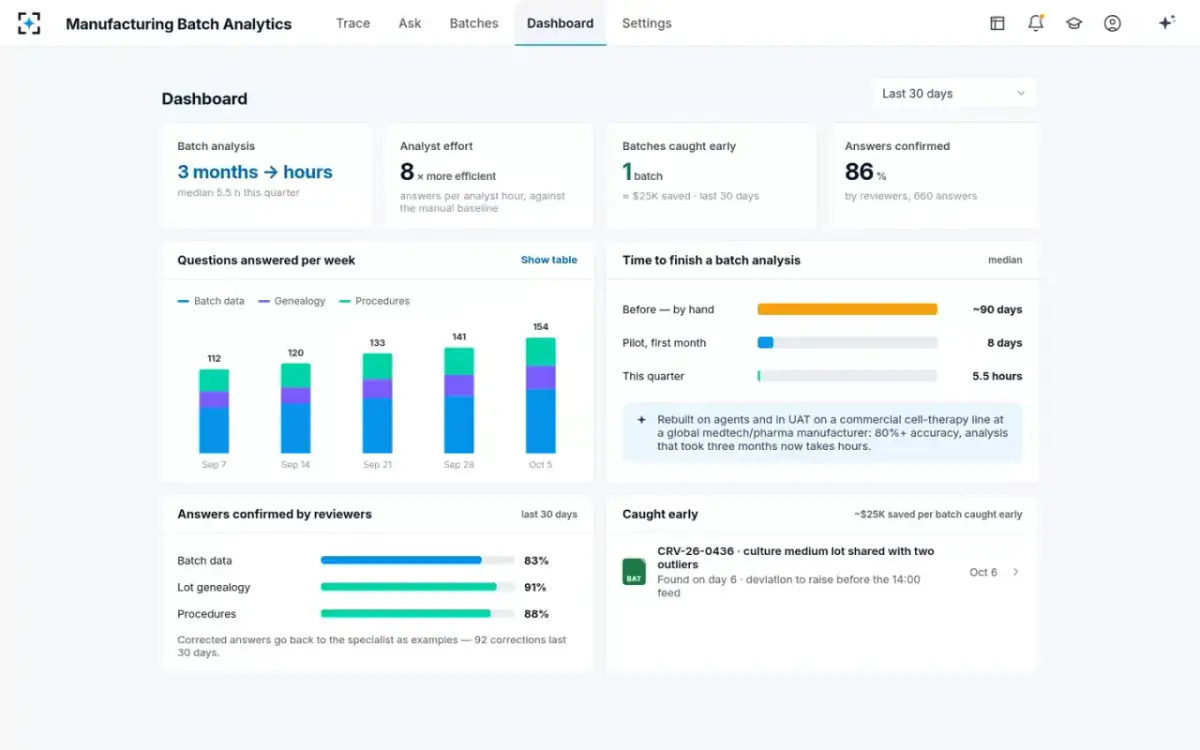
Where this solution does not help is worth stating as plainly. It does not telephone consignees, and the chasing portion of a drill's hours stays exactly where it was. It does not decide anything: holds, quarantines, notifications and classifications remain a named person's signature. It cannot invent links that were never recorded — a dispensing step with no lot code is a gap in your records, and the honest output is to show the gap. And it reads the systems you have; a plant whose supplier certificates are unreadable scans gets a backward walk that stops at receipt until those are read. A drill will surface all four of those, which is the argument for running one before buying anything.
What a drill report has to say to be worth repeating
A drill report that records a time and a pass is a filing exercise. One worth repeating records five things: what was chosen and why, what the four scores were, what could not be found and what that implies, what will change with an owner and a date, and what the next drill will do differently as a result.
The "could not be found" section is the one that decides whether the programme improves. It is also the one most likely to be softened before sign-off, because it reads as a failure. It is not: an evaluation that must be "documented and justified" is an evaluation whose findings are the deliverable. A firm whose drill reports contain no negative findings across three years has either exceptional records or a drill design that avoids them, and an inspector will ask which.
Set the next drill's protocol from this one's gaps. If the certificate reading stopped the backward walk, make next year's lot one whose certificate names its inputs. If the out-of-hours score was poor, run the next one at night. If the reconciliation had an unexplained column, pick a lot with the same shipping pattern and see whether the explanation now exists. What the assessment has to say when it is not a drill follows the same facts into the document a real event produces. To run your own lot through the walk, start from Manufacturing Batch Analytics.
Questions people ask
How often should you do a mock recall?
EU GMP requires the effectiveness of recall arrangements to be evaluated periodically and the evaluation to be documented and justified, without setting a frequency. The defensible answer is whatever your own risk assessment supports and your procedure states — and whatever lets you close the previous drill's actions before the next one starts.
Does GMP require mock recalls?
Not by name. Chapter 8 of the EU GMP guide requires periodic evaluation of recall arrangements and says that "consideration should be given as to whether mock-recall actions should be performed". A firm that chooses a different form of evaluation must record and justify that choice; a firm that records nothing has not met the requirement, whichever method it used.
How do you score a mock recall?
Keep four scores rather than one: time from the pretend notice to a complete consignee list, the gap between quantity delivered and quantity accounted for by state, the depth in the distribution chain you could actually evidence against the depth you aimed at, and the number of other lots sharing the same upstream input that the drill found. Record how each was obtained, so the next drill is comparable.
What are FDA recall effectiveness check levels?
Five levels, set in 21 CFR 7.42(b)(3) by the share of consignees to be contacted: level A is 100 percent, level B a case-by-case percentage between 10 and 100, level C 10 percent, level D 2 percent and level E none. The recall strategy specifies which level applies, and the purpose in all cases is to verify that consignees at the specified depth were notified and acted.
What should a mock recall report contain?
The lot chosen and the reason for choosing it, the pretend defect and the intended depth, the four scores with how each was measured, everything that could not be found and what that implies, and actions with named owners and dates. Reconciliation should be shown as a table with an explicit unaccounted-for column rather than folded into consumption.
How do you test traceability before buying software?
Run your own drill by hand first and record the scores, then give the same lot to each tool on your own data and score it the same way. Insist on three things: your lot, not the vendor's; the query and the records behind every answer; and an explicit account of how gaps in your data are shown. A tool that returns a shorter list without saying which steps had no lot code recorded is the one to worry about.