GMP roles and responsibilities around a batch question split five ways, and the process scientist holds the facts. A process scientist in pharma — in many plants a member of the manufacturing science and technology group, in others process sciences or technical services — owns the understanding of how one product behaves on one line. Day to day that means trending the line, investigating the batches that fall outside their limits, and answering a question the quality unit asks again and again: which other batches are affected? What the role does not own is the decision. The quality unit approves or rejects, the deviation lead sets the class, the Qualified Person decides holds and release, and the manufacturing lead has to act long before any report is written. Botminds' Manufacturing Batch Analytics sits underneath all five desks rather than at one of them: it answers the factual questions — which lots, which batches, what the trend is, what the procedure says — with the query or the cited page behind every answer, so each desk waits for a decision rather than for data.
The people on this page are fictional characters in sample data on a fictional cell-therapy line: Corventa on Line C2 at Plant 3 in Leiden. The rules quoted are the current published ones from the European Commission, the FDA and the International Council for Harmonisation.
One batch question, measured by the desk it is waiting on
≈90days
estimated for a full outlier investigation by hand on one fictional line
4hours
the window a procedure allows to tell process sciences and quality after an action-limit result
24hours
the window a procedure allows for a product impact assessment after a supplier recall
5.5hours
median time to finish a batch analysis on the product's sample data this quarter
What does a pharmaceutical process scientist do?
Four things, in rough order of how much of the week they take. Trending: watching the attributes that describe the process — viability, growth, potency, yield — batch after batch, against control and release limits. Investigating: when a batch falls outside a limit, establishing what happened, from the batch record, the laboratory results, the raw material lots and the equipment history. Answering: fielding the quality unit's questions about scope, which almost always reduce to "which other batches share this". And improving: changing the process, the specification or the procedure so the same thing happens less often.
Underneath all four sits one skill that no job advert names: assembling a defensible picture of a batch out of four systems that were not designed to be read together. That is why the role is so often described by its tools rather than its judgement.
The GMP rules do not define the role at all. What they define is the qualification behind it — "each person engaged in the manufacture, processing, packing, or holding of a drug product shall have education, training, and experience, or any combination thereof, to enable that person to perform the assigned functions" (21 CFR 211.25) — and the duty to write down who does what, which is where this page spends most of its time.
One batch question, five desks: who establishes, who decides, who acts
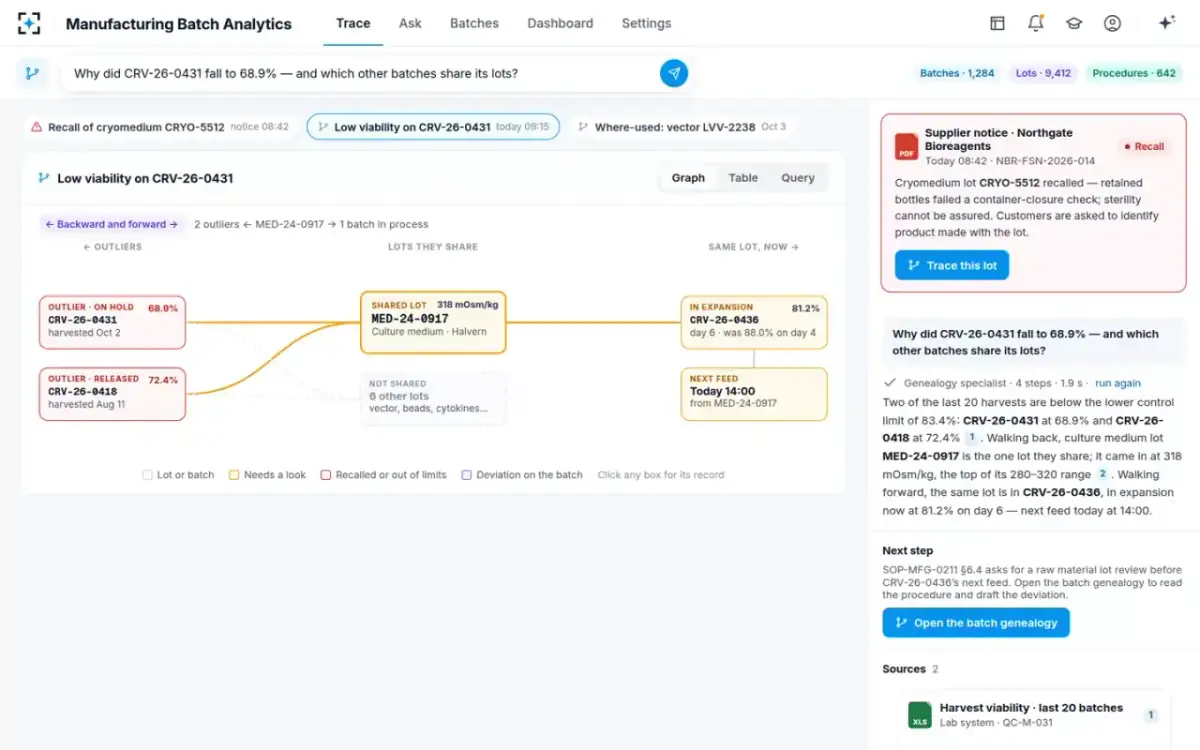
Take a real shape of question: harvest viability on one batch comes in at 68.9%, below a 70% release limit, and a second batch three weeks earlier was also low. Five people are now involved, and they need different things from the same facts.
The five desks around one batch question, and what each one stops waiting for
Today
Trends the line, investigates the outlier and answers the quality unit's questions about scope — and spends more of the week joining tables than understanding the process.
With agents
Asks in plain words and gets the genealogy, the chart or the cited page with the query beside it; signs the facts in the draft.
Still theirs: the judgement about what the data means, and the write-up
Today
Waits on a scope assembled by hand from batch records, shipment lists and certificates, against a procedure's clock.
With agents
Receives a signed assessment listing the exposed batches and doses, what is known and what is proposed.
Still theirs: holds, quarantine, disposition and notification — with quarantine needing an electronic signature
Today
Needs the facts in the record rather than in somebody's spreadsheet before a class can be set.
With agents
Gets a deviation drafted from the genealogy and the cited procedures, with the class marked as a proposal.
Still theirs: the classification decision
Today
If a lot is suspect, wants to know before the next feed — and often learns after it.
With agents
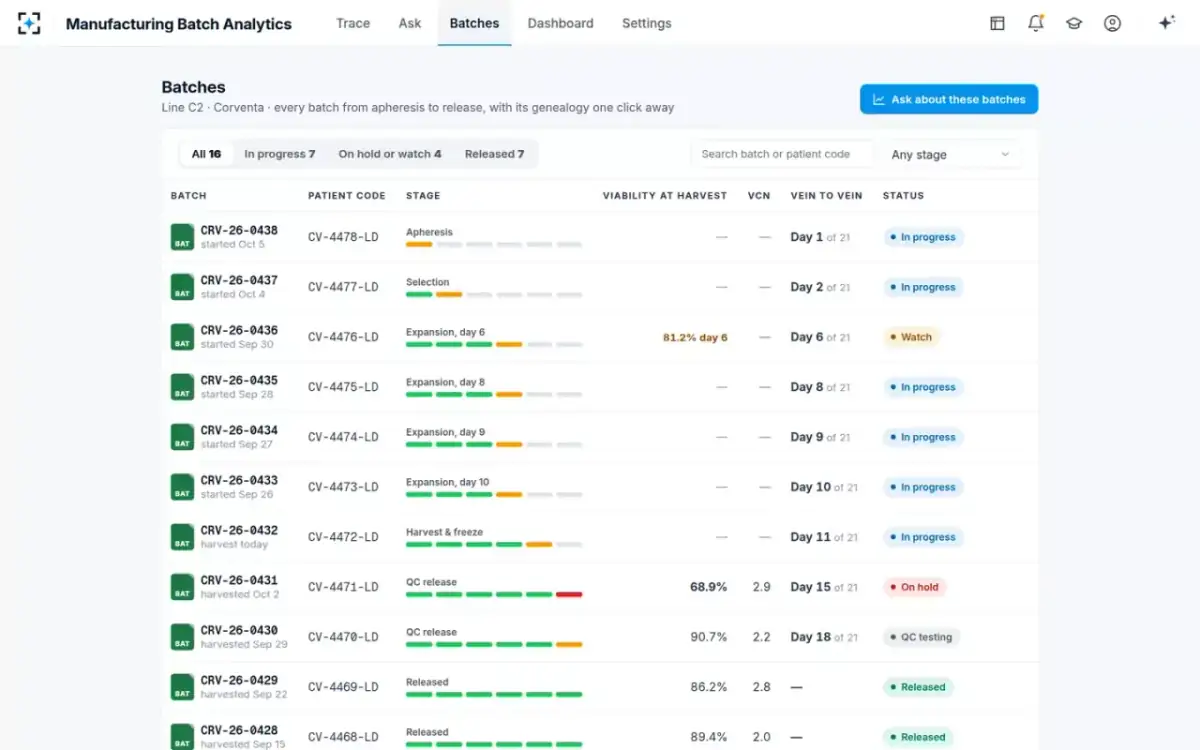
Sees every batch from apheresis to release with stage and status, and confirms the answers that reach the plant dashboard.
Still theirs: what happens on the line in the next shift
Today
Owns what each team may see, and needs every answer to show where it came from.
With agents
Sets the data boundaries, watch rules and approvers once; every answer shows its query or its page.
Still theirs: the boundaries, and who approves what
Reading the table as a sequence rather than a cast list is the useful move. The facts travel from one desk to the next, and the only thing that changes with faster analysis is how long each handover takes. Nothing in the product changes who the handover is to.
What is the difference between process sciences and QA?
Process sciences establishes; quality assurance decides. That is the whole distinction, and the rules are unambiguous about the second half of it. US regulations give a quality control unit both the responsibility and the authority to approve or reject every component, container, closure, in-process material, packaging material, label and drug product, and the authority to review production records to make sure no errors occurred — or that any that did were fully investigated (21 CFR 211.22(a)).
Read that list again from a process scientist's point of view. The authority to approve or reject covers in-process materials, which means the lot a scientist suspects is not theirs to hold. The authority to review production records to assure that errors were fully investigated means the investigation a scientist writes is reviewed by the unit that will also decide what happens next. Those are not overlapping roles; they are sequential ones.
Process sciences and the quality unit, row by row
Process sciences: What happened to the batch, which attributes moved, which lots and batches share the cause, and what the process data supports.
The quality unit: Whether the investigation is complete and whether the record shows what it claims.
Process sciences: The technical conclusion, and what to propose.
The quality unit: Approve or reject; the deviation class; hold, quarantine and disposition; whether to notify.
Process sciences: The facts: this is what the data shows, and this is how it was established.
The quality unit: The record: production and control records are reviewed and approved by the quality unit before release.
Process sciences: Advises manufacturing on the process, often before the next operation.
The quality unit: Independent of production, which is what makes the approval meaningful.
Process sciences: Classify the deviation, release or hold product, or close its own investigation.
The quality unit: Delegate the authority to approve or reject, however good the analysis in front of it is.
Process sciences: Assembling the facts across four systems before anyone can decide anything.
The quality unit: Waiting on a scope it cannot produce itself, while a procedure's clock runs.
The authority the quality unit cannot delegate
Two sentences in EU GMP Chapter 2 do most of the work in any argument about who decides. The first: "People in responsible positions should have specific duties recorded in written job descriptions and adequate authority to carry out their responsibilities. Their duties may be delegated to designated deputies of a satisfactory qualification level. There should be no gaps or unexplained overlaps in the responsibilities of those personnel concerned with the application of Good Manufacturing Practice" (EU GMP Part I, Chapter 2). The second is a limit on how much any one person may carry: "The responsibilities placed on any one individual should not be so extensive as to present any risk to quality."
Delegation to a qualified deputy is allowed; delegation to a tool is not a category the rules contemplate. A specialist that drafts an impact assessment has not been delegated anything — it has produced a document that a named person either signs or does not. That distinction is worth labouring internally before anyone deploys analytics into an investigation path, because it is the difference between a tool that reduces work and a tool that creates a finding.
Chapter 2 also opens with the sentence that explains why all of this is written down at all: "The correct manufacture of medicinal products relies upon people. For this reason there must be sufficient qualified personnel to carry out all the tasks which are the responsibility of the manufacturer. Individual responsibilities should be clearly understood by the individuals and recorded."
Who investigates a batch deviation, and who signs it off?
In many plants the investigation is led by the function closest to the process — process sciences for a process attribute, quality control for a laboratory result, engineering for an equipment failure — with the quality unit owning the file. The sign-off is not the same act as the investigation, and the rules put it firmly on one desk: the quality control unit reviews and approves every production and control record, packaging and labeling included, against the firm's approved procedures before any batch is released or distributed (21 CFR 211.192).
So a process scientist signs facts and a quality unit signs records. Writing that down in a procedure saves an argument during every deviation, and it also decides what an electronic signature in your systems should mean. A signature that only says "approved" is useless a year later; one that records a meaning — I confirm the facts in this assessment are correct — can be read by anyone.
The handovers in one investigation, from the first question to the signed deviation
Agent
The facts are assembledThe trend, the shared lots, the limits that apply and the actions the procedure asks for, each with its query or its section and page.
Never: decides, classifies or holds anything
A person decides
The process scientist establishes and signs the factsJudges what the data means, writes the technical conclusion, and signs with a recorded meaning.
Never: sets the deviation class or holds the lot
A person decides
The manufacturing lead acts on the lineDecides what happens at the next feed on the batches still in culture, with the suspect lot flagged.
Never: waits for the investigation to be finished first
A person decides
The deviation lead sets the classReceives the proposed class with the evidence behind it and decides the actual class.
Never: inherits the proposal automatically
A person decides
The Qualified Person decidesHolds, quarantine, disposition and notification, with quarantine needing an electronic signature.
Never: delegated, and not merged with the investigator's desk
Who classifies a batch deviation, and why it is not the investigator
The quality unit decides, and the reason is structural rather than political. A class drives consequences: notification, batch disposition, whether a CAPA is opened, what gets reported and to whom. The person who established the facts has an interest in the conclusion — not a dishonest one, simply a professional one — and the independence of the classification is part of what makes the record trustworthy. It is the same logic that keeps the quality unit independent of production.
In practice the investigator proposes. A good proposal states the class, the criteria it was read against, and the facts that place the event in that class, so the decision is a review rather than a fresh start. On the fictional line that is exactly the shape of the drafted deviation: the class arrives marked as a proposal, and the deviation lead decides it.
Where this goes wrong is when the proposal is implicit — a file that reads as though the class were obvious — because nobody can later tell whether the class was decided or inherited. Mark proposals as proposals, including in templates.
Holds, quarantine and release: the Qualified Person's decisions
In the EU the Qualified Person's decisions are the sharpest end of the batch question, and they are easily confused with the analysis that feeds them. Whether to hold a lot, whether to quarantine stock, what to do with product already at a treatment centre, whether to notify a competent authority: these are judgement calls made with incomplete information against a clock.
Analysis helps in exactly one way — by making the known facts complete and attributable sooner — and it is worth being honest that this does not make the decision easier. It makes it earlier, which is usually better and occasionally harder, because an earlier decision has fewer results to rest on. The deadline-driven version of this is the 24-hour product impact assessment, where the facts and the decision are separated by hours rather than weeks.
The manufacturing lead's clock: before the next feed, not after the report
The most underrated desk in a batch question belongs to the manufacturing lead, because it is the only one with a deadline set by biology. If a suspect medium lot is in a batch currently in expansion, the decision about the next feed happens this afternoon whether or not anybody has established anything. An investigation that produces an excellent answer next month has produced it for the file, not for the line.
This is why "which batches in progress share this lot" is a different question from "which batches were affected", and why it should be answerable in minutes. On the fictional line the shared medium lot MED-24-0917 appears in a batch still in expansion, with its next feed at 14:00; that is the fact that changes what somebody does today. The variability behind it is the subject of when an in-specification lot still moves your yield.
The line's open questions on one screen
What does GMP say about defining responsibilities? No gaps, no unexplained overlaps
It asks for three things, and a plant that has them written down argues far less. First, recorded individual responsibilities that the individuals themselves understand. Second, specific duties in written job descriptions, with adequate authority to carry them out, and deputies of a satisfactory qualification level where duties are delegated. Third, no gaps and no unexplained overlaps between the people applying GMP.
Annex 11 adds the one that matters once systems are involved: "There should be close cooperation between all relevant personnel such as Process Owner, System Owner, Qualified Persons and IT. All personnel should have appropriate qualifications, level of access and defined responsibilities to carry out their assigned duties" (EU GMP Annex 11, §2). Level of access is in that sentence deliberately. Who may read which data is part of a defined responsibility, not an IT detail — which is why the scopes in a batch analytics tool belong to a named owner, as the settings on the fictional line belong to the head of process sciences.
Seven lines a written responsibility matrix has to contain for a batch question
- Who establishes the facts, per kind of event
A process attribute, a laboratory result and an equipment failure may each have a different lead. Name them, and name the deputy.
- Who decides the deviation class, and from what
The criteria, who applies them, and the requirement that any proposal arrives marked as a proposal.
- Who may hold or quarantine, and with what signature
Including what the signature means and what happens outside working hours.
- Who approves the record before release
The quality unit reviews and approves production and control records before a batch is released or distributed; say who within it.
- What the line may do before the file closes
The line matrices often omit. A manufacturing lead needs written authority to act on in-progress batches on preliminary facts.
- Who owns data scopes and watch rules
Level of access is a defined responsibility. Name the owner of each scope, each watch rule and each approver list, and review them on a schedule.
- What each signature means, in words
"I confirm the facts are correct" and "I approve this record" are different acts. Write the meanings into the procedure, not just into the system.
What changes when the facts arrive in minutes instead of weeks
Not the decisions, and not who makes them. What changes is where the time goes, and the shape of the week on the investigating desk. Botminds' own estimate for a full outlier investigation by hand on the fictional Line C2 splits roughly as follows: 25 days pulling batch records and laboratory results, 20 joining more than 300 columns and agreeing what each metric means, 20 walking lot links through material movements, 10 finding the procedure passages that applied, and 15 writing up the finding and drafting the deviation.
Where an estimated 90-day investigation went, by task
One full outlier investigation by hand, estimated, on the fictional Line C2
- Pulling batch records and laboratory results · 25 days · 28%
- Joining columns and agreeing definitions · 20 days · 22%
- Walking lot links · 20 days · 22%
- Finding the procedure passages · 10 days · 11%
- Writing up and drafting · 15 days · 17%
Four of those five tasks are assembly. The fifth — writing up the finding — is the one with judgement in it, and it is the one that gets squeezed when the first four overrun. A desk that spends four fifths of an investigation collecting data is a desk whose conclusions are written in a hurry, which is a quality problem long before it is a productivity problem.
Two second-order effects are worth planning for. The quality unit starts receiving better-evidenced proposals sooner, which changes its review from reconstruction to judgement — and raises its expectations of what a proposal should contain. And the process scientist's remaining week is spent on the work the role exists for: knowledge about the product. ICH Q10 treats that work as an enabler rather than a nicety, naming knowledge management — systematically gathering, analysing, keeping and sharing what is known about products, processes and components — as one of the two enablers of a pharmaceutical quality system (ICH Q10, section 1.6). A line whose questions are answered in hours accumulates that knowledge; one whose questions take a quarter forgets what it learned.
Every batch on the line, with stage, status and the figures the desks ask about
If you are drawing this line in a procedure for the first time, write the handovers before the job descriptions: the responsibilities fall out of the handovers, and the gaps become obvious. To see the five desks working from one set of facts, start from Manufacturing Batch Analytics, or read what to test before you buy a traceability tool.
Questions people ask
What is the difference between MSAT and QA?
Manufacturing science and technology — process sciences, in many plants — establishes what happened to a batch and what the process data supports. Quality assurance decides: approve or reject, the deviation class, hold and disposition, and whether the record is complete. The US rules give the quality unit the authority to approve or reject materials and products and to review production records; they do not give it to the investigating function.
Who investigates a batch deviation?
Usually the function closest to the cause — process sciences for a process attribute, quality control for a laboratory result, engineering for equipment — with the quality unit owning the file and approving the outcome. What the rules insist on is that the investigation be thorough, that it extend to other potentially affected batches, and that the record be reviewed and approved by the quality unit before release.
Who classifies a batch deviation?
The quality unit, not the investigator. The investigator proposes a class with the criteria and the facts behind it; the deviation lead decides. Keeping those two acts separate is what makes the classification independent of the person who established the facts, and it is why a proposed class should always be marked as a proposal.
What does GMP say about defining responsibilities?
EU GMP Chapter 2 asks that individual responsibilities be clearly understood and recorded, that people in responsible positions have specific duties in written job descriptions with adequate authority, that delegation be to deputies of a satisfactory qualification level, and that there be no gaps or unexplained overlaps between those applying GMP. It also warns that no individual should carry responsibilities so extensive as to present a risk to quality.
What does a process scientist need to know about GMP?
Enough to know where their authority ends. In practice: which attributes are specification limits and which are action limits, what triggers an investigation and how far it must extend, what a deviation class drives, which decisions belong to the quality unit and the Qualified Person, what a signature means, and why the record has to show how a conclusion was reached and not only what it was.
Does faster analysis change who decides?
No. On the fictional line the specialists trace, query, cite and draft; a named person confirms the facts, the quality unit decides the deviation class, and the Qualified Person decides holds, quarantine, disposition and notification. What changes is how long each desk waits for the facts — and how much of the investigating desk's week is left for the judgement the role exists for.