A lot genealogy is the set of links that joins a finished batch to every lot that went into it, and every lot to every batch that came out of it. Walk those links backward from one batch and you get its inputs: the donation, the vector, the culture medium, the cryomedium, the bottles that cryomedium was filled into. Walk them forward from one input and you get the batches it entered, the shipments they left on and the markets and patients they reached. The work is hard because the links do not live anywhere in one piece: the batch record sits in the manufacturing execution system, the lab results in the laboratory system, the lot movements in the enterprise system and the supplier certificates in a folder of PDFs, so an engineer asked "which batches used this lot?" has to join four systems by hand before the real question starts. Botminds' Manufacturing Batch Analytics builds those links from the plant's own data, read-only, and answers a lot question as a genealogy walked in both directions at once.
The worked examples on this page are sample data in the product: a fictional autologous CAR-T therapy, Corventa, made on Line C2 at Plant 3 in Leiden, with fictional suppliers (Northgate Bioreagents, Halvern) and fictional treatment centres. The regulations quoted are real and linked where they appear.
What is lot genealogy?
Lot genealogy is the graph of material identity through a process. Each node is a lot or a batch; each edge is a recorded event that consumed one and produced or affected another. The graph is not an analytical luxury — the obligation to be able to draw it is written into the oldest parts of the rules, because a lot code is useless unless the disposition of that lot was written down. Each container or group of containers of a component must be "identified with a distinctive code for each lot in each shipment received", and 21 CFR 211.80(d) then says what the code is for: "This code shall be used in recording the disposition of each lot."
That single sentence is the atom of a genealogy. A code that is assigned on receipt but never written against a consumption is a label, not a link. Genealogies that fall apart under investigation often fail there: the lot was coded, the dispensing step recorded a material name and a quantity, and nobody wrote the code down. Six months later the only way to recover the link is the weighing printout, if it still exists.
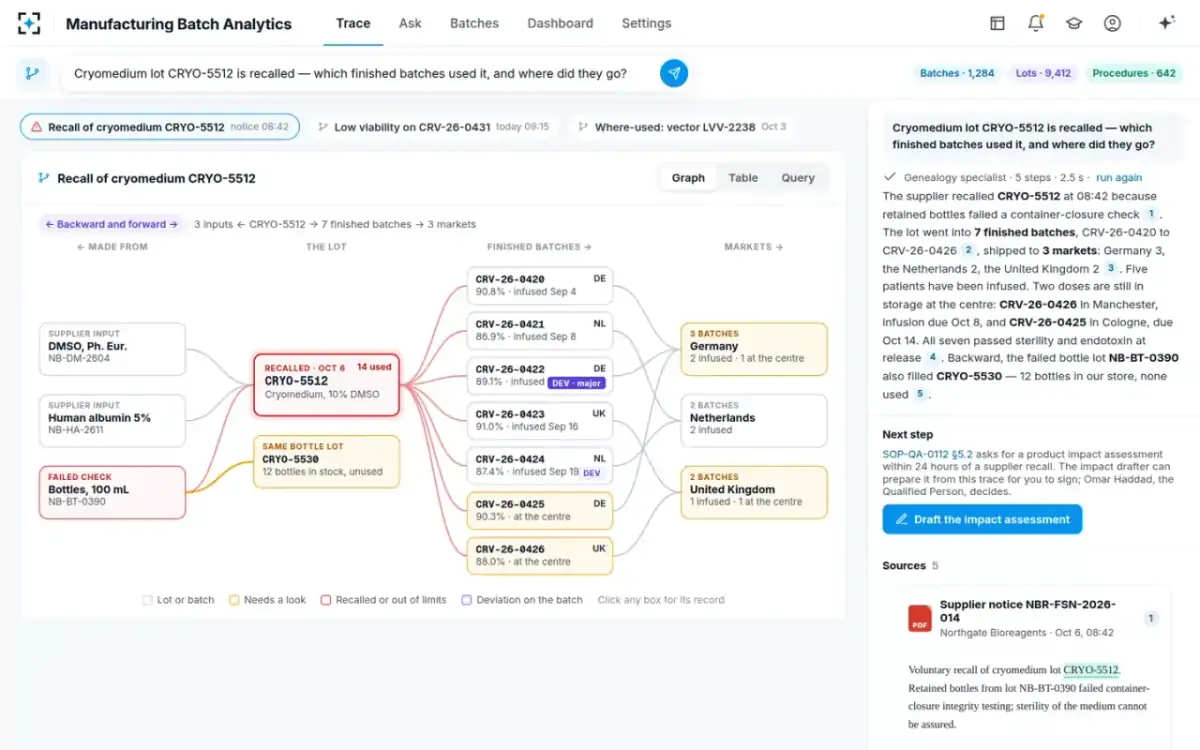
In a cell therapy the graph has a shape most plants do not have. Every batch starts from one donation and ends in one patient, so the forward walk from a shared input fans out into named doses at named hospitals rather than into pallets. The sample recall on this page is of that kind: one cryomedium lot, seven finished batches, five patients already infused.
The lot genealogy of one recalled cryomedium lot in Manufacturing Batch Analytics
Backward · the inputs
Starting material
Apheresis, one donation per batch
chain-of-identity code only — never a name
Supplier input
DMSO, Ph. Eur. · NB-DM-2604
on the supplier's certificate for the recalled medium
Supplier input
Human albumin 5% · NB-HA-2611
on the same certificate
Failed check
Bottles, 100 mL · NB-BT-0390
the input that actually failed
The process
The recalled lot
CRYO-5512 · cryomedium, 10% DMSO
filled from bottle lot NB-BT-0390 · 14 bottles used
Same bottle lot
CRYO-5530
12 bottles in store, unused — the lot the notice never named
Expansion and harvest
Line C2, Plant 3 — Leiden
viability at harvest recorded on every batch
Fill and freeze
Cryopreservation in CRYO-5512
the step that put the lot into the dose
Forward · the batches and markets
Germany
3 batches · CRV-26-0420, 0422, 0425
2 infused · 1 still at the centre; 0422 carries a major deviation
Netherlands
2 batches · CRV-26-0421, 0424
both infused
United Kingdom
2 batches · CRV-26-0423, 0426
1 infused · 1 still at the centre
Backward and forward are two different walks over the same links
The two directions are often spoken of as one capability, and they are not. They start from different objects, read different systems first, answer different people and fail in different ways. A team that has built one and assumed it has the other will discover the difference during a recall, at the worst possible hour.
The backward walk starts at a batch and asks what entered it. It is the investigator's direction: a harvest came out low, and the question is what was different about this batch. It reads the batch record and the material movements, and it is bounded — a batch has a finite bill of materials, and the walk terminates at the supplier's certificate. The forward walk starts at a lot and asks where it went. It is the quality unit's direction: a supplier has withdrawn something, and the question is who has it now. It reads movements, then batch dispositions, then distribution records, and it is unbounded in a way the backward walk is not, because one drum of excipient can enter a year of production.
The backward walk and the forward walk, question by question
Backward · from a batch to its inputs: What went into this batch, and what was different about it?
Forward · from a lot to the batches and markets it reached: Which batches used this lot, where did they go, and what state is each unit in now?
Backward · from a batch to its inputs: Manufacturing science and technology, the process scientist on the deviation.
Forward · from a lot to the batches and markets it reached: The quality unit, the Qualified Person, the person who must decide a hold.
Backward · from a batch to its inputs: The batch production record and the dispensing movements for that batch.
Forward · from a lot to the batches and markets it reached: The issue movements for that lot, across every batch that consumed it.
Backward · from a batch to its inputs: At the supplier certificate for each incoming lot — a bounded list.
Forward · from a lot to the batches and markets it reached: At a shipment, a dose or a unit of stock — a list with no natural bound.
Backward · from a batch to its inputs: Any other batch that shares an input. One batch's own record never names its siblings.
Forward · from a lot to the batches and markets it reached: Why the lot failed, or which attribute of it mattered. Exposure is not causation.
Backward · from a batch to its inputs: A material dispensed without its lot code reads as absent rather than unknown.
Forward · from a lot to the batches and markets it reached: A lot re-packed or re-coded mid-chain ends the walk one hop short of the truth.
The last row of that table is the one to dwell on. A walk that stops one hop short does not announce itself; it returns a shorter list, and a shorter list looks like good news. That is the structural reason a recall scope assembled by hand tends to be narrower than the truth rather than wider.
What is the difference between a genealogy and a where-used report?
A where-used report answers one hop of the forward walk: give it a lot number and it lists the batches that consumed that lot. A genealogy is the whole graph, in both directions, with as many hops as the material took. The difference matters most when the thing that actually failed is not the thing the notice names.
In the sample recall, the supplier's notice named cryomedium lot CRYO-5512: retained bottles had failed a container-closure check, so sterility could not be assured. A where-used report on CRYO-5512 returns the seven finished batches that were frozen in it, and for most purposes that is the answer. But the backward walk from CRYO-5512 reaches the three inputs on the supplier's certificate, one of which is bottle lot NB-BT-0390 — the thing that failed. Turning round at that node and walking forward again finds that the same bottle lot also filled a second cryomedium lot, CRYO-5530, received on 22 September, twelve bottles still in Leiden's store, none used. A where-used report on CRYO-5512 alone would have missed it, and so would a trace that only ever went one way.
That is the practical test of whether a plant has a genealogy or a where-used report: ask it for the lots that share an input with a named lot. If the answer requires someone to read a supplier certificate and start a second query by hand, the plant has one hop, not a graph.
One recalled lot traced both ways in Manufacturing Batch Analytics
The five records the links are actually built from
Nothing in a plant stores a genealogy. It is derived, every night, from five families of record that exist for other reasons, and the quality of the graph is the quality of the weakest of them.
How Manufacturing Batch Analytics builds the lot links, nightly and read-only
Agent
Material movementsReceipts, issues to a batch, transfers and returns from the enterprise system. These are the edges: each issue line joins one lot to one batch.
Never: writes a movement, a status or a disposition back
Agent
Supplier certificatesThe certificate of analysis for each incoming lot, which names the inputs the supplier itself used and lets the walk continue past the plant boundary.
Never: treats a certificate value as a test the plant performed
Agent
Batch production recordsThe dispensing and processing steps, which confirm that a lot named in a movement was actually consumed, and when, and by whom.
Never: quotes a record still open or unapproved as a final result
Agent
Laboratory resultsIn-process and release results by test method, so every node on the graph carries the numbers that decide whether it matters.
Never: recalculates or rounds a reported result
Agent
Shipments and chain of custodyWhere each finished batch went, when, to whom, and what state the unit is in now — the last hop of the forward walk.
Never: shows a patient name or date of birth; chain-of-identity codes only
A person decides
A named reviewer confirms the answerBefore a trace is saved to a dashboard or attached to an assessment, a person checks it against the query shown beside it and confirms or corrects it.
Never: is bypassed because the walk was fast
Two of those five are often weaker than teams expect. Supplier certificates are usually the only route past the plant's own four walls, and they often arrive as scanned PDFs whose input lot numbers are typed into nothing; the shared-input question cannot be answered at all until they are read. And distribution records are often held to a lower standard than production records, even though the rule asks for exactly the fields a forward walk needs: "the name and strength of the product and description of the dosage form, name and address of the consignee, date and quantity shipped, and lot or control number of the drug product". Two of those five fields are the last hop of the graph.
What a batch record must already hold, field by field
Most of the backward walk is already a legal requirement, which is the useful thing to tell a validation lead who is about to specify a genealogy: you are not asking for new data, you are asking for the data in 21 CFR 211.188(b) to be joinable. The rule lists thirteen things a batch production record must document for each significant step, and the table below reads them as the edges and attributes of a graph.
21 CFR 211.188(b), read as the links of a lot genealogy
| What the rule requires | What it contributes to the graph |
|---|---|
| Dates | Orders the nodes, and lets a walk be bounded by a date range — "the batches made in the week either side of this one". |
| Identity of individual major equipment and lines used | A second kind of edge: batches that shared a vessel or a line, which a material-only genealogy cannot see. |
| Specific identification of each batch of component or in-process material used | The backward edges themselves. Without the word "specific", a material name is not a link. |
| Weights and measures of components used in the course of processing | Lets a reconciliation test the graph: quantity issued against quantity recorded as consumed. |
| In-process and laboratory control results | The attributes on each node — the numbers that decide which of seven exposed batches is the one to worry about. |
| A statement of the actual yield and a statement of the percentage of theoretical yield | The first signal that a node is abnormal, before anyone has asked a traceability question at all. |
| Complete labeling control records, including specimens or copies of all labeling used | Joins the batch to what the market actually received, which is where a recall notice has to land. |
| Description of drug product containers and closures | The node that failed in the sample recall. A genealogy that stops at the medium never reaches the bottle. |
| Any sampling performed | Tells an investigator whether a retained sample exists to test, which changes what the assessment can conclude. |
| Identification of the persons performing and directly supervising or checking each significant step | Lets a walk be grouped by shift or operator, the comparison that finds a procedural rather than a material cause. |
| Any investigation made according to 211.192 | Links a node to the deviation on it, so an exposure list arrives already annotated. |
Read that way, the gap between a compliant batch record and a usable genealogy is almost entirely a joining problem. The data is required to exist; it is not required to be in one place, in one shape, with one agreed meaning per column. That is the work.
Bidirectional tracking: what the ATMP rules ask of a cell therapy
For advanced therapies the two-walk requirement is explicit, and it is stated as a system to be built rather than a report to be producible. The European Commission's GMP guidelines for advanced therapy medicinal products put it in one sentence.
"A system that enables the bidirectional tracking of cells/tissues contained in ATMPs from the point of donation, through manufacturing, to the delivery of the finished product to the recipient should be created."
European Commission, EudraLex Volume 4, Part IV: GMP for ATMPs, §6.35 (22 November 2017)
Three things in that sentence do real work. "Bidirectional" settles the argument about whether a where-used report is enough. "From the point of donation … to the recipient" sets the two ends of the graph outside the plant, at a collection centre and a hospital bed. And "should be created" with, in the next sentence, a requirement that it exist "since the beginning of the manufacture of batches for clinical use" makes it a precondition of clinical manufacture rather than something to be assembled when asked.
The same section says how far the graph must reach sideways, into materials: traceability must cover "Identification (including batch number) of critical raw materials and other substances that come into contact with the cells or tissues used as starting materials that may have a significant impact on the safety of the finished ATMP". A cryomedium that the cells are frozen in is squarely inside that description, and the bottles it was filled into are one short step behind it. It also says how long: for an advanced therapy, the data must be retained for a minimum of thirty years after the product's expiry date. A genealogy with a thirty-year horizon cannot live in a spreadsheet on one scientist's drive.
EU GMP's general production chapter asks every manufacturer for the same thing in less specific words: "Supply chain traceability should be established and the associated risks, from active substance starting materials to the finished medicinal product, should be formally assessed and periodically verified." Periodically verified is the part easiest to skip, and it is the subject of the mock recall drill.
Why 211.192 makes the forward walk a legal obligation, not a nice-to-have
Even outside advanced therapies, the forward walk is required — not by a traceability rule but by the investigation rule. When a batch shows an unexplained discrepancy or fails a specification, 21 CFR 211.192 says the investigation cannot stop at that batch.
The rule's last sentences set the reach: the investigation has to extend to other batches of the same product, and to other products, that may have been associated with the specific failure or discrepancy, and it has to be written up with its conclusions and follow-up (21 CFR 211.192).
Read it as an instruction about direction. Other batches that may have been associated with the failure are a forward walk from whatever the failure was associated with — a material lot, a vessel, a line, a shift, a reagent in a test method. No amount of reading the failing batch's own record will produce that list, because a batch record contains no information about any other batch. An investigation that documents the failing batch thoroughly and says nothing about its siblings has not been done thoroughly; it has been done in one direction.
This is also why the two walks have to be the same walk. The honest sequence for a deviation is: backward from the failing batch to its inputs, then forward from each input to the other batches that took it, then filter that list by the attributes on each node. Three queries in three systems, done by hand, can take days. When an in-specification lot still moves your yield follows exactly that sequence on the sample data and shows what the comparison found.
Where a hand-walked genealogy goes wrong: the shared input nobody looked for
The characteristic failure of a hand-walked trace is not an error in what it reports. It is a boundary nobody wrote down. Someone decides, reasonably, where the walk stops — at the lot the notice named, at the plant's own receipts, at the batches made in the same month — and the scope of the answer becomes the scope of that decision. Because the decision is implicit, nothing in the finished assessment says what was not looked at.
The sample recall shows the two boundaries that matter. The first is depth: stopping at the recalled cryomedium lot rather than continuing to the bottle lot that failed. The second is the turn: having reached the failed input, walking forward from it rather than returning to the original question. Both are cheap to cross when the links are in one graph and expensive when each hop is a query in a different system, which is exactly why they get crossed when someone remembers and not when nobody does.
The second lot the notice never named, found by walking back then forward
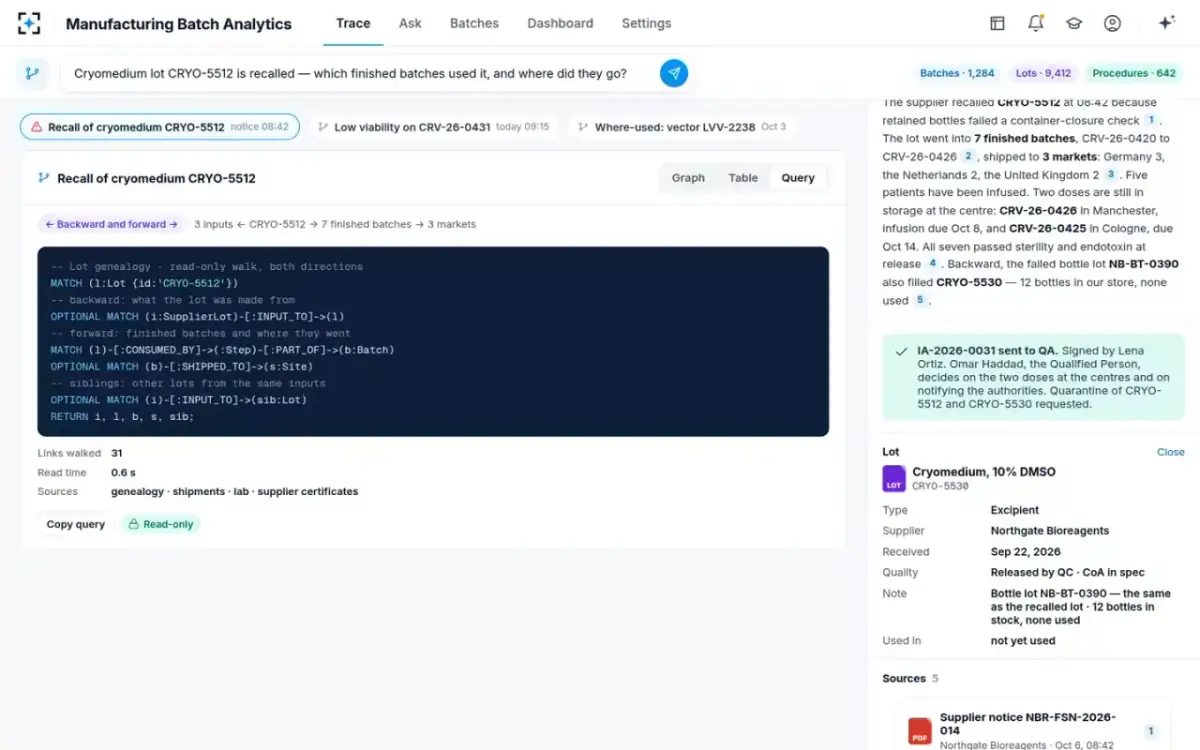
Reading a genealogy graph: nodes, status and the result on each node
A graph is only an improvement on a list if each node carries enough to act on. Seven exposed batches with nothing but batch numbers forces a second round of work; seven nodes carrying release results, deviations and current status is an exposure assessment. In the sample trace, each of the seven finished batches shows its sterility result (no growth on all seven), its endotoxin value (0.12 to 0.31 EU/mL against a limit of 1.0), any open deviation — CRV-26-0422 carries a major one, DEV-2026-0168 — and where the dose is now: five infused between 4 and 19 September, two still in storage at a treatment centre.
That last field is the one that changes behaviour. Exposure says seven; what can still be acted on says two. A trace that returns only the first number sends a quality unit to re-derive the second from shipment paperwork, under a clock. The six tests below are what we would ask of any genealogy before relying on it in an investigation, ours included.
Six tests a lot genealogy must pass before an investigation leans on it
- Does it walk both ways from one question?
Backward to inputs and forward to batches and markets, without a person starting a second query. If the forward walk is a separate report, the two will drift apart under time pressure.
- Does it cross the plant boundary?
A supplier's own input lots come from the certificate of analysis. A graph that stops at receipt cannot answer "what else shares this failed input", which is the question that found the second lot in the sample recall.
- Does every node carry its results and its status?
Release and in-process results, open deviations, and whether the unit is shipped, stored or administered. Exposure without state is half an answer.
- Does it show what it read?
The query, the systems and the number of links walked, beside the answer. A reviewer has to be able to check a trace, not believe it.
- Does it distinguish absent from unknown?
A step with no lot code recorded must read as a gap in the graph, never as a step with no inputs. It is one of the most dangerous silent failures in a hand-built trace.
- Is it read-only?
A traceability tool with write access to a batch record or a lot status is a data-integrity problem wearing an analytics badge. Holds and quarantines belong to a named person's signature.
In the product the graph is built nightly from material movements, every connection is read-only, and a trace is shown with the query and the systems it read. What a scoped exposure list then has to become — six findings in a fixed order, on a clock — is set out in the product impact assessment. To see the walk itself, screen by screen, start from Manufacturing Batch Analytics.
Questions people ask
What is lot genealogy in manufacturing?
It is the record of material identity through production, read as a graph: each lot and batch is a node, and each recorded consumption, transfer or shipment is an edge. In discrete manufacturing it is often called a genealogy or a pedigree and is used for warranty and recall work; in pharmaceutical manufacturing it also carries release results, deviations and dispositions, because the question is rarely "which batches" alone but "which batches, and what state is each in".
What is the difference between forward and backward traceability?
Backward traceability starts from a finished batch and finds everything that entered it — the investigator's direction. Forward traceability starts from an input lot and finds every batch, shipment and market it reached — the recall direction. They read the same links in opposite directions, and a plant can be good at one and unable to do the other, which is why the ATMP guidelines ask specifically for bidirectional tracking rather than for traceability in general.
What is a where-used report?
A report that takes one lot number and lists the batches or orders that consumed it — one hop of the forward walk. It is a standard function in an enterprise system and it is genuinely useful. It cannot answer a question that needs two hops, such as which other lots were filled from a failed bottle lot, because that requires walking back to the shared input first.
How is a batch genealogy built?
By joining material movements (the edges) to batch records (the confirmation that a lot was consumed), laboratory results (the attributes on each node), supplier certificates (the hops beyond the plant) and shipments (the last hop). None of those systems holds the graph; it is derived, and it has to be rebuilt as new movements land. In the product it is rebuilt nightly, read-only, and shown with the query that produced it.
Does an investigation have to cover other batches?
Yes, where they may be implicated. 21 CFR 211.192 requires an investigation into an unexplained discrepancy or a failed specification to reach other batches of the same product, and other products, that may have been associated with that failure. That is a forward walk from whatever was shared — a material lot, a vessel, a line — and it cannot be satisfied by reading the failing batch's own record.
How far back does lot traceability have to go?
It depends on the product, and the ranges are long. Ordinary drug product records must be kept at least a year past the batch's expiry date under 21 CFR 211.180(a). For an advanced therapy medicinal product, the European Commission's ATMP guidelines require traceability data — donation code, internal code, critical raw material batch numbers — to be retained for a minimum of thirty years after expiry. A genealogy with that horizon is an archiving commitment, not just a reporting one.